In This Article
A professional combi drill is a hammer-capable 18V driver built for daily trade abuse rather than the occasional Saturday shelf. It combines drilling, screwdriving and masonry hammer action in one brushless body, and it’s the tool that separates a site bag that earns its keep from one that gets left in the van. If you’ve ever watched a £40 hobby drill cook itself mid-fix-out, you already know why this category matters.

Here’s the thing nobody tells you when you’re stood in the trade counter aisle at 7am: torque figures on the box rarely match how a drill actually feels after nine hours of first-fix. What most buyers overlook about this category is that the difference between a “fine for now” drill and a genuinely professional one shows up in month six, not day one — it’s the bearing wear, the chuck slop, and whether the brushless motor is still running cool when everyone else’s brushed equivalent has started smoking. Reviewers consistently note that the drills which feel identical in the shop diverge sharply once they’ve drilled a few thousand holes.
This guide walks through seven genuine, currently available combi drills spanning entry-level trade kit through to site-hardened flagships, with honest spec interpretation, aggregated review sentiment, and buyer-type advice for each. We’ll also cover the practical questions that actually decide a purchase: which battery ecosystem locks you in, how warranties really work for tradesmen, and whether Makita or DeWalt deserves the crown. Affiliate disclosure: this article contains Amazon Associates links, and we may earn a small commission on qualifying purchases at no extra cost to you.
Quick Comparison Table
| Drill | Torque | Brushless | Weight (body) | Best For |
|---|---|---|---|---|
| Makita DHP484Z | 54 Nm | Yes | 1.6 kg | All-round refinement |
| DeWalt DCD796 | 70 Nm | Yes | 1.5 kg | Compact power |
| Bosch GSB 18V-55 | 55 Nm | Yes | 1.0 kg | Value entry to Pro system |
| Milwaukee M18 FPD2 | 135 Nm | Yes | 1.8 kg | Heavy-duty torque |
| Ryobi R18PD7 | 85 Nm | Yes | 1.7 kg | Budget-conscious trade |
| Metabo SB 18 LTX-3 | 120 Nm | Yes | 1.9 kg | Metalwork & 3-speed control |
| DeWalt DCD1007NT | 169 Nm | Yes | 2.0 kg | Structural/heavy site work |
Looking at the table, torque alone doesn’t crown a winner: the Milwaukee and DeWalt DCD1007NT lead on raw numbers, but the Makita and Bosch remain the picks for anyone drilling overhead all day, where weight and balance matter more than headline Nm. The Ryobi’s 85 Nm sits in an unusually strong middle ground for a drill that costs roughly half what the Milwaukee does, which is exactly why it turns up on so many vans that aren’t wedded to a premium ecosystem yet.
💬 Just one click – help others make better buying decisions too!😊
Top 7 Professional Combi Drills: Expert Analysis
1. Makita DHP484Z — best all-round refinement for daily trade use
The DHP484Z’s standout feature is how little it fights you: light, well-balanced, and quiet enough that you forget it’s a power tool. Specs first — it delivers 54 Nm of torque, 30,000 impacts per minute in hammer mode, and 2,000 rpm, paired with Makita’s LXT brushless motor and an 18V system that’s one of the largest in the industry. In practice that torque figure undersells it; the motor’s efficiency means it rarely feels underpowered even against drills with bigger numbers on the box. Based on the spec comparison, this is the drill for kitchen fitters, joiners and multi-trade contractors who value control and comfort over sheer brute force — anyone drilling above shoulder height for hours will feel the difference in their forearm by 3pm. Reviewers consistently praise its reliable build and premium materials, and UK buyers on trade forums flag the absence of a bit-holding magnet as the one genuine miss on an otherwise tightly engineered tool. It’s worth noting this is typically sold as a bare unit, so budget for batteries separately if you’re not already on LXT.
Pros:
✅ Exceptionally refined balance for overhead work
✅ Whisper-quiet brushless motor with minimal heat build-up
✅ Huge LXT battery ecosystem across 40+ tools
Cons:
❌ No bit-holding magnet included
❌ Bare-unit pricing means batteries add real cost
Typically found in the low-to-mid £100s body-only, with kits pushing toward £250. For LXT owners this is close to a no-brainer value proposition; for newcomers, weigh the battery investment before committing. Check current price and availability on Amazon.
2. DeWalt DCD796 — best compact power-to-size ratio on the market
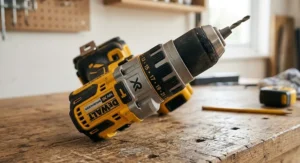
The standout here is raw torque squeezed into a genuinely small footprint. This second-generation XR brushless model strikes a brilliant balance between professional performance and reasonable pricing, and the numbers back it up: 70 Nm of torque at just 173mm in length, making it one of the most compact drills a UK tradesperson can buy without sacrificing pulling power. What that compactness means in practice is fewer knuckle grazes in stud cavities and loft joists, where a longer drill simply won’t fit. Here’s what to weigh: the fully metal gearbox is built for longevity under repeated impact-mode use, and the magnetic bit holder and three-position LED work light are the kind of small details that only matter once you’re using the tool daily. UK contractors on trade sites consistently flag the light as genuinely useful rather than a gimmick, since it actually illuminates the workpiece rather than the ceiling. One verified UK buyer noted it comfortably handled six flat-pack furniture builds without a recharge, though that’s a lighter-duty benchmark than site drilling into masonry.
Pros:
✅ 70 Nm torque in a 173mm compact body
✅ Fully metal gearbox built for durability
✅ Three-position LED light plus magnetic bit holder
Cons:
❌ XR battery ecosystem locks you into DeWalt pricing
❌ Case quality varies between kit bundles
Prices generally sit in the £150-£250 range depending on whether it’s bare or bundled with batteries and a case. Given the size-to-torque ratio, it earns its place on most professional shortlists. Check current price and availability on Amazon.
3. Bosch GSB 18V-55 Professional — best value entry into a professional 18V platform
The standout advantage is straightforward: this is Bosch’s deliberate on-ramp into its Professional 18V ecosystem, priced accessibly without cutting real corners. On specs, it delivers 55 Nm and 1,800 RPM, and is rated to handle wood up to 35mm, steel up to 13mm, and masonry drilling with its 13mm Roehm metal chuck. What most buyers overlook about this model is that it’s also compatible with AMPShare, a multi-brand battery alliance, meaning your battery investment isn’t locked to Bosch alone if you later diversify your kit — a genuinely unusual piece of future-proofing at this price point. Based on the spec comparison, this suits tradespeople who want a “starter Professional” tool rather than a DIY-grade drill, particularly electricians and general builders who don’t need FUEL-tier torque every day. Aggregated review sentiment on retailer sites is broadly positive on build quality and quietness, though a handful of buyers flag it as slightly heavier in the hand than expected for its compact dimensions.
Pros:
✅ Genuine Professional-tier build at accessible pricing
✅ AMPShare compatibility reduces battery lock-in
✅ 13mm metal chuck with solid power transfer
Cons:
❌ Torque trails premium rivals for heavy masonry
❌ Some buyers report it feels heavier than its size suggests
Body-only pricing tends to sit in the £120-£180 range, with kits including batteries and an L-BOXX case climbing toward the £250-£300 bracket. For value-conscious professionals entering the Bosch system, it’s a sensible first purchase. Check current price and availability on Amazon.
4. Milwaukee M18 FPD2 — best for heavy-duty torque and demanding fixings
There’s no subtlety to this drill’s standout feature: an outstanding 135 Nm of torque that puts it well ahead of most rivals on this list. The spec sheet won’t tell you this, but user reports suggest that torque translates directly into confidence with large hole saws and thick steel, tasks where lesser drills bog down and stall. Key numbers worth knowing: a 175mm compact length despite the power output, a 13mm heavy-duty chuck, and REDLINK PLUS overload protection that guards both tool and battery under sustained load. Based on the spec comparison, this is the drill for plumbers running large hole saws, electricians working steel conduit, or builders who simply refuse to compromise on power — it’s genuinely a different tier from the entry and mid-range options here. One UK-based tradesperson review described drilling 17mm holes through steel without the tool faltering, and another noted it as “by far the best I’ve ever had” across several drills owned. The trade-off is size and weight relative to the Makita or Bosch, which matters if you’re working overhead for extended periods.
Pros:
✅ Class-leading 135 Nm torque for demanding fixings
✅ REDLINK PLUS digital overload protection
✅ Compact 175mm body despite the power output
Cons:
❌ Noticeably heavier than mid-range alternatives
❌ Premium M18 batteries add significant cost
Body-only units typically sit around £150-£220, while kits with two batteries and a case can reach £300-£350. For anyone whose daily work regularly maxes out a lesser drill, the investment pays for itself in reduced downtime. Check current price and availability on Amazon.
5. Ryobi R18PD7 ONE+ — best budget-conscious pick for trade-level power
The standout here is punching well above its price bracket: this is the most powerful percussion drill in the ONE+ range, delivering up to 85 Nm of torque, which comfortably beats several pricier rivals on paper. Specs worth flagging: a 13mm ratcheting metal chuck, a two-speed gearbox with 24 torque settings, and brushless technology that Ryobi says delivers longer runtime and motor life than its brushed predecessors. What that means in practice is a drill that can genuinely handle masonry and steel work despite sitting at a fraction of the Milwaukee’s price. Based on the spec comparison, this suits tradespeople who are budget-conscious or building a first professional kit, particularly those who already own ONE+ garden or automotive tools and want to consolidate onto a single battery platform spanning over 150 tools. Aggregated Amazon.co.uk review sentiment is strongly positive on power and build quality, though a genuine and recurring complaint across multiple verified UK reviews is the chuck loosening during sustained use — several buyers specifically mention having to twist it hard to lock and re-checking it mid-job.
Pros:
✅ 85 Nm torque well ahead of its price bracket
✅ ONE+ ecosystem spans 150+ home and trade tools
✅ First-ever 3-year manufacturer warranty on Ryobi power tools
Cons:
❌ Chuck reportedly loosens during sustained use
❌ Brand perception lags premium rivals on some sites
Bare units generally run from £60-£100, with starter kits including batteries and a charger typically £100-£180. For value per Newton-metre, it’s difficult to beat. Check current price and availability on Amazon.

6. Metabo SB 18 LTX-3 BL Q I — best for metalwork and precision 3-speed control
The standout feature is the third gear: most combi drills on this list are two-speed, but this Metabo adds a third speed setting reaching 3,800 rpm, purpose-built for fast progress through metal rather than just wood and masonry. Core specs include 120 Nm of hard torque, a 32,300 bpm impact rate, and Precision Stop electronic torque control for delicate work where over-driving a screw would ruin the job. On paper this means a drill genuinely tuned for fabricators and metalworking tradespeople rather than a generalist tool wearing a metalwork badge — the extra gear isn’t a marketing flourish, it’s a real productivity gain when you’re drilling dozens of steel brackets a day. It also runs on the CAS (Cordless Alliance System) battery platform, which Metabo shares with several other brands including Mafell, giving slightly broader ecosystem flexibility than a single-brand system. What most buyers overlook is Metabo’s warranty structure: standard cover is only one year on the tool itself, though registering through an authorised LiHD partner within four weeks can unlock a 3-year “Full Service” warranty that also covers wear and tear — a detail worth checking before you buy, since not every UK retailer offers that partner status.
Pros:
✅ Rare third gear tuned specifically for metalwork
✅ 120 Nm hard torque with precision electronic control
✅ CAS battery platform shared across multiple brands
Cons:
❌ Full 3-year warranty depends on registering via a LiHD partner retailer
❌ Less common on UK high-street trade counters than DeWalt/Makita
Body-only pricing generally falls in the £150-£220 range. For anyone whose daily work leans toward steel and fabrication rather than timber and masonry, this is a genuinely differentiated choice. Check current price and availability on Amazon.
7. DeWalt DCD1007NT — best for structural and heavy-duty site work
This is the flagship of the list, and the standout feature is torque headroom most tradespeople will never fully exhaust: 169 Nm, delivered through a high-efficiency brushless motor and an all-metal drivetrain. Key specifications worth understanding: it’s built with an ANTI-ROTATION safety system designed to cut power if the bit binds suddenly, which matters enormously when you’re driving large-diameter bits into dense material and a snap-back could otherwise wrench your wrist. What most buyers overlook about this tier of drill is that the anti-rotation safety feature isn’t a luxury extra — it’s a genuine injury-prevention system, and Mister Worker’s technical analysis recommends a minimum of 70 Nm for professional use, rising past 100 Nm for structural work, which this drill comfortably exceeds. Designed explicitly for electricians, installers, construction contractors and industrial maintenance teams, this is the choice for anyone whose work genuinely demands maximum power and durability day after day, not just occasionally. The trade-off is straightforward: it’s the heaviest and most expensive drill on this list, and that extra mass matters if the bulk of your work is light first-fix rather than structural fixing.
Pros:
✅ 169 Nm torque — genuine structural-grade power
✅ ANTI-ROTATION safety system for high-bind-risk drilling
✅ All-metal drivetrain built for industrial daily use
Cons:
❌ Heaviest drill on this list at around 2kg body-only
❌ Premium pricing puts it out of reach for occasional users
Expect body-only pricing in the £200-£300 range, climbing well past £300 in full kit form with batteries and a case. For contractors doing genuinely heavy-duty work daily, the investment is easily justified. Check current price and availability on Amazon.
Practical Usage Guide: Getting the Most From Your Combi Drill on Site
Setup matters more than most buyers assume. Before first use, fully charge every battery through at least one complete cycle rather than topping up from 60%, since lithium-ion cells calibrate their fuel gauge more accurately after a full cycle — skipping this is a common reason drills seem to “die early” in their first fortnight. Check the chuck is torqued down properly (ratcheting chucks especially, per the Ryobi complaints above); a loose chuck under hammer action will loosen further within minutes, not hours.
For the first 30 days, the most common mistake tradespeople make is running every job in top gear regardless of material. Gear one delivers more torque at lower RPM and is the correct choice for large-diameter holes and stubborn masonry; gear two is for general timber and screwdriving speed. Running gear two into brick repeatedly is a fast route to premature motor wear and stripped bits. Maintenance is genuinely simple but frequently skipped: blow dust out of the vents weekly if you’re working in a dusty environment, wipe the chuck jaws clean of masonry dust monthly, and store batteries at roughly 40-60% charge if a tool is going into storage for more than a few weeks, since lithium-ion cells degrade faster stored at full charge. One optimisation trick many manuals don’t emphasise: rotating between two batteries on a genuinely full day of drilling, rather than running one flat before swapping, keeps both cells within their optimal temperature and voltage range and measurably extends pack lifespan over a year of daily use.
✨ Don’t Miss These Exclusive Deals!
🔍 Take your toolkit to the next level with these carefully selected combi drills. Click on any highlighted item to check current pricing and availability. These tools will help you deliver professional results your clients will trust!
Real-World Scenarios: Matching the Drill to the Trade
The multi-trade jobbing builder working a mix of first and second fix across brick and timber, drilling maybe 40-60 holes a day, is best served by something like the Bosch GSB 18V-55 or Makita DHP484Z — enough torque for the occasional masonry job without the weight penalty of a flagship for everyday screwdriving.
The electrician running steel conduit and drilling through joists constantly needs torque and speed under sustained load more than raw power headroom; the Milwaukee M18 FPD2’s 135 Nm and heavy-duty chuck are built precisely for this repetitive high-load use, and the compact 175mm length matters in tight consumer units and loft spaces.
The apprentice or sole trader building a first proper kit on a tight budget genuinely gets more torque per pound from the Ryobi R18PD7 than almost anything else here, and the ONE+ ecosystem means future tool purchases (impact drivers, angle grinders, even garden kit) share one battery platform rather than starting a second one from scratch.

How to Choose a Professional Combi Drill
Choosing the right model comes down to matching a handful of criteria to how you actually work, not to headline specs alone.
- Match torque to your typical material. For general trade work 55-70 Nm is genuinely sufficient; reserve 100 Nm+ for structural fixing, large hole saws or dense steel.
- Weigh battery ecosystem before the tool itself. If you already own batteries from a brand, staying within that platform saves hundreds of pounds over a career.
- Prioritise brushless motors for daily professional use. The efficiency and heat management genuinely extend both runtime and tool lifespan under repeated hard use.
- Check chuck quality, not just capacity. A 13mm rating means nothing if the chuck loosens under vibration, as several genuine user reviews flag on budget models.
- Consider weight for overhead and repetitive work. A 200g difference feels negligible in the shop and significant by hour six on a ceiling.
- Understand the warranty terms before, not after, purchase. Registration deadlines and “authorised partner” requirements can quietly halve your effective cover.
- Buy body-only if you already have a battery platform, and only buy a full kit if you’re starting fresh — it’s almost always cheaper per component.
Makita vs DeWalt Combi Drill: The Trade’s Biggest Debate
This comparison comes up on every trade forum, and honestly, it’s closer than brand loyalty suggests. On raw numbers, DeWalt’s DCD796 wins with 70 Nm against the Makita DHP484Z’s 54 Nm, and its second-generation XR motor is genuinely efficient. But torque alone misses what separates the two in daily use: Makita’s LXT platform is one of the largest and most respected in the industry, and independent UK reviewers consistently describe the DHP484Z as more refined in the hand, with smoother power delivery and reduced fatigue over a full shift, even while conceding its stated torque is lower than DeWalt’s.
Where DeWalt pulls ahead is compactness relative to its power — 173mm housing 70 Nm is a genuinely impressive engineering trade-off, useful in tight stud cavities. Where Makita pulls ahead is ergonomics and a marginally quieter motor, which matters over an eight-hour shift more than most buyers initially credit. In practice, the decision usually comes down to which battery ecosystem you’re already invested in rather than which drill is objectively “better” — both are Professional-tier tools that will comfortably outlast a career’s worth of budget alternatives.
Brushless Motor Longevity in Trade Use
The brushless-versus-brushed question isn’t close for professional use, and the reasoning is mechanical rather than marketing. A brushless motor is more efficient, runs cooler, and has a longer lifespan, automatically adjusting its power output to the task, whereas brushed motors rely on physical carbon contacts that wear down through friction with every use. What that means for a tradesperson drilling dozens of holes daily is straightforward: brushless drills offer up to 50% more runtime per battery charge and a significantly longer tool lifespan because there are no carbon brushes to wear out. Reviewers across the models in this guide repeatedly note that brushless tools stay noticeably cooler under sustained hammer-drilling, which matters directly for longevity — heat is the primary driver of premature motor and electronics failure in any power tool. The upfront cost is higher, typically £20-£40 more than a brushed equivalent at the same torque rating, but for anyone using a drill five days a week, that premium is recovered within the first year through reduced downtime and replacement costs alone.
18V Battery Ecosystem Compatibility
Buying a combi drill is really buying into a battery platform, and this decision quietly shapes every future tool purchase you make. When you buy a cordless drill, you’re also buying into a battery system, and if you plan to expand your cordless tool collection, choosing a brand with a wide range of “bare tools” sold without batteries — like DeWalt’s XR, Makita’s LXT, or Milwaukee’s M18 — will save significant money in the long run. Two platforms in this guide break from strict brand lock-in: Bosch’s GSB 18V-55 supports AMPShare, a multi-brand alliance, while Metabo’s SB 18 LTX-3 runs on CAS, shared with brands like Mafell and Lamello. Ryobi’s ONE+ system, meanwhile, is unusual in spanning over 150 tools across home, garden and trade categories on a single battery, which is genuinely attractive for a sole trader who also wants garden and automotive tools on the same charger. The practical advice: before buying your first drill, honestly project what else you’ll need in the next three years, because switching platforms later means either running two chargers indefinitely or writing off existing batteries entirely.
Drill Warranty for Tradesmen: What’s Actually Covered
Warranty terms vary far more between brands than most buyers realise, and the fine print matters disproportionately for daily trade use. Milwaukee offers a standard 1-year warranty on machines, batteries and chargers as standard, extendable to 3 years through registration. Bosch now offers 36 months of warranty on Professional Blue power tools plus batteries and chargers, provided the purchase is registered through Bosch’s Pro360 Warranty Registration process. Ryobi has introduced its first-ever 3-year warranty across its electric and cordless tools, including the full 18V ONE+ range, a genuinely notable shift for a brand historically seen as DIY-tier. Metabo’s structure is more conditional: a standard 1-year warranty on machines and chargers, extendable to 3 years by registering within 4 weeks of purchase, with a further “Full Service” tier covering wear-and-tear repairs only available through authorised LiHD partner retailers. The pattern across every brand is the same: extended cover is rarely automatic. If you don’t register within the stated window — typically 4 weeks — you default back to the base 1-year term, an easy thing to miss when you’re focused on getting a new tool onto the van rather than filling in paperwork.
Heavy Duty Cordless Combi Drill vs Standard Combi Drill
The line between “heavy duty” and “standard” combi drills isn’t marketing fluff, though the terms aren’t strictly regulated either. In practice, heavy duty models in this guide — the Milwaukee M18 FPD2, Metabo SB 18 LTX-3 and DeWalt DCD1007NT — share three traits standard models typically lack: torque comfortably above 100 Nm, all-metal drivetrains rather than partial polymer construction, and additional safety systems like anti-kickback or anti-rotation control. Standard combi drills, by contrast, are perfectly adequate — even genuinely good — for general first and second fix, screwdriving, and occasional masonry, but they’re not engineered for the sustained high-load cycles of structural fixing or continuous steel drilling. The distinction that actually matters for a buying decision is duty cycle: how many hours a day, how many days a week, and how consistently near the tool’s power ceiling you’re working. A standard drill run within its comfortable range will last years; a standard drill run daily at its absolute limit will fail faster than a heavy-duty model working well within its own.
Long-Term Cost & Maintenance
Total cost of ownership rarely matches sticker price, and it’s worth running the numbers before buying on price alone. A £70 budget drill that needs replacing every 18 months of daily trade use costs more over five years than a £180 professional model lasting the full period, even before accounting for the lost productivity of downtime and warranty claims. Battery costs compound this further: a single 5.0Ah battery for a premium brand typically costs £70-£100, meaning a two-battery kit represents a genuine chunk of total spend — factor this in when comparing a “cheap” bare tool against a pricier bundled kit. Maintenance costs on brushless drills are also structurally lower, since there are no brushes to replace and sealed bearings on premium models reduce the need for regreasing that cheaper loose-ball equivalents require. Realistically, budget £15-£25 a year in consumables (chuck keys, bit sets, occasional battery replacement amortised) for a drill used daily, against potentially several hundred pounds in lost site time if a budget tool fails mid-job.
Common Mistakes When Buying a Professional Combi Drill
The most frequent error is buying on torque alone without checking chuck quality or battery ecosystem — a high-Nm drill with a chuck that loosens under vibration, as flagged in genuine reviews of some budget models, will frustrate you daily regardless of its power. The second common mistake is ignoring warranty registration deadlines entirely; missing a 4-week window on a Metabo or Bosch purchase quietly halves your effective cover for no reason beyond an unfilled form. Third, many buyers underestimate weight fatigue, choosing the highest-spec drill available without considering that an extra 300-400g becomes genuinely punishing on overhead work by mid-afternoon. Finally, starting a second battery ecosystem for a “better deal” on one tool is a false economy for most tradespeople — the ongoing cost of running two charger systems and two sets of batteries almost always outweighs a one-off saving.
Safety, Regulations & Compliance Guide
Professional combi drills sold in the UK must meet electrical safety requirements under the Electrical Equipment (Safety) Regulations, with manufacturers required to affix either a UKCA or, under continued recognition, a CE marking to demonstrate conformity before the tool can legally be placed on the Great Britain market — worth checking on any tool bought second-hand or from an unfamiliar importer. Beyond electrical compliance, daily professional use also brings the drill into scope of the Control of Vibration at Work Regulations 2005, which exist because regular and frequent exposure to hand-arm vibration can lead to permanent health effects, most likely when contact with a vibrating tool is a regular part of a person’s job. This is genuinely relevant for anyone running a combi drill in hammer mode for extended daily periods — employers have a legal duty to assess and manage that exposure, and tradespeople using their own tools should be aware of the same risk even without a formal employer relationship. Choosing a well-balanced, lower-vibration model and taking regular breaks from hammer-mode work isn’t just comfort advice; it’s genuine, evidence-based risk reduction.
FAQ
❓ What torque do I need for a professional combi drill?
❓ Is Makita or DeWalt better for tradesmen?
❓ How long should a professional combi drill last?
❓ Do all combi drill batteries fit other brands?
❓ Is a heavy duty combi drill worth it for occasional DIY?
Conclusion
There’s no single “best” professional combi drill, only the drill that matches your material, your daily hours, and the battery platform you’re already committed to. For most tradespeople balancing power against comfort, the Makita DHP484Z and DeWalt DCD796 remain the sensible core of this list; for anyone regularly pushing into structural or heavy steel work, the Milwaukee M18 FPD2 or DeWalt DCD1007NT justify their premium. Budget-conscious buyers genuinely shouldn’t overlook the Ryobi R18PD7, which delivers trade-level torque well below trade-level pricing. Whatever you choose, prioritise chuck quality, warranty registration, and battery ecosystem over headline torque figures alone — those are the details that decide whether a drill is still earning its keep on your van in three years’ time, not the numbers printed on the box.
✨ Ready to upgrade your kit? Compare live pricing on today’s top combi drills and find the one that fits your trade.
Recommended for You
- 18V Combi Drill: 7 Best Picks Tested for UK DIYers (2026)
- Budget Combi Drill: 7 Best Picks UK 2026 (Under £100)
- 7 Best Cordless Combi Drills UK 2026
Disclaimer: This article contains affiliate links. As an Amazon Associate, I earn from qualifying purchases. If you purchase products through these links, we may earn a small commission at no additional cost to you.
✨ Found this helpful? Share it with your mates! 💬🤗
