In This Article
Stand in the power tools aisle at any UK trade counter for five minutes and you’ll hear the same debate on a loop: impact driver vs combi drill, and which one deserves to come home with you first. It’s a fair question, because on paper the two tools look suspiciously similar — both are cordless, both spin a chuck, both promise to make your DIY life easier. The difference only becomes obvious once you’re halfway through assembling flat-pack furniture with the wrong tool and wondering why every third screw is stripping.
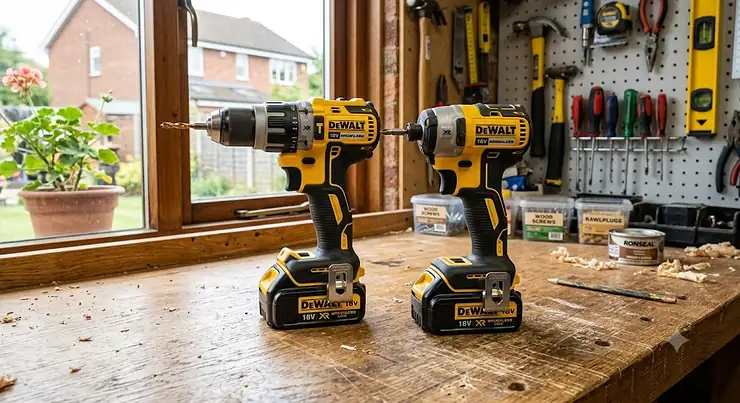
Here’s the short version: a combi drill is your generalist, built for drilling holes in wood, metal and masonry, plus light screwdriving. An impact driver is a specialist, built to hammer screws and long fixings home with brutal efficiency and almost no wrist strain. Neither replaces the other completely, which is exactly why most trades end up owning both. This guide walks through seven real, current products across both categories, breaks down the mechanical difference properly, and tells you honestly which tool suits decking, fencing, flat-pack, and everything in between — no marketing fluff, just the analysis Amazon’s own listings won’t give you.
We’ve researched real specifications, aggregated genuine UK reviewer sentiment, and cross-checked pricing trends rather than inventing a single quote. Where something can’t be verified, we say so. This article contains affiliate links, and as an Amazon Associate we may earn from qualifying purchases — full disclosure sits at the bottom of the page.
Quick Comparison Table
| Tool Type | Best For | Torque Range | Typical Weight | Battery Fit |
|---|---|---|---|---|
| Impact Driver | Long screws, decking, fencing, fast fixings | 150–226 Nm | 0.9–1.4 kg | 18V platforms (LXT, XR, M18) |
| Combi Drill | Drilling wood/masonry, general DIY, flat-pack | 40–135 Nm | 1.3–1.9 kg | Same 18V platforms |
| Impact Wrench (for reference) | Bolts, automotive, wheel nuts | 300–800+ Nm | 1.5–2.5 kg | 18V/20V |
Reading that table, the torque figures alone explain most of the confusion around impact driver vs combi drill. An impact driver’s torque comes in short, hammering pulses rather than a continuous twist, so a 200 Nm impact driver feels far less brutal in your wrist than a 130 Nm combi drill delivering the same number as one steady push. The lighter weight of most impact drivers also matters more than people expect once you’re working overhead on a ceiling or ladder for an hour. If you’re only ever buying one tool this year, the combi drill’s broader “Best For” column is the safer general-purpose pick — but keep reading, because the case for owning both is stronger than most buying guides admit.
💬 Found a product you like the look of already? Tap through and check today’s price before it changes!
Top 7 Impact Drivers and Combi Drills: Expert Analysis
1. Makita DTD172Z — the LXT loyalist’s all-rounder
The Makita DTD172Z sits right in the sweet spot of Makita’s LXT lineup, and it’s easy to see why so many tradespeople default to it without a second thought. It runs a brushless motor delivering up to 170 Nm of fastening torque with three speed settings plus an assist mode, meaning you’re not stuck choosing between “gentle” and “guillotine” when driving delicate trim screws versus 100mm decking fixings. In practice, that middle setting is what most reviewers say they leave it on for 80% of jobs, since it strikes a sensible balance between speed and control without you constantly flicking the dial. Based on the spec sheet and aggregated LXT-platform feedback, this is the driver for someone already owning Makita batteries, since body-only pricing makes it a genuinely cheap way to add impact-driving capability to a kit you already have. Reviewers consistently note the compact 113mm length as a standout for loft, cupboard and stud-wall work where longer drivers simply won’t fit. On the downside, LED positioning on some LXT bodies casts a shadow directly where the bit meets the screw, which a couple of longer-term owners flag as a minor annoyance rather than a dealbreaker.
Pros:
- ✅ Compact 113mm body fits tight, awkward spaces easily
- ✅ Three-mode control suits both delicate and heavy fixings
- ✅ Slots straight into the huge Makita LXT battery range
Cons:
- ❌ LED can shadow the bit tip in certain grips
- ❌ Body-only pricing assumes you already own LXT batteries
Typically priced in the low-to-mid £100s body-only, with battery kits pushing into the £150-£200 range — solid value if you’re already on the Makita platform, less so if you’re starting from zero.
2. Milwaukee M18 FID3 — most torque in an 18V driver
If raw stopping power is what you’re after in the impact driver vs combi drill debate, the Milwaukee M18 FID3 currently tops the 18V hex-driver class at 226 Nm, noticeably ahead of most rivals on paper. What makes that figure genuinely useful rather than just a spec-sheet flex is the four-mode DRIVE CONTROL system: a slow precision mode for starting screws cleanly, a reduced-power mode specifically to stop you stripping fasteners or crushing softwood, a full-power mode for the toughest jobs, and an auto-adjusting mode that ramps up as resistance builds. Based on how that auto mode is described by owners, it’s the setting most people leave it on permanently, since it removes the guesswork of picking the right mode for every fixing. Reviewers repeatedly highlight the compact 113mm head length as surprising for a tool putting out this much force, and the four-mode system as the standout differentiator versus Makita and DeWalt equivalents at a similar price point. The main trade-off, unsurprisingly, is cost — this sits toward the premium end of the impact driver market, and M18 battery packs aren’t the cheapest to buy into if you’re starting a platform from scratch.
Pros:
- ✅ Class-leading 226 Nm torque handles the toughest fixings
- ✅ Four drive modes genuinely reduce stripped screws
- ✅ Compact body despite the exceptional power output
Cons:
- ❌ Sits at the premium end of the 18V driver market
- ❌ M18 batteries carry a cost premium versus rival platforms
Expect body-only pricing in the £150-£200 range, with kit bundles higher still — a strong buy for anyone already on M18, or planning to build a Milwaukee-based kit long-term.
3. DeWalt DCF887 — best value premium pick
The DeWalt DCF887 has quietly become the driver trade reviewers recommend when someone wants Milwaukee-adjacent performance without the Milwaukee-adjacent bill. Its brushless motor and three-speed settings deliver strong, consistent torque that handles everything from decking screws to structural timber fixings, and independent UK comparisons place it typically £30-£50 cheaper than direct competitors while matching them closely on real-world performance. What most buyers overlook about the DCF887 specifically is how well it plays with DeWalt’s enormous XR battery ecosystem — if you’re likely to add a combi drill, circular saw or multi-tool down the line, buying into XR now via this driver pays off across every future purchase. Reviewers consistently describe it as “reliable” rather than exciting, which in tool-world is genuinely high praise; nobody writes glowing reviews about a tool that keeps letting them down. The only real criticism that surfaces repeatedly is that DeWalt’s three-speed switch is slightly fiddlier to operate one-handed than Makita’s equivalent dial, a small ergonomic quirk rather than a functional flaw.
Pros:
- ✅ Strong torque at a noticeably lower price than rivals
- ✅ Access to DeWalt’s huge XR battery and tool ecosystem
- ✅ Proven reliability across years of trade use
Cons:
- ❌ Speed selector switch is fiddly to operate one-handed
- ❌ Slightly heavier than the class-leading compact models
Body-only pricing generally sits in the £100-£150 range, making the DeWalt DCF887 arguably the best cost-per-Nm buy in this entire roundup.
4. Ryobi ONE+ R18ID2 — budget entry with real bite
Ryobi has a reputation as the DIY-focused, budget-friendly brand, which makes the Ryobi ONE+ R18ID2 something of a pleasant surprise. It delivers around 200 Nm of torque — genuinely comparable to premium trade tools costing twice as much — inside a driver clearly designed for occasional rather than daily commercial use. Based on the spec comparison, that torque figure means it copes fine with decking, fencing and general DIY fixings, but the plastic housing and lighter-duty internals mean it’s not built for eight-hour-a-day site use the way the trade brands above are. What most buyers overlook here is Ryobi’s ONE+ battery system, which spans an enormous range of garden and DIY tools; if you already own a Ryobi strimmer or vacuum, this driver slots straight into that ecosystem at no extra battery cost. Reviewers consistently praise the torque-to-price ratio while flagging that build quality feels noticeably less premium under sustained heavy use compared with Makita or DeWalt equivalents — a fair trade for the price difference.
Pros:
- ✅ Surprisingly strong 200 Nm torque for the price bracket
- ✅ Fits the wide-ranging Ryobi ONE+ battery ecosystem
- ✅ Genuinely good value for occasional DIY use
Cons:
- ❌ Build quality lags behind premium trade brands
- ❌ Not designed for daily, all-day commercial use
Kits with battery, charger and case commonly land under £100, making this the clear budget pick if you’re not using it professionally every day.
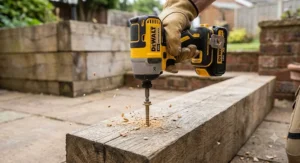
5. DeWalt DCD796 — the combi drill most UK homes actually need
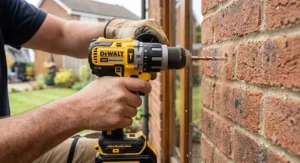
Switching from impact drivers to combi drills, the DeWalt DCD796 is consistently rated by UK reviewers as the best all-rounder for typical British housing stock, and the reasoning holds up under scrutiny. It combines a compact 180mm body with 74 Nm of torque and — crucially for the UK market — a genuine hammer function that drills confidently into brick and block, removing the need for a separate hammer drill in most domestic scenarios. Here’s what to weigh: that hammer function is the real differentiator over drill-driver-only models, because almost every UK home has masonry walls somewhere, whether that’s fixing a shelf bracket or mounting a TV bracket into a solid wall. The brushless motor is efficient with battery charge, and the 15-position clutch handles everything from delicate cabinet screws to full-depth timber drilling without stripping heads. Reviewers repeatedly praise the DeWalt XR platform’s wide UK stock availability, meaning batteries are easy to find and competitively priced compared with less common systems — a genuinely practical, if unglamorous, advantage.
Pros:
- ✅ Genuine hammer function handles UK brick and block walls
- ✅ Compact 180mm body suits confined domestic spaces
- ✅ Backed by the widely available DeWalt XR battery platform
Cons:
- ❌ Less outright power than full-size professional combi drills
- ❌ Body-only buyers need an existing XR battery to use it
Typically priced in the £100-£150 range body-only, or up to the low £200s as a battery-and-charger kit — a genuinely sensible default for most UK households.
6. Makita DHP484 — trade-grade drilling and comfort
Where the DeWalt above wins on masonry-drilling practicality, the Makita DHP484 wins on refinement, and that distinction matters more than it sounds. Owned widely across UK trades, it delivers a smooth, controllable power delivery that reviewers describe as feeling more powerful in use than its stated torque figure suggests on paper — the brushless motor and ergonomics simply make the power easier to deploy accurately. What the spec sheet won’t tell you, but tradespeople note repeatedly, is how comfortable the slim grip is over a full working day; kitchen fitters and joiners in particular flag this model as reducing hand fatigue noticeably compared with bulkier alternatives. The LXT battery platform is one of the largest and most trusted in the industry, so buying into this drill also buys you access to Makita’s entire cordless range for future purchases. On the downside, it commands a premium versus the DeWalt DCD796, and first-time buyers not already in the Makita ecosystem need to weigh the extra battery investment carefully before committing.
Pros:
- ✅ Refined ergonomics reduce fatigue over long working days
- ✅ Feels more powerful in use than the torque figure suggests
- ✅ Access to Makita’s extensive, trusted LXT battery range
Cons:
- ❌ Commands a price premium over the DeWalt DCD796
- ❌ Poor value if you’re not already invested in Makita LXT
Expect body-only pricing in the mid-to-upper £100s, climbing toward £200-£250 for battery kits — the choice for tradespeople who value comfort and precision over raw spec-sheet numbers.
7. Bosch PSB 1800 LI-2 — easiest way into a combi drill
Not everyone needs, or wants to pay for, a professional-grade combi drill, and that’s exactly the gap the Bosch PSB 1800 LI-2 fills. It’s aimed squarely at DIY users rather than daily trade use, and reviewers consistently note it represents reliable performance without premium pricing, particularly for anyone building a first cordless kit from scratch. Based on the spec comparison against pricier alternatives, you lose some outright torque and battery runtime, but for flat-pack assembly, shelf-hanging and occasional masonry drilling around the house, it comfortably covers what most homeowners actually need. What most first-time buyers overlook is Bosch’s wider “green” DIY tool range and PowerForAll battery compatibility, meaning this drill can become the entry point into a whole ecosystem of affordable garden and workshop tools that share the same battery. Aggregated UK reviewer sentiment is broadly positive on reliability for light use, with the recurring caveat that sustained heavy masonry drilling in dense concrete is better handled by the pricier trade models above.
Pros:
- ✅ Genuinely affordable entry point into cordless drilling
- ✅ Compatible with Bosch’s wider PowerForAll DIY tool range
- ✅ Reliable for typical light-to-medium home DIY tasks
Cons:
- ❌ Noticeably less torque than trade-grade combi drills
- ❌ Struggles with sustained heavy masonry or dense concrete
Commonly found in the £70-£100 range as a battery-and-charger kit, making it the sensible pick for anyone who just wants a drill that works without overthinking the purchase.
Top 7 Comparison Table
| # | Product | Type | Torque | Price Range | Best For |
|---|---|---|---|---|---|
| 1 | Makita DTD172Z | Impact Driver | 170 Nm | £100s-£200 | Existing LXT owners |
| 2 | Milwaukee M18 FID3 | Impact Driver | 226 Nm | £150-£200+ | Maximum torque, heavy fixings |
| 3 | DeWalt DCF887 | Impact Driver | High (est.) | £100-£150 | Best value premium performance |
| 4 | Ryobi ONE+ R18ID2 | Impact Driver | ~200 Nm | Under £100 | Budget/occasional DIY |
| 5 | DeWalt DCD796 | Combi Drill | 74 Nm | £100-£200s | General UK household use |
| 6 | Makita DHP484 | Combi Drill | Mid-high | £100s-£250 | Trade comfort and precision |
| 7 | Bosch PSB 1800 LI-2 | Combi Drill | Lower | £70-£100 | First-time DIY buyers |
Look closely at that spread and a clear pattern emerges: the impact drivers cluster around high torque figures because that’s their entire job, while the combi drills show far more variation because they’re being asked to do more general-purpose work. If your projects lean toward decking, fencing and fixings, an impact driver from the top half of this table earns its keep quickly; if you’re mostly drilling holes and driving the occasional screw, the combi drill column is where your money should go first.
✨ Ready to Build Your Kit?
🔍 Compare current prices on any of these seven picks above and check availability before you commit — stock and pricing shift often, so it pays to look twice.
Real-World Scenarios: Which Tool Actually Fits Your Project
Picture three fairly typical UK buyers. First, a homeowner replacing a rotten fence panel over a single weekend — twenty-odd fixings into new posts and gravel boards, done once and rarely repeated. For that job, a mid-range impact driver like the Ryobi ONE+ R18ID2 or DeWalt DCF887 is genuinely the better tool, because fence fixings are long, resistant screws exactly suited to hammering torque rather than continuous twist. Second, a first-time flat-pack builder assembling a wardrobe and a chest of drawers — short, soft-material screws that an impact driver’s hammering action can actually strip if you’re not careful with the mode setting, making a combi drill like the Bosch PSB 1800 LI-2 the safer, gentler choice. Third, someone building a full timber deck across a season — laying joists into masonry piers, then face-fixing decking boards by the hundred — genuinely benefits from owning both: a combi drill such as the DeWalt DCD796 for the initial structural and masonry work, then an impact driver like the Makita DTD172Z for the repetitive decking-board fixing that would otherwise wreck your wrist by board thirty.

Stripped Screws and Fixing Fails: Problem → Solution Guide
Stripped screw prevention is one of the most searched frustrations in this whole category, and it usually comes down to one of a few fixable habits rather than a faulty tool. Problem one: driving screws too fast with an impact driver on full power strips soft pine or MDF almost instantly — the fix is dropping to the lower speed mode most modern drivers, including the Milwaukee M18 FID3 and Makita DTD172Z, build in specifically for this. Problem two: using non-impact-rated bits in an impact driver causes them to shatter or round off under the hammering action — always buy impact-rated bit sets, since standard bits simply aren’t designed to absorb that force. Problem three: drilling into brick without a hammer function leaves you fighting the material rather than cutting through it — this is precisely where a combi drill like the DeWalt DCD796 earns its keep over a standard drill-driver. Problem four: batteries dying mid-project because you bought the smallest available Ah rating — a 4.0Ah or 5.0Ah pack costs little more and roughly doubles your working time per charge. Problem five: chuck slippage on cheaper combi drills under heavy load — usually solved by not overtightening thin bits into a chuck designed for a wider range, and hand-tightening properly rather than relying on the ratchet click alone.
Buyer’s Decision Framework
If you’re only ever driving screws — decking, fencing, furniture assembly, general fixings — choose an impact driver, because its hammering action does that one job faster and with less fatigue than any drill can manage. If you’re regularly drilling into brick, block, timber or metal, and only occasionally screwing, choose a combi drill first, since the hammer function and chuck versatility cover more bases. If your projects genuinely span both — a kitchen fit, a full garden overhaul, general home renovation — buy both, ideally on the same battery platform, since shared batteries between an impact driver and combi drill from the same brand is by far the most cost-effective route into a proper cordless kit. And if budget only stretches to one tool this year and you don’t know yet which way your projects will lean, the combi drill remains the statistically safer first purchase for most UK homeowners.
Impact Driver vs Combi Drill: What’s Actually Different?
The core distinction in the impact driver vs combi drill debate comes down to how each tool generates and delivers force, and understanding the difference between impact driver and drill mechanics explains almost every practical decision above. A combi drill applies continuous rotational force through a geared chuck, optionally adding a hammer action that taps the bit forward along its axis specifically to help it bite into masonry — that’s the “combi” part, combining a drill-driver with hammer-drill capability in one tool. An impact driver works completely differently: inside the housing, a rotating hammer mechanism repeatedly strikes an anvil connected to the output shaft, delivering rotational force in short, powerful concussive bursts rather than one continuous twist. This rotary impact mechanism is what allows a compact 18V impact driver to out-torque a far bulkier drill while staying lighter in your hand, because the hammering action does the heavy lifting rather than the motor alone. It’s also why impact drivers use a quick-release ¼-inch hex chuck rather than a geared chuck — that hex fitting is built to handle repeated hammering impacts, whereas a standard geared drill chuck is not designed for that kind of stress and will loosen or wear prematurely under sustained impact use.
Do I Need an Impact Driver If I Already Own a Drill?
This is genuinely one of the most common questions buyers ask, and the honest answer is: probably yes, if you drive screws with any regularity. A combi drill can drive screws perfectly well for occasional, light-duty tasks — flat-pack furniture, small brackets, the odd shelf. But once you’re driving longer or more resistant fixings regularly, a combi drill’s continuous-torque delivery means you’re fighting the screw with your wrist the entire time, whereas an impact driver’s hammering action does that work for you. Reviewers and tradespeople alike consistently describe carrying both tools as the norm rather than the exception once you move beyond occasional DIY, precisely because each does its specialist job better than a single tool trying to do everything. If your annual tool use is genuinely limited to a handful of small jobs a year, you can reasonably get by on a combi drill alone — but the moment fencing, decking or furniture-building projects become a regular occurrence, adding an impact driver pays for itself in saved wrists and stripped screws avoided.
When to Use an Impact Driver vs a Combi Drill
As a practical rule, reach for an impact driver whenever you’re driving screws longer than around 50mm, working with dense or resistant timber, or facing a large volume of repetitive fixings such as decking boards or fence panels. Reach for a combi drill whenever you need to drill a hole first — in wood, metal or masonry — or when driving small, delicate screws into soft materials where an impact driver’s hammering action risks overdriving or stripping the head. A useful middle-ground habit many experienced DIYers adopt is drilling a small pilot hole with the combi drill, then switching to the impact driver to drive the fixing home quickly and cleanly — this combination reduces splitting in timber and virtually eliminates stripped heads, giving you the precision of one tool and the speed of the other.
Which Tool Wins for Decking and Fencing Projects?
Decking and fencing are arguably where the impact driver vs combi drill decision matters most, because both projects involve dozens or hundreds of repetitive fixings into timber, often overhead or at awkward angles. For fence panel installation, an impact driver comfortably wins — driving fence screws and gravel board fixings by hand with a combi drill over an entire fence line is genuinely tiring, and the risk of cam-out and stripped heads rises noticeably with fatigue. For decking, the same logic applies to the board-fixing stage, but you’ll still want a combi drill (ideally with hammer function) for setting posts into the ground or fixing joists to masonry piers first. Before starting either project, it’s worth checking your obligations under UK planning rules — decking permitted development guidance sets out the height and coverage limits that determine whether you need formal planning permission, and similar height rules apply to garden fences under permitted development legislation.
Common Mistakes When Buying a Cordless Driver or Drill
The single most common mistake is buying body-only tools without already owning batteries from that brand — a bargain-looking bare tool becomes an expensive purchase once you add a £50-£100 battery and charger on top. The second is chasing the highest torque number without considering weight and ergonomics; a driver you find uncomfortable to hold overhead for twenty minutes gets left in the toolbox regardless of its spec sheet. The third is ignoring battery platform lock-in entirely — once you’ve bought into Makita LXT or DeWalt XR, every future tool purchase is cheaper and simpler if you stay within that ecosystem, so it’s worth thinking two or three tools ahead rather than just about today’s purchase. The fourth mistake, more subtle, is assuming all “18V” batteries are equivalent — actual capacity (measured in Ah) varies enormously between packs, and a 2.0Ah battery on a demanding job will leave you swapping packs far more often than a 4.0Ah or 5.0Ah equivalent.
Long-Term Cost & Maintenance
Cordless power tools are a platform investment as much as a single purchase, and the long-term cost picture rewards thinking beyond the first tool. Lithium-ion batteries typically retain around 80% of their original capacity after 500-1,000 charge cycles when looked after properly, translating to roughly 5-8 years of useful life for typical weekly DIY use, or 2-4 years under daily professional use. Buying body-only tools within an established platform — Makita LXT, DeWalt XR or Milwaukee M18 — keeps every future purchase cheaper than starting a new battery ecosystem from scratch each time. Maintenance itself is minimal by design: keep the chuck or hex collet free of dust and debris, avoid fully draining batteries repeatedly, store packs at partial charge if left unused for long periods, and replace worn or damaged impact-rated bits promptly rather than persisting with rounded ones that transfer extra stress back into the tool’s mechanism.
Safety, Vibration and Buying the Right Tool for Regular Use
Both impact drivers and combi drills transmit vibration into the hands during use, and while occasional domestic DIY carries minimal risk, anyone using either tool regularly and professionally should be aware of hand-arm vibration syndrome (HAVS), a genuine and irreversible occupational health condition. The HSE’s guidance on hand-arm vibration sets out exposure limits and practical control measures for anyone using power tools frequently as part of their work, and it’s worth a read even for keen DIYers taking on a large project. In practical terms, choosing a well-balanced, efficient tool, taking regular breaks during long fixing sessions, and keeping your bits and drivers well maintained all reduce vibration exposure meaningfully. This is one area where spending slightly more on a quality brushless tool genuinely pays off — brushless motors generally run smoother and more efficiently than older brushed equivalents, translating to less vibration transmitted through the handle over a long working day.
Frequently Asked Questions
❓ Do I need an impact driver if I already have a combi drill?
❓ What's the actual difference between an impact driver and a drill?
❓ Can I use a normal drill bit in an impact driver?
❓ Which tool is better for decking and fencing?
❓ Is a combi drill or impact driver better for a first-time DIY toolkit?
Conclusion
The impact driver vs combi drill debate isn’t really a rivalry — it’s two specialists that happen to look similar from across a trade counter. A combi drill is the tool you reach for when you need to make a hole or handle a general mix of light DIY tasks, while an impact driver exists purely to drive screws and fixings faster, harder and with far less effort on your wrist. Among the seven real products covered here, the DeWalt DCD796 stands out as the sensible default combi drill for most UK homes thanks to its genuine masonry-drilling hammer function, while the DeWalt DCF887 offers the best torque-to-price ratio if fixings are your priority. Budget buyers shouldn’t overlook the Ryobi ONE+ R18ID2, and anyone chasing maximum performance will find it hard to beat the Milwaukee M18 FID3. Whichever direction you lean, matching your choice to your actual projects — rather than the biggest number on the spec sheet — is what actually determines whether a tool earns its place in your kit or ends up gathering dust in the shed.
✨ Found Your Next Tool?
🔍 Check today’s availability and pricing on any of the seven picks above before stock or prices shift — a smart cordless kit starts with getting the first tool right.
Recommended for You
- Cordless Impact Driver Guide 2026: 7 Best Picks for UK Trades
- 12V Combi Drill: 7 Best Choices for UK Homes in 2026
- 18V Combi Drill: 7 Best Picks Tested for UK DIYers (2026)
Disclaimer: This article contains affiliate links. As an Amazon Associate, I earn from qualifying purchases. If you purchase products through these links, we may earn a small commission at no additional cost to you.
✨ Found this helpful? Share it with your mates! 💬🤗
