In This Article
Somewhere between “this drill is too much tool” and “my wrist is done for the day” sits the compact impact driver — the bit of kit that’s quietly become the most-reached-for item in a lot of UK toolbags. A compact impact driver is a cordless, brushless screwdriving tool that combines high rotational torque with a rapid hammering action, packed into a shortened body designed to fit between joists, inside cabinets, and under sinks where a full-size driver simply won’t turn. That’s the 40-60 word version. The longer version is that these tools have quietly reshaped how tradespeople and serious DIYers approach fastening work over the last few years, and 2026’s line-up is the strongest it’s ever been.

If you’ve ever wedged a full-length impact driver into a stud cavity and felt the chuck clip the timber before the bit even reached the screw, you already know why this category exists. A compact impact driver trims anywhere from 20mm to 50mm off the head length of a standard model, and often sheds a few hundred grams too — small numbers on paper, huge difference when you’re working overhead on a ladder for the fourth hour running.
This guide compares seven real, currently available compact impact drivers sold on amazon.co.uk, spanning budget ONE+ options through to premium brushless flagships. We’ll cover torque, head length in millimetres, one-handed usability, and — because British weather and British wiring don’t care about marketing copy — how each one actually holds up according to aggregated customer feedback. As the Wikipedia entry on impact drivers explains, these tools use a spring-driven percussive mechanism rather than the continuous hammering of a hammer drill, which is precisely why they’re so effective at driving long screws without stalling or stripping heads. Whether you’re after the best mini impact driver for a tool bag that already weighs a ton, or a genuinely small lightweight impact driver for occasional home projects, there’s a sensible pick further down this page.
Quick Comparison Table
Before the deep dive, here’s the headline picture. Torque and impacts-per-minute numbers come from manufacturer documentation; head lengths are measured tool-only, without a bit fitted.
| Model | Torque | Head Length | Weight (bare) | Best For |
|---|---|---|---|---|
| Ryobi R18ID2-0 | 200 Nm | 145mm | 1.1kg | Budget DIY entry point |
| DeWalt DCF850N | 205 Nm | 101mm | 0.95kg | Shortest head, tight cavities |
| Milwaukee M12 FID2-0 | 170 Nm | 127mm | 0.9kg | Sub-compact one-handed work |
| Makita DTD154Z | 165 Nm | 116mm | 1.1kg | 3-stage torque control |
| Bosch GDR 18V-200 | 200 Nm | 123mm | 1.0kg | AMPShare battery ecosystem |
| Makita DTD172Z | 140-170 Nm | 108mm | 1.15kg | Refined all-round finish work |
| Milwaukee M18 FID3 | 226 Nm | 100mm | 1.2kg | Maximum power in a compact body |
Looking at the spread here, torque and head length don’t move together in a straight line — the Milwaukee M18 FID3 manages both the shortest head in the group and the highest torque figure, which tells you Milwaukee has spent real engineering budget on gearbox density rather than just shrinking a full-size motor. Budget doesn’t automatically mean bulky either: the Ryobi R18ID2-0 is the longest tool here at 145mm, so if space really is your priority, don’t assume the cheapest option is also the smallest. For anyone weighing up a compact impact driver for tight spaces specifically, head length matters more than the torque figure on the box.
💬 Found a favourite already? Save this page and compare prices before you commit — availability shifts fast on the popular models.
Top 7 Compact Impact Drivers: Expert Analysis
1. Ryobi R18ID2-0 — best budget entry into the ONE+ ecosystem
The Ryobi R18ID2-0 is the tool most UK DIYers reach for first, and there’s a straightforward reason: it slots into the enormous ONE+ 18V battery platform that already powers Ryobi’s drills, saws, and garden tools, so one battery does everything. Rated to 200Nm of torque with a 3,600 impacts-per-minute rate and roughly 3,200rpm no-load speed, it comfortably drives 4x65mm decking screws by the hundred on a single charge of a mid-size battery. Based on the spec comparison with pricier rivals, the torque figure is genuinely competitive — Ryobi hasn’t cut corners on raw power to hit this price point, it’s cut corners on refinement instead.
This is the sensible pick for homeowners tackling flat-pack builds, fence repairs, and the odd deck or shed project rather than daily trade use. Reviewers consistently report that the tool feels well-balanced and comfortable for extended sessions, with several noting it’s manageable even for users with limited hand strength or grip conditions. A recurring theme in aggregated feedback is that buyers new to impact drivers find the step up from a standard drill immediately obvious once they hit a stubborn coach screw.
Pros:
- ✅ Excellent torque-to-price ratio for a first impact driver
- ✅ Joins Ryobi’s huge ONE+ battery and tool ecosystem
- ✅ Magnetic bit tray keeps fixings close during use
Cons:
- ❌ Longest head length in this line-up at 145mm
- ❌ Single-speed trigger control rather than selectable modes
At around £70-90 body-only, and typically in the £90-110 range as a starter kit with a battery and charger, the Ryobi R18ID2-0 is hard to argue with if you’re not already invested in another battery platform — the value proposition here is about the whole system, not just this one tool.
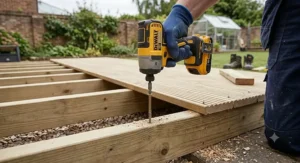
2. DeWalt DCF850N — shortest head length compact impact driver on test
Part of DeWalt’s ATOMIC line, the DeWalt DCF850N measures a genuinely tiny 101mm from tip to tail while still producing up to 205Nm of torque — figures that would have been unthinkable in a compact body five years ago. What most buyers overlook about this model is that the size reduction hasn’t come at the cost of a three-speed trigger; you still get a precision mode for delicate fasteners, a mid setting for general work, and full power for structural fixings, which is unusual restraint for a tool this small.
This is the pick for kitchen fitters, cabinet installers, and anyone working inside stud walls or between joists where every extra millimetre of head length matters. Reviewers consistently note that the reduced weight — under a kilogram bare — makes a real difference during overhead work sessions that run into hours rather than minutes, echoing what ergonomic research on repetitive tool use generally finds about fatigue and tool mass. The trade-off, as with most ultra-compact designs, is that the shorter body sacrifices a little of the leverage a longer-bodied tool gives you when driving the longest coach screws.
Pros:
- ✅ Shortest head length in this comparison at 101mm
- ✅ Three-speed trigger for genuine precision control
- ✅ Sub-1kg bare weight reduces fatigue on overhead jobs
Cons:
- ❌ Requires DeWalt XR batteries, a separate purchase if new to the brand
- ❌ Less leverage than longer-bodied drivers on the longest fixings
Body-only pricing typically sits in the £90-120 range, and the DCF850N is frequently cheaper than equivalent Makita or Milwaukee compacts, which is why ToolStore UK and others flag it as one of the most popular all-round options for 2026 site work.
3. Milwaukee M12 FID2-0 — sub-compact pick for one-handed electrician’s work
At just 127mm long and 0.9kg bare, the Milwaukee M12 FID2-0 runs on the 12V M12 platform rather than 18V, and that distinction matters more than it sounds. Dropping to 12V lets Milwaukee shrink the whole tool, not just the head, which is why this is consistently the model recommended for anyone needing a genuinely one-handed cordless driver for overhead or confined work. It still manages 170Nm of torque, 3,600rpm, and 4,000 impacts per minute — numbers that outperform plenty of older 18V tools despite the smaller battery format.
Here’s what to weigh: the drop-and-load bit holder is designed specifically for single-hand bit changes, which matters enormously if your other hand is holding a torch, a cable, or a fitting steady. Reviewers on trade retailer sites consistently praise how well it fits into a daily-carry pouch without weighing a belt down, with one buyer noting it competes surprisingly well against their full-size M18 driver despite the size difference. The obvious limitation is torque ceiling — this isn’t the tool for driving long decking screws into hardwood joists all day.
Pros:
- ✅ Genuinely one-handed operation with drop-and-load bit holder
- ✅ Lightest bare weight of any model tested here
- ✅ Shares M12 batteries across Milwaukee’s compact tool range
Cons:
- ❌ Lower torque ceiling than the 18V models in this list
- ❌ M12 batteries aren’t interchangeable with M18 tools
Expect to pay somewhere in the £100-130 range body-only, rising toward the mid-£100s for kits with two batteries — a reasonable premium for a tool this specifically engineered for confined-space, one-handed use.
4. Makita DTD154Z — mid-range pick with genuine torque control
The Makita DTD154Z keeps the standard LXT 18V battery fitment that most UK trade users already own, which instantly makes it a lower-friction upgrade than switching platforms. Its headline feature is a three-stage impact selector paired with a variable-speed trigger, letting you dial back both speed and torque for delicate screws — genuinely useful rather than a marketing bullet point, since cheaper compact drivers in this category often only offer trigger-based speed control with no separate torque staging.
Based on the spec comparison, 165Nm sits mid-pack here, but the practical story is about control rather than outright power. Reviewers consistently highlight the brushless motor’s efficiency, reporting noticeably longer runtime per charge compared with the brushed Makita models it replaced, along with reduced heat build-up during sustained use. What the spec sheet won’t tell you, but reviewers note, is that the twin LED ring lighting genuinely helps in the dim conditions common to loft hatches and under-stair cupboards — small quality-of-life detail that adds up over a working day.
Pros:
- ✅ Three-stage impact selector for genuine fastener-specific control
- ✅ Compatible with Makita’s extensive existing LXT battery range
- ✅ Brushless motor runs cooler and longer than older brushed models
Cons:
- ❌ Torque figure trails the DeWalt and Milwaukee premium picks
- ❌ Body-only purchase still needs an LXT battery if starting fresh
Priced typically in the £110-140 body-only range, the DTD154Z earns its keep as the sensible mid-range choice for anyone already sitting on Makita batteries from a combi drill or other LXT tool.
5. Bosch GDR 18V-200 Professional — best for buyers on the AMPShare platform
The Bosch GDR 18V-200 Professional occupies a slightly different lane: it’s part of Bosch’s Professional blue range (not to be confused with the green consumer line), and it plugs into the AMPShare ecosystem that Bosch shares with other manufacturers, which is a genuinely unusual piece of cross-brand cooperation in an industry that normally locks customers into proprietary batteries. At 200Nm torque and a 123mm head length, it sits comfortably in the middle of this comparison on both power and compactness.
Reviewers consistently note that Bosch Professional tools tend to fly under the radar compared with the “big three” of DeWalt, Makita, and Milwaukee, despite performing at a genuinely comparable level — this is the kind of honest analytical territory Amazon listings won’t touch, since it requires comparing across brand reputation rather than just specs. On paper this means buyers who value battery flexibility across brands, rather than loyalty to one manufacturer’s ecosystem, get real practical benefit from going Bosch. The trade-off is narrower third-party accessory availability compared with the DeWalt and Makita platforms, simply due to smaller UK market share.
Pros:
- ✅ Compatible with the cross-brand AMPShare battery system
- ✅ Solid 200Nm torque in a genuinely mid-size compact body
- ✅ Professional-grade build quality often overlooked by buyers
Cons:
- ❌ Smaller accessory and third-party ecosystem than DeWalt or Makita
- ❌ Less brand recognition may affect resale value
Expect a body-only price in the region of £120-150, which puts it roughly on par with the Makita DTD154Z — a straight choice between LXT and AMPShare loyalty for most buyers at this tier.
6. Makita DTD172Z — the most refined Makita compact driver yet
Widely described as the best impact driver Makita has ever produced, the Makita DTD172Z trades a little raw torque for genuine refinement — Quick-Shift Mode automatically reduces rotation speed just before a fastener seats, which in practice means fewer stripped screw heads on delicate finish work like cabinet doors and skirting boards. Reviewers consistently flag this feature specifically, rather than generic praise, because it solves a problem — cam-out on the last turn — that every trade worker has sworn at more than once.
Here’s the honest analytical take: at 108mm head length and roughly 140-170Nm depending on mode, this isn’t the most powerful or the smallest tool here, but it’s arguably the most usable across the widest range of everyday fastening tasks. Reviewers also note the vibration-absorption housing genuinely reduces hand fatigue during long fastening runs — deck builders and framers driving hundreds of screws in a session are the audience most likely to feel the benefit. If your work is mostly finish carpentry rather than structural fixing, this refinement matters more than an extra 30Nm on the spec sheet.
Pros:
- ✅ Quick-Shift Mode reduces cam-out and stripped screws
- ✅ Vibration-absorbing housing reduces operator fatigue
- ✅ Widely regarded as Makita’s most refined compact driver to date
Cons:
- ❌ Among the pricier options in this comparison
- ❌ Not the outright torque leader if raw power is the priority
Typical body-only pricing lands around £140-170, reflecting its position as Makita’s flagship compact rather than a budget or mid-range offering.
7. Milwaukee M18 FID3 — maximum power in a genuinely compact body
Rounding out the list, the Milwaukee M18 FID3 proves that “compact” and “powerful” aren’t mutually exclusive if the engineering budget is there. At 226Nm of torque and a 100mm head length, it beats every other tool in this comparison on raw output while matching the DeWalt DCF850N for shortness — an unusual combination that’s earned it recognition as a top overall pick among several UK and US tool review outlets in 2026.
Based on the spec comparison, this is squarely the tool for tradespeople who refuse to compromise on power just because they need a compact body — deck builders driving structural screws, roofers, and anyone regularly hitting dense hardwood or metal fixings where lower-torque compacts start to bog down. Reviewers consistently describe the M18 platform’s battery ecosystem as one of the deepest available in the UK, meaning this driver slots straight into an existing Milwaukee kit without adding a new charger or battery format to the toolbox. What most buyers overlook is that this level of torque in a compact housing generates more reaction snap through the wrist than the lower-powered models here — worth bearing in mind if you’re new to impact drivers generally.
Pros:
- ✅ Highest torque figure in this entire comparison
- ✅ Matches the shortest head length despite the power increase
- ✅ Shares batteries across Milwaukee’s extensive M18 range
Cons:
- ❌ Premium pricing reflects the performance ceiling
- ❌ Higher torque means more wrist snap for inexperienced users
Body-only pricing typically sits in the £150-190 range, positioning it as the premium pick for buyers who’ve decided compact size shouldn’t mean compromised power.
Practical Usage Guide: Getting the Most From Your First 30 Days
A new impact driver rewards a bit of set-up discipline before you start driving screws in anger. First, always fit impact-rated bits rather than standard screwdriver bits — the percussive shock of impact mode will shatter a standard bit within minutes, and DeWalt FlexTorq or Makita Impact XPS bits are widely reported to significantly outlast generic sets. Second, spend your first few sessions on scrap material getting a feel for how quickly each speed setting reaches full torque; every brand calibrates its trigger feel slightly differently, and muscle memory from a previous driver can catch you out on a new one.
Maintenance is minimal but not optional. Wipe down the chuck and hex collet weekly if you’re using the tool daily, since dust and swarf build-up is the single biggest cause of bits not seating fully — a common complaint in aggregated reviews that’s almost always a cleaning issue rather than a fault. Store batteries at roughly 40-80% charge if the tool won’t be used for more than a few weeks, since lithium-ion cells degrade faster when left fully depleted or fully charged for extended periods. The most common first-30-days mistake is over-tightening delicate fixings by leaving the tool in full-power mode out of habit; if your compact driver has a multi-stage selector, use it — that’s precisely the control DeWalt, Makita, and Bosch engineered these staged modes for.
Real-World Scenarios: Matching the Driver to the Job
The self-employed electrician: Working domestic rewires means squeezing into loft hatches, under-stair cupboards, and stud cavities dozens of times a day, often one-handed while the other hand manages cable or a torch. For this profile, the Milwaukee M12 FID2-0 is the clear match — its sub-127mm length and drop-and-load bit holder are purpose-built for exactly this kind of one-handed cordless driver work, and the separate M12 platform means it doesn’t compete with a heavier M18 drill for battery slots in a tool belt.
The plumbing and heating fitter: A typical electrician plumber tool kit needs a driver that copes with everything from delicate bracket screws to stubborn old fixings on boiler housings, frequently in tight airing cupboards. Here the DeWalt DCF850N‘s three-speed trigger and 101mm head length earn their place — the precision mode protects softer brass fittings while full power handles corroded screws without a fight.
The weekend deck-builder: Driving several hundred decking screws over a bank holiday weekend is a torque-and-runtime problem more than a size problem. The Milwaukee M18 FID3 or Ryobi R18ID2-0 both make sense here depending on budget — the former for raw speed and endurance, the latter if this is a once-a-year project that doesn’t justify a premium tool.
Problem → Solution: Fixing Common Compact Impact Driver Frustrations
Problem: Screws keep stripping on delicate trim work. Solution: switch to a driver with staged torque control, such as the Makita DTD154Z or Makita DTD172Z, and start every fastener on the lowest setting before increasing power only if needed.
Problem: The tool won’t fit the space you need it for. Solution: check head length in millimetres, not just the word “compact” on the box — the gap between the DeWalt DCF850N at 101mm and the Ryobi R18ID2-0 at 145mm is the difference between fitting inside a stud cavity and not.
Problem: Battery life doesn’t last a full working day. Solution: this is rarely the driver’s fault — pair any of these tools with a higher-capacity battery (4.0Ah or above) rather than the compact 1.5-2.0Ah packs often bundled in starter kits, which prioritise weight over runtime.
Problem: Bits keep working loose mid-job. Solution: this is almost always a worn or non-impact-rated bit rather than a faulty chuck; impact bits are hardened specifically to resist the torsional flex that causes standard bits to slip.
Problem: The tool feels front-heavy and tiring during overhead work. Solution: sub-kilogram bare-weight models like the Milwaukee M12 FID2-0 or DeWalt DCF850N genuinely reduce fatigue compared with heavier 18V compacts — worth the switch if overhead work is a regular part of your day.
✨ Ready to stop fighting your tools? Compare current pricing on today’s featured picks before availability changes.
How to Choose a Compact Impact Driver
Working through these criteria in order will get you to the right tool faster than scrolling spec sheets:
- Measure the space you’ll actually be working in. If you’re regularly reaching into stud cavities or between joists, head length in millimetres should be your first filter, not torque.
- Match the battery platform to what you already own. Buying body-only and reusing existing batteries from a drill or saw saves real money and avoids cluttering your van with chargers.
- Decide how much torque you genuinely need. Finish carpentry rarely needs more than 165Nm; decking, fencing, and structural fixing benefits from 200Nm or above.
- Check for staged speed or torque control. A single-speed trigger is fine for occasional DIY but frustrating for daily mixed-fixing trade work.
- Weigh the tool, not just the spec sheet number. Sub-kilogram tools noticeably reduce fatigue during overhead or one-handed sessions.
- Consider bit-change mechanism. One-handed drop-and-load systems matter enormously if you regularly work with one hand occupied.
- Factor in warranty and parts availability. Three-year manufacturer warranties are now standard among the major brands, so treat anything shorter as a red flag.
Compact Impact Driver vs Full-Size Impact Driver
The honest answer to “which should I buy” depends entirely on where you work, not how much power you think you need. Full-size 18V impact drivers typically run 135-155mm in head length and often edge out compact models on outright torque and battery runtime per charge, simply because there’s more room for a bigger motor and gearbox. For open workshop use, deck building, or general construction where access isn’t restricted, a full-size driver remains the more efficient tool — you’ll get through more fixings per battery charge.
A compact impact driver earns its keep specifically where geometry is the limiting factor: between joists, inside kitchen cabinets, in loft hatches, and anywhere one-handed operation matters more than maximum runtime. The performance gap has narrowed dramatically in 2026 — models like the Milwaukee M18 FID3 now match or beat older full-size tools on torque while staying genuinely pocketable. The realistic takeaway for most UK tradespeople is that a compact model has become sensible as a primary driver rather than a specialist second tool, unless your work is dominated by high-volume structural fixing where the extra runtime of a full-size battery pack pays for itself.
Short Head Length Impact Driver: Why Millimetres Matter
It’s easy to skim past head length specs, but the difference between a 145mm and a 100mm tool is the difference between reaching a screw and not reaching it at all. A short head length impact driver, measured tip-to-tail without a bit fitted, becomes critical in three specific scenarios common to UK housing stock: working between roof joists in lofts converted for storage, fixing brackets inside fitted kitchen units after the carcasses are installed, and driving screws in stud walls where noggins and cabling leave narrow gaps.
The DeWalt DCF850N and Milwaukee M18 FID3 both sit around the 100-101mm mark, representing close to the practical floor for current 18V technology — shrinking much further tends to require dropping down to a 12V platform like the Milwaukee M12 FID2-0, which manages 127mm at a lower voltage. Reviewers consistently flag head length as the single most-checked spec among tradespeople working in older UK housing stock, where narrower joist spacing and boxed-in pipework are far more common than in newer builds. If you’re choosing based on a single number, this is the one worth prioritising over raw torque for most confined-space work.
Compact Impact Drivers for Electricians and Plumbers
Trade-specific needs shift the priority list considerably. An electrician plumber tool kit typically demands a driver that’s light enough to carry all day on a belt, fast to switch bits with one hand, and non-bulky enough to fit into ceiling voids, consumer unit cupboards, and under-sink cabinets without repeated repositioning. Torque, somewhat counterintuitively, matters less here than for construction trades — most electrical and plumbing fixings are small screws into brackets, back boxes, and fittings rather than structural timber connections.
The Milwaukee M12 FID2-0 consistently comes up as the trade favourite for exactly this profile, thanks to its sub-kilogram weight and genuinely one-handed bit changes. The DeWalt DCF850N is a close second where a slightly higher torque ceiling is useful — for example, mounting heavier boiler brackets or securing conduit clips into masonry plugs. Reviewers who identify as electricians or plumbers in aggregated feedback repeatedly cite loft, cupboard, and boxed-in access as their primary buying driver, ahead of raw power specs — a useful reminder that the “best” tool on paper isn’t always the best tool for a specific trade.
One-Handed Operation: What Actually Makes a Driver Easy to Use Solo
“One-handed” gets used loosely in tool marketing, so it’s worth being specific about what actually delivers it. A genuine one-handed cordless driver needs three things working together: low enough overall weight that the wrist doesn’t tire holding it one-handed for extended periods, a bit-change mechanism that doesn’t require a second hand to hold a sleeve or collar, and a trigger and forward/reverse switch positioned so they’re reachable without repositioning your grip.
The Milwaukee M12 FID2-0‘s drop-and-load bit holder is the clearest example in this comparison — you can swap bits by dropping the old one out and inserting the new one without touching a collet with your free hand. The DeWalt DCF850N achieves a similar result through its lighter overall mass rather than a dramatically different bit mechanism. What most buyers overlook is that a heavier tool with a fast bit-change system still isn’t genuinely one-handed in practice, because arm fatigue forces a grip change within minutes regardless of how the chuck works — weight and mechanism both have to be right together.
Common Mistakes When Buying a Compact Impact Driver
The most frequent and costly mistake is buying into a new battery platform for a single tool, then discovering you need three more batteries and a charger to make the purchase worthwhile — always check what platform you already own before comparing torque figures. A close second is assuming “compact” is a standardised category; as the comparison table above shows, head lengths in this review alone range from 100mm to 145mm, a 45mm spread that can be the difference between fitting a job and not.
Buyers also commonly underestimate how much a staged torque selector matters once they start mixing delicate and heavy-duty fixings in the same session — a single-speed compact driver that felt fine in isolation quickly becomes frustrating once you’re switching between hinge screws and coach bolts. Finally, don’t buy based on torque alone: the Milwaukee M12 FID2-0 has the lowest torque figure here yet remains one of the most recommended tools in this list for its specific use case, proving that matching the tool to the job beats chasing the biggest number on the box.
Long-Term Cost & Maintenance
Total cost of ownership on a compact impact driver extends well beyond the body-only price. Budget roughly £40-70 per additional battery if you’re expanding a kit, and factor in that impact-rated bits, while more durable than standard bits, still wear out — a quality 30-40 piece impact bit set typically runs £15-25 and is worth treating as a consumable rather than a one-off purchase. Brushless motors, now standard across every model in this comparison, meaningfully reduce long-term maintenance versus older brushed designs, since there are no carbon brushes to replace and the sealed design keeps dust out of the motor housing.
Warranty terms are increasingly generous, with most major brands now offering three-year cover as standard once the tool is registered, which meaningfully changes the cost-per-use calculation over a five-year ownership period compared with buying an unregistered or grey-market import. Batteries remain the component most likely to need replacement first, typically after 500-1,000 charge cycles depending on how consistently they’re run flat before recharging — a habit worth avoiding if you want to get the full working life out of a pack.
Safety, Regulations & Compliance Guide
Compact impact drivers sold in the UK must carry either UKCA or CE marking to be legally placed on the Great Britain market, and current government guidance confirms businesses currently have the flexibility to use either marking while the two regimes continue to be mutually recognised. For everyday buyers this mostly matters as a quality signal — a properly marked tool has been through the required conformity assessment for electrical and mechanical safety, whereas unmarked grey-market imports haven’t.
Vibration exposure is the safety consideration most relevant to daily users, particularly tradespeople using an impact driver for several hours a day. The Health and Safety Executive’s guidance on hand-arm vibration explains that prolonged exposure to vibrating tools can cause permanent damage including vibration white finger, and recommends regular breaks alongside monitoring exposure time under the Control of Vibration at Work Regulations 2005 for anyone using these tools professionally. Practically, this means rotating tasks where possible, wearing anti-vibration gloves for extended sessions, and choosing the lower-vibration end of this comparison — generally the lighter, lower-torque models — where the job allows it.
FAQ
❓ What is the difference between a compact and a standard impact driver?
❓ Is a compact impact driver powerful enough for decking screws?
❓ Can I use a compact impact driver one-handed?
❓ Do compact impact drivers use the same batteries as full-size models?
❓ How short does a 'short head length' impact driver need to be for tight spaces?
Conclusion
There’s no single best compact impact driver for every UK toolbag — the right choice depends on which battery platform you’re already carrying, how tight the spaces you’re working in actually are, and whether raw torque or one-handed manoeuvrability matters more for your typical day. The DeWalt DCF850N and Milwaukee M18 FID3 lead on outright compactness and power respectively, the Milwaukee M12 FID2-0 remains the clearest choice for genuinely one-handed electrical and plumbing work, and the Ryobi R18ID2-0 is still the most sensible entry point for DIYers not ready to commit to a premium platform.
What’s changed in 2026 is how little you now give up by choosing compact. A few years ago, “compact” meant a meaningful torque penalty; today, models like the Milwaukee M18 FID3 outperform many older full-size tools while fitting into spaces those tools never could. Whichever platform you land on, match the tool to where you actually work rather than the biggest number on the spec sheet, and you’ll get more genuine daily use out of it than any single headline figure could predict.
✨ Don’t Miss These Exclusive Deals!
🔍 Take your toolkit to the next level with one of these carefully compared compact impact drivers. Click through to check current pricing and availability on amazon.co.uk, and pick the model that actually fits how — and where — you work.
Recommended for You
- High Torque Impact Driver: 7 Best Picks Tested for 2026
- Impact Driver vs Combi Drill: 7 Real Tools Tested (2026 UK)
- Cordless Impact Driver Guide 2026: 7 Best Picks for UK Trades
Disclaimer: This article contains affiliate links. As an Amazon Associate, I earn from qualifying purchases. If you purchase products through these links, we may earn a small commission at no additional cost to you.
✨ Found this helpful? Share it with your friends! 💬🤗
