
In This Article
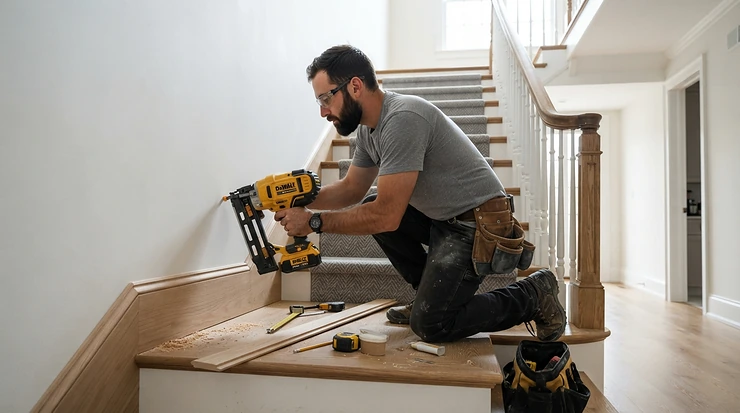
A cordless nail gun for skirting boards is a battery-powered second-fix nailer that drives thin brad or finish nails into skirting without a compressor, hose or gas canister. Each nail lands in a fraction of a second, leaves a tiny hole that needs minimal filler, and frees your other hand to hold the board where it belongs.
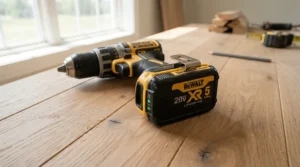
Anyone who has fitted skirting by hammer knows the routine: hold, tap, miss, curse, bend a pin, dent the paintwork. A nailer replaces all that with one squeeze of a trigger. Nail guns come in pneumatic, gas, electric and battery flavours, but for home renovation the battery version wins on sheer convenience. Pick it up, click in a battery, go.
The catch is choice. In 2026, prices stretch from a budget cordless nail gun that costs less than a weekend of takeaways to trade-grade kit priced like a decent mitre saw. So this guide does the sifting for you. I’ve compared real specifications, UK retailer listings and published owner feedback to rank seven nailers. Where the evidence is thin, I’ll say so rather than pretend.
Along the way we’ll tackle the questions that actually decide a purchase. Is it good value for money? Does battery included vs bare tool change the sums? How far can you trust budget brand reliability? By the end, you’ll know which gauge, which nail length and which tool suits your skirting, your wallet and the batteries already sitting in your garage.
Quick Comparison: Best Cordless Nail Gun for Skirting Boards at a Glance
| Product | Type | Approx. bare-tool price | Best For |
|---|---|---|---|
| Einhell TE-CN 18 Li | 2-in-1 nailer/stapler | Under £100 | One-room jobs on a shoestring |
| Ryobi R18GN18-0 | 18 gauge, AirStrike | Around £100-£170 | DIYers already on Ryobi ONE+ |
| Erbauer ERI967NAL | 18 gauge, brushless | Roughly £130-£180 | Shoppers who want a kit |
| Makita DBN500 | 18 gauge, slim nose | Roughly £170-£240 | Tight corners, Makita LXT owners |
| DeWalt DCN680N | 18 gauge, brushless | Roughly £200-£300 | Long runs, 54mm reach |
| Ryobi R15GN18-0 | 15 gauge, angled | Roughly £150-£220 | Chunky skirting on a budget |
| Milwaukee M18 FN16GA | 16 gauge, angled | Roughly £220-£300 | Hardwood skirting, M18 owners |
Looking at the comparison above, the Ryobi R18GN18-0 and Einhell TE-CN 18 Li are the cheapest ways in. The Einhell TE-CN 18 Li‘s short nails and modest firing pace confine it to small jobs, though. For a whole house of skirting, the DeWalt DCN680N and Makita DBN500 justify their premium through reach and consistency. The 15 and 16 gauge Ryobi R15GN18-0 and Milwaukee M18 FN16GA only earn their keep if your boards are thick or hard. These are bare-tool figures, and the battery included vs bare tool decision can shift your real spend meaningfully. Prices are indicative and change constantly, so check the current price before buying.
💬 Just one click — help others make better buying decisions too!😊
Top 7 Cordless Nail Gun for Skirting Boards Options: Expert Analysis
Each pick is judged on what matters for skirting: nail reach, hole size, corner access and whether it’s sensible for the money. Ratings and review comments are aggregated from public retailer listings and published reviews at the time of research.
1. Einhell TE-CN 18 Li — cheapest way into cordless nailing
The Einhell TE-CN 18 Li makes a budget cordless nail gun feel almost suspiciously affordable. It’s a nailer-and-stapler combo that runs on any battery from Einhell’s Power X-Change range. Its gear-driven mechanism is rated for up to 20 shots per minute, and the magnetic magazine holds up to 100 nails or staples. That’s a stroll rather than a sprint: fine for a spare bedroom, tedious across a ground floor. The box includes 32mm nails, so think light skirting fixed to battens or studs. Check the manual for the maximum nail length before assuming it takes longer brads.
Based on the spec comparison, this suits someone doing a room or two who already owns Power X-Change batteries. Owner feedback is mixed. One UK retailer reviewer said the last couple of millimetres sometimes needed a hammer tap and that the depth setting made little visible difference. They also found angled fixing awkward because the nose wobbles. Even so, they called it the cheapest cordless nailer they’d found.
Pros:
- ✅ Very low entry price
- ✅ Nailer and stapler in one tool
- ✅ Shares Power X-Change batteries
Cons:
- ❌ Short supplied nails limit skirting types
- ❌ Reported depth and flush-setting quirks
Roughly £70-£100 bare tool (battery and charger extra). It’s genuine value for money only if you’ll reuse existing Einhell batteries.
2. Ryobi R18GN18-0 — best all-round budget-brand 18 gauge
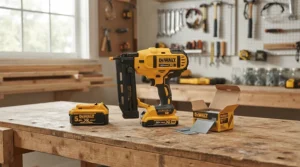
The Ryobi R18GN18-0 is what most people picture when they imagine a budget cordless nail gun that won’t embarrass them. It fires 1.2mm (18 gauge) nails from 15mm to 50mm using AirStrike technology, a self-contained pneumatic-style drive that replaces the compressor. Ryobi claims up to 1,900 50mm nails into pine from one 5.0Ah charge, which is far more than a typical room needs. A dry-fire lockout stops blank shots dinting your skirting, and the LED lights up as you grip the handle.
On paper, the 50mm reach covers standard timber or MDF skirting into studs, and the small hole leaves little to fill. Aggregated feedback is encouraging. B&Q’s listing for the kit version shows 4.1 out of 5 from 10 reviews at the time of research. One UK roundup says most users report no misfires, but warns it can struggle with very dense hardwood and isn’t built for all-day trade use. The real lock-in is the battery: superb if you own Ryobi ONE+ tools, less so if you’d need a fresh battery and charger.
Pros:
- ✅ Generous 15-50mm nail range
- ✅ Dry-fire lockout protects paintwork
- ✅ Shares batteries with 200+ ONE+ tools
Cons:
- ❌ Can struggle with very dense hardwoods
- ❌ Not designed for all-day trade use
Around £100-£170 bare tool depending on retailer and promotions, with starter kits available. It’s the best value for money starting point for most DIYers.
3. Erbauer ERI967NAL — brushless power from a budget brand
The Erbauer ERI967NAL is Screwfix’s own-brand answer to the big trade names, and its standout is a brushless motor at a budget-brand price. Screwfix lists a narrow nose for tight spots, an LED work light, tool-free jam release and depth adjustment, and a removable non-marking nose. It fires 18 gauge brads up to 55mm in sequential or bump mode, and Screwfix quotes 120 nails per minute when firing short nails. In practice, that should keep pace with a fitter working along a long wall, and the non-marking tip helps protect freshly primed skirting.
What most buyers overlook is the battery. Erbauer’s 18V EXT system is tied to Screwfix, so it makes most sense if you’ll add other EXT tools. The single-battery kit includes a 2.0Ah battery, single-port charger and 100 brad nails, a sensible starter package. Sentiment is positive but from small samples. Screwfix customers rate the EXT nailer twin-pack 4.4 out of 5, and a B&Q Ireland listing for the bare 55mm version shows 4.9 out of 5 from 22 reviews.
Pros:
- ✅ Brushless motor at a budget-brand level
- ✅ Narrow, non-marking nose for skirting
- ✅ Kit includes battery, charger and nails
Cons:
- ❌ EXT batteries only suit Erbauer tools
- ❌ Little independent lab-style testing published
Roughly £130-£180 bare tool (indicative), with kits costing more. Strong value for money if you’ll stay in the EXT ecosystem.
4. Makita DBN500 — slimmest nose for tight corners
The Makita DBN500 stands out for one number: Axminster lists just 28mm between the nail exit and the front face of the body. That matters because skirting always ends in a corner, and a slim nose lets you place nails closer to the wall. It drives 18 gauge nails from 15mm to 50mm, with a rocker switch for sequential or bump firing. Axminster quotes roughly 1,000 nails from a 3.0Ah battery. Tool-less depth adjustment, an anti-dry-fire mechanism and a low-battery warning complete a sensible package.
What the spec sheet won’t tell you, but owners note, is heft. One UK buyer built a sauna with over 2,000 32mm stainless brads without a single misfire, yet called the tool heavy for ceiling work. Another reported a couple of jams that cleared quickly. For floor-level skirting, weight is less of a drama. The real gatekeeper is the battery: the Makita DBN500 is sold bare in a case, so it suits people already on Makita’s 18V LXT platform.
Pros:
- ✅ Slim nose reaches tight corners
- ✅ Roughly 1,000 nails per 3.0Ah charge
- ✅ Sequential and bump firing modes
Cons:
- ❌ Noticeably heavy for overhead work
- ❌ Bare tool only; batteries cost extra
Roughly £170-£240 bare tool (indicative). Good value for money for LXT owners, less compelling if you’d start from scratch.
5. DeWalt DCN680N — 54mm reach and pro-level speed
The DeWalt DCN680N is the pick if your budget stretches and your skirting runs are long. Its brushless motor drives 18 gauge nails from 15mm to 54mm. DeWalt quotes up to four nails per second in bump mode, handy for straight runs, though sequential mode is the sensible choice for precise placement. The magazine holds 110 nails, weight is listed at 2.6kg, and the operating range of -20°C to 50°C matters in an unheated renovation in January. Tool-free stall and jam release plus a thumbwheel depth adjuster keep downtime low.
Owner feedback on UK retailer listings is generally positive. Buyers report pinning skirting and architrave without fuss and find it quieter than gas nailers, although one mentioned a couple of jams. An Amazon UK reviewer adds a useful warning: 16 gauge nails won’t fit the 18 gauge magazine, so buy the right nails. For one house of skirting, it’s honestly more tool than you need. For serial renovators, or anyone already on DeWalt XR batteries, the premium buys reach and speed.
Pros:
- ✅ Longest 18 gauge reach here at 54mm
- ✅ Wide operating temperature range
- ✅ Tool-free jam and stall release
Cons:
- ❌ Premium price for occasional DIY
- ❌ Bare tool needs XR batteries
Roughly £200-£300 bare tool, with kits in the £250-£350 region (indicative). It’s a strong value for money buy for heavy users, not one-room DIYers.
6. Ryobi R15GN18-0 — heavier 15 gauge for chunky skirting
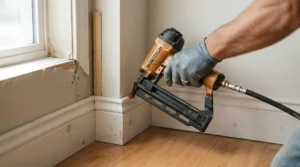
The Ryobi R15GN18-0 takes the AirStrike idea up a gauge. It fires 15 gauge (1.8mm) nails from 24mm to 65mm. Ryobi says it suits skirting boards, door casings and coving, helped by an angled nail cassette for right-angle corners. Thicker nails mean stronger holding power, which pays off with tall MDF profiles that like to bow away from the wall. Ryobi claims up to 1,000 50mm nails per 5.0Ah charge, and a dry-fire lockout plus tool-less depth and jam release mirror its smaller sibling.
Here’s my analytical take. This is the insurance choice: if you know your boards are chunky, the extra holding power beats fighting proud nails. The trade-offs are larger holes that need more filler and fewer nails per charge than the 18 gauge model. I couldn’t find enough verified reviews to characterise owner sentiment for this specific model. Treat it as a spec-led recommendation and read the latest buyer comments before ordering.
Pros:
- ✅ Long 24-65mm reach for thick boards
- ✅ Angled cassette helps in corners
- ✅ Stronger hold than 18 gauge nails
Cons:
- ❌ Bigger nail holes need more filler
- ❌ Fewer nails per charge than the 18 gauge Ryobi
Roughly £150-£220 bare tool (indicative). A budget-brand route to 15 gauge, and good value for money for chunky profiles.
7. Milwaukee M18 FN16GA — premium finish for stubborn hardwood
The Milwaukee M18 FN16GA is the heavyweight here: a 16 gauge, 20-degree angled finish nailer driving 32-64mm nails. It’s built around a nitrogen air spring and a POWERSTATE brushless motor. Milwaukee’s “Ready to Fire” approach removes the ramp-up delay between shots, giving a pneumatic-style response rather than a flywheel-style spin-up. It holds 110 nails and ships with three interchangeable nose pieces. Milwaukee quotes up to 1,200 nails per charge on a 2.0Ah battery.
In practice, it should shrug at solid oak or dense MDF skirting where lesser guns leave nails proud. One UK roundup covering Milwaukee’s M18 16 gauge nailers praises build quality and depth control while flagging cost and weight. I couldn’t verify a large pool of model-specific reviews, so treat that as tentative. Value peaks if you already own M18 batteries, and a -301X kit adds a 3.0Ah battery and charger if you don’t.
Pros:
- ✅ Sinks nails sub-flush in hardwoods
- ✅ Three interchangeable nose pieces
- ✅ No ramp-up delay between shots
Cons:
- ❌ Highest price in this round-up
- ❌ Heavier than the 18 gauge alternatives
Roughly £220-£300 bare tool (indicative). Excellent for M18 owners, overkill for a budget cordless nail gun search.
| Product | Gauge and nail range | Battery platform | Kit or bare | Best For |
|---|---|---|---|---|
| Einhell TE-CN 18 Li | 2-in-1, 32mm nails supplied | Power X-Change | Bare (battery separate) | Small jobs |
| Ryobi R18GN18-0 | 18 gauge, 15-50mm | Ryobi ONE+ | Bare or starter kit | DIY on ONE+ |
| Erbauer ERI967NAL | 18 gauge, up to 55mm | Erbauer 18V EXT | Bare or 2.0Ah kit | Kit buyers |
| Makita DBN500 | 18 gauge, 15-50mm | Makita 18V LXT | Bare (case) | Tight corners |
| DeWalt DCN680N | 18 gauge, 15-54mm | DeWalt 18V XR | Bare or kits | Long runs |
| Ryobi R15GN18-0 | 15 gauge, 24-65mm | Ryobi ONE+ | Bare | Chunky skirting |
| Milwaukee M18 FN16GA | 16 gauge, 32-64mm | Milwaukee M18 | Bare or -301X kit | Hardwood |
The table shows the pattern clearly: your existing battery platform matters as much as the nailer itself. The Ryobi R18GN18-0 and Ryobi R15GN18-0 share one battery system, while the Makita DBN500, DeWalt DCN680N and Milwaukee M18 FN16GA each demand their own trade platform. If you own none of these, the Erbauer ERI967NAL kit is the neatest starter package.
Fitting Skirting Boards with a Cordless Nail Gun: A Practical Guide
Skirting rewards preparation. Here’s the workflow that keeps holes tidy and boards straight.
- Scan before you shoot. Cables and pipes love the space near sockets and floors. Check the electrical safe zones and use a detector, because a nail through a cable is a very bad afternoon.
- Find your fixings. Locate studs, noggins or timber grounds and mark them. Brad nails won’t grip in brick or block, so use grab adhesive there and let the nails hold the board while it cures.
- Test on an offcut. Set the depth wheel so heads sit just below the surface. Adjust one notch at a time.
- Choose your mode. Sequential firing gives control near corners; bump mode speeds long straight runs once you’re confident.
- Nail at sensible spacing. Roughly every 400-600mm at stud positions is a common approach, angling nails slightly for extra grip and staying a little in from board ends to avoid splitting.
- Finish neatly. Fill holes, caulk the top edge gaps and paint.
First-30-day mistakes worth avoiding: loading the wrong gauge of nail, forgetting to remove the battery before clearing a jam, and nailing before checking behind the wall. Store batteries somewhere cool and partly charged between jobs.

Which Budget Cordless Nail Gun Fits Your Project? Three Real-World Scenarios
Scenario one: the one-bedroom refresh. You’re fitting around 14 metres of MDF skirting onto stud walls, once, over a weekend. You own a Ryobi ONE+ drill. The Ryobi R18GN18-0 bare tool is the logical, budget-friendly answer: no new battery, no new charger, and an 18 gauge hole that barely needs filler.
Scenario two: the whole-house renovation. You’re doing every room over several months, with no existing tool platform. Here a kit beats a bare tool. The Erbauer ERI967NAL kit includes battery, charger and 100 nails, and its brushless motor should cope with repeated use. If your skirting is tall and chunky, price up the Ryobi R15GN18-0 with a starter battery too.
Scenario three: the self-employed fitter. You’re already invested in DeWalt or Milwaukee batteries and fit skirting weekly. Buy the matching bare tool, the DeWalt DCN680N or Milwaukee M18 FN16GA, because you already own the expensive part. Choose by wood: 18 gauge for painted MDF and softwood, 16 gauge for solid hardwood.
If you’d fit skirting only once and it’s a small room, the Einhell TE-CN 18 Li is the thriftiest way to skip the hammer, provided you own compatible batteries.
✨ Don’t Miss These Top Picks!
🔍 Take your skirting project to the next level with these carefully selected nailers. Click any highlighted product name to check current pricing and availability. The right tool will help you create crisp, professional-looking finishes your whole household will notice! 🔨
How to Choose a Cordless Nail Gun for Skirting Boards
- Match the gauge to your boards. 18 gauge suits standard MDF and softwood and leaves the smallest holes. Step up to 15 or 16 gauge for tall, solid or dense profiles that need more holding power.
- Check nail reach. The nail must pass through the skirting and bite well into the fixing. One UK guide suggests 45-50mm brads as a standard setup for skirting on timber, so a 50mm ceiling is the practical minimum.
- Pick your battery platform first. The nailer is the cheap part of a system; the battery ecosystem is the long-term commitment.
- Decide on battery included vs bare tool. Own the batteries? Buy bare. Starting fresh? A kit usually beats buying separately.
- Look for three safety-and-quality features. A dry-fire lockout, tool-free depth adjustment and tool-free jam release separate pleasant tools from frustrating ones.
- Be honest about frequency. A one-off room favours a budget cordless nail gun; weekly fitting justifies brushless trade kit.
Budget Cordless Nail Gun: What You Really Get for Less
A budget cordless nail gun trades speed and hardwood punch for accessibility. What you sacrifice is usually firing pace, nose precision and long-haul durability. What you keep, if you choose carefully, is the core benefit: consistent nails, small holes and no hose.
Insist on three boxes ticked before you spend anything. First, tool-free depth adjustment. Second, a dry-fire lockout. Third, a tool-free jam release. The Ryobi R18GN18-0 lists all three, while the Einhell TE-CN 18 Li has a depth setting but attracted reviewer complaints about how well it worked. Also budget a few pounds for decent nails. Poorly collated bargain nails are a commonly cited cause of jams, and jams cost more time than the saving.
Finally, be realistic about material. Budget guns thrive on softwood and MDF skirting; dense oak is where cheaper drives run out of puff, as one UK roundup notes for the Ryobi R18GN18-0.
Value for Money: Cost-Per-Job Thinking and Long-Term Costs
Value for money isn’t the lowest sticker price; it’s cost per finished metre over the tool’s life. Nails are almost free: UK trade counters list 5,000 50mm 18 gauge galvanised nails in roughly the £13-£16 range, so a 20-metre skirting job needing perhaps 80 nails costs pennies. Ryobi’s claim of up to 1,900 50mm nails per 5.0Ah charge suggests battery capacity is rarely your bottleneck. Compare that with the hammer-and-pin approach: cheap in cash, expensive in time and dented paintwork.
The real spend is the platform. A bare tool that shares batteries with your drill is often the cheapest route to value for money, whereas a stand-alone kit only pays back if you’ll use the battery across other tools. Long-term running costs are modest: keep the magazine clear of dust, store batteries cool, and inspect the nose for wear. Compared with gas nailers, whose fuel canisters cost roughly £7-£10 and give about 1,000 shots according to one UK guide, battery tools have no fuel to buy. That’s a real advantage for occasional users.
Battery Included vs Bare Tool: Which Deal Actually Wins?
The battery included vs bare tool question comes down to one honest check: do you already own batteries for that platform? If yes, buy the bare tool and pocket the difference. If no, a kit is almost always better, because buying a battery and charger separately rarely undercuts the bundle.
Kits differ. The Erbauer ERI967NAL kit includes a 2.0Ah battery, single-port charger and 100 nails. DeWalt sells the DCN680 in a two-battery kit with a charger and kit box. Milwaukee’s -301X bundle adds a 3.0Ah battery, charger and case to the Milwaukee M18 FN16GA. Ryobi offers a starter kit with a 4.0Ah battery for the Ryobi R18GN18-0. By contrast, the Einhell TE-CN 18 Li and Makita DBN500 are commonly listed bare.
Here’s what most buyers overlook: nailers sip power. Makita quotes roughly 1,000 nails from a 3.0Ah pack, and Milwaukee quotes up to 1,200 on a 2.0Ah, so a small, cheap battery is plenty for skirting. Don’t pay extra for big-capacity packs unless you’ll use them in a drill or saw too.
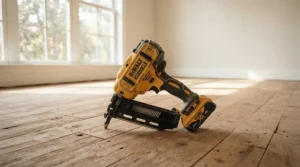
Budget Brand Reliability: How Far Can You Trust a Cheaper Name?
Budget brand reliability is harder to prove than to promise, because independent long-term failure data for these tools is scarce. So judge on evidence you can check. Warranty is the first. Einhell’s UK listing says its manufacturer warranty covers manufacturing defects for the normal lifetime of the tool, excluding wear and misuse, and Screwfix lists longer guarantees on some Erbauer nailers, so read the terms for your exact model.
Ecosystem is the second signal. B&Q describes Ryobi’s ONE+ range as over 200 tools, so your battery investment keeps paying back. Erbauer’s EXT range is narrower but backed by Screwfix’s counter network. Third is usage fit: one UK roundup rates the Ryobi R18GN18-0 as a starter tool rather than all-day trade kit. That’s not a criticism, just a limit to respect.
Reviewers of the Erbauer ERI967NAL and Ryobi R18GN18-0 are broadly positive from small samples, but that’s encouragement, not proof. My take: budget brands are reliable enough for DIY skirting when you buy from a retailer with easy returns and register the warranty.
Cordless vs Pneumatic vs Gas Nailers: What Suits Skirting Best?
| Option | Setup | Running cost | Best For |
|---|---|---|---|
| Cordless battery nailer | Battery and nails only | Nails plus battery wear | DIYers and occasional fitters |
| Pneumatic nailer | Compressor and hose | Nails, compressor upkeep | Workshops fitting daily |
| Gas-fuel nailer | Battery plus fuel canister | Canisters (£7-£10, ~1,000 shots) | Busy pro sites |
| Hammer and pins | Nothing | Pins and time | Tiny one-off repairs |
The table shows why battery nailers dominate home use: no hose to trip over, no canister to reorder, and setup measured in seconds. Gas guns are faster on busy sites, but for a domestic renovation the extra speed rarely repays the running cost. Pneumatic tools remain excellent in workshops, yet dragging a compressor upstairs makes little sense for bedroom skirting.
Features That Actually Matter (And Those That Don’t)
Matter:
- A dry-fire lockout stops nails firing blank and dinting paintwork.
- Tool-free depth adjustment gets nail heads sitting just below the surface.
- A narrow, non-marking nose places nails accurately and protects primed boards; the Makita DBN500 and Erbauer ERI967NAL both lean into this.
- Tool-free jam release turns a rant into a ten-second fix.
- Weight and balance count over a full day of kneeling and reaching.
Matter less:
- Bump-fire speed. Four nails a second on the DeWalt DCN680N is glorious on long runs, but for a single room sequential firing gives better accuracy.
- Brushless motors improve longevity and efficiency, but for one or two jobs a brushed tool is fine.
- Stapler capability on the Einhell TE-CN 18 Li helps upholsterers more than skirting fitters.
- Belt hooks and LEDs are pleasant extras rather than deal-makers.
Safety, Regulations and Tool Compliance for Home Fitters
A nail gun is a power tool, and treating it casually is the fastest route to a trip to A&E. Wear safety glasses and hearing protection, keep fingers away from the nose, and default to sequential firing unless you’re confident. Remove the battery before clearing jams or changing settings.
Tradespeople should also consider hand-arm vibration, which HSE describes as a cause of significant ill health from hand-held power tools. Employers have duties under the Control of Vibration at Work Regulations 2005. Occasional DIY use is a different risk profile from full-time fitting, but the principle of lighter, well-balanced tools holds.
When buying, look for UKCA or CE marking on the tool and charger, and use only the manufacturer’s recommended batteries. Never nail near suspected cables or pipes, never fire into hard surfaces, and store nails and tools away from children.

FAQ
❓ Can I use a cordless nail gun for skirting boards on brick or block walls?
❓ Will a cordless nail gun split MDF skirting boards?
❓ How many nails do I need per metre of skirting?
❓ Is a budget cordless nail gun worth buying for one room of skirting?
❓ How do I hide nail holes in painted skirting boards?
Conclusion: Which Cordless Nail Gun for Skirting Boards Should You Buy?
The best cordless nail gun for skirting boards is the one that fits your batteries, your boards and your budget. Here’s the short version. If you’re on Ryobi ONE+, the Ryobi R18GN18-0 is the sensible, budget-friendly default, and the Ryobi R15GN18-0 covers chunky boards. If you’re starting from scratch, the Erbauer ERI967NAL kit is a neat starter bundle. For the tightest corners and Makita batteries, choose the Makita DBN500. For long runs and DeWalt XR users, the DeWalt DCN680N delivers reach and speed. If your boards are hardwood and you run M18, the Milwaukee M18 FN16GA is the premium answer. The Einhell TE-CN 18 Li remains the thrifty option for tiny jobs.
The bigger lessons apply to any budget cordless nail gun purchase. Weigh battery included vs bare tool before comparing sticker prices. Treat value for money as a platform decision rather than a price tag. And approach budget brand reliability with warranty terms and retailer returns, not just brand reputation. Get those right and skirting stops being a chore and becomes one of the most satisfying jobs in a renovation.
✨ Ready to Finish Your Skirting Boards Like a Pro?
🔍 Compare the picks above, click the highlighted product names to check current pricing and availability, and choose the nailer that fits your batteries and budget. Your hammer can finally retire! 🔨😊
Recommended for You
- Cordless Orbital Sander For Car Bodywork: 7 Best Picks (2026)
- Detail Sander for Tight Corners: 7 Picks UK Buyers Rate (2026)
- Cordless Belt Sander for Heavy Stock Removal: 7 Beasts for 2026
Disclaimer: This article contains affiliate links. As an Amazon Associate, I earn from qualifying purchases. If you purchase products through these links, we may earn a small commission at no additional cost to you.
✨ Found this helpful? Share it with your friends! 💬🤗
