In This Article
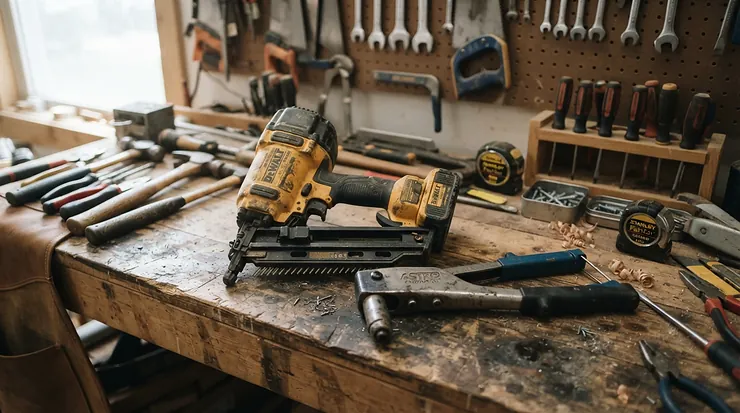
Stand in the trade counter queue at Screwfix on a Saturday morning and you’ll hear the same argument on repeat: battery or hose? It sounds like a small decision. It isn’t. Choosing between a cordless nail gun vs pneumatic nail gun shapes how fast you work, how much you spend on Sundays fixing what a bad tool wrecked, and whether your first fence panel goes up before the tea goes cold.
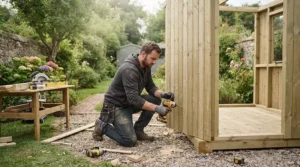
Here’s the short version, because you’re busy: a cordless nail gun runs on a battery (or a battery-plus-gas-cell hybrid) and needs nothing else — pick it up, walk to the far end of the garden, start nailing. A pneumatic nail gun is lighter and cheaper to buy but is tethered to an air compressor by a hose, which means power and reach live wherever that compressor and its lead can go. 🔋 vs 🌬️ — that’s the whole fight in two emojis, but the details underneath decide who wins for your project.
This guide walks through seven real nail guns available in the UK, spanning budget pneumatic brad nailers through to premium cordless framing tools, with honest analysis of where each earns its keep — flooring, fencing, skirting, or first-fix framing.
What is a cordless nail gun vs pneumatic nail gun? A cordless nail gun drives fasteners using an onboard battery (sometimes paired with a gas cell), needing no compressor or hose. A pneumatic nail gun uses compressed air delivered through a hose from a separate air compressor, trading portability for a lighter tool body and lower upfront cost.
Quick Comparison Table
| Factor | Cordless Nail Gun | Pneumatic Nail Gun |
|---|---|---|
| Upfront cost | Higher (£250–£900) | Lower (£70–£670, but add a compressor) |
| Portability | Excellent — no hose | Limited by hose length and compressor location |
| Power consistency | Very good, tapers as battery drains | Consistent, tied to compressor PSI |
| Running costs | Batteries, gas cells | Compressor electricity, hose/fittings wear |
| Best for | Fencing, first-fix, remote sites | High-volume second fix, workshop use |
The headline takeaway is that a cordless nail gun wins hands-down on freedom of movement, which matters enormously on a fence line that runs the length of a 30-metre garden. A pneumatic nail gun, on the other hand, tends to be the cheaper way into nailing if you already own or can borrow a compressor, and it never runs flat mid-shift. Where budget is tight and the job is stationary — say, laying an engineered floor in one room — the maths tips firmly toward air.
An honest comparison like this only works because of independent data on tool vibration and noise — see the HSE’s guidance on nail gun hazards for the safety side of that equation.
💬 Just one click — help others make better buying decisions too!😊
Top 7 Cordless and Pneumatic Nail Guns: Expert Analysis
We’ve spread this list across budget, mid-range and premium options, and across both power sources, so whatever your job — decking, fencing, skirting boards or subfloor — there’s a genuine, currently-available UK product here rather than a generic “best pick” placeholder.
1. DeWalt DCN660D2-GB — best cordless nail gun for flooring and second fix
The standout here is that this is a genuinely gasless, brushless cordless nailer, which means no fuel cells to buy and no cold-start stutter on a January morning. It fires 16-gauge nails from 32mm to 63mm, which covers everything from skirting boards to thicker architrave, and the twin 2.0Ah batteries supplied give roughly 1,200 shots per charge according to the manufacturer’s figures.
What most buyers overlook about a gasless cordless nailer is that mechanical drive (rather than combustion) means consistent power output whether it’s a scorching July afternoon or a frosty site visit in February — gas-powered rivals lose punch in the cold. Based on the spec comparison with combustion-driven alternatives, this makes the DeWalt DCN660D2-GB the safer pick for anyone doing regular indoor second-fix and flooring trim work through the UK’s unpredictable seasons.
Reviewers consistently report smooth, low-kickback firing and praise how quietly it runs next to older pneumatic guns, with several noting the nail sits flush without leaving hammer marks on the surrounding timber — a detail that matters when the client is watching you finish their new skirting.
Pros:
- ✅ Gasless brushless motor — no fuel cells, consistent cold-weather power
- ✅ Bump and sequential firing modes for speed or precision
- ✅ Compatible with the wider DeWalt 18V XR battery platform
Cons:
- ❌ Heavier than a comparable pneumatic finish nailer over a full shift
- ❌ Higher upfront cost than a Tacwise-style budget compressor gun
In the mid-£400s as a two-battery kit, the DeWalt DCN660D2-GB justifies its price for anyone doing flooring and trim work weekly rather than once a year — the battery platform crossover with other DeWalt tools sweetens the long-term value.

2. Makita DBN601ZJ — quietest cordless nailer for indoor finish work
This nailer’s party trick is a pneumatic-spring drive system inside a fully cordless body, meaning it delivers the smooth, consistent strike of an air tool without a hose in sight. It handles 16-gauge straight brads from 19mm to 64mm at up to 3.3 nails per second, which is quick enough for production skirting and architrave runs.
The brushless motor and internal air-spring mechanism mean the depth of drive stays consistent shot after shot, rather than tailing off as many purely mechanical cordless nailers can toward the end of a charge. What the spec sheet won’t tell you, but reviewers note, is that the slim nose profile makes it noticeably easier to work into internal corners than bulkier rivals — a genuine advantage when scribing around door architraves.
This is a body-only tool, so factor in an 18V LXT battery and charger if you’re not already inside the Makita ecosystem; that’s the trade-off for buying into one of the more refined cordless mechanisms on the market.
Pros:
- ✅ Pneumatic-spring drive gives air-tool-smooth firing without a hose
- ✅ Slim nose reaches tight internal corners easily
- ✅ Anti-dry-fire mechanism prevents blank shots that can mark timber
Cons:
- ❌ Sold body-only — battery and charger are a separate cost
- ❌ Narrower nail range than the DeWalt at the top end (max 64mm)
Priced around £400 body-only, the Makita DBN601ZJ rewards existing Makita 18V users far more than someone starting from scratch, where the true cost climbs quickly.
3. Paslode IM360Ci — best cordless nail gun for fencing and first fix
Nothing else on this list drives a 90mm nail without a hose, which is exactly why the Paslode IM360Ci owns the fencing and first-fix category. It combines a small gas fuel cell with a lithium battery to fire nails from 50mm to 90mm — the range you actually need for fence posts, rails, joists and stud work — at up to three nails per second.
Based on the spec comparison with mechanical cordless nailers, the gas-and-battery combination is what allows this tool to punch that hard without the bulk of a full pneumatic compressor rig. Reviewers consistently flag the cold-weather performance, rated to work down to -15°C, as the standout for outdoor jobs that don’t stop for a British winter, and the “Start & Go” motion sensor is repeatedly praised for stopping the battery draining when the tool is set down between fence panels.
This is the nailer contractors reach for on a fencing job precisely because there’s no compressor to drag down a muddy garden — you carry it, the fuel cell and a spare battery, and that’s the whole kit.
Pros:
- ✅ Drives long 50–90mm nails — proper first-fix and fencing power
- ✅ Rated to work down to -15°C, unusual for a gas tool
- ✅ No compressor or hose needed anywhere on site
Cons:
- ❌ Ongoing cost of gas fuel cells alongside battery charging
- ❌ Heavier in the hand than the finer second-fix nailers above
At around £450–£600, the Paslode IM360Ci sits at the premium end, but for anyone regularly building fence panels, sheds or timber frames, the time saved not running air lines more than earns back the difference.
4. Senco S900FN SemiPro — best budget pneumatic nailer for fencing
The standout feature here is price: this pneumatic framing nailer drives nails up to 90mm — proper fencing and sub-floor length — for a fraction of what a cordless equivalent costs. It runs on standard shop air between 4.8 and 8.3 bar and includes a restrictive trigger for safer semi-professional use.
Here’s what the spec sheet doesn’t quite convey: because this is a SemiPro range tool rather than a full production framer, the trigger action is deliberately more cautious, which is exactly right for someone fencing their own garden a couple of weekends a year rather than framing houses daily. Based on the spec comparison with premium framing nailers, you’re trading outright cycle speed for a genuinely accessible price point.
Aggregated reviewer sentiment from trade suppliers consistently describes this as reliable “for the money,” with the caveat that heavy daily professional use will wear it faster than the SN90CXP further down this list — a fair trade at roughly a third of the price.
Pros:
- ✅ Drives fencing-length nails up to 90mm for a budget price
- ✅ Restrictive trigger adds a safety margin for occasional users
- ✅ Includes carry case, safety glasses and oil
Cons:
- ❌ Requires an air compressor capable of sustained 4.8–8.3 bar
- ❌ Not built for continuous daily professional-grade cycle rates
Around the £145–£175 mark, the Senco S900FN SemiPro is the clearest “budget pneumatic” answer to the fencing brief in this whole line-up — provided you already have, or are prepared to buy, a compressor.
5. Senco SN90CXP — premium pneumatic nailer for heavy fencing and framing
This is the professional step up from the S900FN: a 34-degree clipped-head framing nailer built for daily first-fix, fencing and sub-floor work, weighing a comparatively light 3.4kg for a tool in this power class. It’s engineered to use less air per shot than rival framers while still driving the full 50–90mm nail range.
What most buyers overlook about air consumption figures is how much they matter on a busy site — a nailer that sips air lets a smaller compressor keep multiple tools running, whereas a thirsty framer can leave you waiting for pressure to rebuild between bursts. Reviewers consistently highlight the saw-tooth safety nose, which grips angled timber securely during toe-nailing on fence rails, and the low-profile body that slips neatly between studs and joists.
The five-year warranty is a genuine signal of build confidence from Senco, and it’s the detail that tips this toward tradespeople doing fencing and framing as a core part of their week rather than the odd weekend project.
Pros:
- ✅ Lower air consumption than most rivals in its power class
- ✅ Saw-tooth nose grips angled timber for accurate toe-nailing
- ✅ Backed by a five-year manufacturer warranty
Cons:
- ❌ Needs a 3/8″ air fitting and a compressor to match its output
- ❌ Higher price than the SemiPro range for occasional users
Sitting around £560–£670, the Senco SN90CXP is for the fencing contractor who nails hundreds of rails a month and needs a tool that won’t flinch, not the once-a-summer DIYer.
6. Tacwise DGN50V — best budget pneumatic brad nailer for general jobs
At its core, this is the entry point into pneumatic nailing: an 18-gauge brad nailer firing 20–50mm nails, weighing just 1.2kg, running on ordinary 60–100 PSI shop air. It’s aimed squarely at second-fix jobs — skirting, sub-flooring, panelling and light fencing trim — rather than structural framing.
The spec sheet lists an 86dBA noise rating, and here’s what that means in practice: it’s loud enough to want ear defenders for extended indoor use, but broadly in line with most pneumatic brad nailers at this size, so it isn’t an outlier to worry about. Based on the spec comparison with the Senco framing tools above, this is deliberately a lighter, faster-handling nailer for finer work rather than heavy structural fixings — the two categories aren’t really in competition, they’re complementary.
Aggregated seller and buyer feedback across UK trade retailers consistently rates this as reliable “for the price,” which, at under £110, is a genuinely low bar to clear for a DIYer testing the water with pneumatic tools before committing to a bigger purchase.
Pros:
- ✅ Very low price point for a genuine pneumatic nail gun
- ✅ Lightweight 1.2kg body reduces fatigue on long sessions
- ✅ 360° adjustable exhaust keeps air away from your face
Cons:
- ❌ Limited to 50mm nails — no structural or fencing capacity
- ❌ Requires buying or borrowing a compressor separately
At roughly £70–£110, the Tacwise DGN50V is the sensible starting point for anyone who wants to try pneumatic nailing without committing serious money upfront.
7. Tacwise DFN50V — best budget pneumatic finish nailer for flooring and skirting
This 16-gauge finish nailer is the natural step up from the DGN50V when you need a slightly heavier nail for structural trim work like skirting boards, sub-flooring and door frames, firing 20–50mm nails from a 100-brad magazine. At 1.7kg it remains comfortable for overhead and extended horizontal work.
The 16-gauge nail is genuinely the meaningful upgrade over 18-gauge brads here — it holds better in engineered flooring underlay and thicker skirting, where a finer 18-gauge pin can flex or bend on tougher timber. Reviewers consistently describe the bump-fire mode as a real time-saver on long skirting runs, letting a confident user tap along a wall far faster than sequential single-shot firing.
Because it needs 70–120 PSI rather than the DGN50V’s lower range, double-check your compressor’s output before buying — an undersized compressor will leave this nailer underpowered and prone to under-driving nails, which is the single most common complaint in budget pneumatic setups.
Pros:
- ✅ 16-gauge nails hold better in flooring and thicker skirting
- ✅ Bump-fire mode speeds up long straight runs
- ✅ Compact 1.7kg body suited to overhead and trim work
Cons:
- ❌ Needs higher PSI (70–120) than the entry-level DGN50V
- ❌ Not rated for structural fencing or framing nails
At around £100–£130, the Tacwise DFN50V rounds out this line-up as the best-value flooring and skirting companion for anyone who already has a compressor from the DGN50V or elsewhere.
Top 7 Products at a Glance
| Product | Type | Nail range | Price range | Best for |
|---|---|---|---|---|
| DeWalt DCN660D2-GB | Cordless | 32–63mm | £420–£460 | Flooring & second fix |
| Makita DBN601ZJ | Cordless | 19–64mm | £380–£410 | Skirting & trim |
| Paslode IM360Ci | Cordless (gas+battery) | 50–90mm | £450–£600 | Fencing & first fix |
| Senco S900FN | Pneumatic | 50–90mm | £145–£175 | Budget fencing |
| Senco SN90CXP | Pneumatic | 50–90mm | £560–£670 | Pro fencing & framing |
| Tacwise DGN50V | Pneumatic | 20–50mm | £70–£110 | Budget general use |
| Tacwise DFN50V | Pneumatic | 20–50mm | £100–£130 | Budget flooring/skirting |
Look closely and a pattern emerges: the Paslode IM360Ci and the DeWalt DCN660D2-GB dominate the cordless end because there’s simply less UK choice at 18V-and-up nail length than there is in pneumatic, where Tacwise and Senco compete hard on price. If budget is the deciding factor and you already own or can hire a compressor, the Tacwise DGN50V or Senco S900FN deliver real trade capability for a fraction of the cordless spend — but neither matches the untethered freedom of the Paslode IM360Ci on a sprawling fence line.
Best Cordless Nail Gun for Flooring
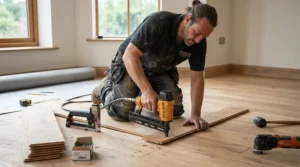
If flooring and skirting are your bread and butter, the decision narrows fast. The DeWalt DCN660D2-GB and Makita DBN601ZJ both sit in a sweet spot: light enough to hold overhead for hours of skirting, precise enough not to blow through engineered flooring boards, and free of any hose to trip over while you’re on your knees fitting boards.
Here’s the practical distinction reviewers keep circling back to — the DeWalt DCN660D2-GB ships as a complete kit with two batteries, so you’re rarely waiting on charge, while the Makita DBN601ZJ is body-only and leans on its pneumatic-spring internals for a smoother strike, which flooring fitters particularly value on delicate pre-finished boards where a harsh mechanical strike can leave a visible dimple. What most buyers overlook is that flooring nail guns need consistent, repeatable depth control far more than raw power — both tools deliver that through thumbwheel depth adjusters rather than trial and error.
For engineered or solid wood flooring specifically, pair either nailer with the correct flooring cleats rather than generic brads; using the wrong fastener profile is one of the more common — and completely avoidable — causes of squeaky floors reported in flooring forums.
Best Cordless Nail Gun for Fencing
Fencing asks something different of a tool: longer nails, more power per shot, and total freedom to walk the length of a boundary without dragging equipment behind you. That’s precisely where the Paslode IM360Ci earns its premium price tag over anything else on this list.
Based on the spec comparison, no cordless competitor currently on the UK market matches its 50–90mm nail range without resorting to a full pneumatic rig, which is why professional fencing contractors consistently choose it over battery-only alternatives that top out around 64mm. The trade-off, and it’s a genuine one, is the ongoing cost of gas fuel cells — something to weigh against how many fence panels you’re actually planning to put up.
If your fencing needs are occasional rather than professional — one garden, a few panels a year — a budget pneumatic option like the Senco S900FN paired with a portable compressor can work out considerably cheaper over a lifetime, provided you don’t mind running a hose across the lawn. It’s a genuine trade-off between upfront convenience and long-term running cost.
Compressor and Hose Setup: What Pneumatic Guns Actually Need
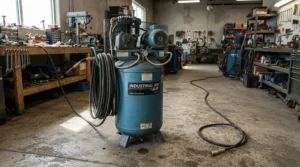
Buying a pneumatic nailer is only half the purchase — you need a compressor, hose, fittings and, usually, an inline oiler and regulator to run it properly, and skipping this step is the single most common mistake first-time buyers make.
For the Tacwise DGN50V and DFN50V, a small 6–24 litre portable compressor delivering the required 60–120 PSI is plenty; these tools sip air compared to structural framers. The Senco S900FN and SN90CXP need more sustained flow given their higher power draw at 4.8–8.3 bar, so a larger tank (24 litres or more) avoids the frustrating pressure-drop stutter mid-job that under-driven nails often trace back to.
Hose length matters just as much as compressor size. A 10-metre hose lets you work a reasonable radius around the compressor, but anything beyond that starts to introduce pressure loss, particularly with narrower-bore hoses. Buy the widest bore hose your budget allows, keep couplings tight, and always check the compressor’s PSI output against the tool’s stated operating range before you buy either one — mismatched kit is a recurring, entirely preventable headache.
✅ Quick setup checklist:
- Confirm your compressor’s PSI range covers the nailer’s stated minimum and maximum
- Use a hose rated for the compressor’s maximum pressure, not just the nailer’s
- Fit an inline regulator if running multiple tools off one compressor
- Add a water trap/filter — condensation in the line causes misfires and rust
Job Site Portability: Cordless vs Pneumatic
This is where the cordless nail gun vs pneumatic nail gun debate really gets decided for most buyers. Picture two identical fencing jobs: one contractor carries the Paslode IM360Ci, a spare battery and a fuel cell in a tool bag and starts nailing the moment they arrive. The other has to first unload a compressor, find a power source or generator, run out a hose, and only then start work — and repeat the whole process every time they move more than a hose-length away.
Reviewers consistently flag this exact scenario as the deciding factor for outdoor and remote work: attics, roof spaces, scaffolding, and anywhere without easy mains power all favour cordless tools heavily. On the other hand, for stationary indoor work — a workshop bench, a single room being fitted out — a pneumatic nailer’s lighter tool body (since the motor and power source live in the separate compressor) can actually reduce arm fatigue over a long shift, because you’re swinging less weight per shot.
The honest answer is that “portability” means different things depending on the job. If you’re moving constantly, cordless wins outright. If you’re anchored to one spot for hours, pneumatic’s lighter gun-in-hand can be the more comfortable choice.
Cost of Consumables: Batteries, Gas Cells and Fuel vs Air
Sticker price only tells half the story, and this is the section that most buying guides skip. A cordless nailer’s running costs are batteries (which degrade over 500–1,000 charge cycles) and, for gas-hybrid tools like the Paslode IM360Ci, ongoing fuel cell purchases — typically bundled with nail packs, so the true cost per shot is a little higher than nails alone.
A pneumatic nailer’s consumables are simpler on paper — just nails — but the hidden cost is electricity to run the compressor and the wear on hoses, couplings and the compressor itself over years of use. Based on the spec comparison across this list, high-volume users driving thousands of fasteners a month will typically find pneumatic tools cheaper per shot over the tool’s lifetime, since there’s no battery degradation curve to factor in and compressed air itself is inexpensive to generate.
For occasional users, the maths flips: a cordless tool that sits unused for months holds its charge and its readiness far better than a compressor that needs draining, checking for rust, and servicing between jobs. Reviewers consistently note that neglected compressors are a common source of frustration precisely because they’re the part of the pneumatic setup most likely to be forgotten about between projects.
How to Choose Between a Cordless and Pneumatic Nail Gun
- Work out your nail length needs first. Fencing and framing need 50–90mm capability; flooring and skirting rarely need more than 64mm — this alone rules out several tools instantly.
- Check what you already own. If a compressor is already sitting in your shed, pneumatic tools become dramatically cheaper to add; if not, factor that cost into any pneumatic purchase.
- Be honest about how far you’ll roam. A fence line, a roof space, or scattered outbuildings all favour cordless; a single room or workshop bench favours pneumatic.
- Weigh usage frequency against running costs. Daily professional use tends to favour pneumatic’s lower cost-per-shot; occasional DIY use tends to favour cordless’s always-ready convenience.
- Match battery platforms where possible. If you already own 18V DeWalt or Makita batteries, a same-brand cordless nailer avoids buying a whole new charging ecosystem.
- Factor in noise tolerance. Compressors add their own running noise on top of the nailer itself, which matters for residential or noise-sensitive sites.
- Budget for the whole kit, not just the gun. A cheap pneumatic nailer plus a compressor, hose and fittings can quietly end up costing more than a mid-range cordless tool.
Common Mistakes When Buying a Nail Gun
The most frequent error, by a wide margin, is buying a pneumatic nailer without checking it against the compressor’s actual output — a mismatch between the tool’s required PSI and what the compressor delivers leads to under-driven nails and constant frustration. A close second is underestimating nail length needs: buying an 18-gauge brad nailer for fencing work, discovering it can’t drive past 50mm, and having to buy again.
On the cordless side, the recurring mistake is buying body-only tools like the Makita DBN601ZJ without pricing in a battery and charger, which can add £80–£150 to the real cost. Reviewers consistently warn against assuming all nail gauges are interchangeable between brands — nail collation angles and shank sizes vary, and using the wrong fastener pack in the wrong magazine is a common source of jams.
Finally, plenty of buyers skip reading the nail range on the box entirely, then find their chosen tool won’t drive the specific fastener length their project calls for — always cross-check nail length against the job before, not after, purchase.
Practical Usage Guide: Setting Up and Maintaining Your Nail Gun
Getting the first thirty days right sets the tone for years of reliable service. Before first use, on pneumatic tools, add a few drops of pneumatic tool oil to the air inlet if the manufacturer specifies an oil-required model (some, like the Tacwise range, are designed to run oil-free — check first, since over-oiling an oil-free tool causes its own problems). On cordless tools, fully charge the battery before first use rather than partially charging, which helps establish accurate battery-life readings from the start.
Load nails according to the manufacturer’s diagram exactly — loading upside down or at the wrong angle is a leading cause of first-week jams. Test-fire into scrap timber of the same type you’ll be working with, adjusting the depth wheel until the nail head sits flush without denting the surrounding surface; this single step avoids the majority of early “the nail’s too deep/too shallow” complaints.
Maintenance-wise, wipe down the nose and magazine weekly on job sites with sawdust exposure, check hose fittings on pneumatic tools for leaks (a hissing sound is your cue), and store cordless batteries at roughly 40–60% charge if the tool will sit unused for more than a month, which extends battery lifespan considerably. A common first-30-days mistake is leaving a pneumatic nailer connected to a pressurised hose overnight — always disconnect and bleed the line before packing up.
Real-World Scenario: Which Nailer Suits Your Project
The weekend fence-builder. Replacing six fence panels over two Saturdays, working alone, no existing compressor. The Senco S900FN SemiPro paired with a modest portable compressor gets the job done for well under half the cost of a cordless equivalent — and since the whole project wraps in a weekend, the lack of portability barely registers.
The flooring fitter working solo across multiple homes. Laying engineered flooring in a different client’s house most days, no fixed workshop. The DeWalt DCN660D2-GB removes the daily hassle of loading a compressor into the van, unloading it, running hoses across someone’s living room floor, and packing it all away again — cordless convenience pays for itself in saved setup time alone.
The professional fencing contractor. Installing close-board fencing for multiple clients weekly, often on properties with no power access. The Paslode IM360Ci is close to unavoidable here — the combination of long nail capacity and complete cordless freedom across muddy, powerless gardens is exactly the scenario this tool was engineered for, and the fuel cell running cost is easily absorbed into a professional day rate.
Safety and Regulations Guide
Nail guns, cordless or pneumatic, are not toys, and UK guidance treats them accordingly. The Health and Safety Executive publishes specific guidance on nail gun hazards, covering everything from accidental discharge risk to hand-arm vibration exposure limits under the Control of Vibration at Work Regulations — genuinely worth a read before regular professional use, and available directly via the HSE’s nail gun safety page.
Always use eye protection rated to EN166, and consider hearing protection for pneumatic tools given the 82–97dBA noise levels reported across the products in this guide. Sequential trigger mode (fire one nail per pull, rather than bump-fire) is the safer default for anyone new to a tool, since bump-fire’s speed comes with a genuinely higher risk of accidental double-fires.
If your fencing project involves a boundary fence over 2 metres — or over 1 metre next to a road — you may need planning permission; the rules are laid out clearly on the Planning Portal’s fencing and walls guidance, and it’s worth checking before you start nailing panels that might later need to come down. For general background on how these tools work mechanically, Wikipedia’s nail gun entry is a solid, neutral starting point.

Frequently Asked Questions
❓ Is a cordless nail gun as powerful as a pneumatic one?
❓ Do I need a compressor for a pneumatic nail gun?
❓ What size nail gun do I need for fencing?
❓ Are cordless nail guns worth the extra cost?
❓ How long do nail gun batteries last?
Conclusion
There’s no single winner in the cordless nail gun vs pneumatic nail gun debate — only the right tool for where you’re actually standing when you pull the trigger. For fencing, first-fix, and anywhere power or space is scarce, the Paslode IM360Ci and its cordless rivals earn their premium price through sheer freedom of movement. For flooring, skirting, and stationary indoor work, budget pneumatic options like the Tacwise DGN50V and Tacwise DFN50V deliver genuine trade-grade results without the cordless price tag, provided you’ve got — or are willing to buy — a compressor to match.
The honest advice, after weighing all seven of these tools against real specs and real reported experience, is to buy for the job you do most often, not the job you might do once. A weekend fencer doesn’t need a £600 cordless framer any more than a daily flooring fitter needs to be dragging a compressor across someone’s new engineered oak boards. Match the tool to the task, check your compressor’s PSI before you buy anything pneumatic, and budget for consumables on either side of the debate — nails are never the whole story.
Recommended for You
- Cordless Nail Gun For Skirting Boards: 7 Proven Picks (2026)
- Cordless Orbital Sander For Car Bodywork: 7 Best Picks (2026)
- Detail Sander for Tight Corners: 7 Picks UK Buyers Rate (2026)
Disclaimer: This article contains affiliate links. As an Amazon Associate, I earn from qualifying purchases. If you purchase products through these links, we may earn a small commission at no additional cost to you.
✨ Found this helpful? Share it with your friends! 💬🤗
