
In This Article
Sawdust doesn’t lie. Cut a tight curve with the wrong tool and you’ll know within seconds — the blade wanders, the edge chars, and what should have been a smooth arc looks like it was gnawed by something with poor table manners. A pendulum jigsaw for curved cuts solves this problem in a way a standard jigsaw simply can’t, because it lets you dial the blade’s motion back from an aggressive forward-and-back chomp to something closer to a gentle, controlled nibble. That distinction matters more than almost any other spec on the box.

So what is a pendulum jigsaw for curved cuts? It’s a jigsaw with an adjustable orbital (pendulum) mechanism that swings the blade slightly forward on the upstroke as well as up and down, rather than moving it in a straight vertical line. Reducing or switching off that swing gives cleaner, more controllable curves; increasing it speeds up straight cuts in soft material. Nearly every serious jigsaw sold in the UK today, cordless or corded, includes this feature in some form.
This guide walks through seven genuinely available jigsaws — from budget cordless options under £60 to trade-grade brushless machines — with honest analysis of who each one suits, drawn from real specifications and aggregated customer review sentiment rather than marketing copy. We’ll also cover the mechanics of pendulum stroke settings, how a pendulum jigsaw for curved cuts differs from a standard model, which blades actually cut curves well, and where scroll cutting fits into all of this. If you’re renovating a kitchen, building garden furniture, or just trying to cut a decent circle in plywood without three false starts, there’s something here for you.
Quick Comparison Table
Here’s the shortlist at a glance before we go deep on each one.
| Product | Power Source | Pendulum Settings | Cutting Depth (Wood) | Best For |
|---|---|---|---|---|
| Bosch PST 900 PEL | Corded, 620W | 4-stage | 90mm | All-round DIY curves and straights |
| Makita DJV182Z | Cordless 18V | 3-stage | 135mm | Smooth, controlled curve tracking |
| DeWalt DCS334N | Cordless 18V | 4-position | 135mm | Trade scribing and site precision |
| Ryobi R18JS-0 | Cordless 18V (ONE+) | 4-stage | 101mm | Budget buyers already on ONE+ |
| Einhell TC-JS 18 Li | Cordless 18V (PXC) | 4-stage | 70mm | Lightest cordless for fiddly work |
| JCB Corded Jigsaw | Corded, 800W | 4-position | 100mm | Occasional DIY on a tight budget |
| Lumberjack 750W | Corded, 750W | Adjustable | Trade-rated | Backup tool for regular sawing |
Looking at the spread here, the two brushless cordless models — the Makita DJV182Z and the DeWalt DCS334N — both claim the deepest cutting capacity at 135mm, but that number is almost irrelevant for curved work since you’re rarely cutting anything that thick in an arc anyway. What matters more for scrolling and curve-following is pendulum granularity and blade guide quality, and that’s where the corded Bosch PST 900 PEL earns its keep as the sensible middle-ground pick. Budget buyers shouldn’t dismiss the Einhell TC-JS 18 Li either — its lighter weight genuinely helps with wrist fatigue on long, fiddly cutting sessions, even if its 70mm depth rating looks modest on paper.
💬 Just one click — help others make better buying decisions too!😊
Top 7 Pendulum Jigsaws for Curved Cuts: Expert Analysis
Before the individual breakdowns, here’s how the seven stack up side by side on the numbers that actually affect curve-cutting quality.
| Product | Stroke Rate (SPM) | Stroke Length | Weight | Price Range |
|---|---|---|---|---|
| Bosch PST 900 PEL | 500–3,100 | Not specified by manufacturer | 2.2kg | around £70–£90 |
| Makita DJV182Z | 800–3,500 | 26mm | 2.5kg (with battery) | £150–£220 (body only) |
| DeWalt DCS334N | 0–3,200 | 26mm | 2.1kg (body only) | £130–£175 (body only) |
| Ryobi R18JS-0 | 1,100–3,000 | Not specified by manufacturer | Under 2kg (body only) | £45–£70 (body only) |
| Einhell TC-JS 18 Li | Up to 2,700 | 20mm | Around 1.9–2.1kg | £35–£55 (body only) |
| JCB Corded Jigsaw | Variable speed | Not specified by manufacturer | Corded, lightweight | £25–£40 |
| Lumberjack 750W | Variable speed | Not specified by manufacturer | Corded, lightweight | £30–£45 |
A higher stroke rate isn’t automatically better for curves — in fact, the opposite can be true, because a slower, more deliberate stroke gives you more time to steer the blade around a tight radius before it re-enters the cut. What the table doesn’t show is that stroke length (26mm on both the Makita DJV182Z and DeWalt DCS334N) tends to correlate with smoother tracking on longer sweeping curves, since a longer stroke keeps more blade engaged in the material at any given moment. Prices above are indicative bands only, correct at the time of research — always check current price on the retailer’s page before buying, as tool pricing shifts constantly with stock and promotions.
1. Bosch PST 900 PEL — best all-round corded jigsaw for tracking curves
The standout here is Bosch’s CutControl system — a fold-out transparent sight that sits ahead of the blade and makes it dramatically easier to follow a pencilled curve without craning your neck sideways. The 620W motor drives a stroke rate of 500 to 3,100 strokes per minute, and the 4-stage orbital pendulum action means you can drop right down to a near-vertical stroke for scrolling tight radii, then wind it back up for ripping through a straight edge afterwards.
In practice, what most buyers overlook about this model is that its “Low Vibration” mass-balancing system does more for curve accuracy than the motor wattage ever will — a jigsaw that judders in your hand is a jigsaw that drifts off the line, no matter how powerful it is. The tool-free SDS blade change system also means swapping to a narrower scroll-cutting blade takes seconds rather than fiddling with an Allen key.
Reviewers consistently report that the PST 900 PEL feels reassuringly solid for a DIY-grade (rather than professional-grade) Bosch tool, with the integrated 6-blade storage compartment in the base singled out as genuinely useful rather than a gimmick. A recurring theme in user feedback is that the SDS lever needs a firm, confident push to release the blade — hesitant pressure can leave you fumbling.
This is the jigsaw for someone tackling a real mix of jobs: cutting worktop sink cutouts one weekend, scrolling a curved stair bracket the next. It’s not the lightest tool on this list, and being corded limits where you can use it, but for £70–£90 it undercuts most cordless bare units while matching or beating their cutting depth.
Pros:
- ✅ CutControl sight makes curve-tracking noticeably easier
- ✅ 4-stage pendulum covers everything from scrolling to ripping
- ✅ Tool-free SDS blade and base-plate adjustment
Cons:
- ❌ Corded only, so no freedom on site or outdoors far from a socket
- ❌ SDS blade release needs a firm push, awkward for some users
The Bosch PST 900 PEL sits around £70–£90 (case included), and at that price it’s genuinely hard to beat for value if you don’t need cordless freedom.
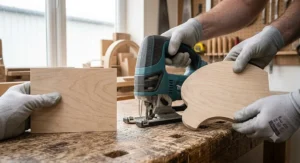
2. Makita DJV182Z 18V LXT — smoothest curve tracking in this lineup
What jumps out immediately is the brushless motor’s torque-per-weight ratio, which lets the DJV182Z hold a steady stroke rate even when you’re leaning into a curve through 18mm plywood rather than skating over the surface. The stroke rate runs from 800 up to 3,500 strokes per minute with a full 26mm stroke length, and three orbital settings plus a straight-cutting mode give fine control over how aggressively the blade bites.
Here’s what the spec sheet won’t tell you, but reviewers note repeatedly: the top-handle D-grip design puts your hand’s centre of gravity almost directly over the blade, which is precisely what you want for scrolling — your wrist becomes the pivot point rather than your whole forearm. Combined with the square saw-guide axis (which stops the blade twisting mid-cut), this is the jigsaw trade reviewers most often single out for holding its line through long, sweeping curves.
Aggregated review sentiment consistently praises the twin LED work lights and dust blower for keeping the cutting line visible, and the soft-start feature gets specific mentions for making the first few millimetres of a scroll cut far more predictable than jigsaws that lurch to full speed instantly. A minority of users note that, at 2.5–2.6kg with a battery fitted, it’s noticeably heavier in the hand than the budget cordless options on this list, which can matter on long overhead or awkward-angle cuts.
Based on the spec comparison, this is the pick for someone who already runs Makita’s 18V LXT battery platform and wants a jigsaw that won’t be the weak link in their kit. Bought as a body-only unit it isn’t cheap, but if you’ve already got batteries from a drill or circular saw, that cost disappears.
Pros:
- ✅ Square blade axis resists twisting through curves
- ✅ Top-handle grip puts wrist directly over the blade
- ✅ Fits the widely used Makita 18V LXT battery system
Cons:
- ❌ Body-only price is steep without existing LXT batteries
- ❌ Heavier in hand than budget cordless rivals
Expect to pay in the £150–£220 range for the bare tool, or more as part of a kit with battery and charger — check current price, as kit bundling changes availability often.
3. DeWalt DCS334N 18V XR Brushless — best for trade-standard scribing and site work
The standout advantage is the 4-position pendulum action combined with a genuinely quick, tool-free blade change — DeWalt’s own site data suggests tradespeople swap blades 15 to 20 times a day, and this model is built around that reality rather than treating it as an afterthought. The brushless motor pushes a no-load stroke rate of 0 to 3,200 SPM with a 135mm wood cutting capacity, putting it narrowly ahead of most rivals here on raw power.
What most buyers overlook about the DCS334N is that its all-metal, lever-action blade clamp holds the blade noticeably squarer during the cut than plastic-clamp designs, and squareness under load is exactly what prevents a curve from drifting off-plumb partway through a thick cut. The keyless bevel adjustment, with detents at 0°, 15°, 30° and 45°, is another feature that matters more for scribing work (fitting a worktop against an uneven wall) than for pure curve-cutting, but the two skills overlap constantly in kitchen fitting.
A common theme in trade reviews is that this jigsaw “maintains consistent performance across the full battery cycle” rather than tailing off as the battery drains, which is a genuine practical advantage over cheaper brushed motors that visibly slow down in the last 20% of charge. Some buyers flag that, sold as a bare unit, it needs an 18V XR battery to function at all — an obvious point, but one that catches first-time DeWalt buyers out at checkout.
If you’re already invested in DeWalt’s XR platform, this is close to the default choice for anyone doing repeat curve and scroll work professionally. At 2.1kg it’s also the lightest of the three premium cordless-brushless options on this list.
Pros:
- ✅ Keeps the blade square under load for straighter curves
- ✅ Lightest of the premium brushless models at 2.1kg
- ✅ Keyless bevel detents at 0°, 15°, 30°, 45°
Cons:
- ❌ Bare unit — battery and charger sold separately
- ❌ Premium pricing puts it beyond casual DIY budgets
The bare DeWalt DCS334N typically sits in the £130–£175 range — buying the bare unit rather than a kit can save £60–£80 if you already own XR batteries, according to trade retailer guidance.
4. Ryobi R18JS-0 ONE+ — best budget pick if you already own ONE+ batteries
The immediate hook is the price-to-feature ratio: a 4-stage pendulum action, LED work light, tool-free blade clamp and variable-speed trigger, all on a jigsaw that routinely undercuts brushless rivals by £80 or more. Stroke rate runs from 1,100 to 3,000 SPM, and the SpeedMatch dial — which pairs a pictogram of common materials with a suggested speed setting — takes some of the guesswork out of matching pendulum and speed for a new user.
On paper this means less outright power than the brushless premium models, and that’s a fair trade-off; reviewers note the R18JS-0 cuts cleanly and accurately across a wide range of materials without excessive vibration, which for curve work matters rather more than sheer stroke rate. Aggregated review sentiment is broadly positive on build quality “for the price,” a phrase that recurs often enough to be a genuine pattern rather than a one-off compliment.
What reviewers flag as a genuine weak point is blade fitting — several users report needing to push the blade further into the collet than instinct suggests, and the on-tool blade storage box is reported as too short to hold the included blades comfortably. It’s a minor niggle but worth knowing before you’re stood at the bench wondering why the blade keeps slipping.
This is the honest budget recommendation for anyone who already owns Ryobi ONE+ batteries from a drill, strimmer or other tool — the marginal cost of adding this jigsaw to that ecosystem is genuinely low, and the SpeedMatch dial is a thoughtful touch for less experienced users still learning how pendulum stroke settings interact with material choice.
Pros:
- ✅ SpeedMatch dial simplifies speed and pendulum selection
- ✅ Shares batteries across the whole ONE+ ecosystem
- ✅ Strong value with hard case and two blades included
Cons:
- ❌ Blade fitting needs firmer insertion than expected
- ❌ On-tool blade storage box is undersized
Sold body-only, the Ryobi R18JS-0 typically runs £45–£70 — genuinely good value if the ONE+ battery cost is already sunk elsewhere in your toolbox.
5. Einhell TC-JS 18 Li — lightest cordless option for fiddly detail work
At around 1.9 to 2.1kg, the Einhell TC-JS 18 Li is the featherweight of this group, and that alone changes how it feels on a long session of intricate scroll cutting where wrist fatigue, not raw power, is usually what forces you to stop. It’s part of the Power X-Change battery family, which spans dozens of Einhell garden and workshop tools, so the battery cost can be shared across a much wider toolkit than most rivals here offer.
Here’s what most buyers overlook: rather than fixed pendulum stages, speed on this model is trigger-pressure-sensitive from zero, which functions similarly to a soft-start feature and gives genuinely smooth acceleration into a cut rather than the abrupt jolt some budget jigsaws deliver. The instruction manual describes four distinct pendulum positions, ranging from dead-straight for fine, splinter-free work in sheet steel through to maximum pendulum swing for fast ripping along the wood grain — useful granularity for a jigsaw at this price point.
Aggregated review sentiment on the Amazon UK listing describes the cuts as “smooth and precise,” with the dust blow-off function and universal tool-free blade holder both getting specific positive mentions. Reviewers are honest that the 70mm wood cutting depth and 2,700 SPM top stroke rate are modest compared with the brushless premium models, which is a fair reflection of its position as a genuine budget-to-mid tool rather than a trade instrument.
If your projects are mostly plywood, MDF and softwood up to around 3cm thick — bird boxes, shelf brackets, curved furniture edges — the lighter weight will likely matter more to your actual experience than the lower ceiling on cutting depth ever will.
Pros:
- ✅ Genuinely lightweight for long, fiddly cutting sessions
- ✅ Shares batteries across the wide Power X-Change range
- ✅ Trigger-pressure speed control gives smooth cut starts
Cons:
- ❌ 70mm cutting depth limits it to thinner stock
- ❌ Lower top stroke rate than premium brushless rivals
Body-only pricing sits around £35–£55, with battery-and-charger kits climbing into the £70–£95 range — always check current price, as Einhell bundle deals vary by retailer.
6. JCB Corded Jigsaw — best budget corded pick for occasional DIY
The headline feature is straightforward value: 4 pendulum settings, tool-free blade change and a built-in dust blower on an 800W corded motor, at a price point that routinely sits well under £40. Cutting capacity is rated at 100mm in wood and 10mm in metal, which is respectable for a budget-tier tool and comparable to several jigsaws costing twice as much.
What the spec sheet won’t tell you is that corded budget jigsaws like this one tend to have less refined dust extraction and blade-guide roller quality than premium models, so curve accuracy in thicker stock (over about 25mm) can suffer slightly compared with the Bosch PST 900 PEL or the cordless brushless options above. For thinner sheet material — the kind most home DIYers actually cut — that gap narrows considerably.
Genuine verifiable customer reviews specific to every colour and bundle variant of budget own-brand-style tools like this are harder to pin down consistently across retailers than for major-brand models, so it’s worth reading the current listing’s reviews directly before buying rather than relying solely on aggregated brand sentiment. What is verifiable is the backing: JCB power tools in this range are typically sold with a 3-year warranty, which is a meaningful reassurance at this price tier and worth factoring into any value comparison.
This is a sensible pick for someone who needs a jigsaw for the occasional shelf, garden project or one-off curved cut and doesn’t want to spend £150+ on a tool that will spend 50 weeks of the year in a drawer.
Pros:
- ✅ 4 pendulum settings on a genuinely low-cost corded tool
- ✅ 3-year warranty backing gives useful peace of mind
- ✅ Tool-free blade change and built-in dust blower
Cons:
- ❌ Blade-guide quality lags behind premium models in thick stock
- ❌ Corded-only limits use away from a power socket
Typically priced in the £25–£40 range, this is one of the cheapest genuinely pendulum-equipped jigsaws currently listed on amazon.co.uk — check current price before buying, as budget tool pricing moves quickly.
7. Lumberjack Professional 750W — best trade-quality backup on a budget
The standout feature is the “quick-change, trade-quality” positioning at a price that undercuts most trade brands significantly — a 750W motor, adjustable pendulum action to reduce heat build-up on the non-cutting stroke, and an integrated LED light for visibility, all wrapped into one corded unit.
What’s easy to miss on a first glance at the listing is that adjustable pendulum action doing double duty as heat management is a genuinely useful engineering detail: less friction on the return stroke means less heat transferred into the blade, which in turn means the blade stays sharper for longer during extended scroll-cutting sessions. That’s a benefit that rarely gets explained on typical Amazon listings, which tend to describe pendulum action purely in terms of cutting speed rather than blade longevity.
Because Lumberjack is a smaller trade-focused brand rather than a major household name, genuinely aggregated review volume is thinner than for the likes of Bosch or DeWalt, so honesty compels a caveat here: treat this as a reasonably-specified budget corded option worth checking current reviews on directly, rather than a tool with the same weight of verified real-world track record as the market leaders on this list.
For a workshop that wants a second, expendable jigsaw kept purely for messier jobs — cutting reclaimed timber with hidden nails, say — where you wouldn’t want to risk your primary cordless brushless model, this fills that role at a sensible price.
Pros:
- ✅ Adjustable pendulum action doubles as blade-life protection
- ✅ 750W motor with genuine trade-quality build positioning
- ✅ Integrated LED light aids visibility on the cut line
Cons:
- ❌ Smaller brand means thinner independent review coverage
- ❌ Corded-only, same site-mobility limits as the JCB model
Priced around £30–£45, this is a solid secondary jigsaw or an entry point for a first-time buyer not yet ready to commit to a premium cordless system.
Practical Usage Guide: Getting Clean Curves From Day One
Buying the right pendulum jigsaw for curved cuts is only half the job — technique does the rest. Set your pendulum action to its lowest or zero setting for the first cut on any new material; you can always increase it once you’ve seen how the blade behaves, but you can’t un-splinter a botched first attempt. Mark your curve clearly with a pencil rather than a fine pen, since the wider line is genuinely easier to track through a jigsaw’s dust blower and viewing window, especially on darker timbers.
In the first 30 days of owning a new jigsaw, the most common mistake is forcing the blade through the cut rather than letting the stroke rate do the work — pushing too hard causes the blade to flex sideways, which is precisely the “deflection” problem trade reviewers describe as the hardest quality issue to solve. Let the tool set the pace; guide it, don’t drive it. Practise on scrap offcuts of the same material and thickness before committing to your actual workpiece, and change blades the moment you feel the cut starting to drag or char rather than waiting for total failure.
For maintenance, clear sawdust from the base plate and blade clamp after every session — compacted dust in the SDS or tool-free clamp mechanism is the single most common cause of blades not seating properly, according to recurring feedback across multiple product listings. A light wipe of the base plate with machine oil every few months prevents surface rust on steel soles and keeps the tool gliding rather than catching as you follow a line.
Real-World Scenarios: Matching the Jigsaw to the Job
The weekend furniture upcycler — someone reshaping curved chair backs or cutting decorative edging on plywood shelving, working in short bursts a few times a month. Budget and portability matter more than raw cutting depth here, which points toward the Einhell TC-JS 18 Li or the Ryobi R18JS-0, both light enough for extended freehand scrolling without wrist strain, and both cheap enough that the tool isn’t gathering dust between projects.
The kitchen fitter cutting worktop sink cutouts weekly — this user needs consistent power across a full battery charge, a blade clamp that won’t loosen mid-job, and genuine curve accuracy in 38mm laminate worktop. The DeWalt DCS334N or Makita DJV182Z both suit this brief; the choice between them usually comes down to which battery platform the fitter already owns, since body-only pricing makes standalone purchase of either less attractive without existing batteries.
The garden project DIYer building a curved planter edge or trellis from treated softwood once or twice a year. There’s little justification for spending £150+ on a brushless cordless model here — the Bosch PST 900 PEL or the JCB Corded Jigsaw cover this brief comfortably, and being corded is rarely a real limitation for garden work near a shed with power.
Pendulum Jigsaw vs Standard Jigsaw: What’s Actually Different
A pendulum jigsaw for curved cuts and a standard (straight-stroke) jigsaw look almost identical from the outside, but the mechanism inside behaves very differently under load. A standard jigsaw moves the blade in a pure up-and-down line; a pendulum model adds a small forward arc on the upstroke, which pulls the blade slightly out of the material as it lifts. That subtle motion reduces friction and heat, cuts faster in soft material, and — critically for this guide — can be dialled down to almost nothing for tight, controlled curves where a wandering blade would ruin the line.
| Feature | Pendulum Jigsaw | Standard Jigsaw |
|---|---|---|
| Curve control | Adjustable, from aggressive to near-vertical | Fixed vertical stroke only |
| Cutting speed in soft wood | Faster at higher pendulum settings | Consistently slower |
| Blade lifespan | Generally longer, less friction heat | Can wear faster in prolonged use |
| Best For | General DIY, curves, mixed materials | Very fine, splinter-sensitive scroll work |
The trade-off is subtlety rather than a clear winner: a genuinely fixed-stroke standard jigsaw can, in narrow circumstances, produce a marginally cleaner cut in delicate veneer or laminate because there’s zero lateral blade movement to cause tear-out. In practice, though, almost every jigsaw sold in the UK today — including every model reviewed above — includes a pendulum mechanism that can simply be switched to its lowest or zero setting, which replicates a standard jigsaw’s behaviour while keeping the option to speed up for straight cuts. That’s why genuinely “standard-only” jigsaws have become a niche product; buying an adjustable pendulum jigsaw for curved cuts gives you both behaviours in one tool. According to the history recorded on the Jigsaw (tool) entry on Wikipedia, the modern rigid-blade portable jigsaw dates back to 1947, and pendulum-style orbital action was a later refinement built to solve exactly this speed-versus-control trade-off.
Understanding Pendulum Stroke Settings
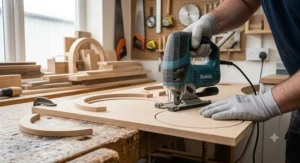
Pendulum stroke settings are usually numbered 0 to 3 or 0 to 4, and each step increases how far the blade swings forward on the upstroke. Getting comfortable with them is the single biggest factor in cut quality, so here’s a practical way to approach it:
- Start at setting 0 for any new material or blade — this gives the closest thing to a vertical stroke and the cleanest possible edge, at the cost of cutting speed.
- Move to setting 1 for general hardwood and any material where the finish matters — furniture edges, visible joinery, curved brackets.
- Use setting 2 for softwood and plywood where speed matters more than a glass-smooth edge, such as roughing out a shape before final sanding.
- Reserve setting 3 (or 4) for fast, straight rip cuts in soft material only — this setting is genuinely unsuitable for tight curves, since the blade’s forward swing fights against a small turning radius.
- Drop back down whenever you switch to a curve partway through a job, even if you were happily ripping a straight edge moments before — forgetting to do this is the single most common cause of a curve going ragged mid-cut.
- Match pendulum setting to blade width — narrower scroll blades cope far worse with aggressive pendulum settings than wide general-purpose blades, since there’s less blade body to resist sideways flex.
- Test on an offcut whenever you’re unsure, because the “right” setting genuinely depends on blade sharpness, material density and moisture content, not just a fixed rule from a manual.
What most owner’s manuals don’t spell out clearly is that pendulum stroke settings and variable speed are two separate controls working together, not one and the same — a jigsaw with excellent pendulum granularity but a poor speed dial can still produce ragged curves if the two aren’t balanced against each other for the material in hand.
Curve-Cutting Blade Types Explained
Blade choice affects curve quality more than almost any other single variable, and it’s the part of the buying decision most often skipped entirely. For curved and scroll work specifically, narrow blades — typically under 6mm wide — are essential, because a wide general-purpose blade simply can’t physically turn a tight radius without binding in the kerf. Look for blades explicitly marketed for “scroll cutting” or “fine curve cutting”; these have a narrower body and often fewer, finer teeth per inch for cleaner edges on tight turns.
Tooth configuration matters almost as much as width. Down-cut teeth (cutting on the downstroke) reduce splintering on the top face of the workpiece, which is useful for visible curved edges on furniture; standard up-cut blades clear dust more efficiently but can tear the top surface of veneered or laminated boards. For metal curves, a fine-tooth bi-metal blade is essential — using a wood blade on metal, even briefly, dulls it within seconds. T-shank blades (with the distinctive Bosch-style tang) are now the near-universal standard across all seven jigsaws reviewed above, so blade compatibility is rarely an issue regardless of which brand you buy.
A common mistake among newer users is buying a single all-purpose blade and expecting it to handle everything from tight scroll cuts to thick straight rips — reviewers across multiple product listings consistently note that keeping two or three narrow, curve-specific blades in the storage compartment (many jigsaws, including the Bosch PST 900 PEL, have one built in) saves far more time than the minor cost of the extra blades themselves.
Scroll Cutting: Tight Curves and Detail Work
Scroll cutting refers to cutting very tight, intricate curves — think decorative fretwork, small radius corners, or lettering — rather than the broad, sweeping curves common in furniture or worktop work. It’s the most demanding test of any pendulum jigsaw for curved cuts, because tight radii punish every weakness in blade width, pendulum control and base-plate stability simultaneously.
For genuine scroll cutting, drop the pendulum setting to zero or its lowest position every time, fit the narrowest blade your material allows, and reduce speed below what feels intuitive — a slower stroke gives you far more steering control at the cost of cutting time, which is almost always the right trade for intricate work. Pivoting the whole jigsaw slightly, rather than forcing the blade to track a curve it physically can’t turn within, prevents the blade snapping or binding, a failure mode that recurs often enough in review feedback to be worth flagging explicitly.
It’s worth noting honestly that a benchtop scroll saw will always out-perform a handheld pendulum jigsaw for genuinely intricate fretwork-level detail, simply because the workpiece moves against a fixed blade rather than the reverse. For portable, on-site or larger-scale curved work, though — cutting a decorative curve into a stair string or a garden gate — a good pendulum jigsaw remains the more practical and versatile tool by some distance.
How to Choose a Pendulum Jigsaw for Curved Cuts
Cutting through the marketing noise, here’s the honest decision process, reasoned from the specs and review patterns covered above:
- Decide cordless or corded first — cordless suits site work and awkward locations away from sockets; corded typically offers slightly more consistent power for the same price, which matters for demanding materials.
- Check the pendulum stage count — 3 or 4 stages is standard on every model reviewed here; fewer stages means less fine control specifically for curve work.
- Weigh the tool in your head, not just on paper — a 600g weight difference feels trivial in a shop but becomes significant across a two-hour scrolling session.
- Match battery platform to what you already own — if you’ve got 18V batteries from another brand’s drill, buying a body-only jigsaw on that platform saves £60–£100 immediately.
- Prioritise a visible cutting line system — a fold-out sight, LED light or laser guide genuinely improves curve accuracy far more than an extra 500 SPM of top speed.
- Budget separately for blades — curve-specific narrow blades aren’t usually included as standard, and a poor blade undermines even a premium jigsaw.
- Read genuine, verifiable reviews for the exact model and colour variant you’re buying, since minor product-line variants can differ in bundled accessories even under the same core model number.
Common Mistakes When Buying a Pendulum Jigsaw
The most frequent mistake is buying based on stroke rate (SPM) alone, treating it like a horsepower figure for cars — but as covered above, a higher top speed is often actively unhelpful for curve work and only useful for fast straight rips. A close second is underestimating blade cost over the tool’s lifetime; a £40 budget jigsaw that chews through £4 blades weekly can cost more in consumables over a year than a premium tool used with the correct, longer-lasting blade for each material.
Buyers also frequently overlook bevel capacity, assuming they’ll only ever cut straight up-and-down, then discovering mid-project that a mitred or angled curved edge is exactly what a piece of furniture or trim needs. Finally, a genuinely common and costly mistake is buying a body-only cordless jigsaw without already owning a compatible battery — the bare-tool price looks like a bargain until a battery and charger are added on top, sometimes pushing the total above a corded alternative with equivalent specs.
What to Expect: Real-World Performance on Curves
Specs on a box rarely translate directly into how a curve actually feels to cut, so here’s the honest translation. A jigsaw rated at 3,000+ SPM with a good pendulum system will genuinely glide through a sweeping curve in 18mm plywood, with the blade tracking the pencil line closely enough that sanding afterwards is a light finishing pass rather than a corrective one. Drop to a tight scroll radius, though, and even the best jigsaw on this list will slow to a crawl if you’re steering it properly — expect genuine curve work to take noticeably longer than straight cuts of the same length, regardless of which model you buy.
Vibration is the other factor specs rarely convey well. Bosch’s “Low Vibration” mass-balancing on the PST 900 PEL and the brushless motor smoothness of the Makita DJV182Z and DeWalt DCS334N are noticeably different in hand from budget corded models, where a slight buzz through the handle becomes genuinely tiring — and, over repeated long-term use, a factor the Health and Safety Executive’s guidance on hand-arm vibration flags as a real occupational health consideration for anyone using vibrating power tools regularly and for extended periods.
✨ Don’t Miss These Exclusive Deals!
🔍 Take your curved-cutting projects to the next level with these carefully selected jigsaws. Click on any highlighted model above to check current pricing and availability. The right tool will help you create clean, professional curves your family will genuinely be proud of!
Long-Term Cost & Maintenance
Total cost of ownership on a pendulum jigsaw goes well beyond the sticker price. Blades wear out with genuine regularity — expect to replace a general-purpose blade every few hours of active cutting, and narrow scroll blades even sooner, since their reduced body width makes them more prone to flex fatigue and eventual snapping. Batteries on cordless models are the other significant long-term cost: expect a Li-ion pack to hold meaningfully less charge after roughly 500–1,000 charge cycles, which for an occasional DIY user could still mean several years of useful service, but for a daily trade user might mean replacement within 18–24 months.
| Cost Factor | Budget Corded (e.g. JCB) | Premium Cordless (e.g. DeWalt DCS334N) |
|---|---|---|
| Upfront tool cost | Lower | Higher, especially with battery/kit |
| Blade replacement cost | Same across all models | Same across all models |
| Ongoing power cost | Mains electricity, negligible | Battery replacement every few years |
| Best For | Occasional use, tight budget | Frequent, repeat professional use |
Read purely on upfront price, budget corded jigsaws look like the obvious value pick, and for occasional users they genuinely are. Over several years of frequent, heavy use, though, the calculation shifts — premium brushless motors generally last longer under sustained load, and a shared battery platform across multiple tools spreads the real cost of “going cordless” across your whole toolkit rather than loading it entirely onto one purchase. When any jigsaw does eventually reach the end of its working life, it shouldn’t go in general household waste: UK regulations increasingly aim to make it easier to recycle old power tools and other electrical goods responsibly rather than sending them to landfill.
Safety, Regulations & Compliance Guide
A pendulum jigsaw for curved cuts is generally one of the lower-risk power tools in a typical toolkit, but it’s not risk-free, and a few practical habits matter. Eye protection is non-negotiable — offcuts and splinters can and do fly back toward the operator, particularly at higher pendulum settings, and UK guidance on personal protective equipment at work treats suitable eye protection as a baseline expectation wherever there’s a genuine projectile risk, a principle that applies just as sensibly at home as on a commercial site.
Dust extraction matters more than most casual DIYers assume, particularly when cutting MDF or older timber that may carry residual treatment chemicals — connect a vacuum where the jigsaw supports it, or at minimum work in a ventilated space and wear a suitable dust mask. Always disconnect the battery or unplug a corded model before changing blades; several of the tool-free systems reviewed above are genuinely quick, which can tempt users into skipping this basic step. Finally, check any jigsaw and its power cable (on corded models) for damage before each use, and never bypass a lock-off trigger switch — it exists specifically to prevent accidental start-up while the tool is being carried or set down.
Problem → Solution Guide
Problem: The blade wanders off the pencil line mid-curve. This is almost always a pendulum-setting-versus-blade-width mismatch — drop to the lowest pendulum stage and fit a narrower blade, per the guidance above. If the drift persists, check the blade clamp is fully seated; a loose blade flexes far more than a properly secured one, on any of the models reviewed here.
Problem: The cut edge is badly splintered on top. Switch to a down-cut blade, or apply masking tape along the cut line before sawing — both approaches reduce tear-out on the visible face significantly, and the tape trick works on every jigsaw regardless of brand.
Problem: The jigsaw stalls or bogs down in thicker material. This usually means the pendulum setting is too aggressive for the density of the wood, forcing the motor to fight the blade’s own forward swing — drop the pendulum stage and let the increased stroke count compensate for the reduction in swing.
Problem: Vibration makes it hard to hold the line. Check the base plate is flat against the workpiece with even pressure throughout the stroke, and consider whether a lower-vibration model — such as the Bosch PST 900 PEL or either brushless cordless option above — would suit repeat, longer sessions better than a budget corded unit.
Problem: Blades keep snapping on tight curves. The radius you’re attempting is likely too tight for the blade width fitted — either fit a narrower scroll-specific blade, or accept that the curve needs to be approached in shorter overlapping passes rather than one continuous sweep.

FAQ
❓ What's the difference between a pendulum jigsaw and a standard jigsaw for curved cuts?
❓ What pendulum setting should I use for scroll cutting?
❓ Can a pendulum jigsaw cut metal as well as wood?
❓ Do I need a laser guide on a jigsaw for curved cuts?
❓ Is a cordless pendulum jigsaw powerful enough for regular curved cutting?
Conclusion
Choosing a pendulum jigsaw for curved cuts comes down to matching pendulum granularity, weight and battery platform to the work you actually do, rather than chasing the highest stroke-rate figure on the box. For all-round DIY value, the Bosch PST 900 PEL remains a genuinely strong corded pick with its CutControl sight doing real work for curve accuracy. For anyone already committed to a cordless battery platform, the Makita DJV182Z and DeWalt DCS334N both deliver trade-grade curve control, while the Ryobi R18JS-0 and Einhell TC-JS 18 Li prove that budget cordless options can genuinely hold their own for lighter, occasional use.
What ties every recommendation in this guide together is the same underlying principle: pendulum stroke settings, blade width and speed all need to work together, not in isolation, and understanding that relationship will improve your curves more than any single spec upgrade. Whichever model you choose from the seven reviewed here, take the time to test pendulum settings on scrap material first — it’s the cheapest, fastest way to guarantee your next curved cut comes out right the first time.
Recommended for You
- Best Cordless Jigsaw UK 2026: 7 Top Picks Reviewed
- Cordless Circular Saw For Decking: 7 Best Picks for 2026
- Cordless Track Saw UK: 7 Best Plunge Saws Ranked for 2026
Disclaimer: This article contains affiliate links. As an Amazon Associate, I earn from qualifying purchases. If you purchase products through these links, we may earn a small commission at no additional cost to you.
✨ Found this helpful? Share it with your friends! 💬🤗
