

In This Article
Sand a pine shelf by hand for twenty minutes and you’ll understand exactly why the random orbit sander for woodworking exists. Your shoulder aches, the finish is patchy, and there are still faint scratches running against the grain that only show up once you’ve applied varnish — by which point it’s too late to fix them without stripping back. A decent orbital sander solves that problem in about ninety seconds flat, and it does it without leaving the tell-tale swirl marks that a cheap disc sander or an old belt sander happily etches into your workpiece.
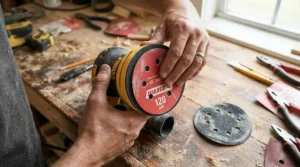
A random orbit sander is a handheld power tool that spins a circular sanding disc while also nudging it in tiny, overlapping ellipses. That dual motion — rotation plus wobble — means no single grain of abrasive ever travels the same path twice in a row, which is precisely why the finish comes out smooth and free of directional scratch patterns, regardless of which way the wood grain runs.
For UK woodworkers, the market genuinely is confusing. You’ve got £25 own-brand tools sitting on the same Amazon page as £300 German precision kit, and the spec sheets rarely explain what any of it actually means for your workshop. This guide breaks down seven real, current models — checked against genuine UK retailer listings and manufacturer data — from bargain-basement DIY sanders through to the trade-grade machines that joiners reach for daily. We’ve also dug into what separates a random orbit sander vs belt sander, how variable speed control actually changes your results, and why fine-grit sanding discs matter more than most buying guides let on. According to Wikipedia’s technical overview of the tool category, this random-orbit action was first commercialised back in 1968, and the fundamental engineering hasn’t really changed since — what has changed is how cleanly modern motors, dust extraction and electronics execute it.
Quick Comparison Table
If you’re short on time, here’s the fast version. Full technical breakdowns and honest analysis of each model follow in the next section.
| Sander | Power/Speed | Weight | Best For | Price Range |
|---|---|---|---|---|
| Black+Decker BEW210-GB | 230W, single speed | 1.3kg | Absolute beginners on a tight budget | Under £35 |
| Erbauer ERO400 | 400W, 6-speed variable | 1.6kg | Budget DIYers wanting real speed control | £40-£50 range |
| Bosch PEX 220 A | 220W, fixed 24,000 opm | 1.2kg | Reliable brand-name DIY sanding | £45-£70 range |
| DeWalt DWE6423 | 280W, 8,000-12,000 opm | 1.28kg | Most woodworkers, corded all-rounder | £75-£100 range |
| Makita BO5041 | 300W, 4,000-12,000 opm | 1.4kg | Fine finishing and furniture work | £95-£130 range |
| Ryobi RROS18-0 | 18V cordless, 20,000 opm | 1.1kg | Cordless convenience, ONE+ owners | £55-£85 range |
| Festool ETS 125 EQ | 250W, 6,000-14,000 rpm | 1.1kg | Professional joiners and cabinetmakers | £280-£360 range |
Looking at the spread above, there’s a clear pattern: the jump from sub-£50 tools to the DeWalt and Makita tier buys you genuine variable speed control and better-built switches, while the leap to Festool territory buys you a disc brake, near-silent dust extraction, and a level of finish consistency that’s hard to justify unless sanding is your daily bread and butter. Budget models like the Black+Decker and Bosch are perfectly capable for occasional shelving and furniture touch-ups, but they’ll leave you wanting more control the moment you tackle a veneered surface or a piece destined for a clear lacquer finish.
💬 Found this comparison useful? A quick share helps other woodworkers land on the right tool first time!
Top 7 Random Orbit Sanders for Woodworking: Expert Analysis
We’ve ordered these from most affordable to most capable, covering corded and cordless options, brushed and higher-spec electronics, and everything from weekend DIY to trade-grade cabinetry work.
1. Black+Decker BEW210-GB — cheapest genuine entry point into orbital sanding
At under £35, the Black+Decker BEW210-GB is about as low as you can go while still getting a proper random orbit sander rather than a toy detail sander. The 230W motor spins the 125mm pad at a fixed no-load speed of up to 13,000rpm with a 2.4mm orbit diameter — enough to strip old varnish off a garden bench or knock the fuzz off a freshly cut pine shelf without much drama.
Because there’s no variable speed control dial, you’re locked into one aggressive setting regardless of the material, which is the honest trade-off for the price. Reviewers consistently note that the multiple gripping areas (palm, jug handle, and body) make it comfortable for short bursts, and the random orbital motion does what it says on the tin — it sands across the grain without leaving swirl marks, just as the manufacturer’s own listing promises. Where it falls down is stamina: the single-speed motor and basic dust bag aren’t built for daily trade use, and the lack of speed adjustment makes it a poor match for delicate veneers or anything heading toward a glossy topcoat.
Pros:
- ✅ Genuinely low price for a real random orbit sander
- ✅ Multiple grip positions reduce hand fatigue on short jobs
- ✅ Quick-fit paper attachment speeds up disc changes
Cons:
- ❌ No variable speed control — one fixed aggressive setting
- ❌ Basic dust bag struggles on longer sanding sessions
At around £25-£35, the Black+Decker BEW210-GB offers solid value if you’re sanding the odd shelf or fence panel a few times a year and don’t want to invest heavily upfront.
2. Erbauer ERO400 — best budget pick with real variable speed control
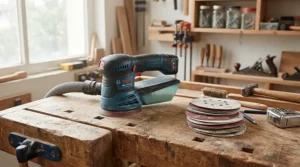
Screwfix’s own-brand Erbauer ERO400 quietly punches above its price bracket. For roughly £40-£50, you get a 400W motor — nearly double the wattage of the Black+Decker above — paired with genuine 6-speed variable speed control running from 5,000 to 14,000 opm. That range matters in practice: dial it down for fine-grit sanding discs on a tabletop finish, or crank it up to strip paint off a door in half the time.
What most buyers overlook about own-brand tools like this is that the cyclonic dust collection system, which spins dust into a separate chamber before it reaches the filter, is genuinely unusual at this price point and noticeably reduces clogging compared with a plain dust bag. The anti-vibration housing also makes overhead work more bearable than you’d expect from a sub-£50 tool. The catch is longevity — the carbon brushes aren’t replaceable, so once they wear out (typically after a few hundred hours of use), the motor’s finished rather than serviceable, which trade users should weigh against the otherwise strong three-year guarantee.
Pros:
- ✅ True 6-speed variable speed control for £40-£50
- ✅ Cyclonic dust box outperforms basic bags at this price
- ✅ Backed by a three-year manufacturer’s guarantee
Cons:
- ❌ Non-replaceable carbon brushes limit long-term serviceability
- ❌ Only available through Screwfix rather than wider retail
Priced in the £40-£50 range, the Erbauer ERO400 is arguably the best value pick for anyone who wants speed adjustment without paying branded prices.
3. Bosch PEX 220 A — the trusted brand-name DIY workhorse
The Bosch PEX 220 A has been a fixture of UK sheds and garages for years, and it’s easy to see why: it’s compact, reliable, and backed by a brand most DIYers already trust. The 220W motor runs at a fixed 24,000 opm with a tight 1.25mm eccentricity, producing a genuinely fine finish on smaller surfaces — chair legs, door frames, skirting boards — rather than large flat panels where a bigger orbit would clear material faster.
Based on the spec comparison with rivals here, the standout feature isn’t the motor at all, it’s the removable microfilter dust box, which Bosch fits as standard rather than the flimsier dust bags several competitors rely on. That keeps a workshop noticeably cleaner over a weekend project. The trade-off, as with the Black+Decker, is the absence of a speed dial — this sander runs at one pace, and while that pace suits fine sanding and polishing work well, it’s not the tool to reach for if you need to hog off a lot of stock quickly. At 1.2kg it’s also among the lightest corded sanders here, which genuinely helps on overhead or vertical surfaces.
Pros:
- ✅ Removable microfilter dust box keeps the workspace clean
- ✅ Lightweight 1.2kg body reduces fatigue on vertical work
- ✅ Trusted Bosch build quality and wide parts availability
Cons:
- ❌ No variable speed control dial for adjusting to material
- ❌ Small 1.25mm eccentricity means slower stock removal
Expect to pay somewhere in the £45-£70 range depending on retailer, making the Bosch PEX 220 A a safe, dependable choice for hobbyist woodworkers who prioritise a fine finish over raw speed.
4. DeWalt DWE6423 — the best all-round corded sander for most woodworkers
If you only read one product entry on this page, make it this one. The DeWalt DWE6423 is the sander that consistently comes up as the sensible default for UK woodworkers, and the spec sheet explains why: a 280W motor with true variable speed control running 8,000-12,000 opm, a 2.6mm orbit diameter for genuinely fast stock removal, and a dust-sealed switch that keeps grit out of the one component most sanders fail at first.
What the spec sheet won’t tell you, but the design choices strongly suggest, is that DeWalt built this for daily use rather than occasional DIY. The sealed 100% ball-bearing construction and the “controlled finishing system” — which limits pad speed on start-up to stop the disc gouging your workpiece the instant you switch on — are both features aimed squarely at people using the tool five days a week, not five times a year. The built-in AirLock-compatible dust port also means you can connect a proper extractor rather than relying on the supplied fabric dust bag, which, honestly, is adequate rather than brilliant. At 1.28kg it sits comfortably in the hand for extended sessions, and the anti-slip grip stays put even when your hands get dusty.
Pros:
- ✅ Genuine 8,000-12,000 opm variable speed control dial
- ✅ Dust-sealed switch and sealed bearings built for daily use
- ✅ AirLock port allows direct connection to a proper extractor
Cons:
- ❌ Supplied fabric dust bag is only adequate, not exceptional
- ❌ 280W sits mid-pack rather than leading on raw power
Typically found in the £75-£100 range, the DeWalt DWE6423 earns its reputation as the sander most people should actually buy.
5. Makita BO5041 — best for a genuinely swirl-free finishing pass
Makita built the BO5041 around one specific job: producing the smoothest possible surface before a final coat goes on. The 300W motor drives the pad through a wide 4,000-12,000 opm variable speed range with a generous 2.8mm eccentricity, and Makita’s own engineering notes describe the resulting action as delivering a swirl-free finish even on end grain — a claim that lines up with what independent trade reviewers report about its performance on fine furniture work.
Here’s what most buying guides skip: the adjustable, 300°-rotating front handle isn’t just a comfort feature, it genuinely changes how you can angle the tool into corners and along mouldings without twisting your wrist awkwardly. Reviewers consistently flag the pad control system, which limits speed on start-up in the same way DeWalt’s does, as a big part of why this sander doesn’t gouge soft timber. The honest downside is weight — at 1.4kg it’s the heaviest corded sander in this line-up, and that extra mass, combined with the through-the-pad dust extraction that’s “decent rather than exceptional” according to trade testers, means serious users often hook it up to a shop vac rather than relying on the bundled dust bag.
Pros:
- ✅ Wide 4,000-12,000 opm range genuinely suited to fine finishing
- ✅ Adjustable rotating front handle improves control in corners
- ✅ Pad control system prevents gouging on start-up
Cons:
- ❌ Heaviest corded model here, which shows on longer sessions
- ❌ Dust bag adequate but best paired with external extraction
Sitting in the £95-£130 range, the Makita BO5041 is the pick for anyone whose finished piece is going under a clear varnish or oil where every scratch will show.
6. Ryobi RROS18-0 — best cordless pick if you’re already in the ONE+ ecosystem
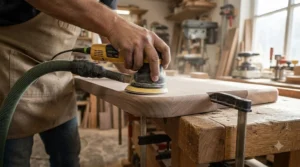
Cutting the cable matters more than most buying guides admit, particularly if you’re sanding fence panels outdoors, working up a ladder, or simply don’t fancy trailing an extension lead across a workshop floor. The Ryobi RROS18-0 runs on Ryobi’s 18V ONE+ platform, which already powers well over 200 different tools, so if you own even one other ONE+ product, this sander effectively costs you nothing extra in batteries or chargers.
On paper this means a 125mm pad, 2.5mm orbit diameter, and a punchy fixed 20,000 opm — enough to hold its own against corded rivals for most woodworking tasks, from smoothing a tabletop to prepping a door for paint. A common theme in aggregated user feedback is that the sealed, rubber-protected switch genuinely does keep dust out better than older Ryobi sanders, extending the tool’s working life in dusty environments. What buyers should factor in is that this is a fixed-speed tool with no variable dial, and — like most bare-tool listings — the battery and charger are typically sold separately, so the advertised body-only price doesn’t reflect your total spend if you’re starting the ONE+ system from scratch.
Pros:
- ✅ Cordless freedom for ladder work and outdoor sanding
- ✅ Shares batteries across 200+ Ryobi ONE+ tools
- ✅ Sealed switch resists dust ingress better than older models
Cons:
- ❌ Single fixed 20,000 opm speed, no variable dial
- ❌ Battery and charger sold separately from the body-only price
Body-only pricing generally sits in the £55-£85 range, making the Ryobi RROS18-0 compelling value specifically for existing ONE+ owners rather than a first cordless purchase.
7. Festool ETS 125 EQ — the professional’s choice for the finest possible finish
At the top of this line-up sits the Festool ETS 125 EQ, a sander that trade woodworkers buy not because they need to, but because the finish quality justifies the outlay once sanding becomes a daily task rather than a weekend chore. The 250W motor drives an electronically controlled 6,000-14,000 opm range through a deliberately tight 2mm sanding stroke — noticeably smaller than every other machine on this list — which is precisely why it produces the cleanest, most swirl-free finishing pass of the group.
Here’s what most spec sheets bury: the built-in disc brake stops the pad the instant it lifts off the workpiece, preventing the small circular scuff marks that happen when a spinning disc touches down at an angle — a genuine pain point on any sander without one. Paired with Festool’s Jetstream dust extraction and a proper extractor (rather than the supplied dust bag alone), airborne dust drops dramatically, which matters both for finish quality and for the sort of long-term respiratory health concerns the Health and Safety Executive has repeatedly flagged around wood dust exposure. At just 1.1kg, it’s also among the lightest tools here, which helps enormously during long finishing sessions. The honest downside is obvious: this is a premium tool at a premium price, and the dust performance genuinely depends on pairing it with the matching extractor rather than judging it on the bundled bag alone.
Pros:
- ✅ Disc brake eliminates start/stop scuff marks entirely
- ✅ Exceptionally light at 1.1kg for fatigue-free finishing work
- ✅ Jetstream extraction delivers outstanding dust control with a Festool unit
Cons:
- ❌ Premium price puts it out of reach for occasional DIY use
- ❌ Full dust performance needs a matching Festool extractor
Typically priced in the £280-£360 range depending on kit configuration, the Festool ETS 125 EQ is the sander professional joiners reach for when a client’s furniture piece can’t afford visible sanding marks.
Practical Usage Guide: Setting Up for a Swirl-Free Finish
Buying the right sander is only half the job — technique determines whether you actually get that swirl-free finishing result the manufacturers promise. Start every project with 80 or 120 grit to remove mill marks and flatten the surface, then work up through the grits in reasonably small jumps (120 to 180 to 240) rather than skipping straight to fine-grit sanding discs, which just skate over scratches left by the coarser paper instead of removing them.
Let the sander’s own weight do the work. Pressing down hard doesn’t speed things up — it actually slows the pad’s rotation under load and increases the risk of visible gouges, particularly on sanders like the Black+Decker BEW210-GB or Bosch PEX 220 A that run at a single fixed speed with no room to compensate. Keep the sander flat and moving in slow, overlapping passes; the “go slow” rule genuinely is the single biggest factor separating a professional-looking finish from an amateur one. In the first 30 days with a new sander, the most common mistake is switching it on before it touches the wood, which can leave a small crescent-shaped dig-in — always start with the pad flat on the surface first.
Maintenance is minimal but not optional: empty the dust bag or box after every session rather than letting it fill completely, since a clogged filter reduces suction and lets more fine dust escape into the air you’re breathing. Check the hook-and-loop pad periodically for worn patches, and replace sanding discs the moment they stop cutting cleanly — a blunt disc generates heat, which can leave burn marks on softer timbers like pine.

Real-World Scenarios: Matching the Sander to the Project
Consider three genuinely different woodworkers. First, the weekend hobbyist building garden furniture from reclaimed pallet wood a few times a year — for this budget, low-frequency use, the Erbauer ERO400 or Bosch PEX 220 A make far more sense than a premium tool that will spend most of its life in a drawer. Neither needs daily-use durability, and both handle rough, splintery reclaimed timber without complaint.
Second, picture a serious hobbyist fitting out a home workshop and building furniture-grade pieces for family and friends — oak sideboards, walnut coffee tables, the sort of work where a visible swirl mark under a satin lacquer would be genuinely embarrassing. This is exactly the buyer the Makita BO5041 or DeWalt DWE6423 were built for: enough variable speed control to handle both aggressive stock removal and delicate final passes, at a price that still makes sense for someone without a business account.
Third, there’s the working joiner fitting bespoke kitchens on-site, moving between properties without always having a power socket handy, then finishing pieces in the workshop afterwards to a standard the client is paying a premium for. That combination — portability plus finish quality — points toward pairing a cordless option like the Ryobi RROS18-0 for on-site prep work with a Festool ETS 125 EQ back at the bench for the final swirl-free finishing pass that goes out the door.
Problem → Solution: Fixing Common Sanding Mistakes
Problem: visible swirl marks appearing under the finish. This almost always comes down to either using worn sandpaper (heat and inconsistent pressure create swirls even on a genuine random orbit sander) or skipping grit stages too aggressively. The fix is straightforward: replace discs more often than feels necessary, and don’t jump more than one or two grit levels at a time when moving to fine-grit sanding discs for the final pass.
Problem: dust everywhere, even with the bag attached. Standard dust bags on budget models like the Black+Decker BEW210-GB capture perhaps half of what a proper shop vac connection would. If you’re doing regular indoor sanding, connecting the sander’s port to a vacuum — even a domestic one with a suitable adaptor — makes a dramatic difference, and it matters for health as much as tidiness; the Health and Safety Executive’s woodworking guidance is explicit that wood dust exposure is linked to asthma, dermatitis, and in the case of hardwood dust, sino-nasal cancer, even in small workshop settings.
Problem: the sander gouges the wood the moment it’s switched on. This happens when the pad touches the workpiece before it’s up to speed, or when a sander lacking a “controlled finishing” start-up feature (like the entry-level Black+Decker and Bosch models here) is pressed down too hard immediately. Always rest the sander flat on the surface, switch on, then apply gentle pressure once it’s running.
Problem: the sander stalls or bogs down on hardwood. Lower-wattage models under 250W can struggle on dense hardwoods like oak or ash at higher grits. If this happens repeatedly, either drop to a coarser grit temporarily to reduce resistance, or consider a step up to a 280W-400W machine such as the DeWalt DWE6423 or Erbauer ERO400, both of which have the headroom to keep pace under load.
Problem: not knowing when to reach for fine-grit sanding discs at all. As a rule of thumb, stop at 180-220 grit for surfaces taking paint (finer grit can actually reduce paint adhesion), but push through to 320 or even 400 grit fine-grit sanding discs for anything getting a clear oil or lacquer finish where the wood grain itself will remain visible.
How to Choose a Random Orbit Sander for Woodworking
Picking the right tool comes down to seven practical criteria, each of which genuinely changes how the sander performs on real projects:
- Power output. Anything from 200W to 250W suits fine finishing and occasional DIY; 280W-400W handles heavier stock removal and daily use without bogging down.
- Variable speed control. A dial adjusting opm (orbits per minute) lets you match aggression to the material — slow for veneers and end grain, fast for stripping old paint.
- Orbit diameter (eccentricity). Smaller orbits (around 1.25-2mm) favour finer finishes; larger orbits (2.5-3mm+) remove material faster but leave a slightly coarser scratch pattern.
- Dust extraction quality. A microfilter box or cyclonic system beats a basic bag, and matters both for a cleaner finish and for your long-term lung health.
- Weight and grip. Under 1.3kg is comfortable for overhead and vertical work; anything heavier is fine for flat benchtop sanding but tiring elsewhere.
- Corded vs cordless. Corded gives unlimited runtime for workshop use; cordless suits site work, ladders, and outdoor jobs where trailing a cable is impractical.
- Disc size and availability. 125mm (5-inch) is the UK standard and the easiest size to find replacement fine-grit sanding discs for in any DIY shed or online.
According to independent UK testing from Expert Reviews, sanders across this market genuinely do vary enormously in real-world ergonomics and dust control even when the spec sheets look similar on paper — which is exactly why hands-on comparisons like the one above matter more than headline wattage figures alone.
Random Orbit Sander vs Belt Sander
The random orbit sander vs belt sander question comes up constantly, and the honest answer is that they solve different problems rather than competing directly. A belt sander runs a continuous loop of abrasive in one direction at high speed, which makes it brutally effective at removing a lot of material fast — flattening an uneven tabletop, stripping thick old paint, or truing up a rough-sawn board. That same directional, aggressive action is exactly why it leaves visible scratches running with the grain if you’re not careful, and why it’s a poor choice for a final finishing pass.
A random orbit sander, by contrast, trades outright stock-removal speed for a swirl-free, direction-independent finish. Its random elliptical motion means it doesn’t care which way the grain runs, so it’s the far safer tool for finishing work, curved surfaces, and anything heading toward a visible clear coat. In practice, most serious woodworkers own both: a belt sander for the rough, early-stage flattening work, and a random orbit sander — something like the DeWalt DWE6423 or Makita BO5041 — for every stage after that.
| Factor | Random Orbit Sander | Belt Sander |
|---|---|---|
| Stock removal speed | Moderate | Fast, aggressive |
| Finish quality | Swirl-free, fine | Can leave directional scratches |
| Grain sensitivity | Works any direction | Must follow the grain |
| Best use case | Finishing, veneers, furniture | Flattening, heavy stripping |
The table above makes the trade-off obvious: reach for a belt sander when speed and flatness matter more than surface finish, and switch to a random orbit sander the moment you’re within two or three grit stages of a finished, visible surface. Trying to do both jobs with a single tool almost always means compromising on one or the other.
Understanding Variable Speed Control
Variable speed control is the single feature that separates a genuinely versatile sander from a one-trick tool, and it’s worth understanding why before you spend money on it. At the low end of a typical 4,000-8,000 opm range, the pad moves slowly enough to work fine-grit sanding discs on delicate veneers or end grain without burning the surface or gouging soft timber. At the top of a 12,000-14,000 opm range, the same tool becomes aggressive enough to strip paint or level a rough board quickly.
Sanders without this feature — the Black+Decker BEW210-GB, Bosch PEX 220 A, and Ryobi RROS18-0 in this line-up — run at one fixed speed chosen by the manufacturer as a compromise between the two extremes. That’s perfectly adequate for occasional, general-purpose sanding, but it removes your ability to slow things down for a delicate finishing pass or speed things up when you’re impatient to clear a lot of material. Models like the Erbauer ERO400, DeWalt DWE6423, Makita BO5041, and Festool ETS 125 EQ all include a genuine dial, and the practical difference shows up most clearly when moving between species — pine at high speed clears fast, but the same setting on oak veneer risks burn marks that only a slower pace avoids.

Fine-Grit Sanding Discs: Getting a Furniture-Quality Finish
Fine-grit sanding discs — typically anything from 240 grit up to 400 or even 600 grit — are where an average finish becomes a genuinely impressive one, but they’re also where most of the wasted money in this hobby happens. Buying premium fine-grit sanding discs and running them straight over a surface still showing 80-grit scratches is pointless; fine grit only refines what’s already flat and even, it doesn’t remove earlier mistakes.
The practical approach is a grit ladder: 80 or 100 to establish flatness, 120 or 150 to remove those marks, 180 or 220 as a general-purpose finishing grit for anything taking paint, and only push into 240-400 territory for surfaces getting a clear oil, wax, or lacquer finish where the timber’s natural grain stays visible. Ceramic and film-backed fine-grit sanding discs last considerably longer than basic paper-backed ones and clog less on resinous softwoods, which matters because a clogged fine-grit disc stops cutting and starts burning almost immediately. Buy a genuine variety pack across several grits rather than a single box — you’ll use far more mid-range and fine discs than coarse ones on typical furniture work.
Common Mistakes When Buying a Random Orbit Sander
The most frequent mistake is chasing wattage as the sole measure of quality. A 400W sander isn’t automatically better than a 250W one — orbit diameter, dust extraction, and build quality all matter just as much for the finish you actually end up with. The second common error is ignoring dust extraction entirely, then being surprised at how much fine dust ends up coating every surface in the workshop; as covered above, this isn’t just a cleanliness issue but a genuine, HSE-documented health concern over time.
A third mistake, particularly with cordless models like the Ryobi RROS18-0, is forgetting to budget for a battery and charger when the advertised price is for the bare tool only — the true cost can be £30-£50 higher than the headline figure suggests if you’re starting from scratch. Finally, buyers regularly underestimate how much variable speed control matters until they’ve already bought a fixed-speed sander and hit a project — veneered furniture, curved mouldings — where it would have made a genuine difference.
Long-Term Cost & Maintenance
Sanding discs are the real ongoing cost of owning any random orbit sander, not the tool itself. A typical hobbyist working through a medium furniture project might use 15-25 discs across several grits, and buying in bulk multi-packs rather than small single-grit boxes noticeably reduces the cost-per-disc over a year of projects. Budget models tend to use standard 8-hole hook-and-loop patterns that fit generic own-brand discs, while some premium tools use proprietary patterns — worth checking before you commit, since it affects your ongoing running costs for years.
On tool longevity, brushed motors with non-replaceable carbon brushes, such as the one in the Erbauer ERO400, have a finite lifespan measured in a few hundred hours of heavy use before the motor needs replacing entirely rather than servicing. Tools with replaceable components and better-sealed switches, like the DeWalt DWE6423 and Festool ETS 125 EQ, cost more upfront but typically work out cheaper per year of ownership for anyone sanding regularly, since a seized switch or worn brush doesn’t mean binning the whole tool.
Safety, Dust and Regulations Guide
Wood dust isn’t a trivial nuisance — it’s a documented occupational health hazard, and that applies just as much to a home workshop as a commercial one. The Health and Safety Executive’s guidance for woodworking sets out control measures under the Control of Substances Hazardous to Health Regulations specifically because both softwood and hardwood dust are linked to asthma and dermatitis, with hardwood dust additionally linked to sino-nasal cancer with prolonged exposure. Practically, that means always using a sander’s dust extraction (bag, box, or connected vacuum), working in a ventilated space, and wearing a properly fitted dust mask for anything beyond a very quick job.
Vibration is the other health consideration worth taking seriously. According to HSE’s advice on hand-arm vibration, regular, frequent use of vibrating hand tools — sanders included — can lead to permanent conditions collectively known as hand-arm vibration syndrome if exposure isn’t managed over time. For most home woodworkers this risk is low given occasional use, but anyone sanding for hours most days should take regular breaks and choose a lighter, lower-vibration tool such as the Bosch PEX 220 A or Festool ETS 125 EQ where practical. Always check a sander carries the UKCA mark for the UK market, use RCD-protected sockets for corded tools outdoors, and never bypass a dust-sealed switch housing, since that seal is specifically there to keep fine abrasive dust away from live electrical components.
Buyer’s Decision Framework
If you’re still undecided, work through this simply: if you’re sanding a handful of times a year on basic DIY projects, choose a budget fixed-speed model like the Black+Decker BEW210-GB because paying for features you’ll rarely use makes no financial sense. If you’re building furniture regularly and finish quality genuinely matters, choose a variable-speed corded model like the DeWalt DWE6423 or Makita BO5041, because the ability to slow down for delicate work will save you sanding mistakes that cost more in wasted timber than the price difference. If portability matters more than anything else — site work, outdoor projects, no easy power access — choose the Ryobi RROS18-0, especially if you already own ONE+ tools. And if sanding is a daily professional task where a visible flaw costs you a client, the Festool ETS 125 EQ pays for itself in saved rework alone.
Frequently Asked Questions
❓ What's the best random orbit sander for a beginner woodworker?
❓ Is a random orbit sander better than a belt sander for furniture?
❓ What grit sandpaper should I start with on new wood?
❓ Can a random orbit sander remove paint from wood?
❓ Do I need a cordless or corded random orbit sander for a home workshop?
Conclusion
There’s no single best random orbit sander for woodworking — only the right one for how often you sand, what you’re building, and how much finish quality actually matters to the finished piece. For occasional DIY, the Black+Decker BEW210-GB or Erbauer ERO400 will do everything you need without overspending. For anyone building furniture regularly, the DeWalt DWE6423 remains the sensible middle ground, while the Makita BO5041 edges ahead specifically for a swirl-free finishing pass on show wood. Cordless convenience belongs to the Ryobi RROS18-0, and if sanding is genuinely part of your livelihood, the Festool ETS 125 EQ is worth every penny of its premium price tag.
Whichever you choose, remember that technique and grit progression matter every bit as much as the tool itself — even the best sander in this list will leave a poor finish if it’s pushed too hard or skipped through the grits carelessly. Get the fundamentals right, match variable speed control to the material in front of you, and any of the seven sanders here will genuinely transform how your projects turn out.
✨ Enjoyed this guide? Share it with a fellow woodworker who’s still sanding everything by hand! 💬🤗
Recommended for You
- Best Cordless Sander UK: 7 Top Picks Tested for 2026
- Cordless Sander For Beginners: 7 Best Picks for UK DIYers (2026)
- Angle Grinder For Rust Removal: 7 Top Picks UK (2026)
Disclaimer: This article contains affiliate links. As an Amazon Associate, I earn from qualifying purchases. If you purchase products through these links, we may earn a small commission at no additional cost to you.
✨ Found this helpful? Share it with your friends! 💬🤗
