In This Article
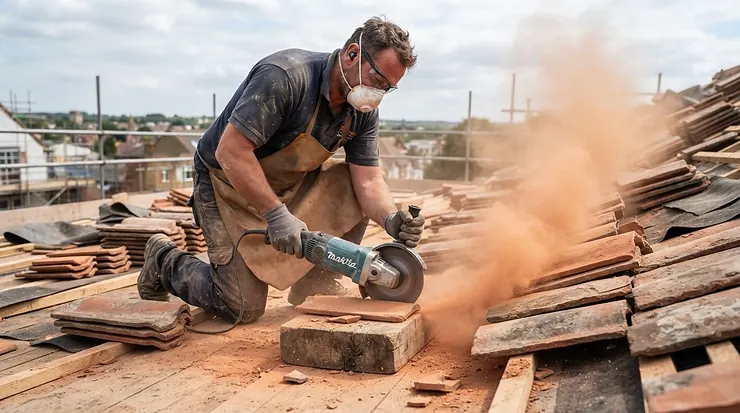
Ask anyone who’s spent a Saturday trying to hack through a lintel with a 115mm grinder, and they’ll tell you the same thing: wrong tool, wrong day. A 230mm angle grinder for heavy-duty grinding is a different animal entirely — bigger disc, more torque, and a motor built to shrug off masonry, structural steel and thick paving rather than flinch at it. It’s the tool that turns a two-hour slog into a twenty-minute job, provided you’ve picked the right one.
So what is a 230mm angle grinder? It’s a 9-inch handheld power tool, typically running a 2,000-2,600W motor at around 6,500-6,600rpm, designed for deep cuts and heavy material removal that smaller 115mm or 125mm grinders simply can’t match. Because these machines weigh 5-6.5kg and generate serious kinetic energy at the disc edge, two-handed operation isn’t optional — it’s the baseline safety requirement, a point the Health and Safety Executive’s guidance on abrasive wheels makes clear when it notes that roughly half of all abrasive wheel accidents trace back to unsafe operating practice rather than equipment failure.
This guide research 7 real 230mm angle grinders currently available on Amazon UK — from sub-£100 workhorses to premium cordless options — comparing them not just on spec sheets but on what those specs actually mean once you’re three hours into a demolition job with dust in your eyes and a deadline looming. We’ll cover heavy-duty grinding discs, torque, safety, and where each model genuinely earns its keep on a construction site.
Quick Comparison Table
| Grinder | Power | No-Load Speed | Weight | Best For |
|---|---|---|---|---|
| Bosch GWS 22-230 JH | 2,200W | 6,500rpm | 5.2kg | All-round reliability |
| Makita GA9020 | 2,000W | 6,600rpm | 5.8kg | Trade-trusted durability |
| DeWalt DWE492 | 2,200W | 6,600rpm | 5.2kg | Control on awkward angles |
| HiKOKI G23ST | 2,000W | 6,600rpm | 5.1kg | Budget-conscious buyers |
| Einhell TE-AG 230/2000 | 2,000W | 6,500rpm | 5.9kg | DIY structural work |
| Metabo WE 26-230 MVT Quick | 2,600W | 6,600rpm | 6.3kg | Continuous professional use |
| Milwaukee M18 FUEL 230mm | 18V cordless | 6,600rpm | 5.3kg | Cordless site freedom |
Looking at the table, the split becomes obvious fairly quickly: Bosch GWS 22-230 JH, Makita GA9020 and DeWalt DWE492 sit in a tightly-matched mid-range band where brand reputation and ergonomic details separate them more than raw output does. HiKOKI G23ST and Einhell TE-AG 230/2000 undercut that group on price without sacrificing the core 2,000W-class performance, while Metabo WE 26-230 MVT Quick and Milwaukee M18 FUEL 230mm push into premium territory where safety braking and cordless convenience justify the extra outlay.
💬 Just one click — help others make better buying decisions too!😊
Top 7 230mm Angle Grinders for Heavy-Duty Grinding: Expert Analysis
Before diving into each model, here’s the fuller spec picture side by side, including how each one prices at the time of research.
| Grinder | Motor | Disc Change | Safety Feature | Price Range |
|---|---|---|---|---|
| Bosch GWS 22-230 JH | 2,200W Champion motor | Spanner + M14 nut | Soft start, restart protection | £150-£190 range |
| Makita GA9020 | 2,000W (2,200W input variants) | Tool-free guard, spanner nut | AVT anti-vibration handle | £110-£150 range |
| DeWalt DWE492 | 2,200W abrasion-protected | Spindle lock | Brush window, two-position handle | £110-£150 range |
| HiKOKI G23ST | 2,000W split-core | Spindle lock | Labyrinth dust protection | Under £100 |
| Einhell TE-AG 230/2000 | 2,000W | Tool-free spindle lock | Soft start | Under £100 |
| Metabo WE 26-230 MVT Quick | 2,600W Marathon motor | Quick-locking nut | Mechanical disc brake (~2.5 seconds), dead-man’s switch | £250-£320 range |
| Milwaukee M18 FUEL 230mm | 18V Powerstate brushless | FIXTEC tool-free nut | RAPIDSTOP brake (under 2 seconds) | £400-£530 range |
1. Bosch GWS 22-230 JH — best all-round soft-start reliability
The standout here is the soft-start function, which tames the initial jolt that makes big grinders feel unpredictable in the first half-second of every trigger pull. Bosch’s 2,200W Champion motor spins the 230mm disc at 6,500rpm, and at 5.2kg it sits on the lighter side for this class, which matters more than it sounds like once you’re holding the thing overhead for the fifth time that hour.
What most buyers overlook about this model is the restart protection: if there’s a power cut mid-cut, the grinder won’t spring back to life the moment power returns — you have to physically re-trigger it, which is a genuinely underrated safety feature rather than a marketing bullet point. The anti-rotation guard is designed to contain fragments if a disc shatters, addressing exactly the failure mode HSE guidance flags as the most common abrasive wheel injury cause.
Reviewer commentary across trade retailer sites consistently frames the Bosch GWS 22-230 JH as a dependable, no-drama workhorse rather than an exciting one — which, for a structural cutting tool, is precisely the point. On paper this positions it well for tradespeople who want Bosch’s accessory ecosystem (widely stocked at Screwfix and Toolstation) without paying for features they won’t use daily.
Pros:
- ✅ Soft start reduces kickback on trigger pull
- ✅ Restart protection prevents surprise reactivation
- ✅ Anti-rotation guard adds disc-burst protection
Cons:
- ❌ No mechanical disc brake, so the wheel free-spins down
- ❌ Standard spanner-based disc changes, not tool-free
At around £150-£190 at the time of research, the Bosch GWS 22-230 JH earns its position as a safe, sensible default rather than a specialist choice — solid value if you want Bosch reliability without stepping up to brake-equipped premium models.
2. Makita GA9020 — best trade-trusted durability
The standout feature is Makita’s AVT (anti-vibration technology) side handle, which genuinely dulls the buzz transmitted into your wrist during long grinding passes — a small detail that compounds into real fatigue reduction over an 8-hour shift. The 2,000W motor pushes 6,600rpm, slightly faster than the Bosch, and the tool-less protective guard means you can reposition the shroud for different cutting angles without hunting for an Allen key.
Based on the spec comparison, Makita has prioritised gearbox durability over headline wattage: the spiral bevel gears and labyrinth sealing are aimed squarely at longevity under dusty site conditions rather than chasing the biggest motor number on the box. This is borne out in genuine buyer feedback — aggregated eBay reviews for the Makita GA9020 sit at 4.7 out of 5 across 31 ratings, with recurring praise for build quality and “typical Makita reliability,” alongside one recurring gripe that some listings don’t include a cutting disc in the box.
Makita also backs the tool with a three-year warranty if you register within 30 days, which says something about how confident the manufacturer is in its own gearbox. For anyone already invested in Makita’s cordless ecosystem, buying into the same brand for a corded heavy grinder at least keeps servicing and spares simple.
Pros:
- ✅ AVT handle meaningfully cuts hand-transmitted vibration
- ✅ Tool-free guard adjustment saves time mid-job
- ✅ Three-year warranty available on registration
Cons:
- ❌ Heavier than the Bosch and DeWalt at 5.8kg
- ❌ Some listings sell the body only, disc not included
Sitting in the £110-£150 range, the Makita GA9020 is the safe bet for anyone who already trusts the brand and wants a grinder built to outlast several disc changes’ worth of abuse.
3. DeWalt DWE492 — best control on awkward angles
DeWalt’s standout is the two-position side handle, letting you swap the auxiliary grip between left and right mounting points depending on which way you’re leaning into a cut — a small but genuinely useful accommodation for tight corners or overhead work. The 2,200W motor and 6,600rpm no-load speed put it neck-and-neck with the Bosch on raw numbers, and at 5.2kg it’s equally manageable for extended sessions.
Here’s what to weigh: the DWE492’s “abrasion protected motor” claim refers to sealed internals designed to keep grinding dust away from the windings, which in practice means fewer motor failures over years of concrete and masonry work compared with unsealed budget alternatives. The brush window is a nice touch for maintenance — you can visually check carbon brush wear without fully dismantling the housing, cutting servicing time down considerably.
Trade forum discussion around the DWE492 tends to be fairly quiet, which in tool reviewing usually reads as a good sign: nobody’s complaining loudly, and it just gets used. What the spec sheet won’t tell you, but reviewer patterns suggest, is that DeWalt’s spindle lock mechanism engages more positively than some rivals’, making disc changes noticeably faster once you’ve done it a few times.
Pros:
- ✅ Two-position handle adapts to awkward cutting angles
- ✅ Sealed motor resists dust ingress over time
- ✅ Brush window simplifies maintenance checks
Cons:
- ❌ No soft-start feature, so the initial kick is sharper
- ❌ Kitbox versions add cost over the bare tool
Typically priced in the £110-£150 range, the DeWalt DWE492 suits buyers who value ergonomic flexibility as much as outright grinding power.
4. HiKOKI G23ST — best budget pick for occasional heavy jobs
The standout here is straightforward: a genuinely capable 2,000W, 6,600rpm grinder at a price that undercuts most rivals by a wide margin. HiKOKI (the rebranded former Hitachi power tools division) has kept the labyrinth construction and halved stator coils from its Hitachi-era design, which cools the motor more efficiently and protects it from dust ingress — features that would normally command a premium elsewhere.
Based on the spec comparison, what you’re sacrificing at this price point is soft start; several buyer reviews explicitly flag that the trigger delivers full power immediately, so a firm two-handed grip from the very first second matters more here than on grinders with a gentler ramp-up.
Aggregated eBay buyer reviews put the HiKOKI G23ST at an impressive 4.9 out of 5 across 46 ratings, with genuine praise describing it as “solid,” a fair price, and comparable to older Hitachi-branded units some buyers had used for years previously — a case where inherited brand trust from the Hitachi era is clearly carrying over. Reviewers consistently note it handles paving slabs and tile cutting with ease, provided you use quality discs rather than the thinnest budget ones.
Pros:
- ✅ Strong power-to-price ratio among 230mm grinders
- ✅ Labyrinth dust protection extends motor lifespan
- ✅ Genuinely high buyer satisfaction in aggregated reviews
Cons:
- ❌ No soft-start function, full power on trigger pull
- ❌ Fewer ergonomic extras than premium rivals
At under £100 at the time of research, the HiKOKI G23ST is arguably the best-value entry point into serious 230mm grinding for DIYers and occasional tradespeople alike.
5. Einhell TE-AG 230/2000 — best budget pick for DIY structural work
Einhell’s standout feature is the tool-free spindle lock combined with a soft-start mechanism — a combination that’s genuinely rare at this end of the market, where soft start is often the first feature manufacturers cut to hit a price point. The 2,000W motor spins the 230mm disc at a constant 6,500rpm through a robust metal gear head, and Einhell has clearly built this for continuous site-style use rather than occasional garage projects, despite sitting in DIY-friendly pricing territory.
Here’s what most buyers overlook: at 5.9kg it’s among the heaviest grinders in this list, which does mean more fatigue over long sessions, but that extra mass also translates into a steadier, less “buzzy” feel when cutting through thick steel or concrete lintels compared with lighter, more nervous-feeling grinders.
Because Einhell doesn’t carry quite the trade-counter presence of Bosch or Makita in the UK, verified individual customer review data is thinner on the ground than for the bigger names — what’s clear from retailer descriptions is the soft-start and tool-free disc change, but buyers should weigh the smaller installed base of long-term user feedback against the attractive price. If you’re tackling occasional structural cutting rather than daily professional use, that trade-off is a reasonable one.
Pros:
- ✅ Soft start rare at this price point
- ✅ Tool-free spindle lock speeds up disc changes
- ✅ Metal gear head built for continuous-style use
Cons:
- ❌ Heaviest grinder on this list at 5.9kg
- ❌ Thinner pool of verified long-term user reviews
Usually among the more affordable 230mm grinders, typically under £100, the Einhell TE-AG 230/2000 is a smart pick for the DIYer tackling a genuine structural project rather than light trims.
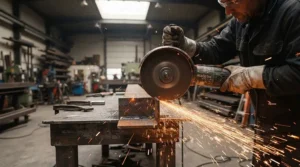
6. Metabo WE 26-230 MVT Quick — best torque and safety brake for continuous site use
The standout feature is the mechanical disc brake paired with a dead-man’s switch — release the trigger and the disc stops within roughly 2.5 seconds, rather than free-spinning for the 10-15 seconds you’d get on brake-free rivals. That’s not a small detail: a spinning 230mm disc carries genuine momentum, and a fast, forced stop matters enormously the moment you set the tool down or it slips from your grip.
The 2,600W Marathon motor outputs more raw torque than every other corded grinder on this list, running at 6,600rpm with an 18Nm torque rating that translates into noticeably less bogging-down when the disc bites into thick steel sections or reinforced concrete. Metabo’s VibraTech (MVT) damping system and rotating handle — mountable in three positions — mean the extra weight (6.3kg, the heaviest corded option here) is at least manageable through reduced vibration transfer.
Based on the spec comparison, this is squarely a professional-grade tool: the electronic overload protection, restart protection and Metabo’s “Quick” tool-free disc-change system all point to a machine designed for people using it eight hours a day, not occasionally at weekends. What most buyers overlook is that Metabo’s dead-man’s switch, which requires continuous pressure rather than a lock-on trigger, actually improves safety on a tool this powerful, even though it demands slightly more hand fatigue over long sessions.
Pros:
- ✅ Mechanical disc brake stops the wheel in around 2.5 seconds
- ✅ Highest torque output of the corded models here
- ✅ MVT damping reduces vibration despite the extra weight
Cons:
- ❌ Heaviest corded grinder on this list at 6.3kg
- ❌ Premium pricing compared with Bosch or DeWalt
At roughly £250-£320 at the time of research, the Metabo WE 26-230 MVT Quick is built for tradespeople who run a grinder continuously and need the safety margin that a proper disc brake provides.
7. Milwaukee M18 FUEL 230mm — best cordless freedom for site use
The standout feature is simple: it’s a genuinely capable 230mm grinder with no cable at all, powered by an 18V REDLITHIUM battery rather than a wall socket. Milwaukee’s Powerstate brushless motor delivers 6,600rpm and, according to the manufacturer, up to 68 cuts through 42mm stainless steel pipe on a single 12.0Ah charge — numbers that matter far more once you translate them into “I don’t need to find a generator on a half-built site.”
RAPIDSTOP, Milwaukee’s disc brake, halts the wheel in under two seconds, matching the safety benefit Metabo offers but without a trailing cable to snag on scaffolding or rebar. Here’s what to weigh: at 5.3-5.4kg it’s competitive with corded rivals despite carrying a battery, but that’s the bare tool weight — factor in a 12.0Ah battery and the working weight climbs, which is worth testing in-hand before committing.
The FIXTEC nut allows fully tool-free disc changes, and the anti-vibration side handle plus removable dust screens point to a design genuinely built around jobsite realities rather than showroom specs. On paper, the trade-off is upfront cost: buying into the M18 platform (bare tool plus battery and charger, or joining an existing M18 ecosystem) costs meaningfully more than an equivalent corded grinder, though anyone already running Milwaukee M18 tools sidesteps that cost entirely.
Pros:
- ✅ No cable, full mobility anywhere on site
- ✅ RAPIDSTOP brake stops the disc in under two seconds
- ✅ Shares batteries across the whole M18 platform
Cons:
- ❌ Premium price, especially with battery and charger included
- ❌ Runtime ultimately capped by battery charge
Priced from around £400 bare up to £530 with a battery included, the Milwaukee M18 FUEL 230mm suits professionals who already run M18 tools or who put a genuine premium on cordless freedom over raw cost.
230mm vs 115mm/125mm Angle Grinders: Which Size Do You Actually Need?
This is the question that trips up more buyers than any spec comparison. A 115mm grinder handles roughly 90% of domestic UK tasks — cutting paving slabs, grinding welds, removing rust — and does it at lower weight and lower cost. Step up to 125mm and you gain a little more cutting depth and material coverage per pass. Reserve 230mm grinders specifically for jobs where cutting depth genuinely matters: thick steel sections, structural concrete, masonry over roughly 40-70mm thick. The trade-off is real. A 230mm grinder weighs 5-6.5kg against 1.7-2.7kg for a 115mm model, demands two-handed operation at all times, and generates substantially more kinetic energy if a disc fails — which is precisely why guarding, PPE and correct technique matter more here than on any smaller grinder.
| Factor | 115mm/125mm Grinder | 230mm Grinder |
|---|---|---|
| Typical weight | 1.7-2.7kg | 5-6.5kg |
| Max cutting depth | 28-40mm | 65-70mm+ |
| Operation | One or two-handed | Two-handed only |
| Best For | DIY, trims, welds, tight spaces | Structural cutting, masonry, thick steel |
The analysis here is simple: buying a 230mm grinder for tasks a 115mm model handles comfortably means carrying unnecessary weight and cost for no real benefit, while buying a 115mm grinder for structural work means it simply won’t cut deep enough — there’s no clever workaround for physics. If your job list genuinely includes concrete lintels, thick box-section steel, or paving slab demolition, a 230mm angle grinder for heavy-duty grinding earns its extra bulk. If it doesn’t, save the money and the wrist strain.
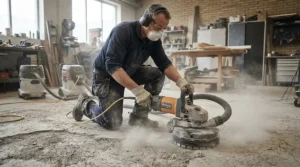
How to Choose a 230mm Angle Grinder for Heavy-Duty Grinding
Picking the right model comes down to seven practical checks, each worth weighing against how you’ll actually use the tool.
- Motor wattage — 2,000W is a sensible baseline; 2,600W models like the Metabo WE 26-230 MVT Quick deliver noticeably more torque under load for thick material.
- Safety braking — a mechanical or electronic disc brake, as found on the Metabo WE 26-230 MVT Quick and Milwaukee M18 FUEL 230mm, stops the wheel in seconds rather than letting it free-spin.
- Soft start — reduces the initial kickback torque, which matters most for less experienced users or anyone working from a ladder or awkward stance.
- Weight and balance — every extra 500g matters over a full working day; test-hold a model in-store where possible before buying online.
- Corded vs cordless — corded gives unlimited runtime at lower cost; cordless models like the Milwaukee M18 FUEL 230mm trade battery life for total mobility.
- Disc-change mechanism — tool-free systems (Metabo’s Quick nut, Milwaukee’s FIXTEC) save real time across a working week of frequent disc swaps.
- Warranty and parts availability — brands with strong UK trade-counter presence, such as Makita GA9020 and Bosch GWS 22-230 JH, make servicing and spare parts noticeably easier to source.
Heavy-Duty Grinding Discs: What Actually Matters
The grinder is only half the equation — heavy-duty grinding discs determine what that motor can actually achieve, and this is where buyers most often shortchange themselves. A 230mm grinder is only as capable as the disc bolted to it: a cheap, thin metal-cutting disc will bind, overheat and wear through far faster than a reinforced depressed-centre disc rated for the tool’s full 6,600rpm. What most buyers overlook is that discs carry their own maximum RPM rating printed on the label, and running a disc below its rated speed is fine, but a mismatch the other way is a genuine safety hazard, not a technicality. For genuinely heavy-duty work — cutting rebar-reinforced concrete, structural steel, or repeated masonry cuts — buy discs specifically rated for that material rather than a generic “multi-purpose” disc, since the bonding agents differ meaningfully between metal, stone and masonry formulations. Diamond blades are worth the extra outlay for concrete and paving work specifically: they last dramatically longer than abrasive discs on masonry and produce a cleaner cut with less disc wear per metre cut. Reviewers across trade forums consistently note that disc quality, not grinder brand, is the single biggest factor in whether a 230mm grinder job goes smoothly or turns into a frustrating, disc-eating slog — a detail that’s easy to miss when the buying decision focuses entirely on the tool itself.
Large Disc Torque Explained: What the Numbers Mean for Your Job
Large disc torque is the figure that actually predicts how a grinder behaves once it’s under real load — not the no-load rpm figure most listings lead with. No-load speed tells you how fast the disc spins with nothing resisting it; torque tells you how well the motor holds that speed once it’s biting into thick steel or dense concrete. This is why the Metabo WE 26-230 MVT Quick, rated at 18Nm, feels noticeably more confident cutting through structural material than a lower-torque 2,000W grinder, even though both spin at similar rpm figures on paper. Here’s what the spec sheet won’t tell you directly: when a lower-torque grinder bogs down mid-cut, the temptation is to push harder, which increases the risk of kickback and uneven wear on the disc edge — exactly the scenario the HSE’s guidance on the Provision and Use of Work Equipment Regulations 1998 is designed to prevent through proper equipment selection for the task. Practically speaking, if your work regularly involves cutting depth beyond 40-50mm in dense material, prioritise a higher-wattage, higher-torque model over a lighter, lower-power grinder — the time saved not fighting a stalling motor pays for itself within the first few jobs.
Two-Handed Grip Safety: Why 230mm Grinders Demand It
Two-handed grip safety isn’t a suggestion for 230mm grinders — every model in this guide, from the HiKOKI G23ST to the Milwaukee M18 FUEL 230mm, is designed and guarded on the assumption of two-handed operation at all times. The reasoning is physical rather than bureaucratic: a 230mm disc spinning at 6,500-6,600rpm carries far more rotational energy than a 115mm equivalent, and if the disc catches or a kickback occurs, a single-handed grip simply cannot control the resulting torque reaction. According to HSE guidance HSG17 on abrasive wheels, nearly half of all abrasive wheel accidents result from unsafe operating procedure rather than mechanical failure — a statistic that puts the emphasis squarely on technique and grip rather than equipment quality alone. In practice, that means keeping the auxiliary side handle fitted at all times (never removing it “just for this one cut”), maintaining a firm stance with feet positioned to absorb a kickback rather than be knocked off balance, and never locking the trigger on models without a genuine dead-man’s switch, such as the Metabo WE 26-230 MVT Quick. Hand-arm vibration is a related, longer-term risk worth taking seriously too — HSE’s guidance on hand-arm vibration notes that regular exposure from tools like grinders can cause permanent nerve and blood vessel damage over years of use, which is part of why anti-vibration handles on models like the Makita GA9020 and Metabo WE 26-230 MVT Quick matter for anyone using a grinder daily rather than occasionally.
Practical Usage Guide: Setup, First 30 Days and Maintenance
Getting a new 230mm grinder set up correctly in its first few weeks prevents most of the common early failures. Before first use, always fit the guard in the correct orientation for your task (cutting guards differ from grinding guards on several models), check the disc’s rated RPM against the tool’s maximum speed, and hand-tighten the flange nut fully rather than relying on the spanner alone for the initial seating. During the first 30 days, resist the temptation to push the tool harder than the motor wants to go — new brushes and bearings benefit from a gentler break-in period, and several manufacturer warranties (including Makita’s three-year extension) require registration within a set window, so do this immediately rather than filing it away. Maintenance-wise, clean dust from the motor vents after every heavy session using compressed air rather than a cloth, since packed dust is the single biggest cause of premature motor failure in site-condition grinders. Check the carbon brushes every few months on brushed models (the DeWalt DWE492‘s brush window makes this genuinely quick), and inspect the guard and flange for cracking or wear before every job, not just periodically. A common first-30-days mistake is storing the grinder with a part-worn disc still fitted — discs degrade differently in storage than in use, and starting a new job with an old, unknown-condition disc is a false economy that costs more in re-cuts than a fresh disc would have.
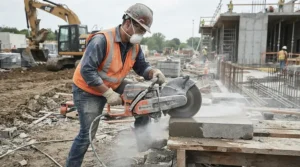
230mm Grinders for Construction Site Use: Real-World Scenarios
Construction site use puts genuinely different demands on a 230mm grinder than an occasional home workshop job, and matching the right tool to the right profile saves both money and frustration.
The self-employed groundworker cutting paving and kerbs daily: frequent, repeated cuts in masonry and concrete favour a corded grinder with strong dust sealing and a tool-free disc change, since time lost swapping discs adds up fast across a working week — the HiKOKI G23ST or Einhell TE-AG 230/2000 offer strong value here without the premium price tag.
The electrical or plumbing contractor working across multiple sites without reliable power access: mobility trumps raw power here, making the Milwaukee M18 FUEL 230mm‘s cordless design genuinely valuable despite the higher upfront cost, particularly for anyone already invested in the M18 battery platform.
The structural steel fabricator running the grinder for hours at a stretch, daily: continuous-duty reliability and safety braking become non-negotiable at this frequency, which is exactly where the Metabo WE 26-230 MVT Quick‘s disc brake and 2,600W Marathon motor justify the premium price over lighter-duty alternatives.
Matching your actual usage pattern — occasional versus daily, mains-fed versus mobile, light structural versus heavy fabrication — to these profiles is a more useful exercise than simply buying the highest-spec model available.
Buyer’s Decision Framework: Which 230mm Grinder Should You Choose?
If you’re weighing several strong options, a simple decision tree cuts through most of the noise. If safety braking and continuous daily use are your priority, choose the Metabo WE 26-230 MVT Quick because its dead-man’s switch and mechanical brake are built for exactly that demand profile. If cordless mobility matters more than upfront cost, choose the Milwaukee M18 FUEL 230mm because eliminating the cable outweighs the price premium for anyone working across multiple sites without reliable power. If you want dependable mid-range performance from an established brand, choose either the Bosch GWS 22-230 JH or the Makita GA9020 because both balance soft-start comfort or anti-vibration ergonomics against sensible pricing. If budget is the deciding factor and your usage is occasional rather than daily, choose the HiKOKI G23ST or Einhell TE-AG 230/2000 because both deliver genuine 2,000W-class performance without premium-brand pricing. Finally, if handle flexibility on awkward angles matters most for your specific jobs, choose the DeWalt DWE492 because its two-position side handle solves a problem the other grinders on this list don’t directly address.
Common Mistakes When Buying a 230mm Angle Grinder
The most frequent mistake is buying based on wattage alone without checking weight and ergonomics — a 6.3kg grinder like the Metabo WE 26-230 MVT Quick is genuinely harder to control overhead than a 5.1kg model like the HiKOKI G23ST, regardless of how their spec sheets compare. A second common error is assuming all 230mm grinders are interchangeable for every heavy task; a grinder built for grinding welds flat isn’t necessarily optimised for deep structural cutting, and matching the tool’s guard and disc compatibility to your actual job matters more than most buyers realise before their first project. Buyers also frequently skip checking disc availability and cost before committing to a grinder — some models favour specific flange or nut systems that limit which third-party discs fit cleanly, which becomes a recurring frustration only after purchase. Underestimating vibration exposure is another mistake: anyone planning genuinely regular use should prioritise anti-vibration handles (Makita’s AVT, Metabo’s MVT) rather than treating them as a minor convenience feature, given the long-term health risks documented in HSE’s guidance on hand-arm vibration. Finally, several buyers overlook safety braking entirely when it’s arguably the single most valuable safety feature available on premium models like the Metabo WE 26-230 MVT Quick and Milwaukee M18 FUEL 230mm — a disc that stops in two seconds rather than fifteen is a meaningfully different risk profile the moment something goes wrong.
Long-Term Cost & Maintenance: The Real Cost of Ownership
The purchase price is only the starting point for total cost of ownership on a 230mm grinder. Discs are the real recurring expense — heavy structural cutting can chew through several discs across a single demanding job, and diamond blades, while pricier upfront, last dramatically longer on masonry and concrete work, often paying for themselves within a handful of jobs compared with repeatedly replacing abrasive discs. Carbon brushes on brushed motors (all models here except the Milwaukee M18 FUEL 230mm) typically need replacing every so often depending on use intensity, and models with accessible brush windows, like the DeWalt DWE492, keep that a quick, low-cost job rather than a workshop visit. Cordless ownership carries a different cost structure entirely: battery replacement every few years and the upfront cost of the M18 platform mean the Milwaukee M18 FUEL 230mm costs more over its lifetime than an equivalent corded tool, unless you’re already sharing batteries across other M18 tools, in which case the marginal cost drops considerably. Warranty terms also matter more than they first appear: Makita’s three-year extension on registration effectively extends the useful ownership window at zero extra cost, while premium brands like Metabo generally offer stronger build tolerances that reduce total repair frequency across years of continuous professional use, even if the upfront price sits higher.
| Cost Factor | Budget Models (HiKOKI, Einhell) | Premium Models (Metabo, Milwaukee) |
|---|---|---|
| Upfront price | Under £100 | £250-£530 range |
| Disc/battery running cost | Standard disc cost only | Disc cost, or battery replacement cycle |
| Expected service life | Solid for occasional-to-regular use | Built for continuous daily use |
| Best For | Occasional to regular DIY/trade use | Daily professional site use |
Weighing this table against your actual usage frequency is more useful than comparing sticker prices alone: a tradesperson running a grinder five days a week will recoup a premium model’s extra cost in downtime avoided far faster than someone using it for the occasional weekend project.
FAQ
❓ How fast does a 230mm angle grinder spin?
❓ Can I use a 230mm angle grinder to cut concrete?
❓ Is a cordless 230mm angle grinder as powerful as a corded one?
❓ Do I need special PPE for a 230mm angle grinder?
❓ How often should I replace grinding discs on a 230mm grinder?
Conclusion
Choosing the right 230mm angle grinder for heavy-duty grinding really comes down to matching the tool to how often, and how hard, you’ll actually use it. For occasional structural jobs, the HiKOKI G23ST and Einhell TE-AG 230/2000 deliver genuine capability without premium pricing. For dependable, trade-trusted performance, the Bosch GWS 22-230 JH, Makita GA9020 and DeWalt DWE492 each bring their own ergonomic strengths to a fairly evenly-matched mid-range field. For daily professional use where safety braking and raw torque matter most, the Metabo WE 26-230 MVT Quick stands out, while the Milwaukee M18 FUEL 230mm answers the specific need for cordless mobility across multiple sites. Whichever model fits your workload, remember that the grinder itself is only one part of the equation — correct heavy-duty grinding discs, disciplined two-handed grip safety, and realistic expectations around large disc torque under load all shape whether the tool performs the way its spec sheet promises. Construction site use, in particular, rewards buyers who think in terms of total cost and safety margin rather than sticker price alone.
✨ Don’t Miss These Exclusive Deals!
🔍 Take your grinding projects to the next level with these carefully selected products. Click on any highlighted item to check current pricing and availability. These tools will help you tackle genuinely heavy-duty jobs with confidence your family and clients will appreciate!
Recommended for You
- Cordless Angle Grinder for Cutting Tiles: 7 Best Picks (2026)
- 125mm Angle Grinder: 7 Best Picks; Buying Guide (2026)
- Cordless Angle Grinder Under £100: 7 Best UK Picks for 2026
Disclaimer: This article contains affiliate links. As an Amazon Associate, I earn from qualifying purchases. If you purchase products through these links, we may earn a small commission at no additional cost to you.
✨ Found this helpful? Share it with your friends! 💬🤗
