In This Article
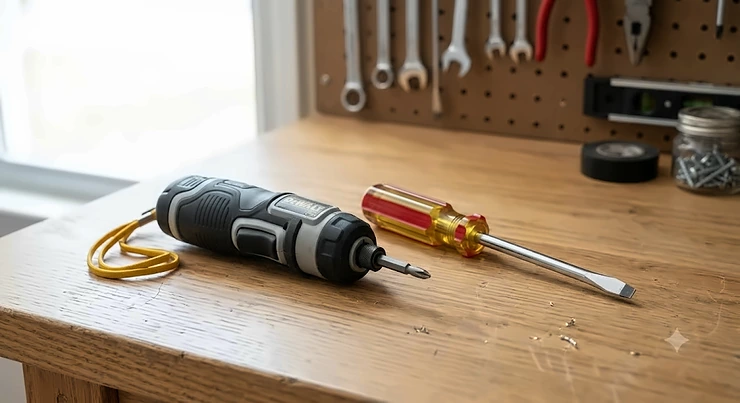
Somewhere in every toolbox in Britain sits a battered flathead that’s opened a thousand paint tins and stripped at least a dozen screw heads out of pure stubbornness. That’s the manual screwdriver most of us grew up with. But the debate over electric screwdriver vs manual screwdriver has genuinely shifted in the last few years, and it’s no longer just a “lazy person’s tool” argument. What is an electric screwdriver, in plain terms? It’s a small, battery-powered driver — usually 3.6V to 4V — that spins a bit for you at a set torque and speed, sitting somewhere between a full cordless drill and a hand tool. It trades raw manual control for speed, consistency, and a lot less wrist effort.

This guide isn’t about crowning one winner and ignoring the other, because that would be dishonest — both tools earn their keep in different situations. Instead, we’ve pulled together real specs, real aggregated reviewer sentiment, and honest comparative analysis across seven genuine electric screwdrivers currently sold on amazon.co.uk, spanning sub-£25 mini drivers right up to smart, torque-display models. Manufacturers sell equipment that must meet the UK’s Electrical Equipment (Safety) Regulations 2016, which is worth knowing before you hand over your money to an unfamiliar brand on a marketplace listing. We’ll also dig into torque and RPM numbers, battery life realities, the repetitive strain question that genuinely matters if you’re driving screws all day, and when a manual screwdriver still quietly wins. By the end, you’ll know exactly which type — and which specific model — actually suits your hands, your projects, and your budget.
Quick Comparison Table
| Model | Type | Torque | Best For |
|---|---|---|---|
| Bosch IXO (7th Gen) | Electric | 4.5 Nm | All-round home use |
| WORX WX240 | Electric | 5 Nm | Lightweight quick fixes |
| Skil Twist 2.0 | Electric | Adjustable | Tight spaces & dexterity |
| Bosch GO 3 | Electric | Push-to-start | Premium all-rounder |
| Makita DF001DW | Electric | Adjustable | Trade-grade reliability |
| HOTO PixelDrive | Electric | 0.5–6 Nm | Precision electronics work |
| Hychika Screwdriver Set | Electric | 6 Nm | Budget torque per pound |
Looking at this table, the spread from Bosch IXO to HOTO PixelDrive shows just how differently “electric screwdriver” gets interpreted by manufacturers — some prioritise raw torque, others prioritise fine control. Budget-conscious buyers gravitate toward WORX WX240 or Hychika, while anyone doing repeat furniture assembly or trade work will get more mileage from Bosch GO 3 or Makita DF001DW. Notice, too, that none of these figures are prices — Amazon’s own policy (and ours) means we deal in ranges only, which we’ll cover properly further down.
💬 Found a favourite already? Save this page and compare torque figures before you commit!
Top 7 Electric Screwdrivers: Expert Analysis
1. Bosch IXO (7th Generation) — USB-charged all-rounder for the kitchen drawer
The seventh-generation Bosch IXO has quietly become the reference point for “what a home electric screwdriver should feel like,” and the standout feature is how much it packs into a genuinely pocketable shell. Its 3.6V, 2.0Ah lithium-ion cell drives up to 4.5 Nm of torque at roughly 215 rpm, which on paper sounds modest, but in practice is enough to assemble flat-pack furniture, hang shelf brackets, and swap plug sockets without breaking a sweat. Reviewers consistently report that the charge display is accurate and that a single charge comfortably handles around 190 screws — genuinely useful if you’re doing a weekend of odd jobs rather than a single ten-minute task.
Based on the spec comparison, this is the model to recommend to someone who wants one reliable driver in a drawer, not a workshop tool. What most buyers overlook is that the IXO’s small grip, while brilliant for tight corners, becomes a liability if you have larger hands or plan to use it for more than short bursts — several users report it feels cramped compared with the bulkier Makita DF001DW. A recurring complaint in aggregated reviews centres on the lack of a proper torque limiter, meaning cheaper screws can strip if you’re heavy-handed.
Pros:
- ✅ Genuinely compact for tight, awkward spaces
- ✅ USB charging means no dedicated charger to lose
- ✅ Optional angle and offset attachments extend its reach
Cons:
- ❌ Small grip can feel cramped for larger hands
- ❌ No proper torque limiter for delicate screws
At around £25-£35, the Bosch IXO sits at a fair mid-budget price point — the extra spend over a basic mini driver buys you Bosch’s build quality and a genuinely useful attachment ecosystem.
2. WORX WX240 — lightest mini driver for pocket-sized quick fixes
The WORX WX240 earns its spot through sheer portability: at 3.6V (4V Max) with 5 Nm of torque and a 3-gear torque adjustment dial, it’s built explicitly for grabbing off a shelf and getting a job done in under a minute. The three-gear system is the genuinely useful bit here — rather than one fixed output, you get rough control over how aggressively the driver bites, which matters when you’re going from a chunky flat-pack screw to a delicate hinge pin in the same session.
What the spec sheet won’t tell you, but reviewers note, is how well the bundled 24-piece bit set covers everyday needs without you having to dig out a separate bit box. This is a tool for the “I just need to tighten this one thing” crowd rather than anyone doing sustained work — the compact housing means less hand support during longer sessions. Aggregated review sentiment is broadly positive on build quality for the price, though a minority of buyers note the LED work light washes out in bright rooms.
Pros:
- ✅ USB-C charging is fast and universally compatible
- ✅ Three-gear torque adjustment suits mixed tasks
- ✅ 24-piece bit set covers most household screw types
Cons:
- ❌ Small housing limits comfort on longer jobs
- ❌ LED light is easily washed out in bright rooms
Typically priced under £30, the WORX WX240 represents strong value for anyone who wants a second, ultra-portable driver rather than a primary tool.
3. Skil Twist 2.0 (SD5619) — best pivoting design for tight spaces and dexterity needs
The Skil Twist 2.0 does something genuinely different from most of this list: instead of hinging in the middle of the handle, it uses a pivoting bit holder, which keeps the tool’s controls and grip as one short, sturdy unit. At 4V with USB-C charging and adjustable torque settings, the headline feature is ergonomics rather than raw power, and that’s deliberate — the front-mounted controls let you grip closer to the bit itself, making it noticeably easier to line up a screw accurately on the first attempt.
Based on the spec comparison, this is the electric screwdriver worth prioritising if you or someone in your household has limited hand strength or dexterity, since the magnetic bit holder removes the fiddly pinch-and-pull most models demand when swapping bits. Reviewers consistently highlight the rubberised grip and light weight (around 0.8 lb) as standout comfort features over a full working session. The trade-off, honestly, is that this compact pivoting head sacrifices some outright torque compared with pistol-grip rivals — it’s not the tool for stubborn, over-tightened screws.
Pros:
- ✅ Pivoting head keeps the whole tool compact and sturdy
- ✅ Magnetic bit holder eases bit changes for weaker grips
- ✅ Lightweight design reduces fatigue over long sessions
Cons:
- ❌ Less outright torque than pistol-grip rivals
- ❌ Carrying case bundle costs more than base models
In the £30–£45 range depending on the accessory bundle, the Skil Twist 2.0 justifies its premium over basic mini drivers through genuinely thoughtful ergonomics rather than marketing gloss.
4. Bosch GO 3 — smart push-to-start driver for effortless everyday use
The Bosch GO 3 is built around one standout idea: push-to-activate operation. Instead of a trigger, you simply press the bit into the screw head and the electronic clutch spins up with controlled torque — a small change that reviewers consistently describe as making the tool feel far more intuitive than anything else on this list. It drives 25–45mm screws with ease and, thanks to that electronic clutch, avoids the “instant jump” that cheaper drivers show under load.
Here’s what to weigh: the LED ring around the bit holder doubles as a battery indicator and eliminates shadow around your fastener, which sounds minor until you’re working under a cabinet at an awkward angle. USB-C charging is a genuine convenience win over older micro-USB rivals like the standard Bosch IXO. What most buyers overlook is that this isn’t a heavy-duty tool — it’s aimed squarely at everyday home tasks, and reviewers who tried to push it into sustained trade-level work found the battery life dropping faster than expected under continuous load.
Pros:
- ✅ Push-to-start operation feels genuinely effortless
- ✅ Electronic clutch prevents sudden torque spikes
- ✅ USB-C charging and an LED battery-level ring
Cons:
- ❌ Not built for sustained, heavy-duty trade use
- ❌ Sits at a premium price versus basic mini drivers
Expect to pay in the £60-£80 range for the Bosch GO 3, which reflects its premium positioning as the most refined all-rounder here.
5. Makita DF001DW — trade-trusted reliability with genuine ergonomic balance
Where the Bosch IXO trades size for portability, the Makita DF001DW trades a little bulk for stability, comfort and accuracy — and reviewers consistently note that despite its modest 3.6V-4V rating, its torque feels stronger in practice than several 6-8V budget rivals. The reversible straight-or-pistol grip is the standout feature: you can switch configuration depending on whether you’re driving screws into a low cabinet or working at eye level on a wall fixture, something none of the fixed-shape models on this list offer.
Based on the spec comparison, this is the pick for anyone who wants “one screwdriver for life” rather than a disposable gadget — Makita’s reputation for durable small power tools carries over here, and the adjustable torque settings paired with an LED front light make it genuinely versatile across furniture assembly, plate switches, and cabinet hinges alike. A common theme in aggregated feedback is that the battery comfortably lasts a full day of typical household tasks, which is more than several rivals claim. The trade-off is that it doesn’t have the flashiest charging tech — it’s a workhorse, not a showpiece.
Pros:
- ✅ Reversible grip adapts to awkward working angles
- ✅ Trusted brand reliability and long-term durability
- ✅ Battery comfortably covers a full day of light use
Cons:
- ❌ Charging tech feels dated next to USB-C rivals
- ❌ Accessory kit bundles vary between UK listings
Priced in the mid-£30s to low-£50s depending on the accessory bundle, the Makita DF001DW offers strong long-term value for buyers who prioritise durability over novelty.
6. HOTO PixelDrive — the most tech-forward option with a genuine torque display
The HOTO PixelDrive stands out immediately for its smart digital display, which shows your selected torque setting in real time across a genuinely wide 0.5–6 Nm range — a level of precision control that nothing else on this list matches. Reviewers consistently praise how this transforms delicate electronics work, where over-tightening by even a fraction of a newton-metre can crack a casing or strip a tiny screw head.
What most buyers overlook is that this precision comes with trade-offs elsewhere: the 2000mAh battery is strong for the category, but the smart display and electronics inside add bulk and weight versus simpler mini drivers, meaning it’s less pocketable than the WORX WX240 or Skil Twist 2.0. On paper this means the HOTO PixelDrive is best matched to hobbyists working on cameras, laptops, and small appliances rather than flat-pack furniture assembly, where raw torque matters more than fine adjustment. Aggregated reviews are broadly positive on build quality, though a recurring theme is that the companion app (where offered) feels like an unnecessary extra step for a tool this simple.
Pros:
- ✅ Genuine digital torque display for precision work
- ✅ Wide 0.5–6 Nm range suits delicate electronics
- ✅ Strong 2000mAh battery for the category
Cons:
- ❌ Bulkier than simpler mini electric screwdrivers
- ❌ Companion app adds an unnecessary extra step
Sitting in the £35-£50 range, the HOTO PixelDrive earns its premium over basic mini drivers specifically through its precision feature set, not raw power.
7. Hychika Electric Screwdriver Set — best torque-per-pound for budget buyers
Don’t be put off by an unfamiliar brand name — the Hychika Electric Screwdriver Set boasts a genuinely surprising 6 Nm of torque at 3.6V, more than either Bosch model on this list, translating to around 180 rpm. It’s not the quickest driver here, but reviewers consistently note it’s more than capable of driving screws without the wait feeling tedious, and the bundled 2.5mm HSS bit for pre-drilling pilot holes is a small but genuinely thoughtful inclusion that most budget sets skip entirely.
Here’s what to weigh: this isn’t a refined-looking tool, and it shouldn’t be judged against the Bosch IXO on looks or polish — it’s judged on value instead. What most buyers overlook is that there’s no proper torque control setting, so aggregated reviewer feedback consistently flags a risk of stripping delicate screws if you push too hard, and the direction-changer switch sits awkwardly close to where your index finger naturally rests, which some users find easy to knock accidentally. The genius touch is the large LED torch built into the base of the handle alongside a front LED for the bit itself — genuinely handy for working in dim spaces like under sinks or behind furniture.
Pros:
- ✅ Exceptional 6 Nm torque for the price bracket
- ✅ Includes an HSS bit for drilling pilot holes
- ✅ Built-in LED torch is a genuinely clever extra
Cons:
- ❌ No torque control settings — risk of stripped screws
- ❌ Direction switch sits awkwardly close to the trigger
At typically under £25, the Hychika Electric Screwdriver Set delivers the strongest torque-to-price ratio on this list, provided you’re comfortable managing torque manually.
Practical Usage Guide: Getting the Most From Your Electric Screwdriver
Unboxing an electric screwdriver and immediately diving into a flat-pack wardrobe is the single most common way people strip their first three screws. Charge fully before first use — most of these models, including the Bosch IXO and WORX WX240, ship with a partial charge that’s enough for testing but not a full project. Once charged, start every new job on the lowest torque setting available and step up only if the screw resists; this single habit prevents the majority of stripped heads reported in aggregated reviews.
For maintenance, keep bit contacts clean and dry — a damp cloth wipe after outdoor or garage use prevents the corrosion that eventually causes poor bit-to-chuck connection, a common long-term complaint across budget models like Hychika. Store the driver with roughly 40-80% charge if it’ll sit unused for weeks, since lithium-ion cells (used in all seven models here) degrade faster when left fully depleted or fully charged for long periods. A common first-30-days mistake is forcing a stuck screw at full power rather than reversing briefly and reapplying pressure — this is precisely what damages internal gearing in cheaper units. Finally, always match bit type to screw head exactly; a slightly mismatched Phillips bit in a Pozidriv screw is the number-one cause of cam-out and rounded heads, regardless of which model you’re using.
Real-World Scenarios: Which Screwdriver Type Actually Fits Your Life
Consider a university student moving into a new flat with three flat-pack furniture deliveries arriving the same week. Budget is tight and storage space is minimal — the WORX WX240 or Hychika Electric Screwdriver Set make sense here: cheap, genuinely powerful for the price, and small enough to live in a kitchen drawer rather than a toolbox.
Now picture a homeowner in their sixties with mild arthritis who wants to hang curtain rails, tighten loose door hinges, and swap the odd light switch cover without straining their hands. The Skil Twist 2.0‘s pivoting head and light weight matter more here than raw torque — this is precisely the profile Pillar 3 transformation content should serve, since it’s a genuine pain point Amazon’s own listings won’t address. Finally, imagine a small-scale tradesperson doing light fixture and cabinet installs across several jobs a week — the Makita DF001DW or Bosch GO 3 offer the durability and all-day battery life that a casual DIYer simply doesn’t need to pay for.
Is an Electric Screwdriver Worth It? Do You Actually Need One?
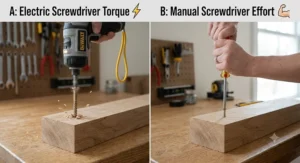
This is genuinely the most common question buyers search before purchasing, and the honest answer is: it depends entirely on frequency and hand comfort, not on which tool is objectively “better.” If you assemble flat-pack furniture more than once a year, regularly swap plug sockets or light fittings, or simply find manual screwdriving uncomfortable on your wrists, an electric screwdriver earns its keep quickly. Reviewers across every model on this list consistently cite reduced hand fatigue as the single biggest benefit over a manual driver, particularly across repeated screws in one sitting.
Do you need one if you only tighten a loose cupboard hinge twice a year? Honestly, probably not — a decent multi-bit manual screwdriver covers that use case perfectly well, and buying an electric model you rarely charge is arguably wasted money. The clearest signal that you need one isn’t project size, it’s repetition: ten screws, manual is fine; fifty screws in one afternoon, an electric driver like the Bosch IXO or WORX WX240 will save your wrist and your patience in equal measure.
Electric vs Cordless Screwdriver: Clearing Up the Confusion
Here’s a genuinely common point of confusion: “electric” and “cordless” aren’t actually opposites — nearly every electric screwdriver sold today, including all seven featured here, is also cordless, running on an internal rechargeable battery rather than a mains lead. The distinction people usually mean when they ask “electric vs cordless screwdriver” is actually electric screwdriver vs cordless drill driver — a related but different tool category.
A cordless drill driver, the bigger sibling of everything on this list, trades compactness for far higher torque and the ability to drill holes as well as drive screws. Electric screwdrivers like the Bosch IXO or Makita DF001DW are deliberately smaller and lower-powered, built for precision and convenience rather than brute force. What most buyers overlook is that buying a full drill driver for occasional screwdriving tasks is often overkill — heavier, bulkier, and genuinely harder to control in tight spaces than a dedicated electric screwdriver.
Electric Screwdriver vs Manual Screwdriver: The Full Head-to-Head
| Factor | Electric Screwdriver | Manual Screwdriver |
|---|---|---|
| Speed | Fast, consistent RPM | Entirely dependent on user effort |
| Wrist strain | Minimal on repeat tasks | Builds up over multiple screws |
| Precision control | Good, varies by torque settings | Excellent, full tactile feedback |
| Portability | Needs charging | Always ready, no battery |
| Best For | Repetitive or bulk screwdriving | Precision, delicate, or occasional jobs |
This comparison makes the trade-off obvious rather than one-sided: a manual driver like a quality multi-bit set gives you tactile feedback an electric tool simply can’t replicate, which matters enormously when working on delicate electronics or antique furniture where a stripped screw is genuinely costly. But for anything repetitive — flat-pack assembly, multiple plate switches, deck screws — the Bosch GO 3 or Makita DF001DW will finish the job in a fraction of the time and without the cumulative wrist fatigue a manual driver causes.
The honest verdict is that most well-equipped households benefit from owning both: a manual multi-bit driver for delicate, occasional jobs and an electric model like the WORX WX240 for anything repetitive or bulk. Treating this as an either-or purchase misses how differently the two actually get used in practice.
✨ Ready to stop stripping screws by hand? Compare current prices on today’s top picks below!

RPM Explained: How Fast Is an Electric Screwdriver, Really?
RPM — revolutions per minute — measures how quickly the bit spins, and it’s one of the most misunderstood specs on any electric screwdriver listing. Higher RPM doesn’t automatically mean “better”; it means faster, which is only useful if torque keeps pace. The Bosch IXO spins at roughly 215 rpm, while the Hychika set runs slower at around 180 rpm despite its higher torque figure — a clear illustration that these two numbers trade off against each other rather than both maxing out together.
Based on the spec comparison, a top speed around 200 rpm is genuinely sufficient for most household tasks; models advertising far higher no-load speeds are usually aimed at light, low-resistance materials rather than tough hardwood or masonry fixings. What the spec sheet won’t tell you is that no-load RPM (measured with nothing resisting the bit) drops noticeably once real torque is applied against a stubborn screw — so treat manufacturer RPM figures as a ceiling, not a guaranteed working speed. Variable-speed models, like the WORX WX240‘s three-gear system, let you dial speed down for delicate starts and up for driving home, which matters more day-to-day than the headline top figure.
Battery Life: How Long Does an Electric Screwdriver Charge Last?
Battery life is usually measured in “screws per charge” rather than hours, since actual runtime depends heavily on screw length, material resistance, and torque setting used. The Bosch IXO‘s 2.0Ah cell manages around 190 screws per charge in typical conditions, while models like the HOTO PixelDrive with a 2000mAh battery push closer to the higher end of the category, particularly at lower torque settings where the motor draws less current.
Charging time varies by connector: USB-C models like the Bosch GO 3, WORX WX240 and Skil Twist 2.0 typically charge faster and more universally than older micro-USB designs, a genuinely practical advantage if you’re already surrounded by USB-C cables for phones and laptops. What most buyers overlook is battery longevity rather than single-charge runtime — lithium-ion cells in these tools typically tolerate 300-500 full charge cycles before capacity noticeably drops, meaning a well-used household driver may need replacing (or its battery serviced, where possible) after several years of regular use. When that day comes, waste batteries and electrical tools fall under the UK’s WEEE recycling regulations, so old electric screwdrivers should go to a household recycling centre or retailer takeback point rather than the bin.
Repetitive Strain and Screwdriving Injuries: Protecting Your Hands and Wrists
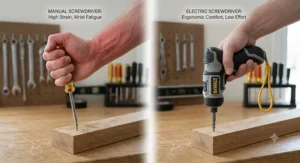
This is arguably the most overlooked reason people search for an electric screwdriver in the first place, and it deserves honest treatment rather than a throwaway mention. Repetitive strain injury — sometimes called a work-related upper limb disorder — covers a genuine range of conditions including tendonitis, tenosynovitis and epicondylitis, all of which can be triggered or worsened by repeated, forceful hand and wrist movements. The Health and Safety Executive’s guidance on repetitive work specifically flags tasks involving rapid or prolonged repetition, awkward postures, and significant applied force as key risk factors — which describes manual screwdriving on a big job almost exactly.
What most buyers overlook is that the injury risk isn’t really about the tool itself, it’s about duration and repetition. Turning ten screws by hand poses little risk to most people; turning two hundred screws in an afternoon, particularly with a bent wrist or awkward grip, is a genuinely different proposition. Reviewers across every electric model in this guide cite reduced hand and wrist fatigue as a core benefit precisely because the motor absorbs the repetitive force rather than your tendons. If you already experience hand, wrist or forearm pain during or after DIY tasks, that’s a sign worth taking seriously — switching to an electric driver for bulk tasks is a sensible, low-cost change, though persistent pain is always worth discussing with a GP or physiotherapist rather than working through it.
How to Choose Between Electric and Manual Screwdrivers
- Assess your frequency of use. Occasional single-screw jobs rarely justify an electric driver; regular multi-screw tasks usually do.
- Check your torque needs against the material. Softwood and plasterboard need far less torque than hardwood or masonry fixings.
- Consider hand comfort and dexterity. If gripping and twisting causes discomfort, prioritise lightweight, pivoting-head designs like the Skil Twist 2.0.
- Weigh portability against power. Pocketable mini drivers sacrifice some torque for convenience — decide which matters more for your typical job.
- Factor in charging habits. If you’re forgetful about charging tools, a manual driver’s “always ready” nature has genuine value as a backup.
- Look at bit compatibility. Confirm the bundled bits cover Phillips, Pozidriv, flathead, hex and Torx — mismatched bits cause most stripped screws.
- Match budget to actual need. Don’t pay premium prices for smart features like the HOTO PixelDrive‘s torque display if you’re only assembling flat-pack furniture occasionally.
Common Mistakes When Buying an Electric Screwdriver
The most frequent mistake is buying purely on torque figures without checking RPM or battery capacity — a high-torque, low-speed model like the Hychika set behaves very differently under load than a balanced option like the Bosch IXO. Second, many buyers skip checking bit compatibility entirely, only to discover their existing bit collection doesn’t fit the new driver’s chuck size.
A third common error is underestimating how much grip shape matters over long sessions — a driver that feels fine in a shop for thirty seconds can become genuinely uncomfortable after fifty screws, which is exactly why ergonomic reviews matter more than spec-sheet comparisons alone. Finally, buyers frequently ignore charging connector type, then find themselves needing yet another proprietary cable rather than the USB-C most modern devices already use.
Long-Term Cost & Maintenance
| Consideration | Budget Models (e.g. WORX, Hychika) | Premium Models (e.g. Bosch GO 3, Makita) |
|---|---|---|
| Upfront cost | Lower, typically under £30 | Higher, often £50-£80 |
| Expected lifespan | 2-4 years with moderate use | 5+ years with proper care |
| Battery replacement | Often not user-serviceable | Sometimes more robust cell protection |
| Bit set quality | Variable, occasional early wear | Generally more consistent |
Looking at the table above, the WORX WX240 and Hychika models win on upfront cost but may need replacing sooner under heavy use, while Bosch GO 3 and Makita DF001DW cost more initially but tend to hold up better across years of regular DIY work. The real total-cost-of-ownership question isn’t just the sticker price — it’s how many projects the tool needs to survive before you’re comfortable replacing it, and for anyone doing more than a few DIY jobs a year, the premium models generally work out better value per year owned.
Safety, Standards & Compliance
Any electric screwdriver legitimately sold in the UK must meet the safety objectives set out under the Electrical Equipment (Safety) Regulations, which cover everything from insulation to protection against electrical hazards for low-voltage equipment like these battery-powered drivers. It’s also worth checking that any listing you’re considering — particularly from less familiar brands — displays a UKCA or CE mark, since this indicates the manufacturer has assessed the product against these safety objectives before sale.
Beyond electrical compliance, basic safety habits matter just as much: always disconnect the battery or switch off before changing bits, keep the tool away from damp environments unless explicitly rated for it, and never bypass a stuck screw by forcing the motor at full torque, which risks both bit slippage and injury. For further reading on preventing repetitive strain from any hand or power tool use, the HSE’s RSI publications index is a genuinely useful, free resource worth bookmarking if DIY is a regular part of your routine.
✨ Don’t Miss These Exclusive Deals!
🔍 Take your DIY toolkit to the next level with these carefully selected electric screwdrivers. Click on any highlighted model to check current pricing and availability on amazon.co.uk. The right driver genuinely makes your next project faster, easier and far kinder to your wrists!
Frequently Asked Questions
❓ Is an electric screwdriver worth it for occasional DIY?
❓ Do I need an electric screwdriver if I already own a drill driver?
❓ What's the difference between electric and cordless screwdrivers?
❓ How fast does an electric screwdriver spin, RPM-wise?
❓ How long does an electric screwdriver battery last per charge?
Conclusion
The electric screwdriver vs manual screwdriver debate isn’t really a contest with one winner — it’s a question of matching the right tool to the right task. For bulk, repetitive jobs, models like the Bosch IXO, WORX WX240 and Makita DF001DW genuinely save your wrists and your afternoon, while a manual driver still earns its place for delicate, precision work where tactile feedback matters more than speed. Torque and RPM figures only tell part of the story — battery life, grip comfort, and how the tool feels after screw number forty matter just as much in practice.
If repetitive strain, hand fatigue, or simply the sheer number of screws in your next project has you hesitating, an electric driver is a genuinely sensible, affordable upgrade rather than an unnecessary gadget. Whichever you choose from this guide, prioritise the model that matches your actual usage pattern over the one with the flashiest spec sheet — that’s the honest, evidence-based route to a tool you’ll actually reach for next time a screw needs turning.
Recommended for You
- Best Electric Screwdriver 2026: 7 Top UK Picks Compared
- Best Compact Impact Driver UK 2026: 7 Top Picks Reviewed
- High Torque Impact Driver: 7 Best Picks Tested for 2026
Disclaimer: This article contains affiliate links. As an Amazon Associate, I earn from qualifying purchases. If you purchase products through these links, we may earn a small commission at no additional cost to you.
✨ Found this helpful? Share it with your friends! 💬🤗
