
In This Article
There’s a particular kind of Sunday-afternoon despair that comes from wrestling a flat-pack wardrobe into submission with a manual screwdriver, wrist aching, knuckles skinned, and half the cam-lock fittings still refusing to bite. If that sounds familiar, you’re exactly who this guide is for. The best electric screwdriver isn’t about brute force — it’s about consistent, controlled torque that gets a screw seated properly the first time, without stripping the head or bruising your palm.
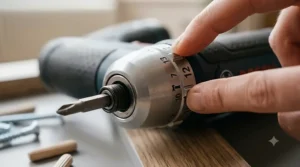
So, what is an electric screwdriver? It’s a small, motor-driven driving tool — usually cordless and battery-powered — that spins a bit to drive or remove screws with far less manual effort than a hand tool, typically offering adjustable speed or torque settings to suit different materials and fastener sizes.
We’ve spent time digging through real specifications, genuine UK retailer listings and aggregated owner feedback to shortlist seven electric screwdrivers that actually earn their keep, from sub-£30 pocket drivers to trade-grade inline models. Whether you’re after the best cordless screwdriver for home use, hunting for something specifically under £30, or trying to make sense of torque settings measured in Nm, you’ll find honest, spec-backed reasoning here rather than a rehashed spec sheet. According to the general engineering definition of a screwdriver, the tool’s job hasn’t changed in a century — only the motor bolted onto it has.
Quick Comparison Table
Before we dig into the full seven, here’s the shortcut version — the standout pick from each category we tested against.
| Product | Torque | Price Range | Best For |
|---|---|---|---|
| Bosch IXO 7th Generation | 5.5Nm | £35–£45 | All-round home DIY |
| WORX WX240 | 5Nm (3-gear) | £20–£25 | Best electric screwdriver under £30 |
| Hychika Cordless Screwdriver Set | 6Nm | £22–£28 | Best torque-for-money |
| DeWalt DWHT66719 FlexDrive | 5Nm (14Nm manual) | £65–£80 | Best inline / trade-style use |
| EZARC 181-in-1 Precision Set | Low, adjustable | £30–£45 | Best for electronics repair |
Look closely and a pattern emerges: torque doesn’t scale neatly with price. The budget Hychika Cordless Screwdriver Set actually out-torques the pricier Bosch IXO 7th Generation on paper, which tells you specs alone are a poor shopping guide — grip comfort, torque control, and bit quality matter just as much. Meanwhile, the DeWalt DWHT66719 FlexDrive justifies its premium not through raw Nm figures but through its inline form factor and six-stage precision, which is exactly what repetitive trade work demands.
💬 Found a pick you like already? Jump straight to it below and see current pricing on Amazon.
Top 7 Electric Screwdrivers: Expert Analysis
We’ve grouped these across budget, mid-range and premium tiers, covering both pistol-grip and inline formats so there’s a genuine option whatever your hands and your jobs demand.
1. Bosch IXO 7th Generation — best all-round pick for everyday home DIY
The seventh-generation Bosch IXO trades on Bosch’s long-standing reputation, and on paper it backs that up with a 20% torque bump over its predecessor. Its 3.6V lithium-ion cell drives roughly 5.5Nm of torque, which in practical terms means it’ll comfortably seat cam-lock fittings and hinge screws in flat-pack furniture without you needing to lean on it. The 2.0Ah battery is rated for around 190 screws per charge — enough for a full furniture-assembly weekend before you need the micro-USB cable again.
Based on the spec comparison, this is squarely a home-DIY tool rather than a trade one: it’s compact, comes with an angle-screw attachment and ten standard bits, and its variable speed trigger is what actually protects your screws from stripping, more than the torque figure alone. Reviewers consistently note the battery life as a strong point and rate it “probably the best electric screwdriver for home use” you can keep in a kitchen drawer, though a few mention the body feels small if you have larger hands, and that the built-in torque limiter can occasionally misbehave.
Pros:
- ✅ Genuinely versatile with angle and offset attachment options
- ✅ Reliable, well-reviewed battery life for its size
- ✅ Fast micro-USB recharge suits everyday use
Cons:
- ❌ Compact grip can feel small for larger hands
- ❌ Torque limiter occasionally inconsistent, per user reports
At around £35–£45 depending on the retailer bundle, the Bosch IXO 7th Generation sits at fair value for a name-brand tool that will genuinely outlast several cheaper alternatives — check current price before buying, as bundles vary.
2. Makita DF001DW — sturdiest ergonomics for daily household jobs
The Makita DF001DW is a 3.6V driver with a reversible straight-or-pistol grip and a genuinely comfortable in-hand feel that punches above its torque rating. What most buyers overlook about this model is that Makita’s motor tuning makes its roughly 4Nm output feel noticeably stronger under load than some 6–8V budget alternatives, because the power delivery is smoother rather than jerky.
It ships with an 81-piece accessory kit including an extension bit holder, which genuinely helps with recessed screws behind appliances or in cabinet backs. Aggregated reviewer sentiment is consistently positive on comfort and build quality — this is a tool people keep using rather than retiring to a drawer — though a recurring complaint is the absence of any onboard battery-charge indicator, so you can be caught out mid-job. Its lack of a variable-speed dial is also a genuine limitation if you’re regularly switching between delicate and heavy-duty fastening.
Pros:
- ✅ Reversible straight/pistol grip suits varied jobs
- ✅ Huge 81-piece bit and accessory kit included
- ✅ Comfortable enough for genuinely long sessions
Cons:
- ❌ No battery-charge indicator on the tool itself
- ❌ Lower peak torque than several same-price rivals
Expect to pay in the £45–£60 range for the Makita DF001DW — a fair price for the brand trust, though value-focused buyers may want to compare torque-per-pound against our budget picks first.
3. WORX WX240 — best electric screwdriver under £30
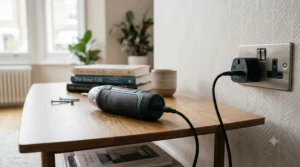
If your search brought you here specifically hunting for the best electric screwdriver under £30, the WORX WX240 is the strongest contender we found. At 3.6V (branded 4V MAX) it delivers up to 5Nm through a genuinely useful 3-gear torque adjustment, which is rare at this price point — most sub-£30 drivers are single-speed only.
Here’s what to weigh: the 24-piece bit set is unusually generous for the money, and USB-C charging (rather than a proprietary or micro-USB cable) means you’re not hunting for an obscure lead when the battery runs flat. The three torque gears genuinely change what the tool is good for — low for electronics and picture hooks, high for timber screws in flat-pack carcasses. Budget-focused reviewers highlight exactly this flexibility, alongside the USB-C convenience, though several note the plastic housing feels noticeably lighter-duty than the metal-reinforced Bosch and Makita options once you’re doing sustained, heavy work.
Pros:
- ✅ Rare 3-gear torque adjustment at this price
- ✅ Modern USB-C charging, no obscure cables
- ✅ Generous 24-piece bit set included
Cons:
- ❌ Lighter plastic build than pricier rivals
- ❌ LED work light has a short auto shut-off
Typically found in the £20–£25 range (prices may vary by retailer), the WORX WX240 is the pick if budget is the deciding factor and you still want genuine torque control rather than a single-speed toy.
4. Hychika Cordless Electric Screwdriver Set — best torque-for-money in the budget tier
Don’t be put off by an unfamiliar brand name — the Hychika Cordless Electric Screwdriver Set boasts a genuinely impressive 6Nm of maximum torque, which on the spec sheet outperforms both Bosch options in this list. At 3.6V and 180 RPM it’s not a fast tool, but reviewers consistently note it drives screws without excessive waiting, and torque is what actually matters for stubborn fasteners.
What the spec sheet won’t tell you, but reviewers note, is that the included 2.5mm HSS pilot-hole bit is a genuinely thoughtful inclusion, saving time when driving into denser timber. The handle also converts between gun grip and straight driver, and there’s a surprisingly bright LED torch built into the base of the handle — a small but useful touch during evening flat-pack sessions. On the downside, aggregated feedback flags real kickback if a screw jams mid-drive, and the direction-changer slider sits awkwardly close to where your index finger naturally rests, making accidental knocks a recurring theme in owner reports.
Pros:
- ✅ Class-leading 6Nm torque for a budget tool
- ✅ Useful 2.5mm HSS pilot-hole bit included
- ✅ Converts between gun grip and straight driver
Cons:
- ❌ No torque-limiter settings to prevent overdriving
- ❌ Direction slider easily knocked during use
At roughly £22–£28, the Hychika Cordless Electric Screwdriver Set is arguably the best raw torque-per-pound on this entire list — just handle it with a bit more care around delicate fixings.
5. Ryobi ERGO-A2 — best for angled and awkward spaces
The Ryobi ERGO-A2 solves a problem most electric screwdrivers ignore entirely: what happens when the screw you need isn’t in a straight, accessible line. It ships with two genuinely useful accessories — an ERGO OFFSET and an ERGO RIGHT ANGLE adaptor — which let you reach fixings behind pipework, radiator brackets, or tight cabinet corners that would otherwise need a manual offset driver.
At 4V with roughly 5Nm of torque and a 200 RPM top speed, it has real muscle for its size. Reviewers consistently praise the included adaptors and Ryobi’s three-year warranty as standout value additions, though the lack of any clutch or variable-speed control is a genuine drawback — several owners note it’s “almost too overpowered for small screws,” meaning fine electronics work risks stripped heads without a steady hand. Based on the spec comparison, this is a tool built for confident, deliberate users rather than absolute beginners.
Pros:
- ✅ Offset and right-angle adaptors solve awkward access
- ✅ Genuinely strong 5Nm torque for its size
- ✅ Backed by Ryobi’s standard 3-year warranty
Cons:
- ❌ No clutch or variable speed control
- ❌ Can strip small or delicate screws without care
Priced around £35–£45, the Ryobi ERGO-A2 earns its place for anyone who regularly meets fixings in genuinely inconvenient locations — check current price and availability before you commit, as bundle contents vary by seller.
6. DeWalt DWHT66719 FlexDrive — best inline design for trade-style control
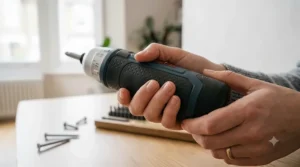
The DeWalt DWHT66719 FlexDrive takes a genuinely different approach: rather than a pistol grip with buttons, it uses a 360° collar you twist and slide forward to activate the motor, which DeWalt calls slide-to-drive control. It’s an adjustment curve worth persevering with, because the payoff is a slim, pen-like barrel that tucks into a tool pouch and can be operated one-handed from almost any grip angle.
On paper it delivers 44 in-lbs (around 5Nm) of powered torque, with a further manual finishing capability up to 124 in-lbs (roughly 14Nm) once the collar is locked for hand-driving — genuinely useful for that final quarter-turn on a stubborn fastener. Six-stage torque adjustment gives real precision across different materials, and the integral 2Ah battery is rated for up to 680 screws per charge via a 60-minute USB-C top-up. Reviewers single out the bright surrounding LED and the torque-stage control as standout features, while noting that the round inline profile gives noticeably less leverage on truly stuck screws compared with a pistol-grip alternative like the Bosch IXO 7th Generation.
Pros:
- ✅ Six-stage torque adjustment for genuine precision
- ✅ Compact inline barrel fits any tool pouch
- ✅ Fast 60-minute USB-C recharge cycle
Cons:
- ❌ Noticeably pricier than compact pistol-grip rivals
- ❌ Round profile offers less leverage on stuck screws
Expect to pay in the £65–£80 range for the DeWalt DWHT66719 FlexDrive — a premium outlay that’s easiest to justify if you’re driving screws daily rather than occasionally.
7. EZARC 181-in-1 Cordless Precision Electric Screwdriver Set — best for electronics and precision work
Furniture and household DIY tools are generally the wrong choice for a laptop teardown or a games console repair — the torque is simply too high and too coarse. The EZARC 181-in-1 Cordless Precision Electric Screwdriver Set is built specifically to solve that, with genuinely low, adjustable torque settings designed to stop you crushing a plastic clip or stripping a 1.4mm Phillips head.
Its headline feature is the sheer bit count: 181 pieces covering an enormous range of specialist fastener types, from Torx and Pentalobe to tri-wing heads used in games consoles, all organised in a magnetic storage case so nothing goes missing mid-repair. This was recognised as an Editor’s Pick in independent UK testing specifically for its adjustable torque and long-lasting battery, and reviewers rate the bit variety highly for anyone doing repeat electronics or hobbyist work. The trade-off is obvious: this isn’t the tool for wardrobe assembly, and its comparatively low maximum torque will feel underpowered against denser DIY fastening tasks.
Pros:
- ✅ Enormous 181-piece bit and accessory range
- ✅ Genuinely precise low-torque settings for electronics
- ✅ Organised magnetic case keeps bits accessible
Cons:
- ❌ Underpowered for heavy household DIY tasks
- ❌ Large piece count takes longer to sort through
You’ll typically find the EZARC 181-in-1 Cordless Precision Electric Screwdriver Set in the £30–£45 range — genuinely good value if your projects lean towards electronics rather than furniture.
Top 7 Electric Screwdrivers at a Glance
| Product | Voltage | Torque | Price Range | Best For |
|---|---|---|---|---|
| Bosch IXO 7th Generation | 3.6V | 5.5Nm | £35–£45 | All-round home DIY |
| Makita DF001DW | 3.6V | ~4Nm | £45–£60 | Comfort and build quality |
| WORX WX240 | 3.6V/4V | Up to 5Nm | £20–£25 | Best electric screwdriver under £30 |
| Hychika Cordless Screwdriver Set | 3.6V | 6Nm | £22–£28 | Best budget torque |
| Ryobi ERGO-A2 | 4V | ~5Nm | £35–£45 | Awkward, angled access |
| DeWalt DWHT66719 FlexDrive | 4V | 5Nm (14Nm manual) | £65–£80 | Trade-style inline control |
| EZARC 181-in-1 Precision Set | Adjustable | Low, precise | £30–£45 | Electronics and repair work |
Read across this table and the real story is trade-offs, not a single winner: the Hychika Cordless Screwdriver Set wins on raw torque-per-pound, the DeWalt DWHT66719 FlexDrive wins on control and form factor, and the EZARC 181-in-1 Precision Set wins decisively if your projects are electronic rather than structural. No single rechargeable screwdriver does everything brilliantly, which is exactly why matching the tool to your actual jobs matters more than chasing the highest number on a spec sheet.
Setting Up Your New Electric Screwdriver: A Practical Usage Guide
Getting the best out of any electric screwdriver starts before you’ve driven a single screw. First, give it a full initial charge — most lithium-ion models like the Bosch IXO 7th Generation and WORX WX240 want an uninterrupted first charge cycle to calibrate the battery management circuit accurately, rather than topping up from 60%.
Next, test your torque setting on scrap material if the tool has adjustable gears. Start low and work up — it’s far easier to add a second pass on an under-driven screw than to extract a stripped one. This matters enormously for flat-pack furniture, where the pre-threaded holes in chipboard are genuinely easy to over-torque and ruin.
In the first 30 days, the most common mistake is skipping bit maintenance: magnetic tips lose their grip over time if you’re constantly dropping them into a toolbox with other metal objects, and worn Phillips bits are a leading cause of cam-out (that horrible moment the driver spins and chews the screw head). Keep bits in their case, inspect tips monthly, and swap a rounded bit before it damages a screw rather than after. Finally, avoid fully depleting the battery on a regular basis — partial top-up charges are kinder to lithium-ion cells over the long run than repeated full-drain cycles, extending the working life of your rechargeable screwdriver by months, if not years.
Real-World Scenarios: Matching the Tool to Your Life
The new renter assembling their first flat-pack flat. Budget matters, storage space is tight, and jobs are occasional rather than constant. The WORX WX240 or Hychika Cordless Screwdriver Set both make sense here — enough torque for wardrobe and bed frame assembly, low enough cost that a rarely-used tool doesn’t feel wasteful.
The homeowner doing steady, varied DIY. Wall plates one weekend, garden furniture the next, the odd cabinet hinge in between. This is the Bosch IXO 7th Generation‘s sweet spot — it’s the generalist that handles the widest spread of everyday jobs without you needing a second tool for anything unusual.
The tradesperson or serious hobbyist fastening daily. Repetition changes what matters — control, speed, and comfort over an eight-hour day outweigh raw torque numbers. The DeWalt DWHT66719 FlexDrive‘s six-stage adjustment and inline grip earn their premium here in a way they wouldn’t for occasional home use.
The tech-focused repairer. Laptops, consoles, drones — anything with fragile fastenings and tiny screw heads needs the low, precise torque of the EZARC 181-in-1 Precision Set rather than any general-purpose driver, however good.
Buyer’s Decision Framework
If you’re still torn, work through this simple priority checklist rather than chasing the “best” model in the abstract:
If your budget is under £30 and jobs are occasional, choose the WORX WX240 because its 3-gear torque still gives you real control despite the low price. If you want maximum torque for the least money, choose the Hychika Cordless Screwdriver Set because it out-punches pricier rivals on paper. If comfort and brand reliability matter most, choose the Makita DF001DW because its ergonomics consistently outrank tools with higher torque figures. If you regularly meet awkward, angled fixings, choose the Ryobi ERGO-A2 for its offset and right-angle adaptors. If you drive screws daily as part of your work, choose the DeWalt DWHT66719 FlexDrive for its precision and inline control. If your projects are electronics rather than furniture, choose the EZARC 181-in-1 Precision Set without hesitation — general DIY drivers are simply the wrong tool for that job.
✨ Ready to add one of these to your toolbox? Compare current prices below before you buy.
How to Choose the Best Electric Screwdriver
Cutting through the marketing, here’s what actually determines whether an electric screwdriver will serve you well:
- Match torque to your typical job. Around 3–6Nm suits most household DIY and flat-pack furniture; anything lower is really for electronics.
- Prioritise adjustability over raw power. A 3-gear or multi-stage tool like the WORX WX240 or DeWalt DWHT66719 FlexDrive protects screws far better than one fixed high-torque setting.
- Check the charging standard. USB-C models charge faster and use cables you likely already own; older micro-USB tools are increasingly inconvenient.
- Weigh grip and weight for your hands. A tool that’s uncomfortable after ten minutes will end up back in the drawer, however good its spec sheet.
- Look at what’s included. Bit variety, adaptors, and a proper storage case add genuine value beyond the driver itself.
- Read aggregated review themes, not star ratings alone. Recurring complaints — like a fiddly direction slider — tell you more than an average score.
- Decide inline or pistol grip based on your jobs, which we cover in detail next.
Electric Screwdriver Torque Settings Explained (Nm)
Torque, measured in newton-metres (Nm), is the rotational force a driver applies to a screw — and it’s the single most misunderstood spec on any electric screwdriver listing. According to the standard physics definition of the newton-metre, it describes force applied at a distance from a pivot point, which in practical driver terms means: higher Nm doesn’t mean “better,” it means “more force before the clutch or motor stalls.”
For most household use, 3–6Nm covers the vast majority of jobs — flat-pack furniture, hinges, wall fixings, brackets. Below 1Nm is precision territory, essential for electronics where a fragile plastic boss or a tiny screw head will shear under anything stronger, which is exactly why the EZARC 181-in-1 Precision Set is deliberately tuned low. Above roughly 6Nm, you’re moving into light-trade territory, useful for denser timber or repeated fastening but genuinely risky for delicate materials if the tool lacks adjustable stages.
The real-world takeaway: a screwdriver with adjustable torque stages, like the DeWalt DWHT66719 FlexDrive‘s six-stage system or the WORX WX240‘s three gears, is more useful day-to-day than one with a single high maximum figure, because you can dial down for delicate work and dial up only when a fastener genuinely needs it.
Inline vs Pistol Grip Screwdriver: Which Wins?
This is one of the most practical decisions in choosing an electric screwdriver, and it genuinely comes down to how you hold and access fasteners, not which is objectively “better.”
Pistol grip models — like the Bosch IXO 7th Generation, Makita DF001DW, and Ryobi ERGO-A2 — put the motor behind a trigger, similar to a small drill. This gives you strong leverage and a familiar grip, which helps on stubborn or partially seized screws, and it’s usually the more intuitive format for beginners.
Inline models, such as the DeWalt DWHT66719 FlexDrive, mimic the shape and feel of a manual screwdriver with a motor built into the shaft. What most buyers overlook about inline tools is how much easier they are to use in genuinely tight spaces — behind appliances, inside electrical enclosures, or anywhere a bulkier pistol grip simply won’t fit. The trade-off, as several reviewers note, is reduced leverage: without a full palm wrapped around a handle, you have less mechanical advantage on a screw that’s really fighting back.
For flat-pack furniture and general household jobs, pistol grip wins on comfort and control. For repetitive trade work in confined spaces, inline earns its keep. Neither is universally correct — match the format to where you’ll actually be using it.
Best Electric Screwdriver for Flat-Pack Furniture Assembly
Flat-pack furniture has genuinely specific demands: predominantly chipboard or MDF material, cam-lock and dowel fittings that strip easily if over-torqued, and dozens of repetitive fastenings in a single sitting. This rules out both extremes — an underpowered precision driver will stall constantly, while an uncontrolled high-torque tool risks blowing out the pre-drilled holes chipboard manufacturers use.
Based on our spec comparison, the Bosch IXO 7th Generation is the strongest general pick here, with enough torque to seat fittings confidently and a variable-speed trigger that lets you ease off as a screw seats. For buyers specifically shopping under £30, the WORX WX240‘s 3-gear adjustment achieves a similar effect at a fraction of the price — start on the low gear for delicate veneered panels, move up for solid timber components. The Hychika Cordless Screwdriver Set is worth considering too, provided you’re mindful of its lack of torque limiting; its raw power makes light work of dowel screws, but a steady hand matters more here than with the adjustable alternatives.
A quick practical tip that Amazon listings won’t mention: pre-driving cam-lock screws by hand for the first quarter-turn, then finishing with the electric driver, reduces the risk of the fitting spinning loose inside softer chipboard.
Common Mistakes When Buying an Electric Screwdriver
The most frequent error is buying on torque figure alone, ignoring whether the tool actually has adjustability — a high-Nm single-speed driver is genuinely more likely to damage delicate fastenings than a lower-torque model with proper gear control.
A second common mistake is overlooking charging standard. Buyers who already own USB-C chargers for phones and laptops will find models like the WORX WX240 and DeWalt DWHT66719 FlexDrive far more convenient than older micro-USB tools, simply because there’s always a compatible cable to hand.
Third, many buyers skip reading aggregated review themes for recurring hardware quirks — the Hychika Cordless Screwdriver Set‘s awkwardly placed direction slider, for instance, only shows up in real owner feedback, never on a spec sheet. Finally, it’s easy to underestimate bit quality: a generous piece count means little if the S2 steel bits round off after a few dozen uses, so where possible check whether reviewers specifically praise or criticise bit durability rather than just counting pieces in the box.
Electric Screwdriver vs Cordless Drill: What’s the Difference
They overlap, but they’re built for different jobs. A cordless drill prioritises raw power and drilling capability — masonry, wood boring, mixing paint — with a chuck that accepts a wide range of bit shanks and typically far higher voltage, often 12V–18V or more. An electric screwdriver, by contrast, is deliberately smaller, lighter, and lower-powered, optimised purely for driving and removing screws with fine control.
For flat-pack furniture, electronics repair, or quick household fixings, an electric screwdriver’s compact size and gentler torque delivery genuinely outperform a drill in practice — you’re less likely to overdrive a screw or fumble a bulky tool in a tight cabinet interior. A drill earns its place when you need to bore pilot holes first or drive long, heavy-duty fasteners into masonry or structural timber, tasks where an electric screwdriver’s lower torque ceiling will simply stall. Many serious DIYers end up owning both, using the drill for prep work and the screwdriver — something like the Bosch IXO 7th Generation or Ryobi ERGO-A2 — for the actual fastening, precisely because swapping bits constantly on a single drill-driver slows the job down.
Safety, Batteries and UK Regulations
Even a small rechargeable screwdriver carries real considerations worth understanding. Regular, sustained use of any vibrating power tool can contribute to hand-arm vibration issues over time; the Health and Safety Executive’s guidance on hand-arm vibration is aimed primarily at workplace use, but its core advice — take breaks, avoid excessive grip force, and don’t rely on tools that feel harsh in the hand — applies just as sensibly to enthusiastic weekend DIY.
Battery disposal is the other practical issue. Every one of the seven tools in this guide uses a built-in or replaceable lithium-ion cell, and under UK law these must never go in general household waste. Under the UK’s WEEE regulations, electrical items and their batteries need to be taken to a designated recycling point or returned through a retailer take-back scheme — look for the crossed-out wheelie bin symbol on the packaging as your reminder. Most large retailers selling electric screwdrivers are required to accept an old like-for-like item free of charge when you buy a new one, so it’s worth asking at checkout rather than binning a dead tool.
FAQ
❓ What is the best electric screwdriver for home use in 2026?
❓ What torque (Nm) do I need for flat-pack furniture assembly?
❓ Is inline or pistol grip better for an electric screwdriver?
❓ What's the best electric screwdriver under £30?
❓ How long do rechargeable screwdriver batteries last?
Conclusion
There’s no single best electric screwdriver — only the right one for the jobs actually in front of you. If you want a genuine all-rounder for everyday home DIY, the Bosch IXO 7th Generation is the safest recommendation on this list. If budget is tight and you still want real torque control, the WORX WX240 proves you don’t need to spend big to get adjustability. For raw power on a budget, the Hychika Cordless Screwdriver Set is hard to beat, while the DeWalt DWHT66719 FlexDrive justifies its premium for anyone driving screws as part of daily, repetitive work.
What ties every recommendation here together is the same underlying principle: match torque and format to your actual jobs rather than chasing the highest number on a box. A rechargeable screwdriver is a long-term relationship — you’ll reach for it dozens of times a year — so comfort, adjustability and genuine reviewer feedback matter more than a single headline spec. Whichever of these seven you choose, you’re buying into a category that’s matured considerably in recent years, with genuinely useful torque control now available even at sub-£30 price points.
✨ Don’t Miss These Exclusive Deals!
🔍 Take your DIY toolkit to the next level with these carefully selected electric screwdrivers. Click through to check current pricing and availability on Amazon, and make your next flat-pack build the easy one for once!
Recommended for You
- Best Compact Impact Driver UK 2026: 7 Top Picks Reviewed
- High Torque Impact Driver: 7 Best Picks Tested for 2026
- Impact Driver vs Combi Drill: 7 Real Tools Tested (2026 UK)
Disclaimer: This article contains affiliate links. As an Amazon Associate, I earn from qualifying purchases. If you purchase products through these links, we may earn a small commission at no additional cost to you.
✨ Found this helpful? Share it with your friends! 💬🤗
