In This Article
Stand in the power tools aisle for five minutes and you’ll hear it: someone asking a very patient member of staff whether they need “the small one or the big one.” That, in essence, is the sds plus vs sds max question, and it’s one of the most misunderstood decisions in the whole DIY and trade toolkit. Pick the wrong one and you’ll either be underpowered on a job that needed real muscle, or lugging around a tool built for breaking concrete when all you wanted was to hang a shelf.
Here’s the short version, which we’ll unpack properly below: SDS plus is the everyday standard — lighter, cheaper, and fine for most drilling into brick, block and concrete around the house. SDS max is the heavyweight cousin, built for bigger holes, sustained chiselling and genuinely tough demolition work. Neither is “better” in isolation. Each is engineered for a different job, and buying based on price or brand loyalty alone is how people end up with a tool that fights them every weekend.
This guide walks through what an SDS drill actually is, how the SDS shank locking mechanism works, and how to weigh up which SDS drill you need for your own projects. We’ve researched seven genuine products currently sold on Amazon UK — spanning budget DIY tools right through to site-grade SDS max hammers — with honest, spec-grounded commentary rather than recycled marketing copy. Prices below are always given as ranges, since exact figures shift constantly; always check the current listing before buying.
Quick Comparison Table: SDS Plus vs SDS Max at a Glance
| Feature | SDS Plus | SDS Max |
|---|---|---|
| Shank diameter | 10mm, 2 open + 2 closed grooves | 18mm, 3 open + 2 closed grooves |
| Typical impact energy | 1.5–3.5 Joules | 5–20+ Joules |
| Best hole diameter | Up to around 26–30mm in concrete | 25mm up to 55mm+ in concrete |
| Weight class | 2–4kg | 5–10kg+ |
| Best For | DIY, electricians, plumbers, light renovation | Groundworkers, demolition, large-diameter anchor holes |
Even a quick glance at that table tells the real story: this isn’t a “which is best” question, it’s a “which job are you doing” question. If you’re mostly drilling fixing holes and the occasional chase for cabling, the lighter shank and lower impact energy of SDS plus is genuinely an advantage — less fatigue, less cost, and a lighter tool bag. Step up into SDS max territory only when you’re regularly drilling past 30mm or need the hammer-only chiselling grunt for breaking out masonry, because that extra power comes with real weight and cost penalties you don’t want to carry unnecessarily.
💬 Not sure yet which category fits your project? Keep reading — the buyer’s framework further down settles it in under a minute.
What Is an SDS Drill?
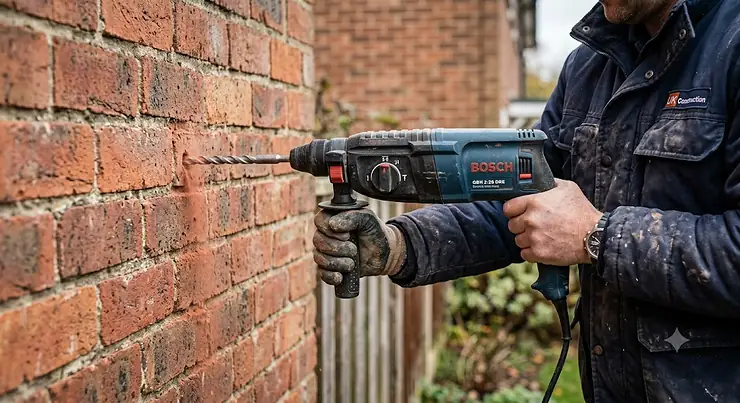
An SDS drill is a rotary hammer that uses Bosch’s Slotted Drive System to lock a bit into the chuck using grooves rather than a traditional friction-grip chuck, allowing far higher impact energy to transfer into masonry and concrete without the bit slipping. It’s the tool of choice whenever a standard combi drill would struggle, judder, or simply refuse to bite into solid brick or concrete.
The clue is in the name. SDS stands for Slotted Drive System (originally the German “Steck, Dreh, Sitzt” — “insert, turn, stays”), and the Wikipedia entry on the system traces its origins back to Bosch’s 1975 patent, which fundamentally changed how power tools handle heavy masonry work. Before SDS existed, drilling a decent hole in a solid wall meant wrestling with a keyed chuck that slipped under torque and chewed through bits.
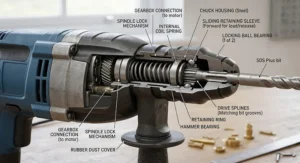
What makes an SDS drill different from a regular hammer drill isn’t just the bit-locking mechanism — it’s the way the hammering action is generated. Rather than relying on two ridged discs grinding against each other (as in a cheap percussion drill), SDS tools use a genuine pneumatic piston mechanism inside the barrel. That’s what allows a hand-held tool to deliver several joules of impact energy without the operator needing to lean their entire bodyweight into it.
SDS Drill Explained: How the SDS Shank Locking Mechanism Works
If you’ve ever wondered why SDS bits wobble slightly when you push them into the chuck before the trigger is pulled, that’s by design, not a fault. Understanding the SDS shank locking mechanism explains almost every quirk new users notice about these tools.
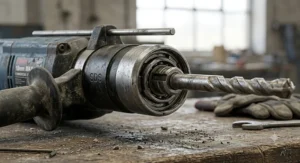
Here’s the SDS drill explained in practical terms: the shank end of every SDS bit has a set of machined grooves — two open slots that run the full length and two closed slots that stop partway. Steel ball bearings inside the chuck drop into these grooves when you insert the bit, and they’re what physically locks it in place. Crucially, the bit is still free to slide back and forth a few millimetres inside the chuck even when locked. That play is what lets the internal piston deliver its hammering blows directly through the bit rather than through the whole tool body, which is also why SDS drills feel comparatively gentle on your wrists for the amount of concrete they’re chewing through.
This differs meaningfully from a keyless or keyed chuck, which grips the entire circumference of a round shank through pure friction. Friction chucks are excellent for wood and metal, where rotation is the main force at play, but they’re a poor match for masonry drilling, where repeated hammer blows need somewhere to go. Push a masonry bit hard enough in a friction-chuck drill and eventually it slips, rounds off, or simply won’t seat true — precisely the failure mode SDS was invented to eliminate. It’s worth noting that SDS-plus and SDS-max bits are not interchangeable without a dedicated adapter sleeve, because the groove spacing and shank diameter are different sizes entirely — buying the wrong bit size for your chuck is one of the most common (and avoidable) mistakes covered further down.
Top 7 SDS Rotary Hammers: Expert Analysis
We’ve split these seven real, currently available products across budget, mid-range and premium tiers, and across both SDS plus and SDS max categories, so there’s a sensible option whichever side of the sds plus vs sds max divide your project falls on.
1. Einhell TC-RH 800 4F — best budget SDS plus for general DIY
The Einhell TC-RH 800 4F is the drill most first-time SDS buyers land on, and for good reason. Its 800W motor drives roughly 2.5 to 2.6 Joules of impact energy through the pneumatic mechanism, enough to comfortably open up fixing holes and chase cable runs into brick and block without struggling.
On paper, that impact figure sits at the lower end of the SDS plus range, but four operating modes (drilling, hammer drilling, and chiselling with or without lock) mean it doubles up as a light demolition tool for jobs like stripping old tiling. The electronic speed control and overload clutch add a genuine safety margin that budget tools sometimes skip entirely.
Reviewers consistently report that build quality punches above the price point, with the E-Box carrying case and included accessories adding practical value rather than being a marketing afterthought. What most buyers overlook about a tool in this bracket is that “budget” doesn’t mean “underpowered” here — it means fewer of the comfort features (vibration dampening, tool-free depth adjustment) that premium models charge for.
Pros:
- ✅ Genuinely capable 2.5J impact for the price bracket
- ✅ Four-in-one functionality covers drilling and light chiselling
- ✅ Comes complete in a hard carrying case
Cons:
- ❌ Corded only, so no cordless flexibility on site
- ❌ Vibration control is basic compared with premium rivals
Priced in the £70-£100 range at the time of research, the Einhell TC-RH 800 4F represents strong value for anyone tackling occasional home renovation rather than daily trade use.
2. Titan TTB278SDS — cheapest entry point into SDS drilling
If your entire SDS wishlist is “put small holes in a wall a few times a year,” the Titan TTB278SDS is the realistic budget floor. This 5kg, 230-240V corded rotary hammer strips SDS drilling back to the essentials: no cordless battery tax, no unnecessary electronics, just a working pneumatic hammer mechanism at an accessible price.
Its lower weight-to-power ratio means it lacks the raw impact energy of the pricier options on this list, but for drilling the occasional 6-10mm fixing hole in masonry, that’s rarely a practical limitation. Based on the spec comparison with rivals in this bracket, the trade-off buyers are making is refinement, not core capability — you’re not getting variable electronics or a depth-adjustment quick-release, but the fundamental hammering action still works.
Aggregated review sentiment is mixed but broadly positive: buyers frequently note it copes well with concrete posts and general masonry, though several mention the depth gauge and bit-insertion process feel less intuitive than pricier competitors, and the tool is heavier in the hand than its size suggests.
Pros:
- ✅ Lowest price point of any drill on this list
- ✅ Handles everyday masonry drilling without fuss
- ✅ Simple, few-parts design with less to go wrong
Cons:
- ❌ Depth stop and bit changes feel fiddly to new users
- ❌ Heavier in use than its size and price suggest
At under £60 in most listings, the Titan TTB278SDS suits anyone who wants to try SDS drilling without committing serious budget upfront.
3. Bosch Professional GBH 2-26 F — best mid-range corded workhorse
The Bosch Professional GBH 2-26 F is the drill most UK tradespeople quietly recommend when asked “what should I actually buy.” Its 830W motor delivers 2.7 Joules of impact energy, a meaningful step up from budget models, and the SDS-plus Quick-Change Chuck means you can swap between an SDS bit and a standard keyless chuck for wood or metal drilling in seconds, without tools.
That flexibility is the real selling point here. Rather than owning a separate combi drill for general jobs, the quick-change system effectively turns this into two tools in one, which matters if you’re trying to keep a van kit lean. Here’s what to weigh up: at 830W and corded, it’s not the lightest or most portable option, but the trade-off buys you sustained power that cordless models in this price bracket genuinely can’t match hour after hour.
Reviewers consistently praise the depth stop accuracy and the reassuring solidity of the build, with the included carrying case adding to the sense that this is a tool built to outlast several renovation projects rather than one.
Pros:
- ✅ Quick-change chuck swaps between SDS and keyless drilling
- ✅ 2.7J impact energy handles most masonry with ease
- ✅ Renowned Bosch Professional build quality and parts availability
Cons:
- ❌ Corded design limits mobility on larger sites
- ❌ Noticeably heavier than 18V cordless SDS plus rivals
Typically found in the £150-£200 range, the Bosch Professional GBH 2-26 F justifies its position as the benchmark mid-range choice.
4. Makita DHR242Z — best cordless SDS plus for tradespeople
Ask electricians and plumbers which cordless SDS drill they reach for daily, and the Makita DHR242Z comes up more than almost anything else. Running on Makita’s 18V LXT platform, it delivers 2.0 Joules of impact energy across three genuine modes: rotation only for wood and metal, hammer-rotation for masonry, and hammer-only for light chiselling.
What most buyers overlook is how much the one-touch chuck and vibration-absorbing handle design contribute to daily usability rather than headline specs. Based on the spec comparison with corded rivals, 2.0J is objectively lower than the Bosch GBH 2-26 F’s 2.7J, but in practice that’s rarely the bottleneck for typical fixing and cable-chase work — the freedom from a trailing cable matters more on most real jobs than the last half-joule of impact energy.
Reviewers consistently highlight the reduced fatigue over a working day and the reliability that’s made Makita’s LXT battery ecosystem a default choice on many UK sites, meaning a tradesperson already invested in Makita batteries can add this tool without extra battery cost.
Pros:
- ✅ Cordless freedom on Makita’s proven 18V LXT platform
- ✅ Three genuine operating modes for varied tasks
- ✅ Vibration-absorbing handle reduces daily fatigue
Cons:
- ❌ Sold body-only, so battery and charger cost extra
- ❌ 2.0J impact energy trails the more powerful corded rivals
Body-only pricing typically sits in the £140-£180 range, with the Makita DHR242Z representing excellent long-term value for anyone already on the LXT battery system.
5. DeWalt DCH273N — best for existing DeWalt XR users
For tradespeople already carrying a DeWalt 18V XR battery kit, the DeWalt DCH273N is close to a no-brainer addition. It’s a brushless SDS plus rotary hammer built to be compact and lightweight without sacrificing the core three-mode functionality buyers expect from a proper site tool.
The brushless motor is worth dwelling on, because it’s not just a marketing bullet point. Based on the spec comparison with brushed alternatives, brushless motors run cooler, last longer between services, and typically deliver more consistent power as the battery discharges — meaning the tool doesn’t noticeably slow down on the last few holes of the day the way older brushed cordless drills often do.
Aggregated feedback consistently flags the compact form factor as a genuine advantage in tight spaces — loft conversions, under-stair cupboards, and similar awkward-access jobs where a bulkier corded tool becomes a liability rather than an asset.
Pros:
- ✅ Brushless motor for longer life and consistent power
- ✅ Compact, lightweight build suited to tight access jobs
- ✅ Slots straight into an existing DeWalt XR battery kit
Cons:
- ❌ Body-only listing means no battery included
- ❌ Impact energy sits in line with, not above, class rivals
Expect a body-only price in the £150-£190 range; the DeWalt DCH273N earns its place through platform compatibility as much as raw specification.
6. Makita HR3540C — best entry point into SDS max
Stepping over the line from SDS plus into SDS max territory, the Makita HR3540C is where things get genuinely more serious. Its 850W motor and SDS-max chuck unlock a 35mm drilling capacity in concrete, roughly a third more than the biggest SDS plus tools can comfortably manage, with Makita’s AVT anti-vibration technology working to keep that extra power from beating up your hands.
Here’s what the spec sheet won’t tell you outright: that jump from SDS plus to SDS max isn’t just about hole diameter, it’s about sustained duty cycle. This is a tool designed to drill dozens of large anchor holes back-to-back on a groundworks job, not the occasional weekend fixing hole — buying this for light DIY would be genuine overkill, both in cost and in the muscle needed to control it comfortably.
User reports consistently describe the anti-vibration system as a meaningful comfort improvement over older SDS max models, particularly during extended chiselling sessions where earlier-generation tools would leave hands numb well before the job was finished.
Pros:
- ✅ 35mm drilling capacity handles large anchor and service holes
- ✅ AVT anti-vibration genuinely reduces hand fatigue over long use
- ✅ Three operating modes cover drilling through to chiselling
Cons:
- ❌ Significant overkill and expense for occasional home use
- ❌ Considerably heavier than any SDS plus tool on this list
Sitting in the £450-£550 range, the Makita HR3540C is squarely a professional-grade investment, not a casual DIY purchase.
7. Bosch Professional GBH 5-40 DCE — best premium SDS max for heavy-duty work
At the top of this line-up sits the Bosch Professional GBH 5-40 DCE, an 1,150W SDS max hammer delivering 8.8 Joules of impact energy — more than three times the punch of the budget SDS plus tools we started with. It handles hammer bits from 12mm up to 40mm, breakthrough bits to 55mm, and core cutters up to 90mm, putting it firmly in professional demolition and large-scale drilling territory.
The standout feature here is the Turbo-Power mode, which redirects rotational energy into extra impact force whenever the tool is switched into hammer-only chiselling. Based on the spec comparison with the Makita HR3540C, the GBH 5-40 DCE’s higher wattage and impact energy make it the faster all-rounder for mixed drilling-and-breaking work, while the Makita’s lighter build suits operators prioritising manoeuvrability over outright power.
Reviewers who’ve upgraded from SDS plus tools describe a genuinely noticeable step change in capability, with several noting they now keep an SDS plus drill purely for light work and reserve this for anything resembling real demolition — a sensible two-tool strategy rather than trying to make one drill do everything.
Pros:
- ✅ 8.8J impact energy tackles serious demolition and large holes
- ✅ Turbo-Power mode boosts chiselling performance on demand
- ✅ Vibration Control keeps extended use genuinely manageable
Cons:
- ❌ Premium pricing reflects its professional-tier positioning
- ❌ At 6.8kg, sustained overhead use is genuinely tiring
Typically listed in the £500-£650 range, the Bosch Professional GBH 5-40 DCE is the tool to reach for once a project moves from “fixing holes” to “breaking things apart.”
Top 7 Products: Specification Comparison
| Product | Chuck Type | Impact Energy | Power Source | Best For |
|---|---|---|---|---|
| Einhell TC-RH 800 4F | SDS Plus | ~2.5J | Corded | Budget DIY drilling |
| Titan TTB278SDS | SDS Plus | Entry-level | Corded | Occasional home use |
| Bosch Professional GBH 2-26 F | SDS Plus | 2.7J | Corded | Mid-range trade workhorse |
| Makita DHR242Z | SDS Plus | 2.0J | Cordless 18V | Daily trade cordless use |
| DeWalt DCH273N | SDS Plus | Class-standard | Cordless 18V | Existing DeWalt XR owners |
| Makita HR3540C | SDS Max | 35mm capacity | Corded | Entry-level heavy duty |
| Bosch Professional GBH 5-40 DCE | SDS Max | 8.8J | Corded | Serious demolition work |
Reading across this table, the pattern from earlier holds firm: impact energy and drilling capacity climb steadily as you move from budget SDS plus tools toward premium SDS max hammers, but so does weight and price. The two cordless entries, the Makita DHR242Z and DeWalt DCH273N, sacrifice a little raw power for genuine site flexibility, which is exactly the trade-off worth making if you’re not drilling large-diameter holes all day. Anyone comparing the Bosch Professional GBH 2-26 F against the Makita HR3540C should recognise these aren’t really competitors — they’re solutions to different-sized problems.
✨ Ready to compare current listings? Click through on any bolded product above to check today’s availability and price.
Practical Usage Guide: Getting the Best from Your SDS Drill
Buying the right drill is only half the job — using it well is what actually determines how long it lasts and how good your results look. Start every new SDS tool by greasing the shank end of each bit lightly before first use; most come with a small grease sachet, and skipping this step is one of the fastest ways to accelerate chuck wear.
During the first 30 days, resist the temptation to lean your full bodyweight into the tool. SDS hammers are engineered to do the pushing for you through the internal piston mechanism — adding manual pressure doesn’t drill faster, it just accelerates wear on the chuck mechanism and tires your arms unnecessarily. Let the weight of the tool and its own hammering action do the work.
On maintenance: wipe down the shank and chuck opening after dusty jobs, since masonry dust is genuinely abrasive and works its way into the locking mechanism over time. For corded models like the Bosch Professional GBH 2-26 F, periodically check the carbon brushes; for cordless tools like the Makita DHR242Z, avoid leaving batteries on charge indefinitely, as modern lithium cells degrade faster when kept permanently topped up rather than cycled normally.
Real-World Scenarios: Which SDS Drill Do I Need?
Working out which SDS drill you need becomes far easier once you match your actual project against a realistic user profile, rather than trying to reason from spec sheets alone.
The weekend DIYer hanging shelves and mirrors: drilling occasional 6-8mm holes into brick or block, a handful of times a year. The Einhell TC-RH 800 4F or Titan TTB278SDS covers this comfortably, and spending more simply buys capability you’ll never use.
The electrician or plumber on daily call-outs: frequent smaller holes across varied properties, often working solo with limited access to power sockets. The Makita DHR242Z or DeWalt DCH273N earns its keep here through cordless mobility, assuming you’re already on that battery platform.
The renovator knocking through a stud wall or fitting a new doorway: occasional but demanding masonry work involving both large-diameter drilling and some chiselling. This is where the Makita HR3540C starts to make sense — SDS max capability without committing to the very top of the price range.
The groundworker or demolition contractor: daily heavy-duty drilling and breaking, where downtime waiting for a weaker tool costs real money. The Bosch Professional GBH 5-40 DCE‘s 8.8J impact energy and Turbo-Power mode are built precisely for this.
Problem → Solution: Common SDS Drilling Issues
Problem: the bit won’t seat properly in the chuck. This is almost always dirt or old grease build-up in the locking grooves rather than a faulty tool. Clean both the shank and the chuck opening with a dry cloth before reinserting.
Problem: drilling suddenly slows or stalls in concrete. Worn or blunted carbide tips are the usual culprit, particularly on budget bit sets used with a higher-power tool like the Bosch Professional GBH 5-40 DCE. Replace bits before they’re fully blunt rather than after, since a struggling bit generates excess heat that shortens the tool’s motor life too.
Problem: excessive vibration causing hand fatigue. Check you’re using the correct mode — running in hammer-and-rotation when only rotation is needed adds unnecessary vibration and wear. Tools with dedicated vibration control, like the Makita HR3540C‘s AVT system, help, but mode selection matters just as much as the hardware.
Problem: the wrong bit size for the job. Buying SDS-plus bits for an SDS-max tool (or vice versa) is surprisingly common among first-time buyers; always check shank type before ordering replacement SDS drill bit sizes, since the two systems are not physically interchangeable without an adapter.
How to Choose Between SDS Plus and SDS Max
- Work out your typical hole diameter first. If you’re rarely drilling past 20-26mm, SDS plus covers you comfortably; regular holes above 30mm point firmly toward SDS max.
- Be honest about frequency of use. Occasional home projects rarely justify SDS max’s weight and cost; daily professional use often justifies it easily.
- Factor in chiselling requirements. If breaking out tiles, plaster or block work is a regular task, the higher impact energy of SDS max genuinely speeds up the job.
- Consider portability needs. Corded SDS plus tools like the Bosch Professional GBH 2-26 F suit fixed workshop or single-site use; cordless models like the DeWalt DCH273N suit multi-location trade work.
- Check your existing battery platform. If you already own 18V batteries for another brand’s tools, staying within that ecosystem (as with the Makita DHR242Z) saves meaningful money over time.
- Budget realistically for bits, not just the drill. SDS max bits cost noticeably more than SDS plus equivalents, and that ongoing cost should factor into your decision.
- Match weight to your physical comfort. A tool that’s technically more capable but too heavy to control comfortably overhead will slow you down, not speed you up.
SDS Plus vs SDS Max: The Real Differences
Beyond the table above, the practical difference between sds plus vs sds max comes down to how each system balances control against raw force. SDS plus shanks measure 10mm with two open and two closed grooves, designed for tools rarely exceeding 3.5 Joules of impact energy. That’s plenty for anchor holes, cable runs, and light-to-moderate masonry work, and it’s why the vast majority of tools sold to homeowners and general tradespeople — including four of the seven products above — are SDS plus.
SDS max shanks step up to 18mm with three open and two closed grooves, engineered specifically to transmit far higher impact energy without the shank itself becoming the weak point. The Bosch Professional GBH 5-40 DCE‘s 8.8 Joules simply couldn’t be transmitted reliably through a 10mm SDS plus shank; the mechanical design has to scale with the power.
What most buyers overlook about the SDS max forms of some hammers is that they typically include a genuine hammer-only mode intended for sustained chiselling, essentially functioning as a lightweight breaker as well as a drill — a capability SDS plus tools offer in a much more limited, lighter-duty form.
Rotary Hammer vs SDS Drill: Clearing Up the Confusion
A surprisingly common point of confusion is rotary hammer vs SDS drill terminology, largely because the terms overlap rather than describe genuinely different tools. Every SDS drill is a rotary hammer; not every rotary hammer necessarily uses the SDS bit-locking system, though in UK retail almost all modern ones do.
The “rotary hammer” name simply describes the mechanism — a tool combining rotation with a hammering action, as opposed to a standard hammer drill, which uses two ridged plates knocking against each other to simulate a hammering effect. That distinction matters practically: a genuine rotary hammer, like every product in this guide, delivers dramatically more usable impact energy than a cheap combi drill’s “hammer mode,” which is why attempting serious masonry work with a combi drill so often ends in a rounded-off bit and a frustrated afternoon.
SDS Drill Bit Sizes Explained
Getting SDS drill bit sizes right avoids two of the most common beginner mistakes: buying bits that don’t fit the chuck, and buying bits too small or large for the job.
For SDS plus tools, common bit diameters range from 5mm up to around 26mm, covering everything from small fixing holes to reasonably substantial anchor points. Beyond that, most SDS plus manufacturers, including Bosch and Makita, recommend stepping up to SDS max rather than pushing a plus-sized tool to its absolute limit repeatedly, since sustained use at maximum capacity accelerates wear disproportionately.
SDS max bits typically start around 12mm and run up to 55mm for standard hammer bits, with core cutters (for larger circular holes, such as pipe penetrations) extending to 90mm or more, as seen on the Bosch Professional GBH 5-40 DCE‘s specification. Bit length also matters, not just diameter — longer bits flex more under load, so for precision holes, a shorter bit of the correct diameter will usually out-perform a longer one being used at less than its full working length.
Common Mistakes When Buying an SDS Drill
The single most common mistake is buying based on motor wattage alone. A higher-wattage motor doesn’t automatically mean more usable impact energy — the Bosch Professional GBH 5-40 DCE‘s 1,150W and 8.8J is a genuinely different tool class from a cheap 1,500W hammer drill with a much lower joule rating, because wattage measures electrical draw, not mechanical hammering force delivered to the bit.
A second frequent error is under-specifying for future projects while over-specifying for current ones — buying an SDS max tool for occasional shelf-hanging is expensive overkill, while buying the cheapest SDS plus tool available for someone about to renovate an entire house risks the tool struggling within months. Reviewers of budget models consistently flag this mismatch as the source of most negative feedback, rather than genuine build defects.
Finally, overlooking accessory costs catches many first-time buyers out. A drill body price rarely reflects the real cost of ownership once you’ve bought a decent bit set, a chisel or two, and — for cordless models like the DeWalt DCH273N — batteries and a charger, which are frequently sold separately from the tool itself.
Long-Term Cost & Maintenance
Total cost of ownership tells a different story than the sticker price alone. A budget corded SDS plus tool like the Einhell TC-RH 800 4F has low upfront cost and minimal running expense — no batteries to replace, and bits are relatively inexpensive — making it genuinely cost-effective for light, infrequent use over many years.
Cordless models shift the maths considerably. The Makita DHR242Z and DeWalt DCH273N are typically sold body-only, meaning the real first-purchase cost includes at least one battery and a charger, unless you’re already invested in that platform. Over several years, battery replacement (lithium-ion cells generally lose meaningful capacity after 3-5 years of regular use) becomes the dominant ongoing cost rather than the tool itself.
SDS max tools like the Makita HR3540C and Bosch Professional GBH 5-40 DCE carry the highest bit and consumable costs, since larger-diameter bits and core cutters cost substantially more than SDS plus equivalents. For occasional use, this tips the economics firmly back toward hiring an SDS max tool for a specific job rather than owning one outright — a point worth genuine consideration before committing to the top of this price range.
Safety, Regulations and Vibration Compliance
Any rotary hammer, by design, transmits vibration into the hands and arms during use, and this isn’t just a comfort issue — it’s a recognised occupational health concern. The HSE’s guidance on hand-arm vibration explains how sustained exposure to vibrating tools can cause hand-arm vibration syndrome (HAVS), a genuinely serious and irreversible condition affecting circulation and nerve function in the hands.
For anyone using an SDS drill professionally or very regularly, understanding exposure action values under the Control of Vibration at Work Regulations is genuinely worthwhile, even for sole traders without formal employer obligations. In practice, this means limiting continuous use, taking regular breaks, and prioritising tools with genuine vibration-dampening features — such as the Bosch Professional GBH 5-40 DCE‘s Vibration Control system or the Makita HR3540C‘s AVT technology — rather than treating those features as marketing fluff.
Beyond vibration, always wear eye protection and a suitable dust mask when drilling masonry, since SDS drilling generates fine, genuinely harmful silica dust regardless of tool size, and check for hidden cabling or pipework before drilling into any wall you haven’t surveyed. For a fuller technical breakdown of exposure limits and control measures, HSE’s L140 guidance book remains the definitive UK reference.
Frequently Asked Questions
❓ What's the difference between SDS plus and SDS max?
❓ Which SDS drill do I need for home DIY?
❓ Can I use SDS max bits in an SDS plus drill?
❓ How much does a good SDS drill cost in the UK?
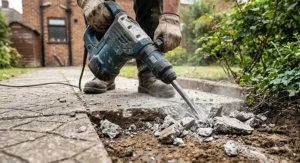
❓ Is SDS plus enough for breaking concrete?
Conclusion
The sds plus vs sds max decision ultimately isn’t about which tool is objectively better — it’s about matching mechanical capability to the actual demands of your project, honestly assessed. For the vast majority of UK DIYers and many tradespeople, SDS plus tools like the Bosch Professional GBH 2-26 F or the cordless Makita DHR242Z deliver everything needed without unnecessary weight, cost or complexity.
Step up to SDS max only once your projects genuinely demand it — regular large-diameter holes, sustained chiselling, or professional demolition work where the Makita HR3540C or Bosch Professional GBH 5-40 DCE‘s extra impact energy translates directly into faster, less exhausting days on site. Budget options like the Einhell TC-RH 800 4F and Titan TTB278SDS prove you don’t need to overspend to get genuinely usable SDS drilling capability for occasional home projects.
Whichever category you land in, prioritise honest self-assessment of how often and how hard you’ll actually use the tool over impulse-buying the most powerful option on the shelf. The right SDS drill is the one that matches your real workload — not the one with the biggest numbers on the box.
✨ Found the right SDS drill for your project? Check today’s price and availability before you decide!
Recommended for You
- Best Right Angle Drill 2026: 7 Top Picks Tested for Tight Spaces
- Electric Screwdriver vs Manual Screwdriver: 7 Best Picks (2026)
- Best Electric Screwdriver 2026: 7 Top UK Picks Compared
Disclaimer: This article contains affiliate links. As an Amazon Associate, I earn from qualifying purchases. If you purchase products through these links, we may earn a small commission at no additional cost to you.
✨ Found this helpful? Share it with your friends! 💬🤗
