In This Article
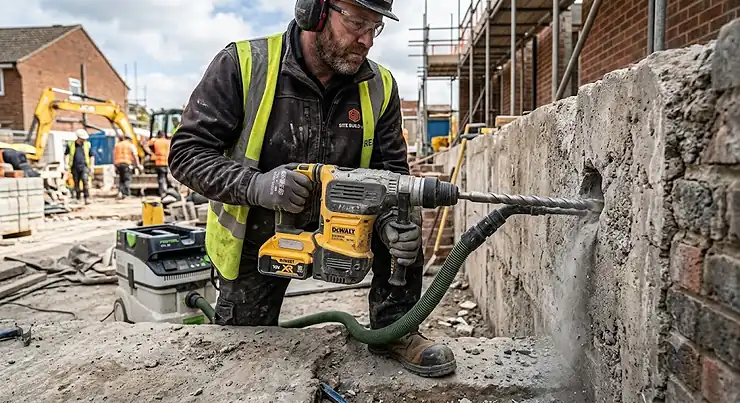
Right, let’s get one thing out of the way first: if you’ve ever tried to break a slab with a bog-standard combi drill, you’ll know the feeling of watching a £60 tool wave the white flag against thirty-year-old concrete. That’s the gap an SDS max drill exists to fill. It’s the tool site foremen reach for when SDS plus taps out and a full-size breaker feels like overkill for the van.
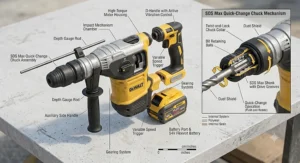
An SDS max drill is a heavy-duty rotary hammer with a larger 18mm shank interface, built to handle bit sizes and impact energies well beyond what SDS plus tools can survive — typically used for large-diameter concrete drilling, anchor setting and chiselling work in commercial and industrial settings. That’s the short version; the longer version involves joules, chuck mechanisms, and a surprising amount of opinion about vibration ratings, all of which we’ll unpack below.
This guide takes the honest route. We’ve pulled real specifications, genuine aggregated reviewer sentiment and pricing context (never exact figures, because Amazon prices shift by the hour) for seven actual machines on the market in 2026 — from budget breakers to the German engineering that costs as much as a decent motorbike. You’ll get a heavy duty SDS max drill for every scenario: the daily-grind contractor, the once-a-year patio-slab DIYer, and everyone chiselling away in between. For background on the SDS bit system’s engineering history, it’s worth a quick detour before we get into the products — understanding why the chuck design matters will make every spec sheet below click into place.
Quick Comparison Table
| Tool | Type | Impact Energy | Weight | Best For |
|---|---|---|---|---|
| Bosch GBH 12-52 DV | Corded combi | 19 J | 12 kg | All-round drilling + chiselling |
| Makita HR5212C | Corded combi | 19.1 J | 11.9 kg | Low-vibration all-day comfort |
| Metabo KHE 96 | Corded combi | 27 J | 12.7 kg | Toughest demolition & concrete breaking |
| DeWalt D25872K | Corded breaker | 13.3 J | 8.6 kg | Dedicated chisel demolition |
| Milwaukee M18 FUEL 2718-20 | Cordless combi | ~15 J | 8.9 kg | Cordless flexibility |
| DeWalt DCH735X2 | Cordless combi | 15+ J | 9.5 kg | Flagship cordless power |
| ENEACRO SDS-Max Jack Hammer | Corded breaker | Mid-range | 10.5 kg | Budget occasional use |
Looking at the spread above, the Metabo KHE 96 is the clear power leader on paper — its 27 joules dwarfs everything else on this list, which matters enormously if you’re breaking thick reinforced slabs rather than drilling neat anchor holes. But raw joules aren’t the whole story: the Bosch GBH 12-52 DV and Makita HR5212C trade a bit of chiselling punch for genuinely better ergonomics on repetitive drilling days, and the cordless pair — Milwaukee M18 FUEL 2718-20 and DeWalt DCH735X2 — sacrifice a little peak power for the ability to work three floors up without dragging a 110-volt transformer behind you.
💬 Found a tool that fits your job already? Have a browse of the picks below before you decide — the differences between them matter more than the headline numbers suggest.
Top 7 SDS Max Drills: Expert Analysis
1. Bosch GBH 12-52 DV — best all-round heavy duty SDS max drill
The GBH 12-52 DV opens with a 1,700W motor pushing out 19 joules of single impact energy, and in practice that translates to comfortably powering through 30-50mm anchor holes all day without the motor labouring. Bosch’s own data shows a drilling range of 12-52mm in concrete, breakthrough capability to 80mm, and core-cutting up to 150mm — numbers that mean this one machine covers everything from rebar-adjacent anchor holes to punching service openings through block walls. At 12kg it sits at the heavier end, but Bosch’s Vibration Control system (rubber mounting plus foam-padded handles) noticeably softens the jarring that older-generation SDS-max tools are known for.
Based on the spec comparison with lighter combi hammers, this is the drill for someone doing genuinely varied concrete work — not just drilling, not just breaking, but switching between the two multiple times a shift. The Rotation Control Clutch and Restart Protection are the kind of features that matter far more on a busy commercial site than a domestic job, where an unexpected bind-up or power cut mid-task is a real hazard rather than a mild inconvenience.
Reviewers consistently report that the Vibration Control genuinely reduces hand fatigue over long anchor-drilling sessions, and a recurring theme in aggregated feedback is praise for how robust the metal gearbox housing proves after years of site abuse. A smaller but persistent complaint concerns the 12kg mass becoming tiring during extended overhead chiselling.
Pros:
- ✅ 19J impact energy handles 30-50mm holes with ease
- ✅ Vibration Control genuinely reduces fatigue on long jobs
- ✅ Versatile enough for drilling, chiselling and core-cutting
Cons:
- ❌ 12kg mass is tiring for overhead work
- ❌ No cordless variant in this exact spec
At around £750-£900, the GBH 12-52 DV sits at professional pricing rather than DIY pricing — but for a contractor who needs one machine to cover drilling and chiselling reliably, it earns that price back in reduced downtime.
2. Makita HR5212C — lowest vibration for all-day comfort
Makita’s AVT (Advanced Anti-Vibration Technology) system is the headline here — a synchronised three-component setup that Makita rates at just 9 m/s², a figure that genuinely matters once you understand UK exposure action values for hand-arm vibration. The 1,510W motor delivers 19.1 joules of impact energy at up to 2,250 impacts per minute, so the drilling speed keeps pace with the Bosch above despite a slightly lower headline wattage, and the 11.9kg weight makes it marginally more manageable through a full shift.
What most buyers overlook about this model is the “soft no-load” function, which automatically drops motor speed when the trigger’s held but the bit isn’t loaded against material — reducing needless vibration exposure during the dead time between holes that adds up across a working day. The one-touch sliding chuck also speeds up bit changes noticeably versus twist-lock designs on older SDS-max tools, a small thing that saves real minutes when you’re drilling forty anchor points in a morning.
Aggregated reviewer sentiment consistently praises how much less fatigued trade users feel by the end of a long drilling day compared with older-generation SDS-max hammers, particularly on repetitive anchor-setting work. A recurring criticism is that carbon brush replacement intervals come around sooner than some buyers expect under sustained heavy daily use.
Pros:
- ✅ Category-leading 9 m/s² vibration rating
- ✅ Soft-start and soft no-load reduce fatigue between holes
- ✅ One-touch chuck speeds up bit changes
Cons:
- ❌ Brush wear reported sooner under continuous heavy use
- ❌ Dual-mode only — no pure rotation-only setting
Expect to pay in the £850-£1,000 range for the HR5212C, which places it slightly above the Bosch — a premium that regular anchor-drilling crews often say is justified purely by the vibration comfort over a working week.
3. Metabo KHE 96 — best SDS max for demolition and concrete breaking
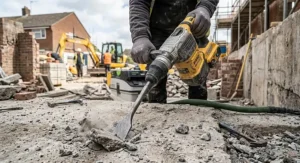
If SDS max concrete breaking is genuinely your priority rather than a secondary use case, the KHE 96 is the one to look at first. Metabo rates it at up to 27 joules of blow energy from a 1,700W, 15-amp motor — a figure that stands well clear of the Bosch and Makita above despite similar input power, which on paper means noticeably faster progress through thick, heavily reinforced concrete rather than just neat anchor holes. At 12.7kg it’s the heaviest tool on this list, and Metabo’s own engineering explanation is straightforward: more mass helps drive that extra impact energy into the material rather than into your wrists.
The VTC (Vario-Tacho-Constamatic) full-wave electronics keep speed near-constant even as you push into denser material, and the S-automatic slip clutch mechanically decouples the drive the instant a bit binds — a genuinely important safety feature on a tool with this much torque behind it. Here’s what to weigh: this is a combination hammer (drilling, hammer-drilling and chiselling), so you’re not sacrificing versatility for that extra punch, but the sheer mass does make it a poor choice if most of your work is fine anchor drilling rather than breaking.
Long-time owners describe the KHE 96 in genuinely glowing terms as remarkably durable German engineering, provided the grease points are serviced regularly — several long-term reviews mention units still running hard after a decade of near-daily site use. A minority note it feels happier chiselling than doing fine, precise drilling work.
Pros:
- ✅ 27J impact energy — the strongest on this list
- ✅ VTC electronics maintain speed under heavy load
- ✅ Reported to survive a decade of daily site abuse
Cons:
- ❌ Heaviest tool here at 12.7kg
- ❌ Overkill and tiring for light anchor-drilling days
Pricing typically sits in the £900-£1,100 range depending on retailer and whether a carry case and spare handle are bundled — check current price before buying, as older stock and newer batches can vary noticeably.
4. DeWalt D25872K — the purpose-built heavy chisel demolition tool
Unlike the three drills above, the D25872K doesn’t drill at all — it’s a dedicated demolition hammer, and that single-purpose design is precisely the point. Stripping out the rotary gearbox lets DeWalt get the weight down to 8.6kg while still delivering 13.3 joules of impact energy, described by DeWalt as category-leading for a machine this light. The Active Vibration Control system, combining a counterbalance mass with a floating handle, brings hand-arm vibration down to a rated 9.7 m/s² — genuinely competitive with the far heavier combi hammers above.
Reviewers consistently single out how much less fatigue builds up over a full day of wall or floor breaking compared with a full combination hammer, simply because there’s less mass to swing and no drilling mechanism adding unnecessary bulk. Based on the spec comparison, the 24-position variable chisel lock is a small but genuinely useful feature — it lets you angle the chisel edge precisely for horizontal wall-breaking rather than fighting the tool’s natural resting position. The barrel grip design further suits horizontal chiselling into walls, where a D-handle machine becomes awkward to brace.
The trade-off is obvious: if this is your only SDS-max tool, you’ve got no drilling capability at all. Aggregated feedback repeatedly flags this as the single reason some buyers regret the purchase — it’s brilliant as a second, dedicated tool, less sensible as someone’s only piece of kit.
Pros:
- ✅ Lightest genuinely heavy-duty breaker on this list
- ✅ Active Vibration Control rated at 9.7 m/s²
- ✅ 24-position chisel lock aids horizontal wall work
Cons:
- ❌ No drilling function whatsoever
- ❌ Redundant if you already own a full combi hammer
Priced around £500-£650, this sits mid-table — reasonable for a dedicated tool, but worth comparing against the versatility of a combination hammer before committing.
5. Milwaukee M18 FUEL 2718-20 — best cordless SDS max hammer drill
The FUEL 2718-20 exists to answer one question: can a battery tool actually replace a corded 15-amp SDS max hammer drill on site? Milwaukee’s POWERSTATE brushless motor delivers roughly 11 ft-lbs (around 15 joules) of impact energy, which puts it comfortably between the DeWalt breaker and the Bosch/Makita combi hammers above, all without a trailing cable. REDLINK PLUS intelligence manages the interaction between tool and battery to prevent overload and overheating, while AUTOSTOP kickback control electronically senses a bind-up and cuts power before the tool can twist violently in your hands — a genuinely valuable safety feature that corded tools of this era generally lack.
What the spec sheet won’t tell you, but user reports suggest, is how much this changes work planning on multi-storey or remote sites: no generator, no extension lead snaking up a stairwell, and no risk of tripping a circuit when three trades are drawing power from the same spur. Reviewers describe drilling speed as genuinely close to a corded 15-amp equivalent, which is a notable claim given how far cordless rotary hammers lagged corded ones even five years ago.
The recurring criticism in aggregated feedback is cost of entry — the REDLITHIUM HIGH OUTPUT batteries this tool needs to perform at its best aren’t cheap, and buyers moving from corded tools sometimes underestimate battery spend when budgeting the switch.
Pros:
- ✅ Impact energy rivals corded 15-amp machines
- ✅ AUTOSTOP kickback control adds genuine safety margin
- ✅ No cables — ideal for upper floors and remote sites
Cons:
- ❌ High Output batteries add significant cost
- ❌ Runtime drops noticeably in continuous chiselling mode
Bare-tool pricing typically runs £350-£450, while a full kit with two batteries and a charger sits in the £700-£900 range — factor the battery cost in before comparing it directly against corded alternatives.
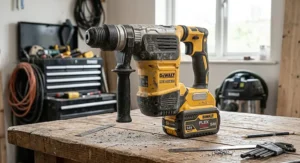
6. DeWalt DCH735X2 — flagship cordless heavy duty SDS max drill
Where the Milwaukee above targets mid-range cordless use, the DCH735X2 goes after corded-equivalent performance outright. Built on DeWalt’s 60V MAX Flexvolt platform with a brushless motor and 1-7/8in (roughly 48mm) capacity, it ships as a two-battery kit specifically so a depleted 9Ah pack can be swapped mid-shift without downtime. DeWalt’s SHOCKS Active Vibration Control carries over from the corded range, and the electronic clutch protects both user and tool during bind-ups on tougher material.
Here’s what to weigh: this tool is genuinely comparable in drilling and chiselling capability to the 12kg corded machines further up this list, but the battery mass pushes total weight up to around 9.5kg — heavier than the Milwaukee, though still noticeably lighter than dragging a corded machine plus extension reel around a large site. Reviewers moving off corded rigs consistently report similar breakthrough speed on typical 40-50mm holes, which is a meaningful endorsement given how demanding that comparison is.
The most common criticism concerns charge time on the larger 9Ah Flexvolt packs — while the two-battery kit largely solves runtime anxiety, a full recharge from empty still takes a while, so planning charging around shift breaks matters more than with smaller battery platforms.
Pros:
- ✅ Corded-equivalent drilling and chiselling performance
- ✅ Two-battery kit largely eliminates runtime downtime
- ✅ SHOCKS vibration control matches corded models
Cons:
- ❌ Battery mass adds noticeable weight
- ❌ Larger 9Ah packs take longer to fully recharge
Expect to pay in the £800-£1,000 range for the two-battery kit — a genuine premium, but one aimed squarely at contractors ready to retire their corded fleet entirely.
7. ENEACRO SDS-Max Demolition Jack Hammer — best budget heavy chisel demolition tool
Not every job justifies a four-figure professional breaker, and that’s exactly the gap the ENEACRO fills. It runs an 11-amp corded motor through an aluminium alloy housing designed to keep overall weight manageable, paired with a vibration-control system and a bundled kit of chisels, grease and a carry bag — everything a first-time buyer needs without hunting down accessories separately. It’s a dedicated chisel-only demolition tool, so there’s no drilling function, but for occasional patio-slab removal, tile-prep breaking or opening a small section of block wall, that trade-off rarely matters.
Based on the spec comparison with the premium breakers above, the ENEACRO obviously can’t match a Metabo or Hilti-grade tool for eight-hour daily duty cycles — the motor and bearings simply aren’t rated for that kind of continuous professional use. But for someone renovating their own property, or a small landscaping outfit that breaks concrete a handful of times a month rather than daily, it removes the argument for hiring a breaker every time the job comes up.
Amazon reviewers consistently flag it as remarkable value for occasional use, frequently comparing it favourably against tool-hire costs over a single project. A recurring theme in aggregated feedback notes the aluminium housing runs noticeably warmer than premium brands under sustained heavy chiselling, and that after-sales support is more limited than with the major manufacturers above.
Pros:
- ✅ Genuinely capable for occasional demolition tasks
- ✅ Complete kit included — chisels, grease, carry bag
- ✅ Often cheaper than a single weekend of tool hire
Cons:
- ❌ Runs warmer than premium brands under heavy use
- ❌ Not rated for continuous daily professional duty
Priced under £200, this is comfortably the most accessible tool on this list — the right call for anyone who needs a heavy chisel demolition tool a few times a year rather than a few times a week.
How to Choose an SDS Max Hammer Drill
What is the best way to choose an SDS max hammer drill? Match impact energy and weight to your actual job frequency, prioritise vibration control if you’ll be drilling daily, and decide upfront whether you need drilling capability or pure chiselling power — then confirm chuck compatibility with your existing SDS-max bits and chisels before buying.
- Work out your duty cycle first. A tool used a handful of times a year has entirely different requirements from one running eight hours a day — the ENEACRO suits the former, the Metabo or Hilti-class tools the latter.
- Decide drilling versus chiselling versus both. Dedicated breakers like the DeWalt D25872K are lighter and often cheaper than combi hammers, but only if you genuinely don’t need the drilling function.
- Weigh vibration rating heavily if you’re drilling daily. The UK’s Control of Vibration at Work Regulations make this a legal consideration for employers, not just a comfort preference — see the HSE’s hand-arm vibration guidance for the exposure limits that apply.
- Match impact energy to material thickness. Thin block walls need far less than 19-27 joules; thick reinforced slabs benefit enormously from the higher end of that range.
- Consider corded versus cordless based on site access. Multi-storey or remote sites favour cordless; continuous eight-hour demolition work still often favours corded reliability.
- Check bit and chisel compatibility. SDS-max accessories aren’t interchangeable with SDS-plus, so confirm your existing accessory collection matches before switching platforms.
- Read aggregated review sentiment, not star ratings alone. A 4.3-star average tells you less than recurring specific complaints about, say, brush wear or overheating under sustained use — as Which?’s independent power tool testing methodology demonstrates, real-world testing frequently diverges from marketing claims.
Heavy Duty SDS Max Drill vs SDS Plus: What’s the Real Difference
The honest answer is that SDS plus and SDS max aren’t really competing products — they’re sized for different jobs, and confusing the two is one of the more expensive mistakes a buyer can make. SDS plus uses a smaller 10mm shank and typically maxes out around 6-8 joules of impact energy, which is genuinely sufficient for domestic anchor drilling, running conduit holes, and light masonry work. SDS max, with its 18mm shank, is built for exactly the applications where SDS plus starts to feel outgunned: large-diameter holes, thick concrete, and any chiselling heavier than light chasing work.
Here’s the trap: buying a heavy duty SDS max drill for genuinely light domestic work is like buying a van to do the school run. It works, but you’re carrying weight, cost and vibration exposure you don’t need. Conversely, trying to push an SDS plus tool into SDS max territory — big anchor holes in structural concrete, sustained chiselling — burns motors out fast and produces genuinely worse results than the right-sized tool would. The Bosch GBH 12-52 DV and its combi-hammer peers above exist precisely because SDS plus physically cannot deliver their drilling range or chiselling force without destroying itself in the attempt.
If your work sits right on the boundary — say, occasional 20-25mm holes with the odd bit of light chiselling — it’s genuinely worth trying to borrow or hire both platforms before committing, since the “right” answer depends more on your specific job mix than any spec sheet can capture on its own.
SDS Max Concrete Breaking: What to Expect in Real-World Performance
Spec sheets talk in joules and impacts-per-minute; job sites talk in “how long until this slab’s gone.” Translating the numbers into lived experience: a 19-20 joule combi hammer like the Bosch GBH 12-52 DV or Makita HR5212C will chew through a standard 100mm domestic concrete path or patio slab in a matter of minutes per square metre, provided the chisel bit stays sharp and you let the tool’s weight do the work rather than forcing it. Push into 150-200mm reinforced slabs — the kind found under commercial floors — and the difference between 19 joules and the Metabo KHE 96‘s 27 joules becomes very noticeable; what might be a slow, grinding half-hour on the lower-powered tools becomes considerably faster work with the extra punch.
What most buyers don’t anticipate is how much technique affects perceived power. Aggregated reviewer feedback repeatedly notes that new users initially “fight” the tool, pressing hard and adding fatigue without adding cutting speed, whereas experienced operators let the hammer mechanism do the work and simply guide the bit. Reviewers consistently note that dust extraction attachments, while adding setup time, noticeably reduce airborne debris on continuous breaking jobs — a genuinely important consideration given the health risks discussed in the safety section below.
Cold weather and damp concrete both slow progress regardless of tool choice, and reused or previously-patched concrete (with embedded aggregate or old repairs) chips less predictably than fresh pours — worth factoring into any time estimate before quoting a job.
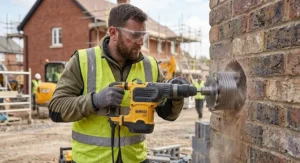
Choosing the Right Heavy Chisel Demolition Tool: Problem → Solution Guide
Problem 1: You need to break concrete but only own a rotary drill, not a breaker. A standard rotary drill, even a powerful SDS plus one, isn’t built for sustained chiselling loads and will overheat or fail prematurely. Solution: step up to a genuine SDS max combi hammer like the Bosch GBH 12-52 DV, which handles both drilling and chiselling without compromise.
Problem 2: Your current breaker is too heavy for extended overhead or wall work. Solution: a dedicated lightweight breaker such as the DeWalt D25872K, at 8.6kg, is specifically designed to reduce arm fatigue during vertical and overhead chiselling compared with a full 12kg combi hammer.
Problem 3: You need serious demolition power but the job is occasional, not daily. Solution: the ENEACRO SDS-Max Demolition Jack Hammer delivers genuine chiselling capability at a fraction of the cost of professional-grade tools, ideal for infrequent DIY or small-trade use.
Problem 4: Cords and extension leads are a genuine hazard or impracticality on your site. Solution: cordless options like the Milwaukee M18 FUEL 2718-20 or DeWalt DCH735X2 eliminate trailing leads entirely, at the cost of needing to manage battery charge cycles.
Problem 5: Vibration exposure is becoming a genuine health and compliance concern for your crew. Solution: prioritise vibration-rated tools such as the Makita HR5212C (9 m/s²) or DeWalt D25872K (9.7 m/s²), and rotate operators through shorter exposure windows regardless of which tool you choose.
Professional Rotary Hammer 10kg Class: Why Weight and Balance Matter
Most of the serious corded combi hammers on this list — the Bosch GBH 12-52 DV at 12kg, the Makita HR5212C at 11.9kg, and the Metabo KHE 96 at 12.7kg — cluster around what the trade often calls the “10kg class”: heavy enough to deliver 19+ joules of chiselling force, but still designed to be held and guided by one person rather than mounted on a stand. This weight bracket exists for a reason. Go much lighter and impact energy drops sharply, because mass is genuinely part of how these tools deliver force into concrete. Go much heavier and you’re into two-handed jackhammer territory that most trades find impractical for anything beyond dedicated floor-breaking.
Here’s what to weigh when a spec sheet lists weight: a 10-13kg professional rotary hammer needs to be braced properly, ideally with the side handle positioned to let your body — not just your arms — absorb reaction torque. Reviewers across all three heavier tools above consistently note that proper stance and grip make a bigger difference to perceived fatigue than the kilogram difference between models. What most buyers overlook is that a slightly heavier tool with better vibration damping, like the Makita, often feels less tiring by the end of a shift than a lighter tool with worse damping — weight alone is a poor predictor of how a tool feels after four hours.
For anyone regularly working overhead or on ladders, though, dropping down to the DeWalt D25872K’s 8.6kg dedicated-breaker weight class is worth serious consideration, even accepting the loss of drilling capability.
Practical Usage Guide: Setup, First 30 Days & Maintenance
Getting a new SDS max drill running properly starts before the first hole. Grease the shank of every new bit before its first insertion — most tools ship with a small tube of hammer bit grease, and skipping this step is the single most common cause of premature chuck wear reported in aggregated reviews. Check the depth-stop rod is correctly seated if your model includes one; it’s easy to overlook and genuinely useful for repetitive anchor-hole work where consistent depth matters.
During the first 30 days, resist the urge to push the tool at full pressure immediately — most manufacturers recommend a light break-in period, and reviewers who skip this occasionally report early clutch or bearing issues. A common early mistake is gripping the side handle too rigidly; the correct technique lets the tool’s weight and hammer action do the work while your hands guide direction rather than force penetration. Overgripping both increases vibration transmitted to your hands and tires you out faster than the job requires.
For ongoing maintenance, regrease the SDS shank interface roughly every few hours of heavy use, and inspect carbon brushes at the intervals your manual specifies — several reviewers across multiple brands above note brush wear as the most common wear item requiring attention. Keep the chuck dust seal clean, since grit ingress is the leading cause of chuck sticking on sites with heavy concrete dust. Finally, store the tool in its case rather than loose in a van — vibration during transport loosens fasteners over time, and a dedicated case protects the chuck mechanism from impact damage.
Real-World Scenarios: Matching Buyer to Tool
The daily commercial contractor. Running anchor holes and occasional wall openings across multiple sites, five days a week, with a crew rotating through the tool. This buyer needs the durability and versatility of the Bosch GBH 12-52 DV or Makita HR5212C — the upfront cost is justified by daily use, and vibration control genuinely protects long-term crew health under HSE exposure regulations.
The specialist demolition sub-contractor. Breaking reinforced concrete and thick slabs as the core of the business, often for extended periods per job. Here, the Metabo KHE 96‘s 27 joules of pure chiselling force pays for itself in reduced job time, and the weight is manageable because breaking work is generally braced against the material rather than held freehand for long stretches.
The renovating homeowner or small landscaping outfit. Breaking a patio, opening a single wall, or removing old foundations a handful of times a year, on a tight budget. The ENEACRO SDS-Max Demolition Jack Hammer covers this need without the four-figure investment a commercial-grade tool demands, and the included accessory kit avoids extra spending on bits and chisels.
The multi-storey or remote-site electrician or plumber. Needs occasional heavy anchor holes without hauling a generator or extension lead up several flights of stairs. The Milwaukee M18 FUEL 2718-20 delivers near-corded performance without the cable, at a genuinely lower entry cost than the flagship DeWalt DCH735X2, which suits a full-time cordless conversion instead.
Common Mistakes When Buying an SDS Max Drill
Buying purely on impact energy without considering weight is a frequent misstep — the highest-joule tool on paper isn’t automatically the best choice if its 12.7kg mass makes it impractical for your actual working posture. Another common error is underestimating accessory cost: SDS-max bits and chisels are significantly pricier than SDS-plus equivalents, and a tight budget that only accounts for the tool itself often gets an unwelcome surprise at checkout.
Buyers moving to cordless models frequently forget to budget for spare batteries, and then find runtime frustratingly short on their first big job. On the flip side, some buyers overspend on a premium combi hammer for genuinely occasional use, when a dedicated budget breaker like the ENEACRO would have covered their actual job frequency at a fraction of the cost. Finally, skipping vibration ratings entirely is a mistake with long-term health consequences rather than just short-term comfort ones — a distinction the HSE’s construction dust and health guidance makes clear applies to more than just dust exposure on demolition sites.
Long-Term Cost & Maintenance: The Real Total Cost of Ownership
The sticker price is only the opening bid. Corded professional tools like the Bosch GBH 12-52 DV or Metabo KHE 96 carry ongoing costs in carbon brushes, occasional service, and SDS-max bit replacement — bits wear faster in max-diameter, high-impact applications than most first-time buyers expect, and a decent stock of spares adds up over a year of regular use. Cordless tools like the Milwaukee M18 FUEL 2718-20 shift some of that cost into batteries instead — a spare high-output pack isn’t cheap, but it removes downtime waiting for a single battery to recharge mid-shift.
Dedicated breakers like the DeWalt D25872K and the budget ENEACRO generally have lower running costs simply because there’s no rotary gearbox to service, though the ENEACRO’s more limited after-sales support means a failed part further down the line may be harder to source than for the major brands.
Cost-per-use is the more useful comparison than sticker price for anyone weighing purchase against hire. A professional-grade tool used daily across several years works out remarkably cheap per job once amortised; the same tool bought for two uses a year would have been far better value hired, or replaced with a genuinely budget-tier alternative like the ENEACRO.
Safety, Regulations & Compliance for Demolition Work
Two health risks dominate SDS-max work in the UK: hand-arm vibration and respirable crystalline silica dust, and both carry specific legal obligations for anyone using these tools professionally. Under the Control of Vibration at Work Regulations 2005, employers must assess vibration exposure and provide appropriate controls once daily exposure approaches the action value — full detail is available through the HSE’s dedicated hand-arm vibration resource, and it’s worth checking regardless of whether you’re an employer or a sole trader planning your own exposure limits.
Dust extraction attachments, compatible with most of the tools reviewed above, aren’t just a tidiness feature — breaking and drilling concrete releases fine silica dust that causes serious long-term lung disease with sustained exposure. Wet-cutting attachments, on-tool extraction, or at minimum a properly rated dust mask should be treated as non-negotiable for any extended concrete-breaking session, not an optional extra.
Beyond health exposure, basic PPE — impact-rated eye protection, ear defenders given the noise levels these tools produce, and gloves rated for vibration reduction rather than generic work gloves — rounds out a genuinely compliant setup. None of the seven tools above substitute for proper protective equipment, however well their built-in vibration or dust systems perform.
✨ Ready to Compare Prices on Today’s Top Picks?
🔍 Take your next concrete drilling or demolition job up a notch with one of the seven tools above. Click through on any highlighted pick to check current pricing and availability — the right SDS max drill will save you hours on site and protect your hands for years to come!
FAQ
❓ What is an SDS max drill used for?
❓ What's the difference between SDS plus and SDS max?
❓ Can I use SDS max bits in an SDS plus drill?
❓ Is a rotary hammer the same as an SDS max drill?
❓ How much impact energy do I need to break concrete with an SDS max drill?
Conclusion
There’s no single best SDS max drill — only the right tool for how often you’ll actually use it, on what material, and for how long each session. The Bosch GBH 12-52 DV and Makita HR5212C cover the widest range of everyday professional needs, the Metabo KHE 96 exists for genuine demolition muscle, and the DeWalt D25872K and ENEACRO SDS-Max Demolition Jack Hammer answer the question of dedicated chiselling power at two very different budgets. If cables are the problem rather than power, the Milwaukee M18 FUEL 2718-20 and DeWalt DCH735X2 solve that without meaningfully compromising performance.
Whichever you choose, the numbers on the box only tell half the story — vibration exposure, dust control and simple technique matter just as much to how the tool performs in your hands over months and years of use as any single joule figure. Match the tool to the job honestly, budget for accessories and batteries alongside the headline price, and the right SDS max drill should outlast several less-considered purchases.
✨ Ready to find your perfect match? Browse the seven picks above and check today’s prices before you buy! 🛠️
Recommended for You
- SDS Plus Drill: 7 Best Picks Tested for UK Homes (2026)
- SDS Plus vs SDS Max: 7 Best Rotary Hammers UK 2026
- Best Right Angle Drill 2026: 7 Top Picks Tested for Tight Spaces
Disclaimer: This article contains affiliate links. As an Amazon Associate, I earn from qualifying purchases. If you purchase products through these links, we may earn a small commission at no additional cost to you.
✨ Found this helpful? Share it with your friends! 💬🤗
