In This Article
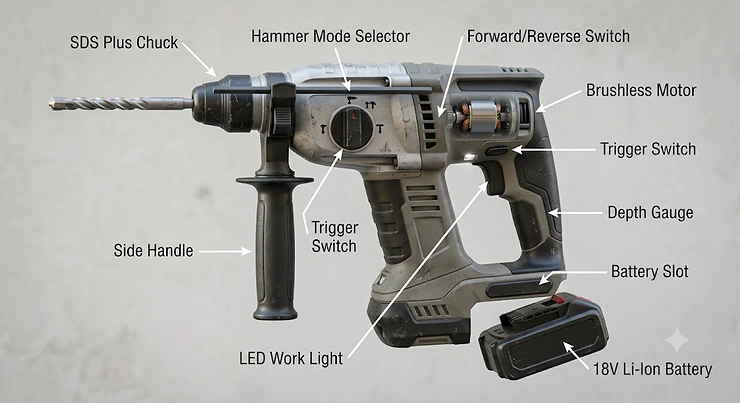
A cordless SDS drill is a battery-powered rotary hammer that uses the SDS (Slotted Drive Shaft) chuck system to punch, rather than simply spin, its way through masonry, brick and concrete — trading a mains lead for a slide-in battery pack while keeping the hammering action that ordinary drills can’t manage. If you’ve ever tried to sink a rawl plug into a Victorian brick wall with a standard combi drill, you already know why this category exists: brute rotation alone just skates off hard aggregate, whereas a proper hammer action chips its way through.
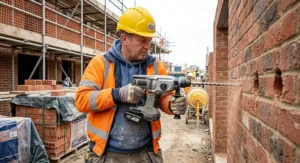
Here’s the thing nobody tells you before you start shopping: “SDS drill” covers an enormous spread of tools, from featherweight DIY units that struggle past 15mm holes to site-hardened beasts that will happily eat through lintels all day. Picking the wrong one isn’t just an inconvenience — it’s the difference between a job finished by lunchtime and a battery that dies halfway through your fourth hole. This guide walks through seven genuinely good cordless SDS drills, drawn from real UK retailers and real owner feedback, and explains which one actually suits your situation rather than just listing what’s on the spec sheet.
We’ll cover budget picks for the occasional DIYer, mid-range workhorses for tradespeople, and a couple of properly premium options for anyone drilling concrete for a living. Along the way we’ll dig into battery runtime on site, why weight and balance matter more than most buyers realise, and how cordless models genuinely stack up against their corded cousins. Original SDS-Plus chucks, incidentally, trace back to a design Robert Bosch patented in the 1970s — you can read more about the history of the rotary hammer if you’re curious how we got here.
Quick Comparison Table
If you’re in a hurry, here’s the shortlist. Full details on every model follow further down the page.
| Drill | Impact Energy | Weight (bare) | Best For |
|---|---|---|---|
| Ryobi R18SDS-0 | 1.3 J | ~2.0 kg | Existing Ryobi ONE+ owners on a budget |
| Einhell TE-HD 18 Li | 1.2 J | ~1.7 kg | Occasional DIY, complete starter kit |
| Makita DHR202Z | 2.0 J | ~2.6 kg | All-round mid-range reliability |
| HiKOKI DH18DBL | 2.6 J | ~3.7 kg | Fastest drilling speed in class |
| DeWalt DCH273N | 2.1 J | ~3.1 kg | Daily site use, tradespeople |
| Bosch GBH 18V-21 | 2.0 J | ~2.4 kg | Best power-to-weight ratio |
| Milwaukee M18 FUEL SDS Plus | 2.0-3.6 J* | ~2.6-3.5 kg | Professionals, heaviest daily use |
*Milwaukee’s SDS Plus range spans several impact energies depending on the exact model — see the full write-up below.
Looking at this table, a clear pattern emerges: impact energy and weight tend to rise together, which is simple physics rather than marketing spin — a beefier hammering mechanism needs a sturdier housing to contain it. The Ryobi R18SDS-0 and Einhell TE-HD 18 Li trade outright drilling power for portability and price, which is exactly the right call if you’re only drilling the occasional shelf bracket. Meanwhile, the HiKOKI DH18DBL and Milwaukee M18 FUEL SDS Plus sit at the sharper end, built for people who drill dozens of holes before lunch and simply cannot afford a tool that flags halfway through.
💬 Just one click — help others make better buying decisions too!😊
Top 7 Cordless SDS Drills: Expert Analysis
Below are seven real, currently available cordless SDS drills, spanning budget, mid-range and premium price brackets, plus a spread of brands so you’re not just reading a Makita advert with extra steps.
1. Ryobi R18SDS-0 — best budget pick for existing ONE+ owners
The standout here isn’t outright power, it’s the ecosystem: if you already own any Ryobi 18V ONE+ tool, this drill arrives “naked” and simply clicks onto a battery you already have sitting in the shed. With a brushed motor delivering up to 1,300 rpm and roughly 5,000 bpm, but only around 1.3 Joules of impact energy, this is honestly a light-duty tool wearing an SDS badge rather than a true site hammer — and that’s fine, provided you know what you’re buying. At around 2kg bare, it’s genuinely one of the lightest SDS drills on the market, which matters enormously for overhead work or anyone drilling dozens of small anchor holes in a single session.
Who should buy this: DIYers fitting shelving, curtain poles, or the occasional TV bracket into masonry, and anyone already committed to the ONE+ battery platform who wants to avoid buying yet another charger. Reviewers consistently note that it copes fine with brick and block but struggles once you’re into dense concrete or repeated deep holes, and a handful of owners report the chuck developing play (“chuck wobble”) after extended heavy use — a fair trade-off at this price point, but worth knowing before you buy.
Pros:
- ✅ Genuinely lightweight at roughly 2kg bare
- ✅ Slots straight into the existing Ryobi ONE+ battery family
- ✅ Four operating modes including chisel alignment for tiling work
Cons:
- ❌ Only 1.3J impact energy — underpowered for dense concrete
- ❌ Some owners report chuck wobble developing over time
Bare units typically sit in the under-£100 range, making this one of the cheapest genuine entry points into cordless SDS drilling — solid value if your workload matches its limits, less so if you’re expecting site-grade performance.
2. Einhell TE-HD 18 Li — cheapest complete kit for occasional DIY
What jumps out about this one is that it’s rarely sold “bare” — most listings bundle a battery, charger, case and a set of SDS bits, so the all-in price is genuinely competitive rather than hiding extra costs at checkout. With around 1.2 Joules of impact energy and a pneumatic hammer mechanism, the Einhell TE-HD 18 Li handles typical stud-wall and light masonry drilling comfortably, plus a forward/reverse function for driving and removing screws, which the more hammer-focused rivals on this list skip entirely.
Based on the spec comparison, this sits a shade below the Ryobi on raw power but claws back ground on completeness and Einhell’s Power X-Change battery system, which now spans an enormous range of garden and workshop tools — useful if you’re building out a cordless toolkit from scratch rather than adding to an existing one. Reviewers on general DIY forums describe it as a dependable once-a-month tool rather than a daily driver, with the caveat that all-metal gearing keeps it feeling more robust than its price would suggest.
Pros:
- ✅ Usually bundled complete with battery, charger and case
- ✅ Forward/reverse function doubles as a screwdriver
- ✅ Compatible with Einhell’s wider Power X-Change battery range
Cons:
- ❌ Lowest impact energy on this list at 1.2J
- ❌ Not intended for repeated deep concrete drilling
Kit prices typically fall in the low-£100s, and given you’re getting a battery and charger thrown in, the value proposition for a first-time buyer is hard to beat.
3. Makita DHR202Z — best all-round mid-range choice
The 3.2 Joule impact rating (some listings show it drilling to 20mm capacity with a brushless motor delivering up to 1,100 rpm and 4,000 bpm) puts real daylight between this and the two budget options above it, while the brushless motor means there are no carbon brushes to wear out over the tool’s life. What most buyers overlook about this model is the rubber joint construction between the motor housing and the battery mount, specifically engineered to stop vibration transmission from shortening battery life — a detail that never makes it onto a bullet-point spec sheet but genuinely extends the working life of your batteries.
This is the drill for someone who wants “the safe choice”: Makita dominates UK trade van stock more than any other brand, which means bits, spares and compatible batteries are never hard to find, even on a Saturday morning. Reviewers and tradespeople repeatedly praise the reliability and the sheer breadth of Makita’s 18V LXT battery range, meaning this tool can slot into an existing fleet of drills, saws and grinders without adding a new charger to the van. The three-mode operation (rotation only, hammer with rotation, hammer only) covers drilling, fixing and light chiselling in one body.
Pros:
- ✅ Backed by Makita’s enormous 18V LXT battery ecosystem
- ✅ Rubber-jointed construction reduces vibration transfer to the battery
- ✅ Three-mode operation covers drilling, hammering and light chiselling
Cons:
- ❌ Sold body-only in most listings — batteries add real cost
- ❌ Heavier than the two budget picks above it
Body-only pricing generally sits in the mid-£100s, climbing well into the £250-£350 range as part of a kit with batteries and a charger — check current pricing before you commit, since kit contents vary wildly between retailers.
4. HiKOKI DH18DBL — fastest drilling speed in its class
HiKOKI (formerly sold as Hitachi) doesn’t get the brand recognition of Makita or DeWalt on UK high streets, but the spec sheet tells a different story: 2.6 Joules of impact energy, a 3,950 bpm impact rate and the ability to drill up to 26mm holes in concrete. HiKOKI’s own testing claims a 40% faster drilling speed than the previous generation model, thanks to a brushless motor paired with what the manufacturer calls Reactive Force Control — essentially a clutch system that reduces kickback risk if the bit binds mid-hole.
Here’s what the spec sheet won’t tell you, but reviewers note: this is a genuinely underrated tool among trade buyers who’ve actually used one, precisely because HiKOKI doesn’t spend on the marketing budget that Makita and DeWalt do. If you’re the kind of buyer who reads spec sheets rather than adverts, this is worth serious consideration — you’re paying for performance rather than badge recognition, and at 3.7kg it’s noticeably heavier than the Bosch and Makita options, so it rewards two-handed use rather than one-handed overhead drilling.
Pros:
- ✅ Highest concrete drilling capacity on this list at 26mm
- ✅ Reactive Force Control clutch reduces bind-up kickback risk
- ✅ Genuinely competitive pricing against bigger-name rivals
Cons:
- ❌ Heavier than most rivals at around 3.7kg
- ❌ Less widespread brand recognition means fewer accessories on the shelf
Body-only prices typically land in the £150-£200 range, representing strong value against similarly specified Makita or DeWalt tools — definitely one to check current pricing on before assuming the big brands are cheaper.
5. DeWalt DCH273N — best for daily site use and site durability
The DeWalt DCH273N delivers 2.1 Joules of impact energy, up to 1,200 rpm and roughly 4,500-4,600 bpm, and DeWalt’s own testing claims more than 90 holes (10mm x 80mm) per charge on a 5.0Ah battery — a genuinely useful real-world figure rather than an abstract rpm number. The standout feature is DeWalt’s “Perform & Protect” vibration control, measured at a best-in-class 6.6 m/s², which directly reduces the risk of hand-arm vibration syndrome over a long working day (more on that risk in the safety section below).
Based on the spec comparison, this sits right at the sweet spot for tradespeople who need a tool that survives being dropped off scaffolding occasionally: an electronic clutch protects the drivetrain if the bit jams, rotation-stop mode handles light chiselling in plaster and tiles, and the DeWalt XR battery platform now covers well over 250 compatible tools, meaning one battery family runs your whole van. Reviewers repeatedly describe it punching through brick and concrete “with no effort” and praise the solid feel of the chuck — a small detail that matters when you’re swapping bits fifty times a day.
Pros:
- ✅ Best-in-class vibration control at 6.6 m/s²
- ✅ Drills over 90 holes per charge on a 5.0Ah battery
- ✅ Part of DeWalt’s 250-plus tool XR battery platform
Cons:
- ❌ Body-only listings still need a compatible battery and charger
- ❌ Chiselling capability is limited to light-duty tasks only
Body-only pricing generally sits in the £140-£180 range, with 2x5Ah kits typically landing nearer the £280-£300 mark — always confirm current pricing, since DeWalt kit bundles change frequently.
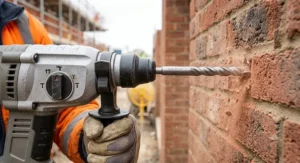
6. Bosch GBH 18V-21 — best power-to-weight ratio
At just 2.4kg bare with a 2.0 Joule impact system, the Bosch GBH 18V-21 delivers one of the best power-to-weight ratios on this entire list — a genuinely important consideration if you’re drilling overhead into a ceiling or holding the tool at arm’s length for any stretch of time. The brushless motor is maintenance-free (no carbon brushes to replace, ever), and Bosch’s Rotation Control Clutch disengages automatically if the bit binds, protecting both the tool and your wrist from a sudden kickback.
What most buyers overlook about the GBH 18V-21 is that Bosch specifically recommends pairing it with a 4.0Ah battery or higher for optimal performance — pairing it with a smaller battery works, but you’ll notice reduced punch on tougher materials. Reviewers frequently mention it as excellent value when bought as part of a battery-and-charger bundle, and one common theme across owner feedback is genuine surprise at how little vibration reaches the hand compared with cheaper alternatives, even without a dedicated anti-vibration handle system like DeWalt’s.
Pros:
- ✅ Outstanding 2.4kg weight for a 2.0J impact tool
- ✅ Brushless motor requires zero carbon-brush maintenance
- ✅ Rotation Control Clutch protects against bind-up kickback
Cons:
- ❌ Needs a 4.0Ah+ battery to perform at its best
- ❌ Chiselling mode is suitable for light tasks only, not demolition
Body-only pricing typically sits around £150-£190, while 2x4Ah or 2x5Ah kit bundles generally land in the £250-£320 range depending on the retailer and current promotions.
7. Milwaukee M18 FUEL SDS Plus (M18 FHAFOH16) — best overall performance, premium pick
Independent trade-press testing has repeatedly rated Milwaukee’s M18 FUEL SDS Plus range as the strongest all-round performer in the cordless SDS-Plus category, and the spec sheet backs it up: figures across the range include up to 2.3 Joules of impact energy, roughly 4,600-4,800 bpm, and a POWERSTATE brushless motor paired with Milwaukee’s REDLINK PLUS electronics, which actively protects the tool from overload, overheating and over-discharge. The standout feature buyers actually notice on the jobsite is the AUTOSTOP kickback control, which shuts the tool down within 45 degrees of sudden rotation if a bit binds in rebar — a genuine safety feature, not just a marketing bullet point.
This is the drill for professionals who drill concrete for a living and simply cannot afford downtime. Reviewers who’ve tested it against Bosch and DeWalt equivalents describe it as “simply the best in the class in all performance metrics,” and real-world site use bears that out: the rotating auxiliary handle swings a full 360 degrees for left- or right-handed users, and Milwaukee’s AVS anti-vibration system measures a respectable 8.6 m/s² despite the tool’s higher power output. The trade-off, honestly, is weight and price — this isn’t the tool to buy if you only drill four holes a year.
Pros:
- ✅ AUTOSTOP kickback control shuts down on sudden bind-ups
- ✅ Rated best-in-class for performance by independent trade testing
- ✅ 360-degree rotating auxiliary handle suits left- and right-handed use
Cons:
- ❌ Among the more expensive options in this category
- ❌ Heavier than the Bosch and Makita mid-range alternatives
Prices vary considerably by exact model and kit contents, but expect to pay in the £250-£400+ range for a battery-inclusive kit — this is a premium-tier investment, so it’s worth checking current pricing and comparing exact model numbers carefully.
Practical Usage Guide: Setup, First Use & Maintenance Schedule
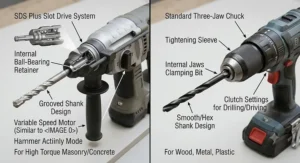
Getting a new cordless SDS drill out of the box right matters more than most first-time buyers expect. Before your first hole, fully charge the battery once (most modern lithium packs don’t need a “conditioning” cycle the way old NiCd batteries did, but a full charge lets you gauge genuine runtime), and always seat the SDS bit fully into the chuck — you should hear and feel a distinct click, and give the bit a gentle tug to confirm it’s locked before pulling the trigger.
A common first-30-days mistake is drilling with the hammer function engaged on wood or metal, where you only need rotation — this wears the mechanism unnecessarily and creates a rougher, less accurate hole. Similarly, applying excessive forward pressure doesn’t drill faster; the hammering mechanism does the work, and pushing harder just fatigues your arm and increases vibration exposure for no real gain. For maintenance, wipe down the SDS shank with a dry cloth after dusty jobs, and every few months add a small amount of SDS-specific grease to the chuck to keep the locking mechanism moving smoothly — most manufacturers sell a small tube of the right grease alongside their bit sets. Store batteries at roughly 40-60% charge if the tool won’t be used for weeks, since lithium-ion packs degrade faster stored at full charge.
✨ Don’t Miss These Exclusive Deals!
🔍 Take your masonry drilling to the next level with these carefully selected tools. Click on any highlighted item to check current pricing and availability — the right cordless SDS drill will save you hours on every job.
Real-World Scenarios: Matching the Right Drill to the Job
Consider three quite different buyers. First, a weekend DIYer fitting a handful of shelf brackets and a TV bracket into a Victorian solid-brick wall, drilling perhaps ten holes a year — the Ryobi R18SDS-0 or Einhell TE-HD 18 Li covers this comfortably, and the money saved versus a premium tool is better spent on a decent set of masonry bits.
Second, a self-employed electrician running first and second fix on new-build sites, drilling dozens of cable-entry holes through masonry and the occasional lintel every single day — here the Makita DHR202Z or DeWalt DCH273N makes far more sense, because both plug into a wider battery ecosystem the tradesperson likely already owns, and the runtime and durability comfortably absorb daily abuse.
Third, a groundworks or shopfitting contractor drilling heavy anchor points into structural concrete for hours at a stretch, where downtime costs real money — the Milwaukee M18 FUEL SDS Plus or HiKOKI DH18DBL earns its higher price tag through raw drilling speed and kickback protection that genuinely reduces injury risk on a long, repetitive shift.
Buyer’s Decision Framework
If you drill fewer than twenty holes a month in brick or block, choose a budget model like the Ryobi R18SDS-0, because the extra power of a premium tool goes largely unused and you’d simply be paying for capacity you never touch. If you’re on a jobsite daily and already own 18V batteries from a specific brand, choose that brand’s mid-range SDS drill — the Makita DHR202Z or DeWalt DCH273N — because battery compatibility saves more money over time than chasing the single “best” spec sheet. If your work involves core-drilling large diameters or heavy anchor fixing into structural concrete, choose the Milwaukee M18 FUEL SDS Plus, because its combination of impact energy and kickback protection is built specifically for that load. And if weight is your overriding concern — say, for overhead ceiling work — prioritise the Bosch GBH 18V-21 for its exceptional power-to-weight ratio over raw impact energy alone.
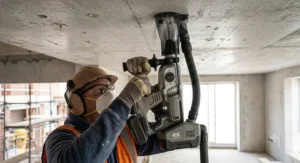
How to Choose a Cordless SDS Drill
Picking the right tool comes down to seven practical criteria, each worth weighing before you spend a penny:
- Impact energy (Joules) — this determines how quickly the tool bites into hard material; anything under 1.5J suits light DIY, while 2J-plus handles genuine masonry and concrete work.
- Battery compatibility — if you already own 18V batteries from a brand, staying within that ecosystem saves significant money over buying a bare tool from scratch.
- Weight and balance — overhead or prolonged one-handed drilling favours lighter tools, even at the cost of some raw power.
- Vibration rating (m/s²) — lower figures mean less fatigue and lower long-term health risk under UK vibration exposure guidance.
- Number of operating modes — three-mode tools (drill, hammer-drill, hammer-only) add genuine chiselling versatility that two-mode budget tools lack.
- Chuck and bit availability — mainstream brands mean spares and replacement bits are never hard to source, even from a local trade counter.
- Warranty and battery ecosystem size — a bigger platform of compatible tools protects your investment as your toolkit grows.
| Criteria | Budget Priority | Trade Priority |
|---|---|---|
| Impact Energy | 1.2-1.5J acceptable | 2.0J+ preferred |
| Weight | Lighter preferred | Balanced against power |
| Battery Ecosystem | Less critical | Highly important |
| Best For | Ryobi R18SDS-0, Einhell TE-HD 18 Li | DeWalt DCH273N, Milwaukee M18 FUEL SDS Plus |
Reading across this table, the honest takeaway is that there’s no single “best” cordless SDS drill — only the right tool matched to your actual drilling frequency and existing battery investment, which is precisely why the earlier decision framework matters more than any individual spec.
Cordless SDS Drill vs Corded SDS Drill
The obvious appeal of going cordless is freedom of movement — no trailing lead across a scaffold, no hunting for a socket on an unwired new-build, and no extension reel to trip over. Modern brushless 18V motors have closed the power gap considerably; tools like the Milwaukee M18 FUEL SDS Plus and HiKOKI DH18DBL now genuinely rival mid-range corded units for raw drilling speed, something that simply wasn’t true a decade ago.
| Factor | Cordless SDS Drill | Corded SDS Drill |
|---|---|---|
| Portability | Excellent — no lead required | Limited by cable/extension length |
| Sustained power | Very good, battery-dependent | Consistent, unlimited runtime |
| Weight | Generally lighter | Often heavier due to motor size |
| Ongoing cost | Battery replacement over time | No battery cost, higher power draw |
| Best For | Site work, awkward access, short bursts | Continuous heavy demolition, workshops |
That said, corded rotary hammers still win outright for continuous, hours-long demolition or repeated large-diameter core drilling, since they never run flat mid-job and typically pack a higher raw impact energy for a given tool weight. The honest verdict: if your work is spread across a site with awkward access and shorter drilling bursts, go cordless; if you’re doing sustained heavy-duty demolition in one location with a plug socket nearby, a corded rotary hammer remains the more cost-effective and reliable option.
What to Expect: Runtime, Weight & Balance on Site
Battery runtime is the single most misunderstood spec in this category. Manufacturers quote “holes per charge” figures — DeWalt’s claimed 90+ holes per charge on the DCH273N, for instance — but that number assumes 10mm holes in standard concrete, and real-world runtime drops noticeably in denser aggregate, deeper holes, or colder weather, since lithium-ion cells lose some efficiency below around 5°C. A common real-world estimate for a mid-range 18V SDS drill with a 4-5Ah battery is somewhere between 60 and 150 typical anchor holes, depending heavily on material hardness and bit sharpness — a blunt bit alone can cut runtime by a third.
Weight and balance matter more than raw specs suggest, particularly for overhead work or repetitive drilling at chest height. A drill’s centre of gravity shifts noticeably once the battery is attached — a bare tool listed at 2.4kg might sit closer to 3kg with a 4Ah pack fitted, and that extra mass, positioned behind your gripping hand, changes fatigue levels considerably over a full shift. Reviewers consistently note that tools with a rear-mounted battery (like most SDS-Plus designs on this list) feel noticeably more front-heavy during overhead drilling than side-handle or D-handle corded equivalents, which is worth bearing in mind if ceiling work makes up a meaningful chunk of your workload.
Features That Actually Matter (And Those That Don’t)
Cutting through the marketing noise: impact energy, weight, and vibration rating genuinely matter and should drive your buying decision. Brushless motors matter too, not because “brushless” sounds premium, but because they extend runtime per charge by roughly the amounts manufacturers claim (generally 30-50% versus equivalent brushed motors) and remove a genuine maintenance task from your schedule.
What matters rather less: maximum no-load rpm figures in isolation, since a hammer drill’s rpm rarely correlates directly with real drilling speed in masonry the way it does with a standard combi drill in wood. Bluetooth connectivity and app-based tool tracking (available on some premium Milwaukee models via ONE-KEY) is a genuine convenience for large fleets managing dozens of tools, but adds little practical value for a sole trader or DIYer. Similarly, an LED worklight is genuinely useful, but shouldn’t be a deciding factor between two otherwise comparable tools — nearly every model on this list includes one as standard.
Common Mistakes When Buying a Cordless SDS Drill
The single biggest mistake buyers make is purchasing a bare “body only” tool without checking they actually own a compatible battery and charger — a genuinely great-value body-only listing can suddenly become the most expensive option once you’ve added a battery, charger and case separately. Second, buyers frequently prioritise impact energy alone while ignoring weight, ending up with a tool that’s technically powerful but exhausting to use overhead for more than a few minutes at a stretch.
A third common error is assuming all “SDS” tools are equivalent — SDS-Plus (the standard used by every tool on this list) and SDS-Max (a larger, heavier-duty format for serious demolition work) are not interchangeable, and buying the wrong bits for your chuck type is a frustratingly common and entirely avoidable mistake. Finally, many buyers skip checking vibration ratings entirely, despite this being one of the clearest indicators of long-term comfort and health risk under sustained use — a genuinely important oversight given how directly it affects your body over years of use.
Safety, Regulations & Dust/Vibration Compliance
Drilling into concrete, brick or masonry generates respirable crystalline silica dust, and the UK’s Health and Safety Executive is explicit that heavy, prolonged exposure carries serious long-term lung health risks. Anyone drilling regularly for work should read the HSE’s guidance on construction dust, which sets out practical control measures including on-tool extraction attachments — several manufacturers, including Milwaukee and Bosch, sell dust-extraction add-ons compatible with their SDS ranges, and it’s genuinely worth the extra spend if you’re drilling indoors regularly.
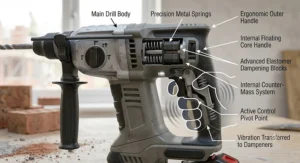
The other health consideration that’s easy to overlook is hand-arm vibration syndrome (HAVS), a real and sometimes irreversible condition caused by prolonged exposure to vibrating tools. The HSE’s hand-arm vibration guidance sets out exposure action values that employers and self-employed tradespeople are expected to monitor — this is precisely why the vibration rating (m/s²) quoted for each tool above genuinely matters, not just as a spec-sheet number but as a real occupational health figure worth taking seriously. In practice, this means taking regular breaks during extended drilling sessions and choosing the lowest-vibration tool your budget allows if masonry drilling forms a meaningful part of your regular work.
Long-Term Cost & Maintenance
Total cost of ownership extends well beyond the initial purchase price. Replacement SDS-Plus bits typically cost a few pounds each for standard masonry sizes, rising for specialist core bits or chisels, and a decent starter bit set is a sensible add-on purchase alongside any of the tools above. Batteries represent the biggest ongoing cost consideration: a genuine branded 18V 5.0Ah pack typically runs into the tens of pounds, and most lithium-ion packs hold a useful working life of several years before capacity noticeably degrades, though heavy daily use on a jobsite will shorten that lifespan compared with occasional weekend use.
When a battery does eventually reach end of life, it cannot simply go in general waste — lithium-ion cells are classified as hazardous and pose a genuine fire risk if damaged or crushed in a bin lorry. The UK government’s guidance on recycling batteries and electrical waste explains how to dispose of them safely through dedicated collection points, and it’s worth taping the terminals before drop-off to prevent short-circuiting in transit. Factoring in bits, batteries and eventual disposal, a mid-range cordless SDS drill bought once and properly maintained will typically outlast several cheaper alternatives bought and replaced in succession — the long-term value case for spending slightly more upfront is genuinely strong.
Frequently Asked Questions
❓ What's the difference between SDS-Plus and SDS-Max?
❓ Can a cordless SDS drill replace a corded rotary hammer completely?
❓ How long does a cordless SDS drill battery actually last per charge?
❓ Is a higher impact energy always better?
❓ Do I need a dust extraction attachment for a cordless SDS drill?
Conclusion
Choosing the right cordless SDS drill really comes down to being honest about how often you’ll actually use it and what you already own. Occasional DIYers are well served by the Ryobi R18SDS-0 or Einhell TE-HD 18 Li, both of which handle typical household masonry jobs without unnecessary expense. Tradespeople drilling daily should look to the Makita DHR202Z, DeWalt DCH273N, or HiKOKI DH18DBL, all genuinely capable mid-range performers that plug into established battery ecosystems. And for anyone drilling concrete professionally at volume, the Bosch GBH 18V-21 and Milwaukee M18 FUEL SDS Plus represent the premium tier worth the extra spend.
Whichever you choose, weigh impact energy against weight and vibration rather than chasing the single highest spec number, and factor in the battery ecosystem you’re buying into — it matters more for long-term satisfaction than most buyers expect going in. A well-matched cordless SDS drill should feel like an extension of your arm rather than a burden you’re fighting against, hole after hole.
Recommended for You
- SDS Max Drill Guide: 7 Best Heavy-Duty Picks for 2026
- SDS Plus Drill: 7 Best Picks Tested for UK Homes (2026)
- SDS Plus vs SDS Max: 7 Best Rotary Hammers UK 2026
Disclaimer: This article contains affiliate links. As an Amazon Associate, I earn from qualifying purchases. If you purchase products through these links, we may earn a small commission at no additional cost to you.
✨ Found this helpful? Share it with your friends! 💬🤗
