
In This Article
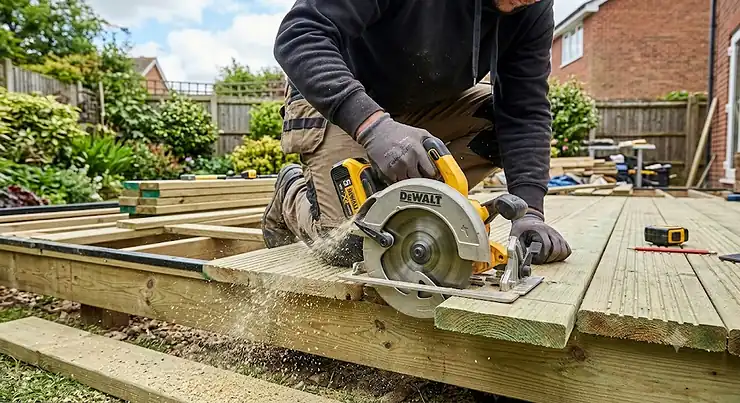
Somewhere between the fifth trip back to the shed for an extension lead and the moment you trip over it mid-cut, most people decide it’s time to go cordless. A cordless circular saw for decking is exactly what it sounds like — a battery-powered saw built to slice through deck boards, joists and treated timber without tethering you to a socket forty feet from where you’re actually working. That’s the whole appeal, and honestly, it’s a good one.
But “cordless” is where the simplicity ends. Blade diameter, cut depth, bevel range, battery platform, brushless versus brushed motors — the spec sheet reads like a foreign language until you know what actually matters for outdoor decking work specifically, as opposed to general DIY. Treated timber behaves differently under a blade than the pine stud you might cut indoors, and a saw that’s brilliant for kitchen worktops can feel underpowered the moment it meets a 47mm deck joist.
This guide cuts through that. We’ve researched seven genuine, currently available saws spanning budget, mid-range and premium price points, cross-referenced their real specifications, and pulled together aggregated review sentiment where it’s verifiable — never invented. You’ll also get a proper look at treated timber blade wear, realistic cut depth for deck boards, how to store a saw so damp garden air doesn’t wreck it, and what changes when you’re cutting outdoor timber rather than indoor sheet material. Worth noting early: if your project involves a raised platform, it’s worth a quick check of the planning permission rules for decking before you buy anything, since height and coverage limits can affect the scale of the job.
What Is a Cordless Circular Saw for Decking?
A cordless circular saw for decking is a battery-powered handheld saw, typically running on an 18V platform with a 115–190mm blade, designed to make straight and bevelled cuts through deck boards, joists, and treated softwood without a mains power cable. The best models balance sufficient cut depth for joist work with the portability needed for outdoor, on-site use.
Quick Comparison Table
| Saw | Blade Size | Max Cut Depth (90°) | Weight | Price Range |
|---|---|---|---|---|
| Einhell TE-CS 18/165 Li-Solo | 165mm | 54mm | 2.9kg | under £100 (body only) |
| Bosch UniversalCirc 18V-53 | 160mm | 53mm | 2.9kg | £50-90 (body only) |
| DeWalt DCS571 | 115mm | 38mm | 2.5kg | £110-160 (body only) |
| Ryobi ONE+ R18CS7-0 | 184mm | 60mm | 2.45kg | £90-130 (body only) |
| Makita DHS680 | 165mm | 57mm | 3.3kg | £160-220 (body only) |
| DeWalt DCS570 | 184mm | 67mm | around 3.4kg | £160-230 (body only) |
| Milwaukee M18 FUEL FCS552 | 165mm | 57mm | around 3.2kg | £180-260 (body only) |
Looking at the spread above, the gap between the DeWalt DCS571 and the rest isn’t really about quality — it’s about job scope. At 38mm cut depth, the DCS571 is brilliant for trimming boards and battens but won’t touch a full joist in one pass, whereas the DeWalt DCS570 and Ryobi R18CS7-0 both clear 60mm-plus, enough for most treated timber joists in a single cut. If your decking project is mostly boards and edging, don’t overspend on depth you won’t use; if you’re building the substructure from scratch, depth is non-negotiable.
💬 Bookmark this comparison — you’ll want to check back before you commit to a battery platform!
Top 7 Cordless Circular Saws for Decking: Expert Analysis
1. Einhell TE-CS 18/165 Li-Solo — best budget entry for occasional decking jobs
The Einhell TE-CS 18/165 Li-Solo is the cheapest genuinely usable option on this list, and it doesn’t feel like it’s cutting corners to get there. Its 165mm blade delivers a 54mm cut depth at 90° and 35mm at 45°, with a no-load speed up to 4,500rpm — enough headroom for most single-pass deck board cuts. Based on the spec comparison, what stands out is the Power X-Change battery compatibility: if you already own an Einhell lawnmower, hedge trimmer or drill, the battery you’ve already got slots straight in, which is where a lot of the real savings live. It’s compatible with Einhell’s optional guide rail system too, useful for long, straight runs along a deck edge.
This is squarely a homeowner’s saw rather than a tradesperson’s daily driver — reviewers consistently note it’s light, manageable for one-off or occasional projects, and good value, with the trade-off being less sustained power under heavy, repeated cutting compared with the premium brands. What most buyers overlook is that the “Li-Solo” designation means body-only: budget for a battery and charger on top if you’re not already on the platform.
Pros:
- ✅ Genuinely affordable entry point into cordless decking work
- ✅ Compatible with the wider Einhell Power X-Change battery range
- ✅ Guide rail compatible for long, straight deck-edge cuts
Cons:
- ❌ Less sustained power than premium brushless rivals
- ❌ Sold body-only, so battery cost is extra if starting fresh
At under £100 for the body, the Einhell TE-CS 18/165 Li-Solo represents strong value for anyone building a modest deck who isn’t planning to use the saw weekly.
2. Bosch UniversalCirc 18V-53 — best for straightforward DIY decking and shelving
The Bosch UniversalCirc 18V-53 is part of Bosch’s “Power for All Alliance,” meaning its 18V battery also runs tools from other participating brands — a genuinely useful bit of ecosystem thinking if your shed already has a mixed bag of green Bosch DIY tools. On the spec sheet, it carries a 160mm premium Optiline blade with 24 carbide-tipped teeth, a 53mm cut depth, and a 4,300rpm no-load speed, weighing 2.9kg. Here’s what to weigh: Bosch itself markets this saw specifically for terrace decking and chipboard shelving, and the CutControl front guide is a small but genuinely handy addition for keeping a cut line straight without a pencil and a steady hand.
Aggregated retailer information around this model highlights the built-in vacuum connection, said to remove over 90% of cutting dust — a legitimately practical feature for anyone cutting treated timber near a lawn or planting beds where sawdust runoff matters. On paper, this is a saw built for the “one deck, one pergola, the occasional shed” category of user rather than daily site use.
Pros:
- ✅ Power for All Alliance battery works across multiple Bosch DIY tools
- ✅ CutControl guide helps keep straight lines without marking up
- ✅ Strong dust extraction claim, useful for garden-adjacent cutting
Cons:
- ❌ 53mm depth is on the shallower side for thick joists
- ❌ Not part of Bosch’s professional 18V system, so no crossover with blue-range tools
Priced from around £50-90 body-only, the Bosch UniversalCirc 18V-53 earns its keep as a sensible, no-fuss choice for weekend decking projects.
3. DeWalt DCS571 — most manoeuvrable saw for tight, awkward cuts
The DeWalt DCS571 takes a different approach entirely: a compact 115mm blade rather than the usual 165mm-plus. That gives a shallower 38mm cut depth at 90° and 25mm at 45° — genuinely too shallow for full joist work — but it buys you something the bigger saws can’t offer: real manoeuvrability in confined spaces. Based on the spec comparison, this saw was designed with roofers, kitchen fitters and joiners in mind, for trimming roof battens, sizing flooring access panels and cutting stud timber, and that DNA carries over neatly to decking edge trims and fiddly cuts around posts.
What most buyers overlook is that this compact format is a specialist tool, not a do-it-all saw. Reviewers consistently rate the tool-free depth and bevel adjustment highly, and the rafter hook is a small but appreciated touch for hanging it off a joist while you switch tasks. Retailer listings explicitly flag decking and flooring access among its intended applications, alongside its more traditional trade uses.
Pros:
- ✅ Compact 2.5kg body handles awkward angles other saws can’t reach
- ✅ Tool-free depth and bevel adjustment speeds up repeat cuts
- ✅ Slots into the wider DeWalt 18V XR battery ecosystem
Cons:
- ❌ 38mm max depth won’t cut through a full joist in one pass
- ❌ Not the right primary saw if the job is mostly deck-board ripping
At £110-160 body-only, the DeWalt DCS571 makes more sense as a second saw for precision trim work than a sole decking tool.
4. Ryobi ONE+ R18CS7-0 — best value if you’re already on the ONE+ platform
The Ryobi ONE+ R18CS7-0 punches well above its typical price bracket. Its 184mm brushless motor drives a 24-tooth carbide-tipped blade to a genuinely useful 60mm cut depth at 90° and 42mm at 45° — figures that put it level with saws costing considerably more. What most buyers overlook about this model is the ONE+ ecosystem itself: with well over 70 tools sharing the same battery, a homeowner who already owns a Ryobi drill or strimmer effectively gets this saw for the price of the bare tool.
Reviewers consistently report that it cuts cleanly through construction timber, marine ply and even kitchen worktops without straining, and the tool-free depth and bevel adjustments are frequently singled out as easy to use with a clear scale. On paper, the E-control system — which maintains a constant cutting speed under load rather than letting the blade bog down mid-cut — is exactly the kind of feature that matters more in treated decking timber than in soft interior pine, since knots and moisture content vary far more outdoors.
Pros:
- ✅ 60mm cut depth rivals saws twice the price
- ✅ Huge ONE+ battery ecosystem cuts the effective cost for existing owners
- ✅ E-control prevents stalling on inconsistent treated timber
Cons:
- ❌ Ryobi’s own-brand batteries lag behind trade brands on raw power density
- ❌ Not marketed as a professional daily-use tool
Around £90-130 for the body, the Ryobi ONE+ R18CS7-0 is arguably the strongest value pick on this entire list for anyone already invested in the platform.
5. Makita DHS680 — best all-round mid-range saw for regular use
The Makita DHS680 sits comfortably in the “buy once, keep for years” category. Its 165mm brushless motor spins at up to 5,000rpm and delivers a 57mm cut depth at 90°, with bevel capacity up to 50°. Here’s what the spec sheet won’t tell you outright, but Makita’s own automatic speed control does the telling for you: the motor senses load and shifts between a high-speed mode for light cuts and a high-torque mode when it meets resistance — exactly the behaviour you want when a blade suddenly hits a dense knot in treated softwood.
Aggregated customer sentiment is notably consistent here — buyers repeatedly describe the DHS680 as powerful for its size, well-balanced in hand, and reliable enough to get through a full day of decking or framing work on a single 5Ah battery. The twin dust ports and integrated blower are small but genuinely useful for keeping the cut line visible, and the magnesium build (base, blade case and safety cover) keeps weight down at 3.3kg while staying durable on-site.
Pros:
- ✅ Auto speed control adapts torque to load automatically
- ✅ Reviewers consistently praise all-day battery runtime with a 5Ah pack
- ✅ Magnesium construction balances durability with manageable weight
Cons:
- ❌ Sits at a noticeably higher price point than the Ryobi or Bosch options
- ❌ 3.3kg is heavier than the compact DeWalt DCS571
At £160-220 body-only, the Makita DHS680 is the saw we’d point most regular DIYers and small-job tradespeople toward if budget allows.

6. DeWalt DCS570 — best for deep joist cuts in one pass
Where the DCS571 trades depth for manoeuvrability, the DeWalt DCS570 goes the opposite direction. Its 184mm blade delivers a substantial 67mm cut depth at 90° — enough to clear thick treated joists and doubled-up timber in a single pass, which matters enormously when you’re building a deck substructure rather than just trimming boards. The brushless motor and magnesium shoe are shared DNA with the wider XR range, and DeWalt’s XR battery platform is one of the most established on the market, meaning batteries, chargers and accessories are easy to find and rarely go out of stock.
Based on the spec comparison against the other saws here, the DCS570’s standout is depth headroom rather than any single flashy feature — it’s the saw least likely to leave you flipping the timber over for a second pass, which reviewers of similar DeWalt XR saws consistently flag as a meaningful time saver on bigger builds. What most buyers overlook is that this extra capability comes with extra weight; at around 3.4kg it’s not the saw to reach for if you’re doing fiddly trim work all day.
Pros:
- ✅ 67mm cut depth clears thick joists in a single pass
- ✅ Well-established XR battery platform with wide accessory support
- ✅ Magnesium shoe stays flat and accurate under repeated use
Cons:
- ❌ Heavier than the mid-range options, less suited to overhead or fiddly cuts
- ❌ Premium pricing compared with the Ryobi and Bosch alternatives
Priced around £160-230 body-only, the DeWalt DCS570 is the pick for anyone building a deck from the joists up rather than just replacing boards.
7. Milwaukee M18 FUEL FCS552 — most powerful saw for demanding, repeated cuts
The Milwaukee M18 FUEL FCS552 sits at the top of this list on raw capability. Its POWERSTATE brushless motor drives a 165mm blade to a 57mm cut depth at 90° and 40mm at 45°, with bevel capacity to 50°, and Milwaukee’s own figures claim it can rip 200 pieces of 90mm x 45mm pine stud on a single 3.0Ah HIGH OUTPUT battery charge — a figure that, even allowing for manufacturer optimism, points to genuinely strong endurance for repeated decking cuts across a long day. The REDLINK PLUS electronic intelligence system adds overload protection, the kind of feature you don’t think about until the one time it stops you burning out a motor mid-cut on a stubborn treated joist.
What most buyers overlook about premium saws like this one is that the price gap over mid-range rivals isn’t really about cut quality on an easy piece of pine — both will manage that fine. It’s about consistency deep into a demanding day: reviewers of the FUEL platform broadly note that power stays level right through the battery’s charge rather than gradually fading, which matters if you’re cutting joist after joist rather than a handful of boards. The magnesium shoe and integrated rafter hook round out a build that feels genuinely built for daily trade use rather than occasional weekend jobs.
Pros:
- ✅ POWERSTATE brushless motor maintains power deep into the charge cycle
- ✅ REDLINK PLUS overload protection guards the motor on tough cuts
- ✅ Broad M18 battery compatibility across Milwaukee’s wider tool range
Cons:
- ❌ The most expensive body-only option on this list
- ❌ Overkill for anyone tackling a single small deck repair
At £180-260 body-only, the Milwaukee M18 FUEL FCS552 is the saw for tradespeople and serious DIYers who’ll put real hours on it.
✨ Don’t Miss These Exclusive Deals!
🔍 Take your decking project to the next level with these carefully selected saws. Click on any highlighted model above to check current pricing and availability, and give yourself the confidence of a clean, professional-looking finish your household will actually notice.
Practical Usage Guide: Setting Up Your Saw for Decking
Getting a new cordless circular saw for decking ready to work properly takes fifteen minutes and saves you from a ruined first cut. Start by fitting a blade genuinely suited to treated timber — the stock blade on most saws is a general-purpose option, and swapping to a 24-tooth carbide-tipped blade designed for construction lumber will noticeably improve cut quality on damp, resinous decking boards. Set your cut depth so the blade protrudes no more than around 6mm below the underside of the board; this reduces splintering on the exit side and puts less strain on both blade and motor.
Before your first cut, check the base plate sits perfectly flush and square to the blade — a surprising number of “the saw’s cutting crooked” complaints in aggregated reviews trace back to a knocked or misaligned shoe rather than a faulty tool. In the first thirty days, the most common mistake is rushing the cut, pushing the saw faster than the motor and blade combination can clear sawdust; this is what causes binding, kickback risk and premature blade dulling on treated timber specifically. A light, steady feed rate, letting the saw do the work, will extend blade life considerably and keep cuts cleaner. Finally, build a quick maintenance habit: clear sawdust from the vents and blade guard after every session, since treated timber’s preservative-laden dust is more abrasive to moving parts than dry indoor sawdust.
Real-World Scenarios: Matching the Saw to the Job
Consider three genuinely different decking projects and how the products above map onto them. First, the first-time DIYer replacing six rotten boards on an existing deck over a single weekend, working to a tight budget and unlikely to touch the saw again for a year or two. Here the case for the Bosch UniversalCirc 18V-53 or Einhell TE-CS 18/165 is strong: modest cut depth is entirely sufficient for board replacement, and neither purchase represents a big outlay for occasional use.
Second, picture a keen home renovator building a 12-square-metre deck from scratch, including the joist substructure, over several weekends across a summer. This buyer needs genuine cut depth and stamina, making the Ryobi ONE+ R18CS7-0 or Makita DHS680 the more sensible fit — enough power for joists, without paying full trade-tool prices for a project that still has a finite scope.
Third, a jobbing landscaper or small building contractor fitting decking for multiple clients across a season needs a saw that won’t fade under daily, repeated cutting. That’s precisely the scenario the DeWalt DCS570 and Milwaukee M18 FUEL FCS552 are built for — deeper cut capacity, more robust build quality, and battery platforms with the accessory ecosystem to match a working van rather than a garden shed.
Problem → Solution: Common Decking-Cutting Issues
Splintering on the underside of the cut is one of the most frequent complaints in aggregated review feedback, and it’s almost always down to cutting with the “good” face of the board facing up. Since a circular saw’s blade rotates upward through the material on exit, flipping the board so the finished face is down avoids the problem entirely.
Blade binding mid-cut, particularly in damp treated timber, usually points to feed rate rather than saw power — slow down and let the blade clear its own sawdust rather than forcing it through. Battery life dropping off faster than expected is often a temperature issue: cold garden sheds in winter genuinely reduce lithium-ion output, so store batteries somewhere closer to room temperature and let them warm slightly before a big cutting session. Uneven or wandering cuts, as mentioned above, are frequently traced to a knocked base plate rather than the saw itself — a quick square check with a combination square resolves most of these. Finally, a saw that seems to be losing power partway through a board is very often simply a blunted blade meeting resinous, preservative-treated timber; see the dedicated section below on why treated timber wears blades faster than you’d expect.
Cordless Circular Saw for Outdoor Timber: What Actually Changes Outdoors
Cutting outdoor timber with a cordless circular saw for outdoor timber isn’t fundamentally different from indoor cutting — the physics of a spinning blade through wood fibre doesn’t change — but three practical factors shift noticeably. Moisture content is the first: treated decking boards typically carry more residual moisture than kiln-dried interior stock, which increases resistance on the blade and raises the risk of binding if your feed rate is too aggressive. Preservative chemicals used in tanalised or pressure-treated timber are the second factor, and they’re mildly more abrasive to a blade’s cutting edge than untreated softwood, which is precisely why blade choice matters more outdoors than in.
Temperature and weather are the third variable, and they’re often overlooked entirely. Cold weather reduces both blade performance (metal contracts slightly, and lubricating resin from the wood behaves differently) and battery output, while damp or drizzly conditions raise the obvious question of whether it’s safe to use a mains tool outdoors at all — one of the strongest arguments for cordless in the first place, since there’s no trailing cable to sit in a puddle. Reviewers working regularly with outdoor timber consistently note that a saw which felt perfectly adequate indoors can feel noticeably more strained on a cold, damp deck-build day, which is worth bearing in mind if you’re deciding between a mid-range and premium motor.
Treated Timber Blade Wear: Why Decking Blades Blunt Faster
Treated timber blade wear is a genuinely different problem from ordinary softwood wear, and it catches a lot of first-time deck builders out. Pressure-treated timber is impregnated with preservative compounds — typically copper-based formulations in current UK products — that sit within the wood fibre rather than just on the surface. As a carbide-tipped blade cuts through, those compounds interact with the cutting edge in a way that dry, untreated pine simply doesn’t produce, gradually dulling the tips faster than the same blade would wear cutting interior stud timber.
What most buyers overlook is that a blunting blade doesn’t just cut more slowly — it starts working the saw’s motor harder to compensate, which is exactly the scenario a brushless motor with load-sensing electronics (like the auto speed control on the Makita DHS680 or the E-control on the Ryobi R18CS7-0) is designed to manage gracefully. Practically speaking, this means budgeting for a dedicated, quality carbide-tipped blade for decking work rather than relying on whatever ships in the box, and expecting to replace or resharpen it somewhat sooner than you would for an equivalent amount of indoor cutting. Anyone doing frequent hand-held cutting work is also worth reading up on hand-arm vibration risk, since sustained resistance from a dulling blade increases vibration transmitted through the tool — the HSE’s guidance on hand-arm vibration is a genuinely useful reference here, even for occasional DIY use, not just tradespeople.
Cut Depth for Deck Boards: Getting the Numbers Right
Getting cut depth for deck boards right is simpler than the spec sheets make it look. Standard UK decking boards typically run 28-32mm thick, so in principle almost any saw on this list — even the compact DeWalt DCS571 at 38mm — can clear a single board comfortably. The complication arrives when you’re cutting through a board that’s already fixed in place over a joist, or notching around a post, where you need enough spare depth beyond the board thickness to actually complete a clean cut without repeatedly stopping and restarting.
The bigger consideration is the substructure. Standard deck joists in the UK are commonly 47mm or 100mm+ deep depending on span and load, and if your project involves cutting joists to length rather than just fitting pre-cut ones, you need genuine headroom — this is exactly where the DeWalt DCS570‘s 67mm depth or the Ryobi R18CS7-0‘s 60mm earns its keep over the shallower budget options. A good rule of thumb, echoed across trade guidance, is to set your blade around 3-6mm deeper than the material thickness rather than exactly matching it, which reduces strain on the motor and gives a cleaner finish. If your deck design pushes into structural territory — bearers, posts, anything load-bearing near a boundary or a highway — it’s worth double-checking against current building regulations guidance for decking before cutting anything, since height and structural rules can affect what timber sizes you’re working with in the first place.
How to Choose a Cordless Circular Saw for Decking
- Match cut depth to the job, not the marketing. If you’re replacing boards, 50-55mm is plenty; if you’re cutting joists, look for 60mm or more.
- Check your existing battery platform first. If you already own DeWalt, Makita, Ryobi, Bosch or Milwaukee tools, staying on that platform is almost always cheaper than starting fresh.
- Prioritise a brushless motor. It’s more efficient, generates less heat, and handles the inconsistent density of treated timber more gracefully than a brushed alternative.
- Don’t underestimate weight. A saw that feels fine in the shop can feel considerably heavier after two hours of overhead or awkward-angle cutting on site.
- Budget separately for a proper decking blade. The bundled blade is rarely optimised for treated timber; a dedicated carbide-tipped blade pays for itself in cut quality.
- Consider bevel range if your design includes angled edging. 45° is standard; some saws here reach 50°, useful for decorative border cuts.
- Factor in dust and debris handling. A rotatable dust port matters more outdoors than you’d expect, both for visibility of the cut line and for keeping preservative-laden dust off nearby planting.
Common Mistakes When Buying a Cordless Circular Saw for Decking
The single most common mistake is buying based on price alone and ending up with a saw whose cut depth can’t handle the joists once the project scope grows beyond “just replacing a few boards.” A close second is ignoring battery platform lock-in — buying a saw from a brand you don’t already own tools from means starting an entirely new, often expensive, battery ecosystem from scratch. Buyers also frequently underestimate how much a stock blade limits performance, expecting trade-level cut quality from a blade that was never designed for treated timber in the first place. Finally, plenty of first-time buyers skip checking bevel range entirely, only to discover mid-project that their chosen saw can’t manage the angled cut their deck design calls for.
Cordless vs Corded Circular Saws for Decking
The corded-versus-cordless question genuinely comes down to how and where you’re working, not which is objectively “better.” A corded saw such as the Bosch GKS 190, with its mains-fed 1400W motor, delivers constant power indefinitely — there’s no battery to fade partway through a long joist, and duty cycle simply isn’t a concern. That makes corded the stronger choice for a workshop or garage setting with easy socket access and sustained, repetitive cutting.
Decking work, though, is almost always outdoor, mobile, and frequently some distance from the nearest socket — exactly the scenario cordless was built for. There’s no trailing cable to snag on joists, no extension lead sitting in wet grass, and modern 18V brushless platforms genuinely close most of the power gap that used to make cordless the compromise choice. The trade-off is battery management: you need at least one spare battery and a charging routine if you’re cutting all day, and even the best cordless saws on this list will eventually need a recharge mid-project in a way a corded saw never does. For the overwhelming majority of decking projects, the mobility cordless offers outweighs the minor inconvenience of battery swaps.
Long-Term Cost & Maintenance
The upfront price of a cordless circular saw for decking is only part of the real cost. Replacement carbide-tipped blades for treated timber work typically need replacing or resharpening more often than blades used purely on interior softwood, so budget for at least one spare blade per significant project. Battery longevity matters too — lithium-ion packs gradually lose capacity over hundreds of charge cycles, and buying into an established platform like DeWalt XR or Makita LXT means replacement batteries and compatible accessories remain easy to source years down the line, unlike some smaller or discontinued battery systems.
Weighed against total cost of ownership, the premium saws on this list — the Milwaukee M18 FUEL FCS552 and DeWalt DCS570 — start to make more financial sense the more frequently they’re used, since their motors are built to handle sustained load without the same wear rate as budget alternatives under heavy use. For anyone reaching for the saw twice a year, the lower upfront cost of the Bosch UniversalCirc 18V-53 or Einhell TE-CS 18/165 likely represents better real-world value, since the wear differential simply won’t show up across such light use.
Weatherproof Tool Storage: Protecting Your Saw On Site
Weatherproof tool storage matters more for a cordless circular saw for decking than for almost any other power tool in the shed, precisely because decking work happens outdoors, often near damp soil, sprinklers or unpredictable British weather. Lithium-ion batteries are particularly sensitive to moisture ingress and temperature extremes; a battery left in a damp bag overnight can suffer reduced capacity and, in worse cases, permanent damage. A proper weatherproof case — most saws in this list ship in or offer an optional hard case — keeps rain and site dust away from both the tool body and any batteries stored alongside it.
On an active job site, a dedicated weatherproof storage box, ideally with some ventilation to avoid trapping condensation, is worth the investment if you’re leaving tools out overnight between sessions. Overnight or between-project storage is equally important: keep batteries somewhere dry and at a moderate, stable temperature rather than in an unheated, damp outbuilding, since cold, humid conditions accelerate the very capacity loss that shortens a battery’s working life. It’s also worth noting that battery-powered tools generally compare favourably with mains equivalents on noise and vibration exposure, though not universally — the HSE’s research comparing battery and traditionally powered tools is a genuinely useful read if you’re doing enough decking work to care about long-term hand and arm health, not just tool longevity.
Safety, Regulations & Compliance Guide for Decking Projects
Before any blade touches timber, a few compliance basics are worth ten minutes of your time. If your decking project involves a raised platform, check local permitted development rules — height above 30cm, coverage over 50% of the garden, or proximity to a boundary or highway can all trigger a requirement for formal planning permission depending on your location and property type. Always eye protection, and ideally hearing protection, given that even brushless motors produce meaningful noise under sustained load. Gloves are a more nuanced call: some safety guidance notes that gloves can, counter-intuitively, increase grip force and therefore vibration transmission in certain conditions, so fit matters more than simply wearing any glove.
For anyone using a cordless circular saw regularly rather than occasionally, understanding hand-arm vibration exposure is genuinely worthwhile — prolonged, frequent exposure is linked to long-term circulation and nerve issues in the hands. Taking regular breaks, keeping blades sharp (a dull blade increases the force, and therefore vibration, needed to complete a cut), and choosing a well-balanced saw all reduce this risk meaningfully over a season of decking work.
Features That Actually Matter (And Those That Don’t)
Cut depth, brushless motor, and battery platform compatibility are the three specs genuinely worth prioritising for decking work — everything else is secondary. Bevel range beyond 45° matters only if your design specifically calls for steeper angled cuts; most decking projects never touch it. LED work lights sound like a gimmick but are legitimately useful for shaded corners under a partially built deck. Marketing terms like “professional grade” or “heavy duty” printed on the box carry no standardised meaning and shouldn’t influence a purchase decision on their own — the actual spec numbers and aggregated review sentiment tell a far more reliable story than the branding language wrapped around them.

Frequently Asked Questions
❓ What size cordless circular saw do I need for decking?
❓ Can I use a cordless circular saw on wet or treated timber?
❓ How long does a battery last cutting decking boards?
❓ Do I need planning permission to build a deck in the UK?
❓ Is a cordless circular saw powerful enough for joists?
Conclusion
There’s no single “best” cordless circular saw for decking, and honestly, anyone claiming otherwise probably hasn’t looked closely at how different decking projects actually are. Replacing a handful of rotten boards over a weekend and building a full deck substructure from scratch are genuinely different jobs, and the right saw for one can be the wrong saw for the other.
If you’re taking on a one-off repair or a modest DIY build, the Bosch UniversalCirc 18V-53 or Einhell TE-CS 18/165 cover the essentials without overspending. For anyone already committed to a battery platform and wanting strong all-round performance, the Ryobi R18CS7-0 and Makita DHS680 are hard to beat on value and capability respectively. And if you’re cutting joists regularly, whether as a serious DIYer or a tradesperson, the extra depth and stamina of the DeWalt DCS570 or Milwaukee M18 FUEL FCS552 genuinely earns its higher price. Whichever you choose, pair it with a proper treated-timber blade, store the batteries somewhere dry, and check your local decking regulations before the first cut goes in.
Recommended for You
- Cordless Track Saw UK: 7 Best Plunge Saws Ranked for 2026
- Best 18V Circular Saw for Joiners: 7 Top Picks for 2026
- Cordless Circular Saw: 7 Best Picks Compared for UK DIYers 2026
Disclaimer: This article contains affiliate links. As an Amazon Associate, I earn from qualifying purchases. If you purchase products through these links, we may earn a small commission at no additional cost to you.
✨ Found this helpful? Share it with your friends! 💬🤗
