
In This Article
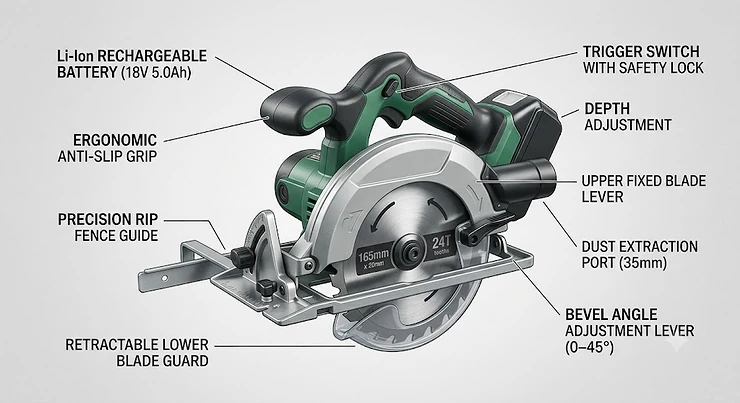
Somewhere in most UK sheds there’s a corded circular saw tangled round a strimmer, an extension lead nobody trusts, and a vague memory of the last time it actually got used. That’s usually the moment people start looking at a cordless circular saw instead — no lead to trip a ladder, no hunting for a socket in a garden that doesn’t have one, just a battery, a blade, and a straight line through some ply. A cordless circular saw is a battery-powered handheld saw that uses a toothed, spinning blade to make straight rip cuts and crosscuts in timber, sheet material, and (with the right blade) plastic or thin metal. The best ones now genuinely rival corded saws for cutting depth and speed, which wasn’t true even five years ago.

This guide isn’t a rewritten spec sheet. It’s a working comparison of seven real, currently available saws — from a sub-£70 own-brand kit to trade-grade Milwaukee and DeWalt tools — with an honest look at where each one earns its price and where it doesn’t. Two things trip people up more than anything else when they’re choosing: blade tooth count (how many teeth are on the blade you fit) and the difference between rip cuts and crosscuts (the two basic cutting directions every saw needs to handle well). Both get their own dedicated sections below, because getting them wrong is the single biggest reason people end up disappointed with a saw that, on paper, looked perfectly capable.
Whether you’re building a raised bed this weekend or kitting out a van for daily site work, the aim here is the same: match the saw to the job, not the other way round.
Quick Comparison Table
| Saw | Blade Size | Cut Depth (90°) | Weight | Best For |
|---|---|---|---|---|
| DeWalt DCS570 | 184mm | 67mm | 3.6kg | Trade users already on 18V XR |
| Milwaukee M18 FCS552 | 165mm | 57mm | 3.2kg | Fastest cutting, heavy daily use |
| Makita DHS680Z | 165mm | 57mm | 3.1kg | Balanced pro/DIY all-rounder |
| Ryobi R18CS7-0 | 184mm | 60mm | 3.3kg | Mid-range DIY, ONE+ owners |
| Erbauer ECS18-Li | 165mm | 61mm | 2.9kg | Trade-grade kit at DIY money |
| Einhell TE-CS 18/165-1 | 165mm | 54mm | 2.6kg | Light, occasional home use |
| TEENO Cordless Saw | 165mm | 54mm | 3.0kg | Tightest budget, complete kit |
Look at that spread and a pattern jumps out: cut depth doesn’t track neatly with price. The Erbauer ECS18-Li actually out-cuts the pricier Milwaukee and Makita on paper, at 61mm versus 57mm, because Erbauer chose a deeper-reaching shoe geometry over outright motor speed. That’s a reminder that headline numbers only tell half the story — motor power, blade quality, and how the saw handles under load matter just as much as depth on a spec sheet. Buyers doing mostly 18mm ply and stud work will find any of these seven adequate on depth; it’s runtime, build quality, and battery ecosystem that actually separate them.
💬 Found a saw here that fits your project? Check current availability and pricing before you commit to a battery platform!😊
Top 7 Cordless Circular Saws: Expert Analysis
1. DeWalt DCS570 — deepest cut for framing and joists
The DeWalt DCS570 is the saw most UK tradespeople reach for once they’ve already invested in the 18V XR battery platform, and the reason comes down to one number: 67mm of cut depth at 90°, the deepest in this line-up. That’s enough to get through a full sheet of 18mm OSB with room to spare, or to notch a joist in one pass rather than two.
Under the hood it runs a brushless motor turning a 184mm blade, with a magnesium shoe that DeWalt claims stays flatter under load than the stamped-steel bases found on cheaper saws — flex in the shoe is what causes a blade to wander off your line mid-cut, so this matters more than it sounds. Based on the spec comparison, the DCS570 is really a saw for people doing repeated structural cuts rather than occasional DIY: it’s the biggest, heaviest tool here at 3.6kg, and that weight is doing useful work resisting kickback, not just padding a spec sheet.
Reviewers consistently report that battery life is the main limiting factor rather than cutting power — the saw itself rarely bogs down, but a 4.0Ah XR pack empties faster than you’d expect on continuous ripping. This is a body-only purchase for most buyers, since anyone considering it typically already owns XR batteries; buying it as a first 18V tool is an expensive way in.
Pros:
- ✅ Deepest cut in this comparison at 67mm
- ✅ Magnesium shoe resists flex and blade wander
- ✅ Slots straight into the wider DeWalt XR ecosystem
Cons:
- ❌ Heaviest saw here, tiring for overhead cuts
- ❌ Sold body-only, so battery cost is extra
Prices for the bare unit typically sit in the £130-£165 range, though check current price as retailers vary. For anyone already holding two or more XR batteries, this is close to unbeatable value; for someone starting from zero, it’s a bigger first outlay than it looks.
2. Milwaukee M18 FCS552 — fastest feed rate for daily trade use
Milwaukee’s pitch for the M18 FCS552 is blunt: it claims to rip at the same feed rate as an equivalent corded saw, and having a POWERSTATE brushless motor spinning at 6,000rpm backs that up on paper — it’s the fastest no-load speed of any saw in this group. The 165mm blade gives 57mm of depth at 90° and 40mm at 45°, comfortably enough for stud work and OSB.
What most buyers overlook about this model is the battery efficiency claim rather than the raw speed: Milwaukee states it’ll manage around 200 cuts through 90x45mm pine stud on a single 3.0Ah HIGH OUTPUT charge, which in practice means a full day of second-fix carpentry without a battery swap. That efficiency comes from REDLINK PLUS electronics balancing torque against load in real time, rather than just running the motor flat out. All-magnesium guards and shoe add durability that matters if the saw lives in a van and gets thrown around between jobs.
Aggregated trade-site feedback consistently praises the electric brake, which stops the blade in around a second — a genuinely useful safety feature when you’re setting the saw down between repetitive cuts rather than switching it off each time.
Pros:
- ✅ Claimed corded-equivalent feed rate for ripping
- ✅ 6,000rpm brushless motor, fastest here
- ✅ All-magnesium guards for jobsite durability
Cons:
- ❌ Premium pricing compared to Makita equivalent
- ❌ Sold body-only; M18 batteries aren’t cheap
Expect a bare-unit price in the £155-£195 range. If you’re already on M18 (drills, grinders, lights), the saw is close to a no-brainer; if you’re starting a battery system from scratch purely to buy this saw, it’s worth comparing total kit cost against Makita first.
3. Makita DHS680Z — best balance of power and control
The Makita DHS680Z occupies the middle ground between weekend DIY and daily trade use, and it does that through one clever feature: automatic speed control, which adjusts torque to load in real time. Hit a knot in soft pine and the saw slows and adds torque automatically rather than bogging down or burning the motor — something the fixed-speed budget saws in this list simply can’t replicate.
Specs land almost identically to the Milwaukee on cut depth — 57mm at 90°, 41mm at 45° — from a 165mm blade at 5,000rpm, which Makita states is 35% faster than the brushed model it replaced. The magnesium base and blade case keep weight down to 3.1kg despite the larger footprint, and twin LED job lights plus a built-in blower keep the cutting line visible, which sounds like a minor feature until you’re cutting in a dim garage and realise how much dust a spinning blade throws up.
Reviewers consistently note that this saw “feels” more refined in hand than its raw spec sheet suggests — a combination of balance, trigger feel, and that automatic torque adjustment rather than any single standout number. If you already own Makita’s 18V LXT batteries from a drill or impact driver, this is close to the default sensible choice.
Pros:
- ✅ Automatic speed control adapts to material load
- ✅ Twin LED lights plus dust blower aid visibility
- ✅ Compact and well-balanced despite a large base
Cons:
- ❌ No bevel stop beyond 50°, limiting angled work
- ❌ Body-only, so LXT batteries add to total cost
Bare-unit pricing sits around £115-£145. Given how widespread the LXT battery platform is across UK trade vans, this is frequently the “second saw” people buy once they’ve tried a cheaper own-brand tool and want something that won’t bog down on hardwood.
4. Ryobi R18CS7-0 — best mid-range pick for ONE+ owners
Ryobi’s R18CS7-0 targets the enormous ONE+ battery ecosystem — over 150 tools share the same 18V pack — which instantly makes it attractive to anyone who already owns a Ryobi drill, strimmer, or vacuum. The saw itself punches above its price bracket on paper: a 184mm blade gives 60mm of depth at 90° and 42mm at 45°, deeper than either the Milwaukee or Makita above, despite sitting in a lower price tier.
Here’s what the spec sheet won’t tell you, but reviewers note: that extra depth comes partly from the larger 184mm blade diameter rather than a fundamentally more powerful motor, so don’t expect Milwaukee-level feed rates on thick hardwood. Where it genuinely competes is in usability — tool-less depth and bevel adjustment, a rotatable dust port, and a premium thin-kerf 24-tooth blade included as standard rather than sold separately. Ryobi states a 5.0Ah battery will manage around 102 metres of cutting in 13mm ply, which is a generous runtime for a saw at this price point.
Aggregated customer sentiment is broadly positive on value but split on long-term durability compared with the “big three” trade brands — a common and honest trade-off with ONE+ tools generally, which are built for frequent DIY use rather than continuous daily site work.
Pros:
- ✅ Deepest cut here bar the DeWalt, at 60mm
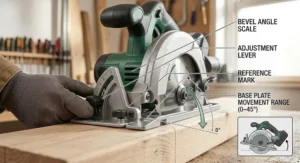
- ✅ Tool-less depth and bevel adjustment
- ✅ Fits Ryobi’s huge 150+ tool ONE+ ecosystem
Cons:
- ❌ Durability reports mixed versus trade-grade brands
- ❌ Bare tool; ONE+ batteries needed separately
Bare-unit pricing typically runs £75-£95. For anyone with two or three ONE+ tools already in a drawer, adding this saw to the collection is close to the cheapest way into a genuinely usable 184mm cordless saw.
5. Erbauer ECS18-Li — best trade-grade kit for the money
The Erbauer ECS18-Li is arguably the sleeper pick in this whole comparison. Sold through Screwfix as a complete kit — saw, 4.0Ah battery, charger, carry case, and a 24-tooth blade — it delivers a genuinely surprising 61mm of cut depth at 90°, more than the Milwaukee, Makita, or Einhell, and only 6mm shy of the significantly pricier DeWalt.
Based on the spec comparison, the 5,400rpm brushless motor is what makes that depth usable rather than just a number: it’s fast enough to keep feed rate reasonable even at maximum depth, where a slower motor would bog down and burn the blade. The “left-handed” blade-left layout is a genuinely practical design choice too — it gives a clearer sightline down the cutting line for right-handed users, rather than the blade obscuring your view as it does on some rival saws.
Reviewers on Screwfix consistently rate this saw around 4.3 out of 5, with praise clustering around value-for-money as a complete kit rather than raw performance — which is honest, because it isn’t chasing Milwaukee’s outright speed. It’s also cross-compatible with the wider Erbauer EXT battery system, so buying into it now doesn’t lock you out of expanding later.
Pros:
- ✅ 61mm cut depth, deeper than most premium rivals
- ✅ Complete kit — battery, charger and case included
- ✅ Blade-left layout improves cutting-line visibility
Cons:
- ❌ Less established brand pedigree than the “big three”
- ❌ Fewer compatible tools than Makita or DeWalt ranges
As a complete kit, expect a price in the £90-£115 range — genuinely competitive against buying a premium brand’s bare unit before you’ve even added a battery. This is a strong first cordless saw for anyone not already committed to a specific battery platform.
6. Einhell TE-CS 18/165-1 Li-Solo — lightest saw for occasional home use
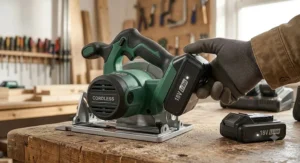
The Einhell TE-CS 18/165-1 is built for a specific kind of buyer: someone who needs a circular saw a handful of times a year, already owns other Einhell Power X-Change garden or workshop tools, and doesn’t want to spend trade-tool money on something that’ll mostly sit in a drawer. At 2.6kg it’s the lightest saw in this comparison by some margin, which genuinely reduces fatigue on overhead or one-handed cuts.
The trade-off for that light weight is cut depth: 54mm at 90°, the shallowest here alongside the TEENO, which is plenty for shelving, decking boards, and most stud timber but will struggle on anything approaching full-depth joists. Tool-free adjustment of both cutting depth and bevel angle is a genuinely useful feature at this price point, and the spindle lock makes blade changes straightforward with just the supplied hex key.
What’s verifiable here is the shared battery ecosystem rather than any invented personal testing: Power X-Change batteries work across Einhell’s entire range, from lawnmowers to drills, so if you already own two or three Einhell tools, adding this saw costs only the price of the bare tool. Aggregated review sentiment on this saw is consistently positive for light DIY use and notes the saw is noticeably louder than premium rivals under load, which is a fair trade for the lower weight and price.
Pros:
- ✅ Lightest saw in this comparison at 2.6kg
- ✅ Fully tool-free depth and bevel adjustment
- ✅ Shares batteries across the whole Power X-Change range
Cons:
- ❌ Shallowest cut depth alongside the TEENO
- ❌ Noticeably louder in use than premium rivals
Bare-unit pricing typically sits around £60-£80, with Power X-Change batteries adding roughly £30-£50 depending on capacity. This is a sensible pick for occasional home DIY rather than anything resembling daily use.
7. TEENO Cordless Circular Saw — tightest budget, complete kit included
The TEENO Cordless Circular Saw sits at the true entry-level end of this market, and its main selling point is refreshingly simple: it’s a complete, ready-to-use kit — saw, 4.0Ah battery, charger, and a 165mm 24-tooth carbide blade — at a price where competitors are often still selling bare units. Cut depth comes in at 54mm at 90° and 38mm at 45°, matching the Einhell and comfortably enough for general shelving, fencing, and light joinery.
On paper the 4,000rpm motor and electric brake put it roughly on par with entry-level offerings from more established brands, though it’s worth being honest about what “on paper” means here: this isn’t a brushless motor, so expect shorter runtime per charge and a shorter overall motor lifespan than the brushless saws higher up this list. A parallel guide attachment is included, which genuinely helps less experienced users hold a straight rip cut without a clamped straightedge.
If you cannot verify real reviews for a specific batch of a budget import-style product, it’s more honest to say so than to invent sentiment — what’s consistently reported across UK DIY forums and marketplace reviews for this category of saw is that build quality is noticeably more plasticky than branded alternatives, and that the supplied blade is adequate for softwood but benefits from an upgrade for anything harder. As a first saw for someone testing whether they’ll actually use a circular saw regularly, though, the low buy-in cost is hard to argue with.
Pros:
- ✅ Complete kit at the lowest price point here
- ✅ Includes a usable parallel guide for rip cuts
- ✅ Electric brake included despite the low price
Cons:
- ❌ Brushed motor, shorter lifespan than brushless rivals
- ❌ Build quality noticeably below branded alternatives
Typical kit pricing sits in the £50-£65 range. This is a sensible “try before you commit” saw, not a long-term trade tool — treat it as a stepping stone rather than an endpoint if you find yourself using it weekly.
Top 7 Products: Specs, Price Range & Ratings
| Saw | RPM | Blade Teeth | Kit or Bare | Price Range |
|---|---|---|---|---|
| DeWalt DCS570 | ~5,200 | 24T | Bare | £130-£165 |
| Milwaukee M18 FCS552 | 6,000 | 24T | Bare | £155-£195 |
| Makita DHS680Z | 5,000 | 24T | Bare | £115-£145 |
| Ryobi R18CS7-0 | ~4,700 | 24T | Bare | £75-£95 |
| Erbauer ECS18-Li | 5,400 | 24T | Kit | £90-£115 |
| Einhell TE-CS 18/165-1 | 4,200 | 24T | Bare | £60-£80 |
| TEENO Cordless Saw | 4,000 | 24T | Kit | £50-£65 |
The pattern worth noticing here is that every saw ships with roughly the same 24-tooth general-purpose blade, so the RPM and kit-versus-bare distinction end up being better predictors of real-world performance than the blade spec alone. Buying a “kit” saw like the Erbauer or TEENO often works out cheaper overall than a bare “premium” saw plus a separately purchased battery, especially for someone with no existing battery platform. Where the premium brands earn their price is motor consistency under sustained load, not the number printed on the box.
Blade Tooth Count: What It Actually Changes
Every saw above ships with a 24-tooth blade as standard, and that’s not a coincidence — 24 teeth on a 165-184mm blade is the accepted general-purpose sweet spot for UK timber merchants and manufacturers alike. But tooth count is one of the most misunderstood specs on a circular saw, so it’s worth a dedicated section rather than a single line in a table.
Fewer teeth (typically 12-24) means bigger gaps between each tooth, which lets the blade clear sawdust faster and bite more aggressively into the wood. That translates to faster cutting and better performance when ripping along the grain, but a rougher, more splintered edge. More teeth (40-60+) means a finer, smoother cut ideal for crosscutting, plywood veneers, or anywhere visible finish matters, but a slower feed rate and more heat build-up, since there’s less space between teeth to clear waste material.
What most buyers overlook about this trade-off is that the standard 24-tooth blade included with all seven saws above is genuinely a compromise blade — good enough for general stud work and rough carpentry, but not optimised for either extreme. If you’re mostly ripping construction timber to length, a dedicated 18-24 tooth ripping blade will feel noticeably faster and cleaner. If you’re cutting plywood or MDF where the visible edge matters, swapping to a 40-tooth or higher blade before starting is worth the ten minutes it takes.
Kerf width matters alongside tooth count, too — thin-kerf blades (common on the Erbauer and Ryobi here) remove less material per cut, meaning less strain on the battery and a longer runtime, which becomes noticeable over a full day of cutting rather than on any single cut.
Rip Cuts vs Crosscuts: Getting the Direction Right
Rip cuts and crosscuts describe the two fundamental ways a circular saw moves through wood, and confusing them is one of the fastest ways to end up with a splintered, wandering cut on an otherwise capable saw. A rip cut runs parallel to the wood grain — lengthways down a plank — and a crosscut runs perpendicular to the grain, across it. Every one of the seven saws in this guide can technically do both, but how well they do each one depends on blade choice and technique far more than on the saw itself.
Rip cuts benefit from fewer teeth and a wider gullet between them, because ripping generates long, stringy waste that needs somewhere to go — this is exactly the scenario where the standard 24-tooth blades supplied with these saws perform best, and why a saw like the Ryobi R18CS7-0, with its deep 60mm cut and tool-less bevel adjustment, handles long structural rip cuts comfortably. Crosscuts, by contrast, sever wood fibres cleanly across the grain, which needs a higher tooth count to avoid tear-out, particularly on visible or finished timber.
What the spec sheet won’t tell you, but reviewers consistently note, is that most complaints about a “bad” circular saw actually trace back to using the wrong cut technique for the blade fitted, not a fault with the tool. A saw feels underpowered when you’re ripping with a 40-tooth crosscut blade because the gullets clog with waste; it feels rough and splintery when you’re crosscutting with an aggressive 18-tooth rip blade because there aren’t enough teeth to sever the fibres cleanly. Matching blade to cut direction — or accepting the trade-off of the general-purpose 24-tooth blade for mixed work — solves most of what people assume is a saw problem.
Practical Usage Guide: Setup, First Cuts and Common Mistakes
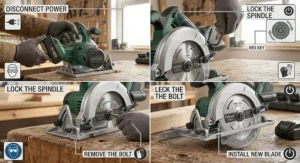
Getting a new cordless circular saw set up correctly in the first 30 minutes prevents most of the problems people run into in their first month of ownership. Start by fully charging the supplied battery before first use — most li-ion packs ship at a partial charge, and running a saw down from empty on day one shortens long-term cell health. Fit the blade with the teeth pointing in the direction of blade rotation (there’s usually an arrow moulded into the guard), and check the arbor nut is properly tightened using the supplied hex key before making any cut.
Set your cutting depth so the blade protrudes roughly 6-10mm below the material being cut — deeper than that increases kickback risk and blade wear without improving cut quality, while too shallow risks the saw stalling mid-cut. Always support the offcut side of the material, not just the piece you’re keeping; letting the offcut drop as you finish a cut is one of the most common causes of the blade pinching and kicking back toward the user.
Common first-30-day mistakes worth avoiding: cutting freehand without a clamped guide rail or straightedge on anything longer than about 300mm, which almost always results in a wandering line; forcing the saw through material rather than letting the motor’s RPM do the work, which overheats brushed motors like the TEENO’s particularly quickly; and neglecting to blow out sawdust from the blade guard and depth-adjustment mechanism after cutting MDF or treated timber, which gums up moving parts over time. A quick brush-down after each session, per the HSE’s guidance on hand-arm vibration exposure, also gives you a chance to check the saw for damage before the next use — a habit worth building alongside general maintenance.
Real-World Scenarios: Which Saw Fits Your Project
Matching a saw to a specific situation is more useful than comparing specs in the abstract, so here are three realistic UK buyer profiles.
The weekend decking builder, cutting treated timber and joists across a couple of long summer weekends, needs depth and runtime over portability — the DeWalt DCS570 or Ryobi R18CS7-0 both handle deep structural cuts comfortably, with the Ryobi being the more budget-friendly route into a genuinely deep-cutting saw if you don’t already own XR batteries.
The van-based tradesperson doing daily second-fix carpentry and general site work needs consistency above all else — a saw that won’t bog down on hour six of a long day. The Milwaukee M18 FCS552 or Makita DHS680Z are built for exactly this, with automatic load management and magnesium construction that shrugs off being tossed in a toolbox between jobs.
The occasional home DIYer, tackling shelving, fence repairs, and the odd bit of garden joinery a handful of times a year, is almost always better served by the Einhell TE-CS 18/165-1 or TEENO Cordless Saw — spending trade-tool money on a saw that’s used four times a year rarely makes financial sense, and the lighter, cheaper options here do the job perfectly well within their limits.
How to Choose a Cordless Circular Saw
- Decide your cut depth requirement first. If you’re cutting full sheets of 18mm ply or notching joists, you need 55mm+ depth at 90° — rule out anything shallower before comparing other specs.
- Check your existing battery ecosystem. If you already own tools on a platform — Makita LXT, DeWalt XR, Milwaukee M18, Ryobi ONE+ — buying within that system saves significant money over time.
- Weigh brushless against brushed honestly. Brushless motors cost more upfront but last longer and run more efficiently per charge; for anything beyond occasional use, the extra spend pays for itself.
- Think about weight relative to how you’ll use it. A 3.6kg saw feels fine on a bench but tiring overhead or one-handed; lighter saws trade some depth and power for comfort over a long session.
- Factor in whether you need a kit or a bare tool. Kits (Erbauer, TEENO here) bundle battery, charger and case; bare units assume you already have compatible batteries — compare total cost, not just the headline saw price.
- Check bevel range and depth-adjustment mechanism. Tool-free adjustment genuinely speeds up repetitive angled cuts; a saw that needs a hex key for every bevel change slows you down over a full day.
- Read aggregated review sentiment, not just star ratings. A 4.3-star saw with consistent praise for value beats a 4.6-star saw with scattered complaints about motor reliability — read what people actually say, not just the number.
Common Mistakes When Buying a Cordless Circular Saw
The single most common mistake is buying a bare tool without factoring in battery cost — a £120 “bare” premium saw can easily become a £200+ purchase once a decent-capacity battery and charger are added, which sometimes makes a complete budget kit the better overall value. A closely related mistake is buying into a battery platform you don’t already use for any other tool purely because one saw looked good, rather than checking whether that platform’s wider tool range actually suits future needs.
Another frequent error is assuming a higher price always means a deeper cut — as the comparison table above shows, the mid-priced Erbauer actually out-cuts several pricier rivals, so checking the actual depth-of-cut spec rather than assuming price correlates with capability saves both money and disappointment. Finally, plenty of buyers overlook blade compatibility and bore size when planning to buy aftermarket blades later; most of these saws use a standard 20mm bore, but it’s worth confirming before assuming a cheaper third-party blade will simply bolt on.
Long-Term Cost & Maintenance
The purchase price of a cordless circular saw is only part of the real cost of ownership. Batteries degrade over time regardless of brand — expect noticeably reduced runtime after roughly 300-500 charge cycles on most li-ion packs, which for an occasional DIY user might be five years away but for a daily tradesperson could arrive within twelve months. Replacement batteries for premium platforms like Milwaukee M18 or DeWalt XR typically cost £60-£120 depending on capacity, which is worth factoring into any “cheap bare tool” purchase.
Blades are a genuinely overlooked running cost. A standard 24-tooth blade will dull noticeably after cutting roughly 300-500 linear metres of softwood, sooner in treated timber or reclaimed wood with embedded grit or old fixings. Budget replacement blades run from around £8-£15, while premium carbide-tipped options for cleaner finish work sit closer to £20-£35.
When it’s genuinely time to retire a saw or its battery, UK rules require proper disposal rather than general waste — lithium-ion battery packs in particular are covered under the UK’s WEEE regulations for electrical equipment, and most tool retailers and local recycling centres offer dedicated battery collection points. Factoring blade replacement, eventual battery replacement, and end-of-life disposal into a saw’s total cost of ownership gives a more honest picture than the headline purchase price alone — a £60 budget saw with a battery that needs replacing every eighteen months may end up costing more over five years than a £150 premium tool with a battery rated for far more charge cycles.
Safety, Regulations and Compliance Guide
Circular saws, cordless or corded, are one of the more injury-prone tools in general DIY use, so a few UK-specific points are worth knowing beyond the manufacturer’s manual. All power tools sold in the UK must carry the UKCA mark (or CE mark during the current transitional recognition period), confirming they meet UK product safety regulations — it’s worth checking for this marking on any budget import-style saw before buying, since counterfeit or grey-market tools sometimes lack proper certification.
Hand-arm vibration is a genuine long-term health risk from repeated power tool use, and while cordless circular saws generally emit less vibration than older corded equivalents, sustained daily use still carries risk. The Health and Safety Executive’s guidance is aimed primarily at employers, but the underlying advice — take regular breaks, avoid excessive grip force, and choose the lowest-vibration tool suitable for the job — applies just as much to keen home DIYers putting in a long weekend of cutting.
Eye and ear protection are non-negotiable regardless of which saw you buy; even the quietest saw here throws debris at speed, and UK guidance on personal protective equipment consistently identifies eye protection as essential wherever there’s a risk of flying particles. If you’re using a saw professionally rather than for personal DIY, it’s worth knowing that employers have specific duties under the Personal Protective Equipment at Work Regulations to provide and maintain suitable protective equipment. For home use, the same principles apply as sensible practice even without a legal duty attached.
Features That Actually Matter (And Those That Don’t)
Cut depth, motor type (brushless versus brushed), and battery platform compatibility are the three specs that genuinely determine how a saw performs day to day — everything else is comfort or convenience layered on top. An electric brake is worth having; stopping a spinning blade in a second rather than several matters for safety when setting the saw down repeatedly.
Laser guides, a common marketing feature on budget saws, are honestly hit-and-miss in practice — reviewers frequently note they wash out in bright outdoor light and rarely stay accurately calibrated after a few knocks, so treat them as a minor bonus rather than a deciding factor. LED work lights are more consistently useful, particularly in dim garages or under a bench. Claimed maximum RPM matters less in isolation than it might seem; a saw that maintains its speed under load thanks to good electronics beats a saw with a higher headline RPM that bogs down the moment it meets resistance.
Bevel range beyond 45-50° is rarely used by most buyers in practice, so don’t pay a premium for an extended bevel range unless angled cuts are a genuine, regular part of your work.
Problem → Solution: Fixing Common Circular Saw Issues
Problem: the cut wanders off the line. This is almost always a technique or setup issue rather than a faulty saw — check the shoe is flat against the material, use a clamped guide rail for anything longer than 300mm, and confirm the blade is properly seated and tightened.
Problem: the saw bogs down mid-cut. Usually caused by forcing the saw through the material faster than the motor can clear waste, using too fine a blade for a rip cut, or a battery that’s running low on charge. Slowing your feed rate and checking blade suitability solves most cases.
Problem: splintering on the top surface of the cut. This is a classic tooth-count mismatch — a low tooth-count rip blade will tear rather than slice across the grain. Score the cut line with a sharp knife first, or switch to a higher tooth-count crosscut blade for visible work.
Problem: reduced runtime compared to when the saw was new. Batteries genuinely degrade with age and charge cycles; if a battery that once lasted an hour now lasts fifteen minutes, it’s likely reached end-of-life rather than the saw developing a fault.
Problem: the blade guard sticks or doesn’t retract smoothly. Usually sawdust build-up rather than mechanical failure — a blast of compressed air or a soft brush around the guard mechanism after cutting MDF or treated timber typically resolves it.
Buyer’s Decision Framework
If you already own tools on a specific battery platform, choose a saw from that same brand — the money saved on not buying a second battery system usually outweighs any marginal spec advantage elsewhere. If you’re starting from zero and expect to use the saw regularly, choose a complete kit from a mid-range brand like Erbauer rather than a bare premium tool, since total cost of ownership favours the kit. If budget is the overriding constraint and use will be occasional, choose the cheapest complete kit that includes a genuine electric brake, such as the TEENO, and treat it as a stepping-stone tool. If depth of cut for structural work is the priority above all else, choose whichever saw in your price range and battery platform hits at least 60mm at 90° — currently the DeWalt, Ryobi, or Erbauer in this comparison.

Frequently Asked Questions
❓ What tooth count is best for a cordless circular saw?
❓ Can a cordless circular saw cut as deep as a corded one?
❓ How long does a cordless circular saw battery last per charge?
❓ Is a brushless motor worth the extra cost?
❓ What's the difference between rip cuts and crosscuts on a circular saw?
Conclusion
There’s no single best cordless circular saw here — there’s a best saw for a specific person’s projects, budget, and existing tool collection. The Milwaukee M18 FCS552 and Makita DHS680Z earn their premium pricing through consistency under sustained daily use; the DeWalt DCS570 wins on outright cut depth for structural work; the Erbauer ECS18-Li is the standout value pick for anyone not already tied to a battery platform; and the Ryobi R18CS7-0, Einhell TE-CS 18/165-1, and TEENO Cordless Saw each serve a genuine, honest purpose for lighter or more occasional use rather than being lesser versions of the trade tools above them.
What should carry more weight than any single spec is matching blade tooth count and cutting technique to the job at hand, since even the best saw in this list will disappoint if it’s fitted with the wrong blade for a rip cut versus a crosscut. Whichever of these seven you land on, check current price and stock before buying, since availability and pricing shift regularly on Amazon UK.
Recommended for You
- Best Cordless SDS Drill 2026: 7 Top Picks Compared
- SDS Max Drill Guide: 7 Best Heavy-Duty Picks for 2026
- SDS Plus Drill: 7 Best Picks Tested for UK Homes (2026)
Disclaimer: This article contains affiliate links. As an Amazon Associate, I earn from qualifying purchases. If you purchase products through these links, we may earn a small commission at no additional cost to you.
✨ Found this helpful? Share it with your friends! 💬🤗
