In This Article
Here’s a confession every toolshed owner eventually makes: you don’t actually need a jigsaw until the exact moment you desperately do. A worktop needs a sink cutout, a stair tread has warped, or you’ve just measured a curved shelf bracket that no circular saw on earth is going to manage. That’s the itch this best cordless jigsaw guide is here to scratch.
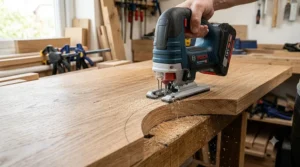
Unlike a drill or an impact driver, a jigsaw isn’t a tool you reach for daily — but when the job calls for it, nothing else will do. It cuts curves, bevels, plunge cuts, and shapes that circular saws and multi-tools simply can’t replicate. The cordless versions on the market in 2026 have also closed the gap on their corded ancestors dramatically; brushless motors and smarter battery management mean you’re rarely giving up meaningful cutting power just to lose the cable.
This cordless jigsaw review pulls together seven genuinely available UK models — from budget bare units under £60 to brushless trade-grade tools well north of £150 — and breaks down what actually separates a good jigsaw from a frustrating one. We’ll dig into orbital action settings, blade change systems, battery run time, and the practical stuff Amazon listings never mention, like why your first three cuts with a new jigsaw always feel worse than they should.
A cordless jigsaw is a handheld power tool that drives a reciprocating blade up and down (and often forward, via orbital action) to cut curves, angles and straight lines in wood, plastic, and thin metal, powered by a rechargeable battery instead of a mains lead — as detailed on Wikipedia’s overview of the jigsaw power tool. Whether you’re a weekend DIYer or fitting kitchens for a living, the right choice depends on far more than motor wattage — and that’s exactly what we’re unpacking below.
Quick Comparison Table
For readers in a hurry, here’s the shortlist before we go deep on all seven.
| Jigsaw | Best For | Orbital Settings | Price Range |
|---|---|---|---|
| Makita DJV182Z | Best overall cordless jigsaw | 3-stage | £120-£150 (body only) |
| DeWalt DCS334N-XJ | Best for XR platform owners | 4-stage | £130-£160 (body only) |
| Milwaukee M18 FJS | Best for pros wanting Fuel power | 4-stage | £180-£230 (body only) |
| Bosch GST 18V-155 BC | Best blade-change system | 3-stage | £150-£180 (body only) |
| Einhell TP-JS 18/135 Li BL | Best mid-range value | 4-stage | £70-£95 (body only) |
| Ryobi R18JS-0 | Best budget ONE+ platform pick | 4-stage | £45-£65 (body only) |
| Black+Decker BDCJS18N-XJ | Best cordless jigsaw for beginners | 3-stage | £35-£50 (body only) |
A quick read of this table tells its own story: orbital settings and price range don’t move in lockstep the way you’d expect. The Einhell TP-JS 18/135 Li BL matches the four-stage orbital action of jigsaws costing twice as much, which is exactly why it punches above its price bracket for anyone doing occasional joinery work. Meanwhile the Black+Decker BDCJS18N-XJ deliberately keeps things to three simple stages, because simplicity is precisely what a first-time buyer needs rather than a dial full of options they’ll never touch.
💬 Found a pick you like already? Bookmark this page and compare current prices before you commit — it only takes a second and could save you a wasted trip back to the returns counter.
Top 7 Cordless Jigsaws: Expert Analysis
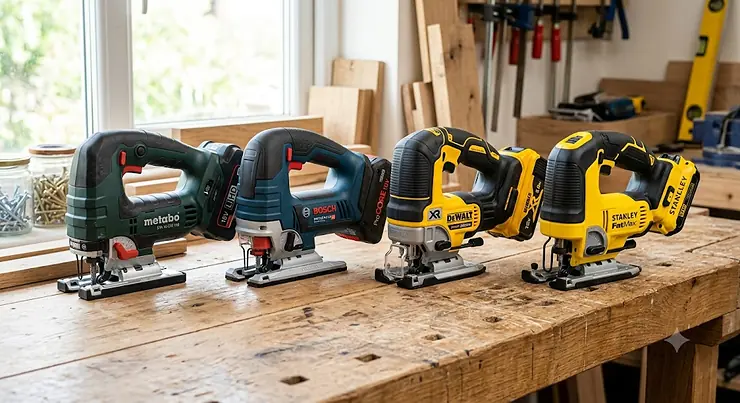
We’ve picked genuine, currently available models spanning budget, mid-range and premium tiers, plus the platform loyalty question that quietly decides most people’s purchase anyway (whichever battery system you already own).
1. Makita DJV182Z — best all-round brushless performer
The standout here is the brushless motor, which Makita pairs with genuinely refined vibration control rather than just raw stroke speed. Specs-wise, it runs up to roughly 3,500 strokes per minute with a three-stage orbital action and around 135mm cutting depth in softwood — numbers that matter because they translate into confidently powering through 18mm kitchen worktop offcuts without bogging down mid-cut. Based on the spec comparison against its rivals, what stands out isn’t outright speed but consistency: the anti-vibration housing keeps the blade tracking straight in long curved cuts, which is exactly where cheaper jigsaws start to wander. Reviewers consistently report that this is one of the smoothest-running 18V jigsaws they’ve used, with several trade-focused write-ups singling out the low vibration transfer during extended use as the main reason it tops so many “best of” lists. What most buyers overlook is that this tool is sold body-only — you’ll need an existing Makita LXT battery, which is either a non-issue (if you already own Makita kit) or an unexpected extra cost (if you don’t).
Pros:
- ✅ Brushless motor gives smooth, low-vibration cutting
- ✅ Widely compatible with Makita’s huge LXT battery range
- ✅ Holds a straight line well on long curved cuts
Cons:
- ❌ Sold body-only — battery and charger cost extra
- ❌ Pricier than most rivals once you add a battery
Body-only pricing sits around £120-£150 at the time of research; factoring in a battery, this lands as a mid-to-premium buy that’s worth it if you’re already inside the Makita ecosystem.
2. DeWalt DCS334N-XJ — best for existing XR battery owners
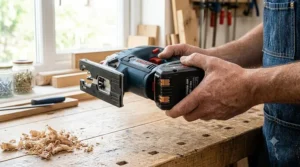
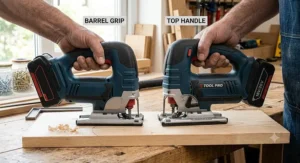
The standout advantage on this one is the four-stage pendulum action, a genuinely useful extra setting compared to the Makita’s three. In practice, the top-handle barrel-grip design paired with roughly 135mm wood cutting depth and a 47-degree bevel range (slightly more generous than most competitors’ 45 degrees) means this jigsaw earns its keep on angled scribing work and overhead cuts where a bow-handle design gets awkward. On paper this means better control for fine detail work; what the spec sheet won’t tell you, but reviewers note, is that the barrel grip takes some getting used to if you’ve only ever held a D-handle jigsaw before — your guiding hand sits closer to the blade, which some find more precise and others find a little too close for comfort on unfamiliar materials. Aggregated review sentiment across trade-tool comparison sites is consistently positive on build quality and tool-free blade changes, with the main gripe being that DeWalt’s own T-shank blades cost more than generic alternatives. If your workshop already runs on 18V XR batteries from drills and impact drivers, this is the obvious no-brainer pick.
Pros:
- ✅ Four-stage pendulum action for finer cut control
- ✅ Tool-free blade change system, no keys required
- ✅ Slightly deeper bevel range than most rivals (47°)
Cons:
- ❌ Barrel grip takes adjustment if you’re used to D-handles
- ❌ Genuine DeWalt blades carry a premium over third-party ones
Expect a body-only price of roughly £130-£160, which is squarely mid-range once you’re already holding an XR battery.
3. Milwaukee M18 FJS — best for professionals wanting Fuel-grade power
The Fuel branding isn’t just marketing here — the standout feature is genuinely trade-oriented power delivery, aimed at users cutting all day rather than for twenty minutes on a Saturday. Specs show a four-stage orbital setting and a brushless “Fuel” motor built for sustained high-torque cutting through dense engineered timber, and Milwaukee backs it with the wider M18 ecosystem that includes everything from site radios to nail guns on the same battery. Based on the spec comparison, this is overkill for someone assembling flat-pack furniture, but for a kitchen fitter doing worktop cutouts five days a week, the sustained power under load is where the extra outlay earns itself back in reduced downtime. What most buyers overlook about the M18 platform generally is how deep the battery ecosystem runs — if you’re already a Milwaukee user, adding this jigsaw genuinely costs you nothing in new chargers or adapters. Aggregated reviewer sentiment is strongly positive on runtime under continuous load, with the recurring criticism being that it’s genuinely heavier in the hand than the Makita or Bosch equivalents, which matters for overhead or prolonged one-handed cutting.
Pros:
- ✅ Sustained cutting power built for daily trade use
- ✅ Slots into Milwaukee’s extensive M18 battery ecosystem
- ✅ Four-stage orbital action for material-specific control
Cons:
- ❌ Noticeably heavier than the Makita or Bosch models here
- ❌ Premium pricing puts it out of reach for casual DIYers
Body-only pricing typically runs £180-£230, making this the priciest tool on our list and one best justified by daily professional use rather than occasional projects.
4. Bosch GST 18V-155 BC — best blade change system on test
What sets this Bosch apart is its blade change system — a tool-free clamp praised across multiple trade comparisons as the fastest lever-action mechanism in this lineup. In real terms, that means swapping from a fine finishing blade to a coarse rip blade takes seconds rather than fiddling with an Allen key, which matters enormously mid-job when you’re switching materials. The brushless motor delivers three orbital settings and a cutting depth in the 130-150mm range depending on material, and Bosch’s L-Boxx compatibility is a genuine convenience if you’re already running the wider 18V Professional system. Here’s what to weigh: Bosch’s own aggregated review data and independent trade-site testing consistently rate this jigsaw highly for cut accuracy and blade retention, but several testers noted the three-stage orbital action feels slightly less granular than DeWalt or Milwaukee’s four-stage systems when working across varied material thicknesses. For joiners who change blades constantly through a working day, the speed of that clamp mechanism alone can be worth the price difference over rivals.
Pros:
- ✅ Fastest, most reliable tool-free blade change of the group
- ✅ Compatible with Bosch’s wider L-Boxx storage system
- ✅ Strong reputation for long-term blade retention and accuracy
Cons:
- ❌ Only three orbital stages versus four on some rivals
- ❌ Sold without battery, charger, or case as standard
At around £150-£180 body-only, it sits in premium territory but is easy to justify for anyone who changes blades multiple times per job.
5. Einhell TP-JS 18/135 Li BL — best mid-range value pick
The standout here is genuinely surprising for the price: a brushless motor and four-stage pendulum stroke, features usually reserved for jigsaws costing far more. Cutting depth reaches around 135mm in wood and 10mm in mild steel, backed by a 10-year guarantee on the motor when registered — numbers that matter because they show Einhell isn’t cutting corners on the components that actually determine longevity. Based on the spec comparison, this tool essentially matches DeWalt and Milwaukee’s pendulum sophistication at roughly half their body-only price, which is precisely why it’s become the default recommendation for anyone already invested in Einhell’s Power X-Change battery system for garden tools. Reviewers consistently note that build quality feels a notch below the “big four” brands in hand-feel and switch action, but that cutting performance itself holds up impressively well against tools costing considerably more. What most buyers overlook is that Einhell’s Power X-Change range spans well over 200 tools, so the battery you buy here works across an entire cordless ecosystem, not just this one jigsaw.
Pros:
- ✅ Brushless motor and four-stage pendulum at a mid-range price
- ✅ Ten-year motor guarantee when registered with Einhell
- ✅ Shares batteries across Einhell’s huge Power X-Change range
Cons:
- ❌ Switch and housing feel less premium than trade-brand rivals
- ❌ Less common on UK trade counters, so fewer accessory options
Typical body-only pricing sits in the £70-£95 range, making it arguably the strongest value-for-money pick in this entire cordless jigsaw review.
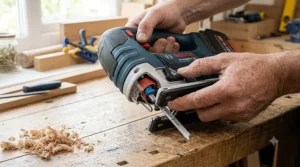
6. Ryobi R18JS-0 — best budget pick on the ONE+ platform
The standout feature is the blade-saver base, a genuinely clever bit of design that lets you drop the shoe to expose unused sections of an otherwise worn blade, stretching accessory life on a budget tool. Specs include a 1,100-3,000 strokes-per-minute variable speed range, four-stage pendulum action, and roughly 101mm wood cutting depth — figures that put it firmly in the “capable for occasional use” category rather than daily trade work. On paper this means comfortably handling shelving, flat-pack modifications, and garden project cuts; what the spec sheet won’t tell you is that Ryobi’s ONE+ system is the single largest cordless battery platform sold through UK DIY retailers, so if you already own a Ryobi drill, mower, or hedge trimmer, this jigsaw effectively becomes a free-ish addition to your toolkit. Aggregated review sentiment is broadly positive for the price point, with the built-in LED and dust blower earning particular praise, though several buyers note the blade clamp feels less positive than the Bosch or DeWalt tool-free systems.
Pros:
- ✅ Clever blade-saver base extends accessory life
- ✅ Fits the UK’s largest cordless battery platform (ONE+)
- ✅ Built-in LED and dust blower aid visibility
Cons:
- ❌ Blade clamp feels less positive than premium rivals
- ❌ Not intended for sustained daily professional use
Body-only price typically runs £45-£65, making this the natural choice for ONE+ owners who need a jigsaw only occasionally.
7. Black+Decker BDCJS18N-XJ — best cordless jigsaw for beginners
For anyone buying their very first jigsaw, the standout feature here is deliberate restraint: a straightforward three-stage pendulum action and clearly marked bevel detents at 0°, 22.5° and 45° that remove the guesswork entirely. Cutting capability is modest compared with trade tools, but that’s the point — a lightweight, compact body and tool-free blade clamp mean a first-time user can get a clean cut without wrestling with a heavy, unfamiliar tool. Here’s what to weigh: this is genuinely one of the easiest cordless jigsaws to pick up and use correctly on the first attempt, and the lock-on switch reduces hand fatigue during longer beginner projects like cutting shelving or garden decking. Reviewers consistently frame it as solid value for occasional domestic use, with the recurring caveat that it isn’t built for dense hardwood or repeated metal cutting — which, for a genuine beginner working through their first few DIY projects, is rarely the job at hand anyway. What most first-time buyers overlook is that Black+Decker’s 18V POWERCONNECT battery system is shared across an enormous range of drills, sanders and garden tools, so this is often the cheapest possible entry point if you’re starting a toolkit from scratch.
Pros:
- ✅ Genuinely simple controls, ideal for absolute beginners
- ✅ Lightweight, compact body reduces fatigue on longer jobs
- ✅ Batteries shared across a huge POWERCONNECT tool range
Cons:
- ❌ Not designed for dense hardwood or repeated metal cutting
- ❌ Basic three-stage pendulum lacks fine-tuning versatility
At roughly £35-£50 body-only, this is comfortably the most affordable entry point in our lineup and a sensible first purchase before you know how often you’ll actually reach for a jigsaw.
✨ Ready to Pick Your Perfect Jigsaw?
🔍 Whichever tier fits your budget, check current availability and pricing before you buy — stock and prices shift often, and a quick check now beats an awkward returns process later. Click through on any highlighted model above to see it for yourself.
Top 7 Products: Full Comparison Table
| Jigsaw | Motor | Orbital Settings | Wood Cut Depth | Price Range | Best For |
|---|---|---|---|---|---|
| Makita DJV182Z | Brushless | 3-stage | ~135mm | £120-£150 | Overall smoothness |
| DeWalt DCS334N-XJ | Brushless | 4-stage | ~135mm | £130-£160 | XR platform owners |
| Milwaukee M18 FJS | Brushless Fuel | 4-stage | ~135mm+ | £180-£230 | Daily professional use |
| Bosch GST 18V-155 BC | Brushless | 3-stage | ~130-150mm | £150-£180 | Fast blade changes |
| Einhell TP-JS 18/135 Li BL | Brushless | 4-stage | ~135mm | £70-£95 | Mid-range value |
| Ryobi R18JS-0 | Brushed | 4-stage | ~101mm | £45-£65 | Budget ONE+ owners |
| Black+Decker BDCJS18N-XJ | Brushed | 3-stage | Modest | £35-£50 | Absolute beginners |
Laid out side by side, the pattern is obvious: brushless motors have become the norm even in the mid-range tier, with only the two cheapest models here sticking with brushed motors to hit their price points. The Milwaukee M18 FJS justifies its premium through sustained professional-grade cutting depth rather than any single headline spec, while the Einhell TP-JS 18/135 Li BL is the clear outlier — brushless performance at a price closer to the budget tier than the premium one. If cutting depth in dense hardwood is your priority, skip straight past the two beginner-focused models at the bottom of the table.
A Cordless Jigsaw for Beginners: Getting Started Right
Buying your first jigsaw is the easy part — using it well in the first month is where most people either fall in love with the tool or shove it in a cupboard. Start by practising on genuine offcuts, not your actual project material; a jigsaw’s blade deflects more than you’d expect on the first few cuts as you learn how much forward pressure to apply. Too little pressure and the blade wanders off your line; too much and it flexes, leaving a bevelled edge instead of a square one.
Set the orbital action to its lowest (or off) setting for your first attempts, even if your model offers four stages. Aggressive orbital settings are brilliant for fast, rough cuts in soft timber, but they make it genuinely harder to follow a tight curve accurately until you’ve built a feel for the tool. Clamp your workpiece rather than holding it — a loose board vibrating under the blade is the single most common cause of a wandering cut for first-time users.
A common early mistake is ignoring blade selection entirely and using whatever came in the box for every material. Keep at least three types on hand: a fine-tooth blade for clean finish cuts, a coarse blade for fast rough cuts, and a bi-metal blade for the occasional metal job. Cheap generic blades wander more than branded ones costing a few pounds extra — a false economy that costs you accuracy on every single cut. Finally, always let the blade reach full speed before it contacts the material; starting the cut slowly is how novice users end up with a chipped, uneven entry point every time.
Real-World Scenarios: Which Jigsaw Suits Your Situation
The weekend renovator fitting a new kitchen worktop. You need clean, accurate sink and hob cutouts in 38-40mm laminate worktop, ideally without a second attempt. The Bosch GST 18V-155 BC‘s fast blade-change system pays for itself here, letting you switch from a plunge-cut blade to a fine finishing blade mid-job without breaking flow.
The flat-renting hobbyist building shelving on a tight budget. You’re cutting softwood and MDF occasionally, storage space is limited, and you don’t want a second battery ecosystem. The Black+Decker BDCJS18N-XJ or Ryobi R18JS-0 (if you already own ONE+ tools) both make sense — neither will impress a tradesperson, but neither needs to.
The self-employed joiner cutting worktops and staircases five days a week. Runtime under sustained load and long-term reliability matter more than any single spec sheet number. The Milwaukee M18 FJS or Makita DJV182Z are the sensible picks here, priced accordingly for daily professional wear.
How to Choose the Best Cordless Jigsaw
- Start with your existing battery platform. If you already own an 18V drill from Makita, DeWalt, Bosch, Milwaukee, Ryobi or Einhell, buying a body-only jigsaw on the same platform is almost always cheaper than starting from scratch.
- Match orbital settings to your actual materials. Three stages is plenty for general DIY; four stages earns its keep if you regularly switch between soft and dense hardwoods.
- Prioritise the blade change system if you switch blades often. A tool-free lever saves genuine time across a working day, far more than most buyers expect before they own one.
- Check bevel range, not just cutting depth. A 45-degree bevel covers most jobs, but a slightly wider range (like DeWalt’s 47 degrees) helps on awkward angled cuts.
- Weigh brushless against your budget realistically. Brushless motors extend both runtime and motor lifespan, but the Einhell TP-JS 18/135 Li BL proves you don’t need premium pricing to get one.
- Factor in battery run time honestly. A jigsaw’s actual working time per charge depends on material density and cut frequency as much as battery capacity — treat manufacturer figures as best-case scenarios.
- Consider weight for overhead or prolonged cutting. The heaviest tools here (Milwaukee, Makita) cut beautifully but tire the wrist faster during long overhead scribing work.
The Health and Safety Executive’s guidance on hand-arm vibration is worth a glance if you’re planning extended daily use, since vibration exposure limits genuinely differ between tools and matter for anyone using a jigsaw professionally.
Orbital Action Settings Explained
Orbital action is the single most misunderstood spec on a jigsaw’s box. Rather than simply moving the blade up and down, orbital action adds a small forward-and-back motion to the stroke, so the blade bites into the material on the upstroke and clears itself on the downstroke. The practical result is faster, more aggressive cutting — but at the cost of a rougher finish and less accuracy on tight curves.
Most cordless jigsaws in 2026 offer either three or four orbital stages, typically ranging from “off” (a pure straight up-and-down stroke, best for clean finish cuts and thin materials) through to the most aggressive setting (fastest cutting, ideal for rough rip cuts in thick softwood where finish quality doesn’t matter). What most buyers overlook is that leaving orbital action switched on for every cut is a mistake — for curved cuts, metal, plastic, or anything needing a clean edge, switching it off entirely usually gives a noticeably better result, even if the cut takes a few seconds longer.
Based on the spec comparison across this list, four-stage systems (DeWalt, Milwaukee, Einhell, Ryobi) offer finer control between “rough” and “aggressive,” while three-stage systems (Makita, Bosch, Black+Decker) simplify the choice to roughly “off,” “moderate,” and “fast.” Neither approach is objectively better — it comes down to whether you value granular control or straightforward decision-making mid-project.
The Blade Change System That Actually Saves You Time
Every jigsaw on this list uses T-shank blades and a tool-free clamp, but “tool-free” covers a surprisingly wide range of real-world experiences. The best blade change systems — Bosch’s lever clamp is the standout here — let you swap a blade in under five seconds with one hand, without needing to fully power down or reposition your grip. Weaker implementations require more fiddling, occasional binding, or a firmer push than feels intuitive on the first few attempts.
Why does this matter beyond simple convenience? Reviewers consistently note that a poor blade-change system discourages users from switching blades when they should, leading people to push on with the wrong blade for a job rather than take thirty seconds to swap it. That’s a false economy — using a coarse rip blade to finish-cut a visible edge, purely because changing blades feels like a hassle, is a common and entirely avoidable mistake. If you expect to switch between fine, coarse, and bi-metal blades regularly (kitchen fitters and joiners, take note), the quality of the blade clamp deserves as much weight in your decision as the motor spec itself.
Battery Run Time: What Actually Determines It
Manufacturer-stated run times are measured under best-case conditions, and real-world battery run time on a jigsaw depends far more on what you’re cutting than the number printed on the battery. Ryobi, for instance, states its RJS18-0 can manage roughly 30 metres of 13mm plywood on a single 5Ah charge — a genuinely useful benchmark, but one that assumes continuous straight cuts in relatively thin, soft material.
Dense hardwood, thick engineered timber, and metal all draw dramatically more current per cut than softwood, meaning the same battery might deliver a fraction of its “rated” run time on a demanding job. Orbital action setting matters too: running the most aggressive orbital stage constantly drains a battery faster than a gentler setting, simply because the motor is working harder per stroke. What most buyers overlook is that battery amp-hour rating (Ah) matters more for run time than voltage — a 5Ah battery will comfortably outlast a 2Ah battery of the same voltage on identical cutting tasks, even though both are labelled “18V.”
For anyone doing full-day cutting work, carrying a spare battery isn’t a luxury — it’s the only reliable way to guarantee you’re not stuck mid-job waiting on a charger. Brushless motors (Makita, DeWalt, Milwaukee, Bosch, Einhell) also extend genuine run time compared with brushed equivalents (Ryobi, Black+Decker), since they lose less energy to friction and heat during operation.
Cordless Jigsaw vs Corded Jigsaw
The cordless-versus-corded debate has genuinely shifted in cordless’s favour over the last few years, but it’s not a total knockout. Corded jigsaws, like the Bosch PST 800 PEL, still deliver unlimited run time and typically slightly more consistent power under sustained heavy loads, since they’re never drawing down a finite battery. For workshop-based use near a socket, that reliability has real value.
| Factor | Cordless Jigsaw | Corded Jigsaw |
|---|---|---|
| Run time | Limited by battery charge | Unlimited while plugged in |
| Portability | Excellent, no trailing cable | Restricted by cable length |
| Power consistency | Very good on brushless models | Consistently high throughout |
| Best For | Makita DJV182Z, site and mobile work | Workshop-based, socket-adjacent tasks |
The analysis here is straightforward: for anyone working across multiple locations on a single job — lofts, gardens, second floors without accessible sockets — cordless wins decisively on convenience without a meaningful power penalty on brushless models like the Makita DJV182Z or Bosch GST 18V-155 BC. For a fixed workshop bench doing repetitive cuts all day, a corded model remains a perfectly reasonable, often cheaper, choice.
Common Mistakes When Buying a Cordless Jigsaw
The most frequent mistake is buying body-only without checking battery compatibility, only to discover the “bargain” jigsaw needs a battery and charger costing nearly as much as the tool itself. Always check whether a battery kit or body-only listing suits your existing tools before comparing prices. A second common error is chasing orbital stage count as if more is automatically better — a four-stage system is wasted on someone who only ever cuts thin softwood on the lowest setting anyway.
Buyers also frequently underestimate weight as a factor, assuming all 18V jigsaws feel roughly the same in hand; in practice, the difference between the lightest and heaviest models here is noticeable within twenty minutes of overhead cutting. Finally, many first-time buyers skip blade quality entirely, assuming the jigsaw itself determines cut quality — in reality, a premium jigsaw with a cheap, worn blade will cut worse than a budget jigsaw with a sharp, quality blade.
Long-Term Cost & Maintenance
The purchase price is only the opening chapter of a jigsaw’s total cost of ownership. Blades wear out faster than most new owners expect — a quality T-shank blade costs roughly £3-£5 and typically lasts anywhere from a handful of cuts in dense hardwood to dozens in softwood, so budget for a small ongoing blade spend rather than treating the single blade in the box as permanent.
Batteries are the other long-term consideration, and this is where platform choice pays off over years rather than months. Buying into an established ecosystem — Makita LXT, DeWalt XR, Milwaukee M18, Bosch Professional, Ryobi ONE+, or Einhell Power X-Change — means a single ageing or failing battery doesn’t strand your whole toolkit, since replacements are cheap and widely stocked compared with obscure or discontinued battery formats. When a battery does finally reach end of life, don’t just bin it: UK regulations require proper disposal of lithium-ion batteries, and the government’s guidance on recycling old electrical items explains where to take them safely. Basic maintenance — keeping the blade clamp free of sawdust and occasionally checking the base plate for squareness — adds up to a jigsaw that performs like new for years rather than degrading quietly after a single season of neglect.
Safety, Dust & Regulations Guide
Cutting timber, MDF and engineered boards produces genuine amounts of fine wood dust, and prolonged, unprotected exposure carries real long-term respiratory risk — a point the Health and Safety Executive’s woodworking guidance covers in detail for anyone cutting regularly rather than occasionally. A basic dust mask rated for fine particulates, plus working in a ventilated space, is sensible practice even for domestic DIY projects, not just trade use.
Eye protection matters more with a jigsaw than many other power tools, since offcuts and splinters can kick back directly toward your face during plunge cuts. Always disconnect the battery before changing blades or clearing a jam — a jigsaw’s blade clamp mechanism can occasionally engage unexpectedly if the trigger is bumped with the battery still fitted. Finally, if you’re cutting near electrical cables, pipework, or structural elements (stud walls, joists), always verify what’s behind the surface first; a jigsaw’s plunge-cut capability is exactly what makes accidental cable strikes possible on unfamiliar walls.
Features That Actually Matter (And Those That Don’t)
Genuinely worth paying for: a brushless motor (better runtime and longevity), a fast tool-free blade clamp (saves real time across a working day), and bevel range beyond the standard 45 degrees if you regularly cut angled joints. LED work lights are a small but surprisingly useful inclusion too, especially for cutting in lofts, under cabinets, or anywhere natural light is poor.
Genuinely overhyped for most buyers: maximum stroke rate figures beyond around 3,000 SPM make little practical difference for domestic DIY use, since material feed rate — not raw blade speed — usually limits how fast you can safely cut anyway. Similarly, an extra orbital stage beyond four rarely gets used in practice; most owners settle into two or three favourite settings and stick with them regardless of how many the dial technically offers.
Frequently Asked Questions
❓ What is the best cordless jigsaw for a beginner?
❓ How long does a cordless jigsaw battery last per charge?
❓ Do I need a jigsaw with orbital action settings?
❓ Is a brushless jigsaw worth the extra cost?
❓ Which jigsaw has the best blade change system?
Conclusion
There’s no single best cordless jigsaw for every reader, and honestly, anyone claiming otherwise is selling you something rather than helping you buy it. What matters is matching the tool to your actual pattern of use: the Makita DJV182Z rewards anyone prioritising smooth, vibration-free cutting; the Bosch GST 18V-155 BC earns its keep through the fastest blade changes on test; and the Milwaukee M18 FJS justifies its premium purely through daily professional durability.
For value-conscious buyers, the Einhell TP-JS 18/135 Li BL remains the standout surprise of this whole cordless jigsaw review — brushless performance at a genuinely mid-range price. And if this is your first jigsaw purchase, don’t overthink it: the Black+Decker BDCJS18N-XJ or Ryobi R18JS-0 will teach you what you actually need before your second, more informed purchase down the line. Whichever you choose, remember that battery platform loyalty, blade quality, and a sensible approach to orbital action settings will affect your day-to-day satisfaction far more than any single spec on the box.
Recommended for You
- Cordless Circular Saw For Decking: 7 Best Picks for 2026
- Cordless Track Saw UK: 7 Best Plunge Saws Ranked for 2026
- Best 18V Circular Saw for Joiners: 7 Top Picks for 2026
Disclaimer: This article contains affiliate links. As an Amazon Associate, I earn from qualifying purchases. If you purchase products through these links, we may earn a small commission at no additional cost to you.
✨ Found this helpful? Share it with your friends! 💬🤗
