In This Article
Sanding is the job nobody enthuses about at the dinner table, and yet it’s the single step that decides whether a refinished chair looks like a labour of love or a school woodwork reject. Pick up the best cordless sander for your situation and that grim, arm-aching chore turns into something almost meditative — pull the trigger, glide, watch the swirl marks disappear. Pick the wrong one, and you’ll be standing in the garden at 6pm on a Sunday wondering why the battery died twenty minutes into stripping the shed door.

A cordless sander is a battery-powered power tool — usually random orbital, sheet, or detail-pad in design — that spins or vibrates an abrasive disc to smooth wood, filler, metal or old paintwork without the tether of a mains lead. That freedom from cables matters more than it sounds: no trailing flex to snag on a ladder, no hunting for an extension lead in a garage with one socket, and — per Wikipedia’s overview of the technology — the randomised orbit-and-spin motion is specifically engineered to avoid the visible circular scratch patterns that plague cheaper single-action sanders.
This guide skips the fluff you’d get from an Amazon listing and gets into the bit that actually helps you buy well: which of the seven real, currently available cordless sanders below suits your budget, your existing battery platform, and the size of job you’re actually planning. We’ll cover entry-level sander kits for first-time buyers, explain why bare tool pricing exists and when it saves you money, unpack what basic sanding sheets actually get you in the box, and work out where value dust collection genuinely earns its keep versus where it’s marketing dressing. By the end you’ll know exactly which cordless sander deserves a spot in your shed.
Quick Comparison Table
| Sander | Type | Power | Price Range | Best For |
|---|---|---|---|---|
| Erbauer ERI1105SDR | Random orbital | 18V brushless, 6-speed | £75-£85 range | Best value bare tool |
| Black+Decker BDCROS18 | Random orbital (kit) | 18V, single-speed | £75-£95 range | Best entry-level sander kit |
| Ryobi R18ROS-0 | Random orbital | 18V ONE+, single-speed | Under £80 | ONE+ battery owners |
| Bosch 18V AdvancedOrbit | Random orbital | 18V, variable speed | £70-£90 range | All-round DIY use |
| Makita DBO180Z | Random orbital | 18V LXT brushed | Around £90-£100 | Trade reliability |
| DeWalt DCW210N-XJ | Random orbital | 18V XR brushless | £100-£120 range | Heaviest daily use |
| Ryobi R18PS-0 / RPS18-0 | Detail/corner palm | 18V ONE+, single-speed | Under £45 | Tight corners & mouldings |
A glance at that table tells you most of what matters before you’ve even read a spec sheet: brushless motors cluster at the top of the price range, and bare tool pricing consistently undercuts kit pricing once you already own a battery. The Erbauer ERI1105SDR stakes out genuinely unusual ground here — a brushless motor and six-speed control at a price point that, in most brands, only buys you a brushed single-speed unit. Meanwhile the Ryobi R18PS-0 sits in its own lane entirely; it’s not trying to compete with the orbital sanders on raw material removal, it’s there for the fiddly detail work none of the round-pad tools can reach.
💬 Just one click — help others make better buying decisions too!😊
Top 7 Cordless Sanders: Expert Analysis
Choosing a genuinely good cordless sander comes down to matching motor type, battery ecosystem and dust handling to the jobs you’ll actually throw at it — not the biggest number on the box. Here’s how the seven strongest current options on the UK market stack up, budget through premium.
1. Erbauer ERI1105SDR — best value brushless bare tool
The standout feature here is simple: nobody else gives you a brushless motor and six variable speeds this cheaply. Erbauer’s EXT range is Screwfix’s own-brand platform, and the ERI1105SDR represents a proper generational leap over its predecessor, with roughly 30% more power and a notably lower vibration output — both figures that matter more in practice than they look on paper.
What that means for actual sanding: brushless motors run cooler and last longer under sustained use because there’s no physical brush contact wearing down inside the motor housing, which is exactly the kind of detail an Amazon listing won’t spell out for you. The six-speed dial lets you drop the orbit rate right down for delicate veneer work, then wind it back up for stripping an old varnish coat — something the single-speed budget sanders on this list simply can’t do.
Based on the spec comparison against rival own-brand tools, this is the sander that punches furthest above its price bracket. Reviewers consistently note that the EXT platform’s battery compatibility (it shares cells with Erbauer’s wider EXT tool range) makes it an easy add for anyone already invested in Screwfix’s ecosystem, though it’s a closed platform — EXT batteries won’t fit a Makita or DeWalt body, and vice versa.
Pros:
- ✅ Brushless motor at a genuinely budget price point
- ✅ Six-speed control rare below £100
- ✅ Reduced vibration for longer sanding sessions
Cons:
- ❌ Locked into the Erbauer EXT battery platform
- ❌ Sold as a bare tool — battery and charger cost extra
Sold as a bare unit in the £75-£85 range, this is the sharpest bare tool pricing on this entire list if you’re already sitting on EXT batteries from another Erbauer tool — the value proposition falls away fast if you’re starting from zero.

2. Black+Decker BDCROS18 — best entry-level sander kit for beginners
The standout feature on this one is that it’s a complete kit, not a bare tool — battery, charger and carry bag all included, which matters enormously if this is your first cordless power tool. Black+Decker built the BDCROS18 specifically for casual DIYers rather than tradespeople, and it shows in the deliberately simplified control layout: one speed, one rocker switch, nothing to configure.
The 18V 1.5Ah battery and 12,000rpm no-load speed put this firmly in the “does the job, doesn’t rush you” category. What most buyers overlook about entry-level sander kits like this is that the battery capacity — 1.5Ah here — is intentionally modest to keep the whole bundle affordable; you’ll get through a reasonable weekend project on a charge, but multi-day refinishing work will mean topping up battery capacity or buying a spare down the line.
Reviewers consistently praise the finish quality on softwoods, describing genuinely swirl-free results on projects like parquet flooring edges, while also flagging that the pace of material removal is noticeably more leisurely than the brushless options further up this list — a fair trade-off for a tool this accessible.
Pros:
- ✅ Complete kit — battery, charger and bag included
- ✅ Simple single-switch operation suits total beginners
- ✅ Genuinely swirl-free finish on softwood and painted surfaces
Cons:
- ❌ 1.5Ah battery gives limited runtime per charge
- ❌ Single speed only — no fine-tuning for delicate work
Priced in the £75-£95 range as a full kit, this remains one of the most sensible entry-level sander kits going if you don’t already own any 18V batteries and want everything in one box.
3. Ryobi R18ROS-0 — best for existing ONE+ battery owners
The standout feature is the ecosystem, not the sander itself: Ryobi’s 18V ONE+ platform now spans several hundred garden and DIY tools sharing one battery type, and if you’ve already got a ONE+ drill or strimmer in the shed, this sander effectively costs you nothing extra in batteries. It runs at a fixed 20,000 orbits per minute with a 2.5mm orbit diameter, tuned for a fine, consistent finish rather than aggressive stock removal.
Here’s what the spec sheet won’t tell you outright: single-speed sanders like this one are genuinely fine for most domestic sanding tasks, because the vast majority of DIY sanding — furniture prep, wall smoothing before painting, tidying up a fence panel — doesn’t actually benefit from variable speed the way fine cabinetry or plastics work does. Where it does show its budget positioning is in raw stock removal on tougher hardwoods, where the brushless competitors on this list will simply out-pace it.
Aggregated review sentiment on Ryobi’s ONE+ sanding tools tends to be positive on value and battery-sharing convenience, with the recurring criticism being that bare tool availability and stock fluctuate — it’s not unusual to see this model heavily discounted one month and briefly unavailable the next.
Pros:
- ✅ Shares batteries across the entire ONE+ tool range
- ✅ Fine, consistent finish thanks to tight 2.5mm orbit
- ✅ Comes with an assortment of grits to start immediately
Cons:
- ❌ Single speed limits control on delicate materials
- ❌ Stock availability can be inconsistent at retailers
At under £80 as a bare tool, and often found reduced, the bare tool pricing here is genuinely one of the more compelling deals on this list — provided you’re already carrying ONE+ batteries.
4. Bosch 18V AdvancedOrbit — best variable-speed all-rounder
The standout feature is the sheer breadth of its speed range — 6,000 to 24,000 orbits per minute via an electronic preselection dial, which is a wider spread than almost anything else at this price point. Bosch built this as a genuine do-it-all sander, aimed squarely at wood, paint, varnish, filler and plaster work, with a second handle for extra control on awkward angles.
On paper this means you get one tool that can crawl along at low orbit speed for polishing a lacquered surface, then wind right up for stripping paint off a garden gate — a flexibility that single-speed rivals like the Ryobi R18ROS-0 simply can’t match. The Microfilter System dust box is worth calling out specifically here, because Bosch has clearly put real engineering into the seal, and reviewers consistently note it captures fine dust noticeably better than a standard cloth or mesh dust bag.
The trade-off, and it’s a fair one, is that Bosch’s Microfilter box doesn’t connect to a standard shop vac hose — some reviewers find that frustrating if they’d rather plumb the sander straight into extraction for larger jobs, which is a design choice worth knowing about before you buy rather than after.
Pros:
- ✅ Wide 6,000-24,000 opm variable speed range
- ✅ Second handle improves control on vertical surfaces
- ✅ Microfilter box captures fine dust effectively
Cons:
- ❌ Microfilter box isn’t compatible with standard vac hoses
- ❌ Bare tool only — battery sold separately
Sold body-only in the £70-£90 range, this sits comfortably as the all-rounder pick for anyone who wants genuine speed flexibility without stepping up to trade-grade pricing.
5. Makita DBO180Z — best premium cordless sander for trade reliability
The standout feature is the badge, frankly — Makita’s reputation for tools that simply keep running, year after year, on building sites where nothing else survives that long. The DBO180Z runs on Makita’s 18V LXT platform and uses Lithium-ion Extreme Technology to squeeze genuine power out of an 18V cell without ballooning the tool’s size or weight.
What most buyers overlook about a tool like this is that the value isn’t really in any single headline spec — it’s in the accumulated engineering: the grip shape, the balance point, the bearing quality that means this thing is still running smoothly after years of daily trade use. Reviewers consistently flag it as heavier than some cordless rivals, including the DeWalt DCW210N-XJ below, but describe the trade-off as worthwhile given the precision and control the balanced grip delivers.
The main criticism that surfaces repeatedly in aggregated feedback is the lack of true variable speed — you get a handful of preset speeds rather than a continuous dial — which some users find limiting compared with the Bosch 18V AdvancedOrbit‘s wider range. For anyone already sitting on Makita LXT batteries from a drill or impact driver, though, this bare unit is close to a no-brainer.
Pros:
- ✅ Exceptional long-term build quality and reliability
- ✅ Lightweight-for-power design thanks to LXT tech
- ✅ Compact, low-profile body works well in tight spaces
Cons:
- ❌ Fewer speed settings than some variable-speed rivals
- ❌ Heavier in the hand than the DeWalt equivalent
Priced around £90-£100 as a bare tool, this is the premium bare tool pricing sweet spot for anyone already committed to the Makita 18V ecosystem across other tools.
6. DeWalt DCW210N-XJ — best brushless power for heavy use
The standout feature is the brushless motor paired with genuinely trade-grade componentry — this is DeWalt’s answer for anyone sanding for hours at a stretch rather than the occasional weekend project. It’s part of the 18V XR range, and the brushless design means more efficient power delivery and a longer service life than the brushed motors found in most of the budget sanders on this list.
Here’s the practical read: a brushless motor doesn’t just last longer, it also runs more efficiently per amp drawn from the battery, meaning you’ll typically squeeze more sanding time out of the same battery capacity compared with an equivalent brushed tool — a detail that matters enormously if you’re sanding all day rather than for twenty minutes on a Saturday. Reviewers consistently describe it as noticeably lighter in the hand than the Makita DBO180Z, while matching or exceeding it on raw power delivery.
The honest downside, and it’s a real one for domestic buyers, is that this tool is priced and positioned for tradespeople — you’re paying for durability and duty-cycle you may never actually need if your sanding consists of the occasional bit of furniture upcycling. If that’s your use case, the Erbauer ERI1105SDR or Bosch 18V AdvancedOrbit will do the job for considerably less outlay.
Pros:
- ✅ Brushless motor built for sustained daily trade use
- ✅ Genuinely lighter than the Makita equivalent
- ✅ Efficient power delivery extends runtime per charge
Cons:
- ❌ Premium pricing aimed squarely at professional users
- ❌ Overkill for occasional or hobbyist sanding needs
Bare tool pricing sits in the £100-£120 range, making this the priciest sander on this list — justified if you’re sanding professionally, harder to justify for occasional DIY.
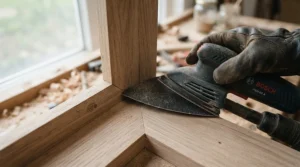
7. Ryobi R18PS-0 / RPS18-0 — best detail sander for corners and mouldings
The standout feature is the triangular pad — every other sander on this list uses a round or rectangular platen, and none of them can get properly into a window sill corner or the inside edge of a picture frame moulding the way this one can. It runs on the same 18V ONE+ platform as the Ryobi R18ROS-0 above, so if you’ve already bought into that ecosystem, this detail sander effectively becomes an accessory rather than a new tool purchase.
Based on the spec comparison, the 1.8mm orbital sanding motion is deliberately gentler than the random orbital sanders on this list — this isn’t the tool for stripping a door down to bare wood, it’s the tool you reach for after the big orbital sander has done the flat surfaces and you’re left staring at four corners it couldn’t reach. The compact, lightweight body and the sanding sheets included (spanning 60 to 240 grit) mean it’s genuinely ready to use straight out of the box.
What most buyers overlook is that a detail sander like this isn’t a luxury add-on — it’s often the difference between a furniture restoration that looks professionally finished right into the corners, and one that clearly shows where the “proper” sander couldn’t reach. As part of an entry-level sander kit build-out, pairing this with a random orbital sander gives genuinely complete coverage for a fraction of what a single premium tool costs.
Pros:
- ✅ Triangular pad reaches corners and edges other sanders can’t
- ✅ Shares batteries with the wider Ryobi ONE+ range
- ✅ Comes with a useful grit assortment out of the box
Cons:
- ❌ Not designed for aggressive material removal
- ❌ Compact pad size means slower coverage on large surfaces
At under £45 as a bare tool, this is genuinely one of the most useful low-cost additions to any entry-level sander kit, particularly for furniture restoration work.
Top 7 Sanders: Full Specification Comparison
| Sander | Motor | No-Load Speed | Weight | Battery Included? | Price Range |
|---|---|---|---|---|---|
| Erbauer ERI1105SDR | Brushless | 6-speed variable | Compact | No (bare) | £75-£85 |
| Black+Decker BDCROS18 | Brushed | 12,000rpm | 1.27kg | Yes (kit) | £75-£95 |
| Ryobi R18ROS-0 | Brushed | 20,000opm fixed | Lightweight | No (bare) | Under £80 |
| Bosch 18V AdvancedOrbit | Brushed | 6,000-24,000opm | Mid-weight | No (bare) | £70-£90 |
| Makita DBO180Z | Brushed (LXT) | Multi-preset | Heavier | No (bare) | £90-£100 |
| DeWalt DCW210N-XJ | Brushless | High-output | Lighter than Makita | No (bare) | £100-£120 |
| Ryobi R18PS-0 | Brushed | 22,000opm | Very light | No (bare) | Under £45 |
Lay these seven side by side and a clear pattern emerges: brushless motors — currently only on the Erbauer ERI1105SDR and DeWalt DCW210N-XJ here — sit at opposite ends of the price spectrum, proving the technology itself isn’t inherently premium, it’s how the rest of the tool is specced around it that drives cost. Bare tool pricing dominates this list because most serious buyers are already carrying at least one battery platform, which is exactly why the Black+Decker BDCROS18‘s complete-kit approach stands out as the anomaly worth highlighting for total beginners.

Cordless Sander vs Corded Sander: Which Actually Wins?
The corded-versus-cordless debate in sanding has quietly flipped over the last few years. It used to be an easy call — corded for power, cordless for convenience — but modern brushless motors like the one in the DeWalt DCW210N-XJ have closed that power gap considerably, to the point where the deciding factor for most buyers is now practical rather than technical.
Corded sanders still edge ahead on genuinely continuous, all-day use — a mains lead never runs flat, and for a workshop where the tool barely leaves the bench, that reliability has real value. Cordless sanders win decisively everywhere else: working up a ladder, sanding a fence at the far end of the garden, moving between rooms during a decorating job. Battery-powered tools also tend to run at slightly lower vibration in day-to-day use, though HSE-commissioned research into battery-powered hand tools found this isn’t a universal rule — some battery tools actually produced higher vibration readings than their corded equivalents, so it genuinely pays to check a specific model’s vibration figures rather than assuming cordless automatically means gentler on the hands.
| Factor | Corded Sander | Cordless Sander |
|---|---|---|
| Continuous runtime | Unlimited | Limited by battery |
| Portability | Restricted by lead length | Full freedom of movement |
| Typical power | Slightly higher on cheap models | Matches corded on brushless models |
| Upfront cost | Usually cheaper | Higher, or requires existing battery |
| Best For | Erbauer’s corded-only stablemates, fixed workshop use | Any of the seven sanders above, mobile jobs |
What this table doesn’t capture is total cost of ownership: if you’re building out an 18V battery ecosystem across a drill, an impact driver and a sander anyway, cordless stops being the pricier option the moment you’re buying your third tool on the same platform, because you’re only paying for bare tool pricing rather than a full kit every time.
How to Choose the Best Cordless Sander for Your Needs
Picking the right tool from seven genuinely decent options isn’t about finding “the best” in the abstract — it’s about matching a sander to your actual workload. Work through these criteria in order and you’ll land on the right pick faster than scrolling through star ratings.
- Check your existing battery platform first. If you already own 18V batteries from any brand on this list, bare tool pricing on a matching sander instantly becomes the cheapest route — this single factor should override almost every other consideration.
- Match motor type to your usage frequency. Occasional weekend use doesn’t need a brushless motor; daily or trade use absolutely does, for longevity reasons alone.
- Decide if you need variable speed. Fine finishing, plastics and delicate veneers benefit hugely from a dial like the Bosch 18V AdvancedOrbit‘s; general DIY sanding rarely notices the difference.
- Think about dust collection realistically. A basic dust bag is fine for outdoor or garage work; a sealed microfilter system earns its keep indoors or for anyone sanding regularly enough to worry about airborne dust exposure.
- Weigh up pad size and shape. A 125mm round pad covers ground fast; a detail sander like the Ryobi R18PS-0 handles the corners the round pads can’t touch.
- Factor in battery capacity, not just voltage. An 18V tool with a 1.5Ah cell and the same tool with a 5.0Ah cell will feel like different tools in terms of runtime — check what’s actually included in any kit.
- Don’t ignore weight and grip. A sander you’ll be holding overhead or at arm’s length for twenty minutes needs to be comfortable, not just powerful — this is where reviewer sentiment on ergonomics genuinely matters.
Practical Usage Guide: Getting the Most From Your New Sander
Unboxing a new cordless sander and immediately attacking a project is the single most common way people end up disappointed with a perfectly good tool. A little setup discipline in the first thirty days makes a genuine difference to both the finish quality and how long the sander lasts.
Start with the battery: fully charge it before first use, even if it arrives with some charge already, because most lithium-ion cells perform and read their remaining capacity more accurately after that first complete cycle. When you fit sanding sheets, check the hook-and-loop alignment carefully — a sheet mounted even a few millimetres off-centre will vibrate unevenly and wear the pad’s Velcro backing prematurely, which is a surprisingly common first-week mistake.
Grit progression matters more than most people realise. Basic sanding sheets typically arrive in a starter assortment — commonly 80, 120 and 240 grit — and the temptation is to grab whichever one’s on top and get going. Work through the grits in sequence instead: coarse to remove material and correct flaws, medium to smooth the coarse-grit scratches out, fine to finish. Skipping a grit stage shows up in the final surface every single time, particularly under gloss paint or varnish.
On maintenance: empty the dust bag or microfilter box after every session, not when it’s visibly full — a half-full bag reduces suction and dust capture noticeably before it looks obviously “full.” Check the sanding pad itself periodically too; the hook-and-loop surface wears down with use, and a tired pad is a common, easily overlooked reason a sander suddenly seems to “lose grip” on sheets that fitted perfectly fine a month earlier.
Real-World Scenarios: Which Sander Fits Which Buyer?
Specs only tell half the story — the other half is who’s actually holding the tool and what they’re trying to achieve with it.
The upcycling hobbyist on a tight budget. Picture someone furnishing a first flat by rescuing charity-shop furniture rather than buying new. Budget matters more than raw power here, and jobs are typically small — a chest of drawers, a dining chair. The Black+Decker BDCROS18 kit is the sensible pick precisely because it bundles everything needed with nothing extra to buy, and its single-speed simplicity removes any decision paralysis for someone still learning grit progression.
The tradesperson doing five jobs a week. This buyer needs a sander that survives daily transport in a van, gets used for hours at a stretch, and can’t afford downtime for a flat battery mid-job. The DeWalt DCW210N-XJ‘s brushless motor and the Makita DBO180Z‘s reputation for longevity both fit this brief far better than anything aimed at hobbyists — the extra spend is recovered many times over in reliability alone.
The keen DIYer restoring a period home. This is someone tackling skirting boards, window frames, panelled doors and the odd bannister over a long-running renovation. Coverage matters as much as power here: pairing the Bosch 18V AdvancedOrbit for flat surfaces with the Ryobi R18PS-0 for corners and mouldings gives genuinely complete coverage without needing to buy a single premium tool that compromises on either job.
Basic Sanding Sheets Explained: Grits, Types and Real Value
“Basic sanding sheets” sounds like a throwaway inclusion, but the sheets that ship with your sander — and the ones you buy afterwards — arguably matter as much as the sander itself for finish quality.
Most cordless sanders on this list use a hook-and-loop attachment system, which lets you swap sheets in seconds without clips or clamps — a genuine improvement over older clip-style systems that fiddled loose mid-sand. Mesh sanding sheets, which the Black+Decker BDCROS18 is supplied with, have perforations throughout the surface rather than a handful of punched holes, meaning dust extraction works regardless of how the sheet is orientated on the pad — a small detail that noticeably reduces clogging on dusty jobs like old paint removal.
Grit numbers tell you how coarse or fine the abrasive is: lower numbers (60-80) remove material fast and leave a rough surface, mid-range (120-150) smooths that roughness out, and fine grits (180-240) produce a near-polished finish ready for staining or painting. Starter packs bundled with entry-level sander kits typically cover this whole range in a handful of sheets — useful for getting started, but genuinely light for any project beyond a single piece of furniture; expect to buy a proper multipack fairly quickly if you’re doing more than one job.
One frequently overlooked point: sheet compatibility isn’t universal. Pad shapes and hole patterns vary between brands, so a basic sanding sheet built for a Ryobi sander won’t necessarily fit a Makita DBO180Z‘s pad perfectly, even at the same nominal diameter. Always check the specific pad’s hole pattern before bulk-buying sheets for a new sander.
Value Dust Collection: Bags, Filters and When It’s Worth Paying For
Dust collection is where the honest answer disappoints marketing copy: it’s rarely about which sander has the “best” system, and much more about matching the collection method to where and how often you’re sanding.
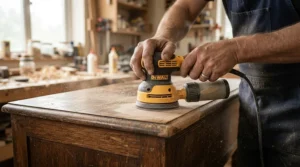
A basic cloth or mesh dust bag, like those on the Ryobi R18ROS-0 and Black+Decker BDCROS18, captures the bulk of larger sanding particles adequately for outdoor or garage work, where a bit of residual fine dust settling isn’t a major concern. Step up to a sealed system like the Bosch 18V AdvancedOrbit‘s Microfilter box, and you’re capturing meaningfully more of the fine dust that a basic bag lets straight through — genuinely worth the extra spend if you’re sanding indoors, in a room you’ll be living in afterwards, or doing it often enough that airborne dust exposure becomes a real consideration rather than a one-off nuisance.
For anyone sanding regularly, connecting to an external vacuum via a dust port adaptor beats any onboard bag or filter system on pure extraction performance, though as noted earlier, not every sander’s onboard system is designed to accept a standard vac hose — check compatibility before assuming you can simply plumb in your existing shop vac.
The genuine value calculation here is straightforward: occasional outdoor use doesn’t justify paying extra purely for dust collection; frequent indoor sanding absolutely does, both for cleanup time saved and for basic respiratory comfort during the job itself.
Bare Tool Pricing: Why Body-Only Sanders Cost Less (And When That’s a Trap)
Five of the seven sanders on this list are sold as bare tools — no battery, no charger, just the sander body. That’s not a manufacturer being stingy; it’s a deliberate model built around the fact that most buyers in any given 18V ecosystem already own compatible batteries from a drill, driver or another tool.
Here’s what most first-time buyers overlook about bare tool pricing: it only saves money if you’re already inside that brand’s battery platform. Buy a DeWalt DCW210N-XJ bare tool with zero existing DeWalt batteries, and you’ll need to add a battery and charger separately — often bringing the real total cost above a comparably-specced complete kit from another brand. The trap is assuming the advertised bare tool price is the full cost of getting sanding.
Where bare tool pricing genuinely shines is for anyone expanding an existing collection — someone with a Makita drill picking up the Makita DBO180Z, for instance, effectively pays only for the sander itself, sharing batteries and a charger they already own across multiple tools. That’s the entire logic behind manufacturers building out these ecosystems in the first place, and it’s a legitimate long-term saving once you’re two or three tools deep on one platform.
If you’re starting completely from scratch with no batteries at all, run the maths properly: add a genuine battery and charger price to any bare tool price before comparing it against a complete kit like the Black+Decker BDCROS18. Often the “cheaper” bare tool ends up costing more once you’ve filled in the gaps.
Common Mistakes When Buying a Cordless Sander
Even careful buyers trip over the same handful of pitfalls when choosing a cordless sander, and most of them are entirely avoidable with a bit of foresight.
The first is buying a bare tool without checking battery cost, covered above — it’s the single most common way a “budget” purchase quietly becomes an expensive one. The second is underestimating battery capacity requirements: a 1.5Ah cell might be fine for an hour of light sanding, but multi-day furniture restoration will have you charging constantly, which gets old fast. The third is ignoring pad compatibility for sanding sheets, only to discover the cheap multipack bought online doesn’t actually fit the sander’s specific hole pattern.
A fourth mistake worth flagging: chasing the highest orbits-per-minute figure without considering variable speed. A sander that’s blisteringly fast at one fixed speed can be genuinely harder to control on delicate work than a slower, variable-speed alternative like the Bosch 18V AdvancedOrbit — raw speed isn’t the same as usability. And the fifth, more subtle mistake is overlooking weight and balance entirely; a sander that reads well on a spec sheet can feel genuinely awkward in extended overhead or vertical use, which is exactly the kind of thing aggregated reviewer feedback tends to flag long before it shows up in marketing photos.
Buyer’s Decision Framework: A Quick Priority Checklist
If you’d rather skip the deep-dive and get a straight answer, work through this simple decision tree.
- If you already own 18V batteries from a brand on this list → buy that brand’s bare tool sander and pocket the bare tool pricing saving.
- If you’re starting completely from zero with no batteries → choose a complete kit like the Black+Decker BDCROS18 rather than adding up bare tool plus battery plus charger separately.
- If you sand daily or professionally → prioritise brushless motors, meaning the DeWalt DCW210N-XJ or the value-brushless Erbauer ERI1105SDR.
- If your work is mostly flat surfaces with occasional corners → pair a random orbital sander with a detail sander like the Ryobi R18PS-0 rather than buying one expensive tool trying to do both jobs.
- If you sand indoors regularly → weight dust collection quality heavily in your decision, favouring sealed systems like the Bosch 18V AdvancedOrbit‘s Microfilter box.
- If budget is the single overriding factor → the Ryobi R18ROS-0 or Erbauer ERI1105SDR bare tools represent the sharpest value on this list, assuming compatible batteries are already owned.
Safety, Vibration and Dust: What UK Regulations Say
Sanding produces two hazards worth taking seriously even for occasional home use: airborne dust and hand-transmitted vibration, both of which are well documented in UK health and safety guidance.
On vibration, prolonged exposure to poorly-designed power tools can contribute to Hand-Arm Vibration Syndrome (HAVS), a condition the Health and Safety Executive’s guidance on controlling vibration describes as causing lasting nerve, blood vessel and joint damage if exposure isn’t managed — and, notably, HSE-commissioned testing found that battery-powered tools don’t automatically produce lower vibration than corded equivalents, so checking a specific model’s declared vibration figure is worth the two minutes it takes.
For dust, the practical advice for home and workshop use mirrors trade guidance at a smaller scale: use dust collection wherever practical (a sealed system like the Bosch 18V AdvancedOrbit‘s Microfilter box genuinely helps here), work in ventilated spaces where possible, and consider a basic dust mask for extended indoor sanding sessions, particularly on old paintwork where lead content can’t always be ruled out on pre-1960s properties. None of this requires professional-grade equipment for occasional DIY use — it’s simply sensible practice that costs nothing beyond a bit of forethought.
Frequently Asked Questions
❓ What's the best cordless sander for a complete beginner?
❓ Are cordless sanders as powerful as corded ones now?
❓ Do cordless sanders come with sanding sheets included?
❓ What battery voltage should I look for in a cordless sander?
❓ How long does a cordless sander battery last on one charge?
Conclusion
Seven sanders, three price tiers, and one consistent theme running through all of it: the “best” cordless sander genuinely depends on what’s already in your toolbox and what you’re planning to sand, not which model has the flashiest spec sheet. If you’re starting from nothing, the Black+Decker BDCROS18 kit removes every barrier to getting started. If you’re already inside an 18V ecosystem, bare tool pricing on the Erbauer ERI1105SDR, Ryobi R18ROS-0, Bosch 18V AdvancedOrbit, Makita DBO180Z or DeWalt DCW210N-XJ makes expanding your collection genuinely cost-effective, and pairing any of them with the Ryobi R18PS-0 detail sander covers the corners the bigger tools can’t reach.
What matters more than any single spec is being honest with yourself about how often you’ll actually use the thing. A £120 brushless trade tool sitting mostly idle in a cupboard is worse value than a £40 detail sander that gets pulled out every weekend. Match the tool to the job, check your existing battery platform before you buy, and don’t skimp on basic sanding sheets or value dust collection if you’re planning to use this thing indoors on a regular basis.
Whichever of these seven you land on, the difference between a rough, disappointing finish and a genuinely professional one usually comes down to patience with grit progression rather than which brand’s logo is on the tool. Get that right, and even the budget picks on this list will produce results worth being proud of.
✨ Ready to get sanding?
Check current prices and availability on any of the seven picks above and pick the one that actually matches your project! 🛠️
Recommended for You
- Cordless Sander For Beginners: 7 Best Picks for UK DIYers (2026)
- Angle Grinder For Rust Removal: 7 Top Picks UK (2026)
- 230mm Angle Grinder for Heavy-Duty Grinding: 7 Best Picks (2026)
Disclaimer: This article contains affiliate links. As an Amazon Associate, I earn from qualifying purchases. If you purchase products through these links, we may earn a small commission at no additional cost to you.
✨ Found this helpful? Share it with your friends! 💬🤗
