
In This Article
Walk into any UK tool shop and the same argument plays out in the aisle: second fix nailer vs brad nailer, 16 gauge or 18 gauge, battery or hose. The labels overlap, the marketing blurs them further, and the wrong choice leaves you with split mitres, wobbly skirting or a wall of holes bigger than they needed to be. This guide untangles it using real specifications and whatever genuine, verifiable buyer feedback exists, rather than manufacturer poetry.
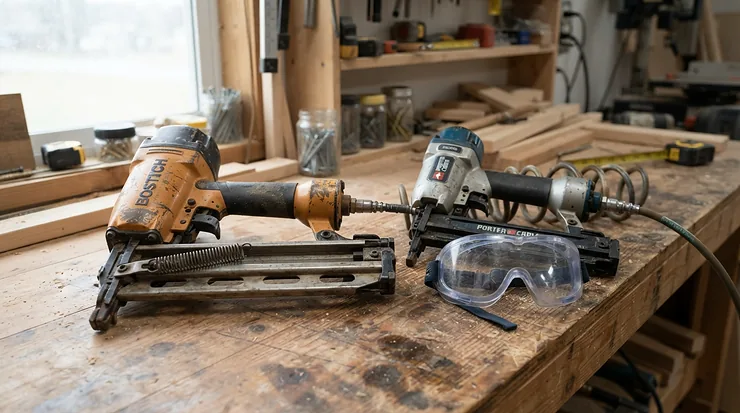
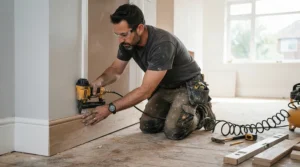
Here’s the short version. In British trade shorthand, a second fix nailer is usually a 16 gauge machine (angled or straight) built for the chunkier jobs. Think skirting boards, which Americans call baseboards, plus door linings and heavy architrave. A brad nailer is its slimmer 18 gauge cousin, built for delicate mouldings where you want holes you can hide with a fingertip of filler. Then the brands scramble the labels. Makita sells a 16G tool called a brad nailer, while Milwaukee files an 18G model under “second fix”. So we’ll judge by gauge and job, not by the sticker.
Below you’ll find seven real tools across budget, mid-range and premium. You’ll also find the gauge maths, practical picks for skirting and architrave, a nail hole filling guide and the safety rules that matter on British sites. All prices are ranges as seen at the time of research (October 2026), so check current price before buying.
Quick Comparison Table: Second Fix Nailer vs Brad Nailer at a Glance
Before the deep dive, here’s the whole field on one screen. Gauge matters more than the badge on the tool, so read that column first.
| Product | Gauge & style | Price range (check current price) | Best For |
|---|---|---|---|
| DeWalt DCN660 | 16G angled, battery | £260-£300 bare | Skirting and general second fix |
| Milwaukee M18 FN16GA | 16G angled, battery | £270-£330 bare | Hardwood trim, pros |
| Paslode IM65 F16 | 16G straight, gas + battery | £400-£480 kit | High-volume fitters |
| Makita DBN601 | 16G straight, battery | Varies; check retailers | Pneumatic feel, no hose |
| Milwaukee M18 FN18GS | 18G straight, battery | £250-£340 bare | Architrave, delicate mouldings |
| Ryobi R18GN18 | 18G straight, battery | £220-£260 kit | DIY value |
| Makita AF506 | 18G, pneumatic | Under £120 | Cheapest entry point |
Looking at the table, the DeWalt DCN660 and Milwaukee M18 FN16GA are the sensible 16G all-rounders. The Paslode IM65 F16 costs more upfront but trades that for a different power system. At the other end, the Ryobi R18GN18 and Makita AF506 are the budget routes into 18G work. If you already own a compressor, the Makita AF506 is the cheapest competent option here by a wide margin.
💬 Just one click — help others make better buying decisions too!😊
Top 7 Second Fix Nailer vs Brad Nailer Picks: Expert Analysis
1. DeWalt DCN660 — best all-round cordless 16G angled
The DeWalt DCN660 is the tool most UK joiners picture when someone says “cordless second fix nailer”. It’s brushless and 18V, and it fires 16 gauge angled nails from 32mm to 63mm. Retailer specs quote up to four nails per second, with sequential and bump firing modes. In practice that nail range covers everything from slim architrave to chunky MDF skirting, while the angled magazine tucks into tight corners and door linings. There’s no gas cell to buy and no hose to trip over. The listed operating range runs down to -20°C, which helps in unheated, half-finished houses.
Verified review depth was thin when researching. One UK marketplace listing showed a couple of owner comments. One buyer liked how easily it loads but warned against emptying a strip completely, and a long-term owner sounded regretful and was eyeing a gas model. Retailer write-ups are warmer but commercial, so weigh them accordingly. On the spec sheet, it suits anyone wanting a single 16G tool for skirting and linings, especially if DeWalt 18V batteries already live in the van.
Pros:
- ✅ Angled nose reaches tight door linings
- ✅ Gas-free, hose-free brushless convenience
- ✅ Wide 32-63mm nail range covers most trim
Cons:
- ❌ Bare tool plus batteries adds up quickly
- ❌ Angled strips can’t be swapped with straight 16G nails
Expect roughly £260-£300 bare and £400-£470 for battery kits. Strong value for pros and ambitious DIYers, overkill for one bedroom.
2. Milwaukee M18 FN16GA — sub-flush power in hardwoods
The Milwaukee M18 FN16GA is the premium take on the same 16G angled recipe. It runs on the 18V FUEL platform with a brushless motor and fires nails up to 64mm from a 110-nail magazine. Both sequential and contact modes are offered. The standout claim is “zero ramp-up”, meaning the tool is ready the instant you pull the trigger rather than spinning up first. That matters when you’re placing nails precisely near a mitre, because the nail lands where you aimed. Milwaukee’s retailers also advertise consistent sub-flush seating even in hardwoods, which is the real test for oak linings and dense architrave.
I couldn’t verify enough independent buyer reviews to summarise genuine sentiment, so this verdict rests on specs and platform logic. What the spec sheet won’t tell you is the battery angle. If you already own M18 batteries, the bare tool becomes one of the cheapest routes to premium 16G performance. If you don’t, factor in the cost of a starter kit.
Pros:
- ✅ Instant-fire design aids precise placement
- ✅ Handles hardwood without leaving nails proud
- ✅ Shares batteries with the wider M18 range
Cons:
- ❌ Independent review evidence is sparse
- ❌ Kits cost noticeably more than bare tool
At the time of research, bare tools sat around £270-£330 and kits in the mid-£400s. Worth it for hardwood-heavy or daily professional work, less so for occasional use.
3. Paslode IM65 F16 — compact gas-powered straight-nail workhorse
The Paslode IM65 F16 takes a different route: a gas fuel cell does the driving, with a small battery firing the spark. It fires 16 gauge straight nails up to 63mm, delivers 30 joules of power and carries a no-mar tip. Straight collation matters here. Straight nails sit square behind skirting profiles and suit tools that need a slim nose. The tool weighs around 2.1kg according to price-comparison listings, noticeably lighter than most battery rivals, and the manufacturer describes it as well balanced for tight spaces.
The trade-off is noise and running costs. One hire-company comparison table lists its sound power at about 103 dB(A), far louder than the 81 dB(A) quoted for Milwaukee M18 FN18GS. Gas cells also mean recurring spend and a slightly fiddlier routine. I found no reliable aggregated reviews to summarise, so I’d treat this as a spec-led recommendation. It suits fitters doing full days of repetitive 16G work who value light weight over quietness.
Pros:
- ✅ Lightweight and balanced for all-day use
- ✅ 30 joules handles softwood and dense MDF
- ✅ No-mar tip protects painted trim
Cons:
- ❌ Louder than brushless battery rivals
- ❌ Fuel cells add recurring running costs
Kits ran roughly £400-£480 at the time of research. Good value only if you’ll actually use it daily.
4. Makita DBN601 — pneumatic feel without the hose
The Makita DBN601 is a 16G straight nailer that uses a spring mechanism to mimic the crisp feel of an air tool. It accepts nails from 19mm to 64mm, holds 110 and weighs between 2.9kg and 3.3kg depending on battery. That’s heavier than the Paslode IM65 F16, so expect more forearm fatigue overhead. What it offers instead is refinement: a slim nose for aiming, tool-less jam clearing, an anti-restart function and Makita’s XPT dust and water resistance. Published sound pressure is 83 dB(A), and vibration is quoted at 2.5 m/s² or less, both useful numbers for a daily-use tool.
Verified review data was limited, so I can’t responsibly summarise buyer sentiment. What stands out analytically is the straight magazine. It reaches skirting faces beautifully but is less friendly in cramped corners than angled rivals. Makita’s three-year warranty on registered tools (excluding batteries and chargers) is a genuine plus.
Pros:
- ✅ Slim nose gives precise placement
- ✅ Tool-less jam clearing saves site time
- ✅ Three-year registered warranty
Cons:
- ❌ Heavier than gas and 18G rivals
- ❌ Straight magazine struggles in tight corners
Pricing varies noticeably between retailers, so check current price. Best for Makita-battery owners wanting straight 16G nails.
5. Milwaukee M18 FN18GS — quietest, smallest holes
The Milwaukee M18 FN18GS is the 18G brad nailer to beat. It fires 1.2mm nails from 16mm to 54mm and holds 110 of them. It weighs 3.1kg and manages up to 1,200 nails on a 2.0Ah battery, per retailer listings. Its secret weapon is the nose system: interchangeable noses stored on board, plus a small contact bracket that lets you drive nails at more acute angles. Combine that with a hole “the exact size of the nail head” and you get genuinely tidy finishing on painted architrave and mouldings. A hire-company table lists its sound power at about 81 dB(A), notably calmer than gas tools.
I found no independent reviews robust enough to quote. The practical analysis is simple: 18G holds less than 16G, so this is a trim tool, not a heavy skirting tool. It earns its keep where appearance beats brute force.
Pros:
- ✅ Very small nail holes simplify nail hole filling
- ✅ Much quieter than gas alternatives
- ✅ Interchangeable noses for different finishes
Cons:
- ❌ 18G holding power limits heavy skirting use
- ❌ At 3.1kg, it’s not the lightest option
Bare tools were around £250-£340 and kits £360-£430. A superb finishing tool for architrave specialists.

6. Ryobi R18GN18 — best value 18G for DIYers
The Ryobi R18GN18 is the budget-friendly 18G option, and the one most likely to appear in a hobbyist’s garage. It fires 15-50mm brads from a 105-nail magazine and weighs about 2.4kg bare, or 2.8kg with a battery. Retailer data cites up to 1,900 50mm nails per charge on a 5Ah battery. Useful features include tool-less depth adjustment, a dry-fire lockout, grip-activated LEDs and a belt hook. On paper, the AirStrike system skips compressor, hose and gas.
One UK round-up named it among the better battery options for second fix. The same piece noted two drawbacks: weight creeps up with a big battery, and the straight magazine makes corners awkward. That matches the spec sheet. For a single-room refresh with some skirting and architrave, it’s a sensible compromise, particularly if you already own Ryobi ONE+ batteries.
Pros:
- ✅ Affordable entry into cordless 18G
- ✅ Dry-fire lockout and tool-less jam release
- ✅ Shares batteries with the ONE+ range
Cons:
- ❌ Awkward in tight corners
- ❌ Heavy with a high-capacity battery
A battery kit sat around £220-£260 at the time of research. Excellent value for homeowners, a stretch for daily professional use.
7. Makita AF506 — cheapest way into 18G (pneumatic)
The Makita AF506 is the old-school option, and it’s still hard to beat on price. It’s an air-powered 18G brad nailer weighing just 1.3kg according to price-comparison listings, which makes it the lightest tool in this roundup by a distance. It handles nails up to 50mm, so skirting up to a modest depth is fine, and the low weight is a joy overhead on coving or high beading. The catch is obvious: you need a compressor and an air hose, and trailing hoses are a real nuisance when working through several rooms.
Review evidence is tiny. A price-comparison site showed just two ratings averaging around four and a half stars, which is far too small a sample to draw conclusions. As analysis, though, the pneumatic design means no battery wear and very few moving parts to fail. It suits anyone who already owns a compressor and wants a fine-finish tool without paying cordless premiums.
Pros:
- ✅ Very light at around 1.3kg
- ✅ Cheapest tool in this roundup
- ✅ Simple, durable air mechanism
Cons:
- ❌ Needs compressor and trailing hose
- ❌ Review pool is tiny
Prices were typically under £120 for the bare tool. Terrific value if a compressor is already in your workshop.
Specs Side by Side
Here’s how the seven stack up on the numbers that affect daily work. Weights are as listed by retailers or comparison sites; some are bare and some include a battery, so treat them as indicative.
| Product | Nail length | Power source | Weight | Best For |
|---|---|---|---|---|
| DeWalt DCN660 | 32-63mm | Battery | About 2.7kg bare | Skirting and linings |
| Milwaukee M18 FN16GA | Up to 64mm | Battery | Not verified | Hardwood trim |
| Paslode IM65 F16 | Up to 63mm | Gas + battery | About 2.1kg | Production fitting |
| Makita DBN601 | 19-64mm | Battery | 2.9-3.3kg | Straight-nail precision |
| Milwaukee M18 FN18GS | 16-54mm | Battery | 3.1kg | Architrave |
| Ryobi R18GN18 | 15-50mm | Battery | 2.4kg bare | DIY value |
| Makita AF506 | Up to 50mm | Air | About 1.3kg | Budget finishing |
The numbers reveal a clear split. The 16G tools reach 63-64mm, which gives real holding power for heavy skirting, while the 18G tools stop at 50-54mm. The Makita AF506 is the lightweight outlier, but its weight advantage disappears once you add a compressor and hose to the van.
Second Fix Nailer vs Brad Nailer: The Core Difference Explained
What is a second fix nailer vs brad nailer? A second fix nailer is a finish-grade nail gun, typically firing 16 gauge nails 32-64mm long, designed to fix skirting, architrave and similar timber trim after plastering. A brad nailer fires thinner 18 gauge brads, trading holding power for smaller, easier-to-hide holes on delicate mouldings.
Think of it as a bruiser versus a fine-point pen. The 16G tool grips harder and copes with dense timber, while the 18G tool leaves a hole you can hide with a thumbnail of filler. The catch is that terminology isn’t consistent. The Makita DBN601 is sold as a “brad nailer” yet fires 16G nails, whereas the Milwaukee M18 FN18GS sits in a “second fix” category yet fires 18G. Always check the gauge on the spec sheet.
| Factor | 18G brad nailer | 16G second fix nailer | Hammer and pins |
|---|---|---|---|
| Hole size | About 1.2mm | About 1.6mm | Varies |
| Holding power | Light to moderate | Strong | Moderate, skill-dependent |
| Splitting risk | Lowest | Low to moderate | Variable |
| Speed | Fast | Fast | Slow |
| Best For | Delicate mouldings, MDF architrave | Heavy skirting, hardwood | A handful of nails |
The table shows why many tradespeople eventually own both gauges. The 16G option wins wherever holding power matters, while the 18G wins wherever the finished surface will be scrutinised. Hammer and pins only makes sense for tiny jobs, because the time cost on a whole house is brutal.
Brad vs Finish Nail Gauge: What the Numbers Really Mean
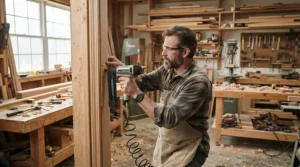
Gauge numbers run backwards, which catches everyone out once. A lower number means a thicker nail, so 16G is chunkier than 18G. Published specs put an 18 gauge brad at about 0.0475 inches (roughly 1.2mm) and a 16 gauge finish nail at about 0.0625 inches (roughly 1.6mm). That 0.4mm gap is invisible on a ruler but obvious in a painted finish. It decides how much filler you’ll need and how much holding power you’ll get.
Two practical points follow. First, brad vs finish nail gauge isn’t a mix-and-match decision: 16G nails are larger and won’t fit an 18G magazine, and vice versa. Second, collation angle matters too. The DeWalt DCN660 and Milwaukee M18 FN16GA take angled strips, while the Paslode IM65 F16 and Makita DBN601 take straight ones. Angled and straight strips aren’t interchangeable either, so buy nails to match the tool.
Finish matters as much as size. Galvanised 16G nails are fine for dry indoor work. Stainless steel is the safer choice for outdoor jobs or timbers high in tannins, such as oak, where ordinary steel can stain. As a rule of thumb, choose a nail length around 2.5 to 3 times the thickness of the trim, so most of the nail bites into the substrate.
Best Cordless Second Fix Nailer for Skirting: What Actually Matters
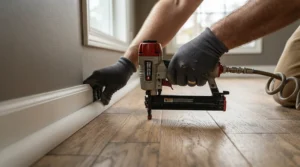
If your priority is the best cordless second fix nailer for skirting, put holding power first. Skirting is thick, often 18-20mm, and tall profiles can bow outwards if fixings are weak. That points towards 16G. The DeWalt DCN660 is my pick for most people because its angled nose reaches the awkward corner behind a radiator pipe and its 63mm capacity handles chunky MDF. For hardwood skirting, the Milwaukee M18 FN16GA is the spec-led upgrade.
Here’s the British wrinkle that most guides skip. Many UK walls are masonry, and a nailer cannot drive nails into brick or block. On solid walls you’ll typically use grab adhesive and plugs or screws, with nails serving only to hold the board while the adhesive cures. Nailers shine on stud partitions and timber grounds. Always locate the studs first, and aim to bury roughly 25mm of nail into solid timber where possible.
On a tight budget, the Ryobi R18GN18 can pin lighter skirting if you pair it with adhesive. It’s not the best cordless second fix nailer for skirting on its own, but as part of an adhesive-plus-pin method it works well. For anything heavier than a modest MDF profile, go 16G.
Best Second Fix Nailer for Architrave: Small Holes, Big Difference
The best second fix nailer for architrave looks different, because the priorities flip. Architrave is thinner, sits right against the door lining and has mitred corners that love to split. Here, hole size and splitting risk matter more than raw power. That makes the Milwaukee M18 FN18GS a standout. Its 18G nails leave tiny holes, its on-board noses help avoid marking the face, and its small contact bracket lets you fire at a steeper angle near mitres.
For painted MDF architrave, the Ryobi R18GN18 is the budget answer, with the same gauge advantage at a gentler price. If you’re fitting hardwood linings, though, step up to 16G with the DeWalt DCN660, because dense timber will reject 18G brads or bend them. The Makita DBN601 also suits architrave work with its slim nose, provided you’re comfortable with 16G holes.
Technique beats tools here. Nail the outer edge and the inner edge at staggered intervals, keep nails well back from the mitre tip, and use adhesive on the mitre joint itself. Reserve the one-nail-per-corner trick for pre-drilled hardwood, where splitting is likeliest.
Moulding and Trim Work: Matching the Nailer to the Profile
Beyond skirting and architrave, moulding and trim work spans a surprisingly wide family. According to a general reference on decorative moulding, casing, base, crown, batten and similar profiles each serve different functions, from concealing joints to protecting walls. Each wants a slightly different nailer approach.
Delicate profiles such as scotia, quadrant, beading and picture rails want 18G. The thin, narrow stock splits easily, so smaller brads save the day. The Ryobi R18GN18 and Makita AF506 do this well, and the Makita AF506‘s low weight is a gift when you’re reaching up to a picture rail. Chunkier profiles, such as deep coving or heavy panel mouldings, favour 16G. The DeWalt DCN660‘s listing explicitly includes coving, cladding and soffits among suitable uses.
A good mixed-trim kit might be one 16G angled tool for the heavy work plus one 18G for the fine work. That’s the combination many professionals converge on. If you can only afford one, pick based on the heaviest profile in your project, then compensate with adhesive on the delicate stuff.
Nail Hole Filling: A Step-by-Step Finishing Guide
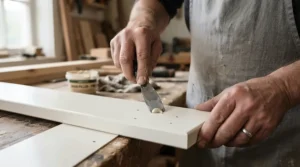
Even the best nailer leaves holes, and nail hole filling is where a good job becomes a great one. Gauge sets your workload here. The Milwaukee M18 FN18GS‘s tiny 1.2mm holes often need only a dab of filler, while 16G holes want a touch more care.
- Set depth first. Test on offcuts so nails finish just below the surface without punching through paper-faced MDF.
- Drive on the right setting. Use sequential mode for precision and bump only for speed on non-visible fixings.
- Choose the right filler. Use a fine, ready-mixed filler for painted work, and wax or tinted filler for stained timber.
- Overfill slightly. Press filler in with a flexible knife, leaving it fractionally proud.
- Sand lightly once dry. Use fine abrasive and a light touch, then wipe dust off.
- Spot-prime. Filler absorbs paint differently, so prime patches before the topcoat.
- Caulk the joints. Run decorator’s caulk along the wall-to-trim line to hide gaps.
Common mistakes in the first month are sanding too hard (which leaves hazy patches) and skipping spot-priming (which causes “flashing” under paint). Disconnect the battery before clearing any jam, too. The HSE’s nail gun guidance highlights accidental firing during maintenance as a real source of injuries, so make removing the power source a habit.

Real-World Scenarios: Which Nailer Fits Your Life?
Specs mean little until they meet a real project. Here are four profiles, each with a budget, environment and usage pattern.
The landlord refreshing a rental. Three rooms, mostly MDF skirting on stud walls, one weekend. Budget under £250. The Ryobi R18GN18 kit makes sense, particularly if ONE+ batteries are already lying around. Add adhesive on any masonry sections.
The ambitious self-builder. A whole house, 14 doors, mixed timber and MDF, spread over months. A 16G angled tool such as the DeWalt DCN660 is the sensible one-tool answer, since it handles skirting and architrave alike.
The full-time joiner. Daily second fix, hardwood jobs, long days. The Milwaukee M18 FN16GA suits those on the M18 platform. Anyone favouring light weight over quietness might look at the Paslode IM65 F16.
The compressor owner on a budget. Already has air and wants cheap fine finishing for beading and picture rails. The Makita AF506 costs less than a night out in some cities and does the job.
If you’re a college-leaver renovating a first flat on weekends, a cheap 18G plus filler beats a premium 16G sitting unused. If you’re a pro, the reverse is true. Match the tool to the hours you’ll genuinely clock.
How to Choose Between a Second Fix Nailer and a Brad Nailer
Follow these steps in order and the decision usually makes itself.
- Identify your heaviest trim. If you’re fixing tall or thick skirting or hardwood, go 16G. If it’s mostly beading and thin architrave, 18G is enough.
- Check your walls. Masonry means adhesive does the heavy lifting, so lighter tools become more viable.
- Pick a power system. Battery gives freedom, gas gives light weight, and air gives the lowest purchase price if you own a compressor.
- Match the battery platform. The cheapest tool is often the one that shares batteries you already own.
- Decide angled or straight. Angled magazines reach corners, while straight ones suit slimmer noses.
- Look at firing modes and safety. Sequential firing is safer and more accurate, and the HSE warns that safety features on nail guns can be defeated by accident or on purpose, so never tamper with them.
- Budget for nails and filler. Consumables are a running cost, particularly with gas.
If you remain torn on second fix nailer vs brad nailer, buy the gauge matching your toughest job and use adhesive to bridge the gap on easier ones.
Long-Term Cost and Maintenance: Cordless, Pneumatic or Gas?
Purchase price is only the first line of the invoice. Over several years, the power system dictates your costs.
| Type | Upfront cost | Running costs | Noise and weight | Best For |
|---|---|---|---|---|
| Battery (e.g. DeWalt DCN660) | Medium to high | Nails and battery wear | Quieter, mid weight | Most users |
| Gas (e.g. Paslode IM65 F16) | High | Fuel cells plus nails | Louder, lighter | Daily production work |
| Pneumatic (e.g. Makita AF506) | Low | Compressor upkeep | Light tool, noisy compressor | Budget and workshop use |
Battery tools shine because they share a platform. A bare Milwaukee M18 FN16GA is a modest outlay if you already own M18 packs. Gas tools like the Paslode IM65 F16 add steady fuel spend, so they pay back only with heavy use. Pneumatic tools have the lowest sticker price, but the compressor and hose are a hidden bill and a hassle.
Maintenance is straightforward in all cases. Keep nailer noses clean of dust, store tools dry and clear jams promptly using the tool-less release. For the Makita DBN601, the XPT dust and water protection helps in grubby site conditions, while air tools want periodic oil according to the maker’s guidance.
Safety, Noise and Compliance for UK Nailer Users
Nail guns look innocent until they aren’t. The HSE reports that nail gun incidents now feature in high numbers in its woodworking accident statistics. Typical causes include hands too close to the workpiece, accidental firing and maintenance with the power still connected. Wear eye protection, keep your off-hand clear of the nose, and remove the battery, gas cell or air line before any jam clearing.
Noise and vibration are the slower-burning risks. The spread between tools is real. One hire-company table lists the Milwaukee M18 FN18GS at about 81 dB(A) sound power against about 103 dB(A) for the Paslode IM65 F16, a difference of over 20 decibels. That’s well over a hundred times the acoustic energy, so hearing protection matters, especially with gas tools. The Makita DBN601 publishes vibration at 2.5 m/s² or below, and the HSE provides hand-arm vibration guidance plus a calculator for estimating daily exposure. That’s useful if you’re fixing trim for hours at a time.
On compliance, tools sold for the UK market should carry UKCA or CE marking, so check the label before buying grey imports. Gas cells are flammable, so store and transport them following the manufacturer’s instructions.
FAQ
❓ Can an 18G brad nailer fix MDF skirting boards?
❓ What nail length should I use for architrave?
❓ Do I need a compressor for a second fix nailer?
❓ Is a cordless nailer worth it for one room?
❓ Can I use 16G nails in an 18G nailer?
Conclusion
So, second fix nailer vs brad nailer: who wins? Neither, and both. The 16G second fix nailer wins on holding power, which makes it the tool for tall skirting, hardwood and anything that must stay put for decades. The 18G brad nailer wins on discretion, leaving holes so small that nail hole filling becomes a five-minute job. The DeWalt DCN660 is my default recommendation for most people choosing one cordless tool. The Milwaukee M18 FN16GA is the upgrade for hardwood and daily professional use, and the Paslode IM65 F16 suits those who prize light weight and don’t mind gas. For finishing, the Milwaukee M18 FN18GS is the neat-freak’s choice, the Ryobi R18GN18 the sensible budget buy and the Makita AF506 the thrifty compressor-owner’s friend. The Makita DBN601 is the straight-nail option for fans of a pneumatic feel.
Remember the practical rules. Match gauge to your heaviest trim, lean on adhesive for masonry walls and respect the HSE’s safety advice. Whichever route you take, pair your nailer with good filler and patient sanding, because that’s where the tidy finish really comes from.
✨ Ready to Upgrade Your Trim Game?
🔍 Click on any highlighted product name above to check current pricing and availability, then pick the nailer that fits your project. Your skirting, architrave and mouldings will thank you!
Recommended for You
- Second Fix Nailers: 7 Best Picks & Costly Mistakes To Avoid (2026)
- Second Fix Nailer: 7 Best Picks For Flawless Trim (2026)
- First Fix Nail Gun vs Second Fix Nail Gun: 7 Best Picks (2026)
Disclaimer: This article contains affiliate links. As an Amazon Associate, I earn from qualifying purchases. If you purchase products through these links, we may earn a small commission at no additional cost to you.
✨ Found this helpful? Share it with your friends! 💬🤗
