In This Article
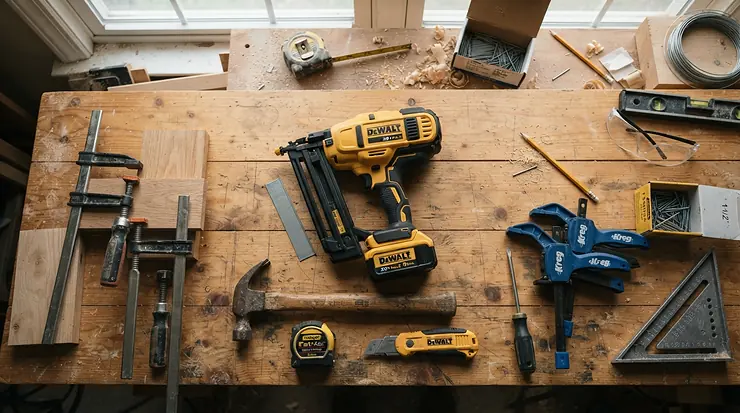
Picture the moment before the glue grabs. You’re holding a mitred corner of a walnut frame together with one hand, the clamp is just out of reach, and the compressor is, naturally, the one thing in the shed that isn’t plugged in. That’s the itch a cordless brad nailer scratches. Slot in a battery, press, fire, and the joint is pinned while the glue does its quiet work. No hose snaking across the floor. No compressor barking from the corner.
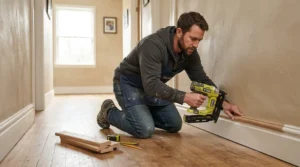
In 2026, a capable cordless brad nailer is no longer a tradesperson’s indulgence. UK stockists now list everything from sub-£50 craft tackers to brushless second-fix tools that cost as much as a decent mitre saw. The gap between them is bigger than the marketing admits. This guide sorts seven real models by what their specs mean in a home workshop: nail range, weight, battery platform, firing modes, and the true cost once you’ve bought the battery you forgot about.
I haven’t hand-tested any of these tools, and I won’t pretend otherwise. What you get instead is honest analysis built on manufacturer data, UK retailer listings and aggregated reviewer sentiment.
What is a cordless brad nailer?
A cordless brad nailer is a battery-powered nail gun that fires thin 18 gauge nails, known as brads, usually 15-50mm long, into timber. It needs no compressor, hose or gas cartridge. Because brads leave tiny holes that fill easily, the tool suits trim, mouldings, cabinet parts and glue-ups where a discreet fixing matters more than brute holding power. Like any nail gun, it swaps the hammer for speed and consistency.
Quick Comparison: Cordless Brad Nailer Options at a Glance
| Model | Power platform | Nail range | Drive / motor | Best For |
|---|---|---|---|---|
| DeWalt DCN680N | 18V XR | 15-54mm | Brushless | Existing XR owners wanting speed |
| Milwaukee M18 FN18GS | M18 | 16-54mm | Brushless, no ramp-up | Hardwood joinery with tidy holes |
| Makita DBN500 | 18V LXT | 15-50mm | DC motor, air-piston | Low-recoil work on slender pieces |
| HiKOKI NT1850DF | HiKOKI 18V | 16-50mm | Brushless, air-spring | Long, comfortable bench sessions |
| Ryobi R18GN18X-0 | ONE+ 18V | 15-54mm | Brushless | ONE+ owners stepping up |
| Einhell TE-CN 18 Li | Power X-Change 18V | 15-32mm | Brushed, geared | Light trim and thin ply |
| Tacwise 1564 | Built-in 4V (USB) | 10mm | Compact electric | Crafts, frames, upholstery |
Looking at the comparison above, the DeWalt DCN680N, Milwaukee M18 FN18GS, Makita DBN500 and HiKOKI NT1850DF sit in the same trade-grade bracket. The deciding factor is rarely nail quality; it’s which battery you already own. The Ryobi R18GN18X-0 undercuts them while staying brushless, which makes it a sensible stepping stone for a hobbyist.
At the other end, the Einhell TE-CN 18 Li and Tacwise 1564 are different animals. They’re lovely for light jobs but won’t drive a 50mm brad into hardwood. Match the tool to your timber, not your ambition.
💬 Spotted a pick that suits your workshop? One click on its name checks current price and availability on Amazon UK!😊
Top 7 Cordless Brad Nailer Picks: Expert Analysis
Every entry follows the same logic: what the spec means in practice, who it suits, what reviewers keep saying, and roughly what it costs. Prices are ranges at the time of research, so check the current price before you buy.
1. DeWalt DCN680N — fastest firing for existing XR owners
Bump mode on the DeWalt DCN680N reaches up to four nails per second, and for anyone already invested in 18V XR batteries, that speed arrives without a second battery bill.
It drives 1.25mm nails from 15mm to 54mm from a 110-nail magazine, with a brushless motor, tool-free jam clearance and a thumb-wheel depth dial. In practice, that range covers everything from delicate bead to chunky skirting. The dial lets you set depth on an oak offcut before the real workpiece gets near the nose. Listings also quote operation down to -20°C, handy for a January garage.
Based on the spec comparison, this is a trade-grade tool priced like one. Most hobbyists will never need four nails a second, but sequential mode is where fine woodworking happens: place, check, fire. Already own XR batteries? The bare unit is a sensible buy. Starting from zero? Price a kit instead.
In a US head-to-head of its 20V MAX sibling, testers rated it among the fastest, with consistent depth and tidy holes, while wishing it locked out when the magazine ran dry. A small set of seven UK-seller ratings averaged 4.7 out of 5, though the comments read more like brand loyalty than detailed testing.
Pros:
- ✅ Brisk firing with consistent depth
- ✅ Wide 15-54mm nail range
- ✅ Tool-free jam clearing and depth dial
Cons:
- ❌ Bare unit still needs battery and charger
- ❌ Dry-fire protection isn’t highlighted in UK specs
Expect around £310-£400 for the bare unit across UK stockists: strong value if you’re already on XR, steep if you’re not.

2. Milwaukee M18 FN18GS — zero ramp-up and a smaller nail hole
Milwaukee’s Ready to Fire design removes the pause between shots, so the Milwaukee M18 FN18GS feels immediate every time you press.
It fires straight 18 gauge nails at a 0° pitch from a 110-nail magazine, with Milwaukee quoting up to 1,200 nails on a 2.0Ah battery. The straight angle matters because the hole left is the size of the nail head, so filling takes seconds. Interchangeable noses stored on the tool and a small work-contact bracket let you fire at tighter angles than bulkier rivals, useful inside a carcass or along a moulding.
On paper, this is the tool for people who judge a job by how invisible the fixings are. Milwaukee also lists power to seat nails sub-flush in hardwoods. If that holds up on your oak and ash, it justifies the premium. It only makes financial sense inside the M18 battery family, though.
The review sample is thin. One UK retailer’s page shows nine reviews averaging five stars, but the comments are brief endorsements, such as it works as expected and feels heavy duty. That’s encouraging, not forensic.
Pros:
- ✅ No ramp-up delay between nails
- ✅ Straight nails leave small, neat holes
- ✅ Spare noses stored on the tool
Cons:
- ❌ Locks you into M18 batteries
- ❌ Little in-depth independent review coverage
Roughly £250-£330 for the bare tool. Fair pricing for the capability, and Milwaukee’s three-year warranty on registration sweetens it.
3. Makita DBN500 — air-nailer feel with low recoil
The Makita DBN500 uses a motor-driven piston to compress air internally, so each shot feels closer to a pneumatic tool than a battery gun’s thump.
A 460W motor delivers roughly 1,000 shots per charge, with 15-50mm nails, a 110-nail magazine and a rocker switch between sequential and bump modes. The nose is slim, with just 28mm between nail exit and the front of the body, so you can see exactly where the brad lands. Listed weight varies from about 2.9kg to 3.5kg between stockists, so check the data sheet.
Reduced recoil is the sleeper feature. A tool that doesn’t hop off a thin moulding is a tool that doesn’t dent it, which matters on slender pieces in fine woodworking. The trade-off is heft: it’s heavier than some rivals, so think twice about long overhead sessions.
I couldn’t find a sizeable pool of verified UK owner reviews, and the retailer review pages I checked were unpopulated. Most of what’s online is manufacturer and stockist copy, so treat the low-recoil claim as promising rather than settled.
Pros:
- ✅ Air-nailer feel with reduced recoil
- ✅ Slim, easy-to-see nose tip
- ✅ Anti dry-fire and built-in job light
Cons:
- ❌ Heavier than the lightest rivals
- ❌ Bare unit sits at the top of the price range
Around £420-£530 for the bare unit at the time of research: premium pricing for a premium feel, best for existing LXT owners.
4. HiKOKI NT1850DF — compact build for long sessions
HiKOKI’s launch material says the HiKOKI NT1850DF is about 30% more compact and 31% lighter than its predecessor, the NT1850DE, which is a big deal when you’re nailing for hours.
It uses an air-spring drive for zero ramp-up, fires 16-50mm nails up to 1.25mm thick, and holds 100 nails. HiKOKI quotes up to 1,650 nails per charge on a 3.0Ah battery and up to three nails per second, though one UK listing says two, so check the data sheet. You get sequential or bump firing, tool-free depth control, and a three-year warranty extendable to five on registration.
The reason to look here is ergonomics. Going by the specs, a lighter body suits a hobbyist who nails at a bench for an hour rather than a site worker doing a full day. The trade-offs are a smaller magazine and a platform with less hobbyist mindshare than DeWalt or Ryobi.
Verified owner reviews of the NT1850DF were scarce in my research. Honest verdict: promising spec, unproven reputation.
Pros:
- ✅ Lighter and more compact than its predecessor
- ✅ Strong claimed run time per charge
- ✅ Warranty extendable to five years
Cons:
- ❌ 100-nail magazine is smaller than some rivals
- ❌ Hard to find verified owner feedback
Pricing across the NT1850 family has ranged from the high-£200s to well over £500 depending on version and stockist, so check the current price carefully. It’s good value only at the lower end.
5. Ryobi R18GN18X-0 — brushless power on a hobbyist-friendly platform
Ryobi calls the Ryobi R18GN18X-0 its most powerful interior nailer yet, bringing brushless tech to the ONE+ battery system that so many UK sheds already contain.
It fires 18 gauge nails from 15 to 54mm, with sequential and contact modes, a dry-fire lockout, an LED work light and a reversible belt hook. Ryobi says the brushless motor sinks nails sub-flush even in hardwood. The older Ryobi R18GN18-0 is still around at a lower price, with a nose Ryobi describes as 45% smaller than the first generation.
With ONE+ batteries everywhere, this is the lowest-friction route into a serious cordless brad nailer for many hobbyists. Dry-fire lockout protects both the workpiece and the drive mechanism, and the belt hook helps when you’re up a ladder fitting coving.
DIY Garden’s review of the earlier AirStrike model scored it 4.3 out of 5. It praised low recoil, non-marring pads and the low-nail indicator, but flagged the weight (about 2.5kg bare), poor cold-weather behaviour and some user reliability questions. Treat those as notes on the previous generation, not this one.
Pros:
- ✅ Brushless power on the ONE+ battery system
- ✅ Dry-fire lockout and LED work light
- ✅ Sequential and contact firing modes
Cons:
- ❌ Gets heavy with a large battery fitted
- ❌ Earlier-generation reliability worries linger
Expect the mid-to-high £200s for the bare brushless tool; the older Ryobi R18GN18-0 has been seen from about £130 to just over £200. Good value for ONE+ owners.
6. Einhell TE-CN 18 Li — budget 2-in-1 nailer and stapler
At under £100 bare, the Einhell TE-CN 18 Li is the cheapest way to put a battery nailer on the Power X-Change platform, and it doubles as a stapler.
It fires 15-32mm nails, just 1mm thick, plus 16-22mm staples, from a magnetic 100-capacity magazine at up to 20 shots a minute via a geared mechanism with a depth adjuster. That one-millimetre thickness is a clue: standard 18 gauge nails in trade-grade tools are listed at about 1.2mm. It explains why DIY Garden warned that these fixings aren’t universal.
Honestly analysed, this suits light jobs such as thin moulding, plywood backs and craft projects. It’s single-shot only and brushed, so it’s slower than premium rivals, but for a hobbyist slow is just another word for careful.
DIY Garden scored it 4.3 out of 5. Its review praised the sturdy rubberised build and comfortable grip, while noting it’s sold without a battery and that you need a hex key to open the tip and clear a jam.
Pros:
- ✅ Very low entry price
- ✅ Nailer and stapler in one tool
- ✅ Shares Power X-Change batteries
Cons:
- ❌ Short 32mm maximum nail length
- ❌ Non-standard nails; hex key needed for jams
Under £100 for the bare tool at the time of research. Excellent value if you already own the battery; otherwise add a starter kit.
7. Tacwise 1564 — featherweight for craft and upholstery
Weighing under 0.7kg with a built-in 4V battery that charges over USB, the Tacwise 1564 is the gentlest on-ramp to cordless nailing.
It fires 10mm 18 gauge (type 180) brads and 6-12mm staples from a bottom-loading magazine, in single or bump mode, with an LED light and belt hook. A 10mm brad won’t hold a skirting board, but it’s perfect for card backs, delicate beading, upholstery and picture frames.
Based on the specs, think of it as a very capable stapler that happens to take brads. If you build model boxes, frames or fabric-covered panels, it’s ideal. If you plan to pin 25mm trim, skip it, because it simply can’t.
DIY Garden’s 4.3 out of 5 praised its simplicity, LED light and USB charging, with warnings about the 10mm limit and the non-replaceable battery. A handful of buyer comments I found also called it handy and good value for hobby use.
Pros:
- ✅ Light enough for long, delicate sessions
- ✅ USB charging; no battery platform needed
- ✅ Storage bag and LED light included
Cons:
- ❌ Only 10mm brads
- ❌ Built-in battery can’t be swapped
Typically about £35-£45 at the time of research: superb value for the right job and the wrong tool for the wrong one.
Spec Showdown: Price, Run Time and Reviewer Signals
| Model | Bare-tool price range | Maker-claimed run per charge | Review signal | Best For |
|---|---|---|---|---|
| DeWalt DCN680N | £310-£400 | About 850 nails on 2.0Ah (US test of sibling) | Strong US test; small UK sample | Fast XR-powered projects |
| Milwaukee M18 FN18GS | £250-£330 | Up to 1,200 on 2.0Ah | 5/5 from nine retailer reviews (tiny sample) | Hardwood joinery |
| Makita DBN500 | £420-£530 | About 1,000 shots | Few verified reviews found | Delicate, low-recoil work |
| HiKOKI NT1850DF | £270 to £500+ (NT1850 family) | Up to 1,650 on 3.0Ah | Few verified reviews found | Compact, long sessions |
| Ryobi R18GN18X-0 | Mid-to-high £200s | Up to 1,900 50mm nails on 5.0Ah (earlier model) | 4.3/5 DIY Garden (earlier model) | ONE+ owners |
| Einhell TE-CN 18 Li | Under £100 | Up to 20 shots a minute | 4.3/5 DIY Garden | Light trim, thin ply |
| Tacwise 1564 | £35-£45 | Built-in 4V, USB charged | 4.3/5 DIY Garden | Crafts, frames |
Run-time claims use different batteries, so don’t compare them like for like: the HiKOKI NT1850DF quotes its figure on a 3.0Ah pack and the Milwaukee M18 FN18GS on a 2.0Ah one. A hobbyist firing a few hundred nails over a weekend will find even the most modest claim plenty. The real separator is review depth, because only the budget trio has a published, UK-focused score.
Your First 30 Days: A Practical Usage Guide for a New Cordless Brad Nailer
Day one: set up and register
Charge a battery, load a strip of nails, then register the tool. Several makers extend warranties on registration within a set window: Milwaukee, Makita and Einhell list 30 days, HiKOKI four weeks. Check gov.uk’s product recalls and alerts for your model, then read the manual, because jam-clearing differs between tools.
Week one: calibrate on scrap
Set depth shallow and work up. Fire into offcuts of the exact timber you’ll use, because pine and oak behave nothing alike. Test both firing modes, and default to sequential for anything visible.
Weeks two to four: build good habits
Buy nails by compatibility, not by price. One Milwaukee 18 gauge pack lists suitability for several makers’ tools, while the Einhell TE-CN 18 Li needs its own slimmer nails. Keep nails dry and stored upright. Remove the battery before clearing any jam and when the tool is in storage. Wipe the nose clean so sawdust doesn’t scuff pale timber.
The most common first-month mistake is over-driving: a nail sunk too deep leaves a crater, and filling craters on a finished piece is no one’s idea of fun. Nudge the depth up in small steps and your fine woodworking stays flawless.
Real-World Scenarios: Three Hobbyists, Three Different Picks
These are illustrative profiles, not real people, but the reasoning is real.
Maya, the weekend framer. She makes about ten picture frames a month and wants to spend under £50. Her work uses thin mitred mouldings, so a 10mm brad is plenty. The Tacwise 1564 fits her budget, weighs next to nothing and charges from a phone lead. Nothing heavier would earn its keep.
Dev, the terrace restorer. He’s fitting skirting and architraves in a Victorian house, and already owns a Ryobi drill and a spare ONE+ battery. He needs 50mm reach and hardwood-capable power, so the Ryobi R18GN18X-0 is the natural pick. He should still pre-drill brittle old timber and test on offcuts first.
Sam, the cabinet maker. He builds shaker-style carcasses most weekends and runs Makita LXT tools. Slender face frames dent easily, so the Makita DBN500‘s low recoil and visible nose suit him. If he ran DeWalt, the DeWalt DCN680N would take its place without drama.
The pattern is simple: platform first, nail length second, budget third. Do it in that order and you won’t buy twice.
✨ Ready to Pin Your Next Project Together?
🔍 Click any highlighted product name above to check current pricing and availability on Amazon UK. Pick the cordless brad nailer that fits your timber, your batteries and your budget!
Problem to Solution: Fixing Common Cordless Brad Nailer Headaches
Nails sit proud of the surface. Increase the depth setting a notch at a time and confirm the battery is charged. Hardwoods may simply need a stronger tool, which is where the Milwaukee M18 FN18GS and Ryobi R18GN18X-0 earn their premium.
Nails sink too deep and dent the surface. Dial depth back and use the non-marring nose cap where fitted. Pale timbers like ash show every crater.
Jams. Remove the battery first. DIY Garden’s guidance is never to clear a jam with the battery in place. The DeWalt DCN680N and Ryobi R18GN18X-0 clear without tools, while the Einhell TE-CN 18 Li needs a hex key, so keep it taped to the case.
Wood splits near the ends. Move the nail away from the edge and consider a shorter or thinner brad. An 18 gauge brad nailer already splits less than heavier finish nailers, but brittle old timber can still crack.
A cold garage dulls performance. DIY Garden’s review flagged cold sensitivity on the earlier Ryobi AirStrike, while DeWalt’s listing quotes operation down to -20°C. Store batteries indoors and let them warm up before a winter session.
How to Choose a Cordless Brad Nailer
To choose a cordless brad nailer, match your battery platform first, nail range second and weight third, then confirm safety marking and the true price. Here are seven steps in order of importance.
- Start with your battery platform. Staying with batteries you own saves a lot, and it’s the biggest single cost swing.
- Match the nail range to your projects. Trim and frames need 15-32mm; skirting needs up to 50mm or more.
- Prefer sequential firing for visible work. Bump mode is fast but less forgiving.
- Weigh the tool with a battery fitted. A tool that’s comfortable on a bench can tire your arm overhead.
- Look for dry-fire lockout and tool-free jam release. They protect the tool and save frustration.
- Buy from traceable sellers. A UK product safety report shows one nail gun sold on a marketplace failing the Supply of Machinery (Safety) Regulations 2008, so favour reputable stockists.
- Count the real cost. Bare tools need batteries and chargers, so price the whole bundle.
18 Gauge Brad Nailer Basics: Why 18 Gauge Nails Suit Fine Woodworking
Gauge describes thickness, and a higher number means a thinner nail. Trade-grade 18 gauge nails are listed at about 1.2mm, finer than the thicker nails a 16 gauge finish nailer uses. That’s why an 18 gauge brad nailer leaves holes you can hide with a dab of filler and why thin stock splits less.
For fine woodworking, that trade-off is exactly the point. Brads aren’t structural. They’re clamps made of steel, holding parts still while glue cures. A rough rule of thumb many woodworkers use is to choose a nail long enough to pass through the top piece and bite well into the base, then test on offcuts.
Beware of fixings that look right but aren’t. The Einhell TE-CN 18 Li takes 1mm nails, while the DeWalt DCN680N and Milwaukee M18 FN18GS are listed for about 1.2-1.25mm. The Tacwise 1564 takes only 10mm type 180 brads. Always check your pack’s compatibility list before you buy 18 gauge nails in bulk.
Best Brad Nailer for Hobbyists: Matching the Tool to Your Budget and Habits
The best brad nailer for hobbyists is rarely the most powerful; it’s the one that fits the batteries and projects you already have. Three honest tiers cover most workshops.
Occasional crafter, under £100. The Tacwise 1564 or Einhell TE-CN 18 Li handle frames, thin trim and upholstery. Be realistic about nail length and you’ll be delighted.
Regular maker with a platform. The Ryobi R18GN18X-0, DeWalt DCN680N, Makita DBN500 or Milwaukee M18 FN18GS make sense when you already own the matching battery. A bare unit turns a big purchase into a modest one.
Detail-obsessed builder. If tidy fixings define your work, the Milwaukee M18 FN18GS‘s straight 0° nails and the Makita DBN500‘s low recoil address the exact problems that spoil fine joinery.
What most buyers overlook is that the best brad nailer for hobbyists also has to be pleasant to pick up. A tool that feels clumsy gets left on the shelf, however clever its spec sheet.

Hobbyist Workshop Tools: Where a Cordless Brad Nailer Fits and What It Really Costs
Among hobbyist workshop tools, a cordless brad nailer sits between the clamp and the router: it won’t replace either, but it makes both far more useful. It speeds up glue-ups, holds mitres square while adhesive cures, and frees both hands for alignment.
| Tier | Models | Typical bare-tool price range | Best For |
|---|---|---|---|
| Budget | Tacwise 1564, Einhell TE-CN 18 Li | £35-£100 | Crafts, frames, light trim |
| Mid-range | Ryobi R18GN18X-0, Milwaukee M18 FN18GS | £250-£330 | Regular makers, hardwood trim |
| Premium | DeWalt DCN680N, Makita DBN500, HiKOKI NT1850DF | £270-£530 | Heavy users on a matching platform |
Cost-per-use reasoning helps here. A £300 tool used on 50 project days over two years works out at roughly £6 a day before the battery, while a £40 tacker comes in under £1. But only one of them can pin skirting. The hidden line in every budget is the battery and charger, which can rival the tool itself, so the platform you already own is the biggest saving available.
Cordless Brad Nailer vs Pneumatic: Which Wins in a Home Workshop?
| Factor | Cordless brad nailer | Pneumatic brad nailer |
|---|---|---|
| Upfront cost | £35-£530 bare, batteries extra | Tool often cheaper, but compressor and hose needed |
| Hoses and compressor | None | Required |
| Weight | Roughly 2.4kg and up for trade models, plus battery | Lighter; the Makita AF506 is listed at 1.3kg |
| Noise | Tool noise only; the Makita DBN500 is listed at 79 dB(A) | Tool plus compressor noise |
| Best For | Mobility, tidy workshops, occasional use | High-volume work, lighter hand fatigue |
Pneumatic tools win on weight and sometimes on tool price, but they add a compressor, hose and fittings to buy, store and drain. For most hobbyists, a cordless brad nailer wins on convenience: you grab it, fire it, and put it away. If you already own a compressor, staying pneumatic with something like the Makita AF506 is perfectly respectable. If you don’t, buying into a battery platform you’ll use for drills and sanders too is the smarter spend.
Features That Actually Matter (And Those That Don’t)
Matter: depth adjustment you can use without tools, because you’ll change it constantly. A dry-fire lockout, like the one on the Ryobi R18GN18X-0, prevents marks on your workpiece and wear on the mechanism. Tool-free jam release saves your patience. A visible, slim nose lets you place brads precisely, which is where the Makita DBN500 shines.
Don’t matter as much: four nails per second. It’s a lovely number on a box, but hobbyists work in careful bursts. Bump mode is nice to have yet rarely essential.
Depends on your work: an LED light helps in dim garages and inside cabinets, and a belt hook helps on ladders, but neither changes the quality of a joint. Weight matters more than most spec sheets let on, since a lighter tool such as the HiKOKI NT1850DF or the Tacwise 1564 reduces fatigue across a long afternoon. The best feature list is the shortest one that covers your actual projects.
Safety, Regulations and Compliance for Home Workshops
A brad nailer is small, but it is still a fastener launcher. The HSE’s nail gun guidance notes that built-in safety features can be defeated accidentally or deliberately, that tools shouldn’t be modified, and that anyone using one should be trained. Its advice also covers disconnecting the power source before maintenance, which for battery tools means removing the battery.
Practical rules for a home workshop:
- Wear eye protection and ear defenders; DIY Garden’s guidance recommends both.
- Never point the tool at anyone, and keep your free hand away from the nailing path.
- Prefer sequential firing for precise work; US NIOSH and OSHA guidance reports roughly double the injury risk with contact triggers compared with sequential ones.
- Remove the battery before clearing jams or storing the tool.
On compliance, machinery sold in Great Britain must satisfy the Supply of Machinery (Safety) Regulations 2008, as the OPSS report mentioned earlier shows. Reputable stockists list manufacturer details and marking, and listings such as DeWalt’s show CE marking. Marking requirements can change, so confirm current rules on gov.uk before importing anything unbranded.

Frequently Asked Questions
❓ How many nails will a cordless brad nailer fire per battery charge?
❓ Is a cordless brad nailer better than a corded electric one for small jobs?
❓ Should I buy a cordless brad nailer as a bare tool or a kit?
❓ Do I need UKCA or CE marking on a cordless brad nailer?
❓ What is the cheapest sensible way into cordless nailing?
Conclusion
The right cordless brad nailer is the one that matches your battery drawer, your timber and your patience. If you already own 18V XR batteries, the DeWalt DCN680N is the fast, trade-grade choice. For hardwood trim and tidy straight nails, the Milwaukee M18 FN18GS makes a persuasive case. The Makita DBN500 suits low-recoil delicacy, and the HiKOKI NT1850DF looks promising for comfort, though its reviews are still thin.
Most UK hobbyists will find the Ryobi R18GN18X-0 the most approachable step-up, particularly with ONE+ batteries already in the shed. On a tight budget, the Einhell TE-CN 18 Li and Tacwise 1564 cover light trim and craft work for less than the price of a good chisel. If your nailing is mostly 25mm trim or smaller, you’ll save real money with either.
Pick the platform first, test depth on offcuts, and wear your eye protection. A well-chosen 18 gauge brad nailer should disappear into your workflow, leaving nothing behind but crisp joints and very small holes.
Recommended for You
- Second Fix Nailer Vs Brad Nailer: 7 Proven Picks (2026)
- Second Fix Nailers: 7 Best Picks & Costly Mistakes To Avoid (2026)
- Second Fix Nailer: 7 Best Picks For Flawless Trim (2026)
Disclaimer: This article contains affiliate links. As an Amazon Associate, I earn from qualifying purchases. If you purchase products through these links, we may earn a small commission at no additional cost to you.
✨ Found this helpful? Share it with your friends! 💬🤗
