
In This Article
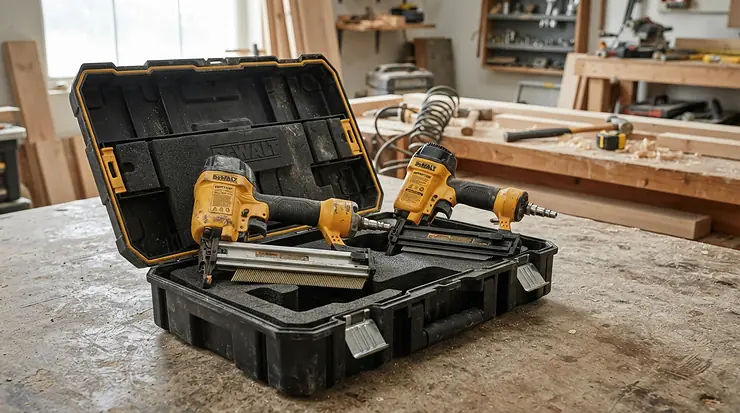
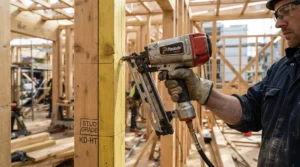
First fix nail gun vs second fix nail gun is really a question about job stage. A first fix nailer drives thick 50–90mm framing nails into structural timber (studs, joists, rafters). A second fix nailer places slim 16 or 18 gauge brads to hold skirting, architraves and trim, leaving holes small enough to fill and paint.
The principle behind both is the same one described in the general history of the nail gun: a driver blade, pushed by air, gas or a spring mechanism, hammers a fixing home in a fraction of a second. What changes between stages is how much force you need and how much collateral damage you can tolerate.
Get it wrong and you’ll find out fast. Fire a 16 gauge brad into a floor joist and it does nothing but look tidy. Fire a 90mm framing nail into a skirting board and you’ve split the timber, dented the face and started a conversation about who’s paying for the replacement.
This guide sorts the two tool families properly. You’ll get a spec-by-spec comparison of seven real nailers (four for first fix, three for second fix), plain-English coverage of nail gauge differences, and honest analysis of structural vs cosmetic fixing. We also cover first fix work on joists, stud wall construction and what to prioritise if you want the best first fix nail gun for timber framing. Prices below are ranges only, so check current prices before you buy.
Quick Comparison: First Fix Nail Gun vs Second Fix Nail Gun
Before the individual reviews, here’s the whole argument on one screen.
| Feature | First fix nailer | Second fix nailer |
|---|---|---|
| Typical job | Studs, joists, rafters, roof battens, timber frame panels | Skirting, architrave, door linings, beading, cabinet trim |
| Nail type | About 2.8–3.3mm framing nails, 50–90mm long | 16 gauge (about 1.6mm) or 18 gauge (about 1.2mm) brads |
| Collation | 30–34° paper strips, angled magazine | Straight or 20° angled brad strips |
| Power (example) | 82 joules on the Paslode IM350+ | 30 joules on the Paslode IM65 F16 |
| Weight (typical) | About 3.3–4.5kg | About 2.1–2.9kg |
| Hole left behind | Big, and hidden inside the structure | Tiny, and filled and painted |
| Trigger advice | Sequential first, bump only where sensible | Bump is more acceptable on thin material |
| Best for | Paslode IM350+, DeWalt DCN692 | Paslode IM65 F16, DeWalt DCN660N |
The table shows a simple trade: first fix tools buy holding power with weight and mess, while second fix tools buy neatness with limited penetration. Neither is a “better” tool, because they solve opposite problems. If you can only afford one, start from the job stage where you’ll spend most of your hours, not the one with the flashier spec sheet.
💬 Just one click — help others make better buying decisions too!😊
Top 7 First Fix and Second Fix Nail Guns: Expert Analysis
Every pick below is a real, currently listed model with specs checked against manufacturer and retailer data. Where I mention customer feedback, it’s a summary of themes in published reviews and forum threads, not invented quotes, and I flag where independent reviews were thin. Prices are approximate ranges at the time of research.
1. Paslode IM350+ — the gas-and-lithium site regular
The Paslode IM350+ is the tool trade retailers point to first when someone asks about gas framing, and the seventh-generation version is aimed squarely at long framing days. It fires 50–90mm nails at 82 joules, holds 55 nails, and manages two to three fixings per second. Paslode quotes up to 9,000 shots per battery charge and around 1,100 shots per fuel cell at −5°C.
On paper, that 82J is what drives a 90mm nail through 47mm timber into the next member without stalling. The 3.3kg weight matters more by mid-afternoon than any joule rating does. Gas rewards volume framing (wall panels, roof cut-ins, long runs) and suits anyone who doesn’t want a hose. The listed operating range starts at 0°C, though, so a frosty January shell is worth thinking through before committing.
Buyer feedback on retail pages skews positive, with reviewers describing big time savings versus hammering. One low rating came from a buyer who returned it because their stock of clipped-head nails wouldn’t suit the tool, so check nail collation first.
Pros:
- ✅ Strong 82J drive for 90mm nails
- ✅ Lightweight for a framing nailer
- ✅ No compressor or hose to manage
Cons:
- ❌ Ongoing fuel cell costs
- ❌ Fussier below 0°C
Expect roughly £350–£450 for a complete kit at the time of research, and it’s a solid verdict for anyone framing weekly rather than yearly.
2. DeWalt DCN692 — gas-free framing that squeezes between 400mm studs
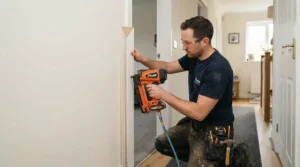
The DeWalt DCN692 is the sensible answer if you’re already deep in 18V XR batteries and want to delete fuel cells from your life. It has a brushless motor, two speed settings, sequential and bump modes, and takes 30–34° paper or wire collated nails from 50–90mm.
DeWalt says it drives 90mm ring-shank nails into softwood and 63mm into hardwoods, with a tool-free jam clearance and a dry-fire lockout. The two speed settings let you match energy to nail length rather than firing 50mm nails at full 90mm force. DeWalt also lists a −20°C to 50°C working range, which is a genuine winter advantage over gas. It’s designed to fit between studs at 400mm centres, which is exactly where cramped nailing happens.
At around 4.1kg bare, it’s heavier than the gas alternatives once a battery is clipped on. One UK forum user called DeWalt’s first fix nailer “a bit heavy but very good”, and another complained about a firing delay on a DeWalt framing nailer, so check recent reviews for the current version.
Pros:
- ✅ Runs down to −20°C
- ✅ No gas, cleaner running costs
- ✅ Two speeds for different nail lengths
Cons:
- ❌ Heavier than gas rivals
- ❌ Some users report lag versus air-spring tools
Bare units sit in the mid-£200s to mid-£300s, with kits higher, which makes it strong value if you own the batteries.
3. HiKOKI NR1890DBCL — air-spring drive with almost no lag
The HiKOKI NR1890DBCL (retailers now ship it as the NR1890DC after a code update) uses an air-spring drive, which is the technology most forum users praise when comparing cordless framers. It fires 50–90mm, 2.9–3.3mm nails, up to two per second, with selectable sequential or bump mode and tool-free depth adjustment.
What that means in practice is less recoil, more consistent flush driving and no ramp-up delay, because there’s no flywheel to spin up. The magazine holds 47 nails, fewer than the 55 on the Paslode IM350+, so budget for more reloading on big runs. It’s about 4.1kg without a battery, and considerably more once a 5.0Ah pack is fitted. Safety extras include a 30-minute auto-shutdown and a dry-fire lockout.
A Tool Talk reviewer described it as punchy and quieter than other guns but heavy for prolonged overhead work. That’s a fair summary of the trade-off: superb response, not the lightest tool on a scaffold.
Pros:
- ✅ Near-instant firing, minimal recoil
- ✅ Selectable sequential or bump mode
- ✅ Brushless motor, no fuel cells
Cons:
- ❌ Heavy for overhead work
- ❌ 47-nail magazine means more reloads
Kits with two 5.0Ah batteries land roughly in the £450–£600 range, and it’s a premium buy for professionals who prize firing feel.
4. Tacwise KDH90V — the compressor-fed budget workhorse
The Tacwise KDH90V is the pneumatic option for anyone who already owns a compressor or is happy to buy one. It fires 34° paper collated strip nails from 50–90mm, weighs 3.8kg, runs at 70–120psi, and offers sequential or contact trip firing with adjustable depth and a rotatable exhaust.
Because it has no battery or fuel cell, the running costs are essentially air and nails. The manual lists 5.8 CFM at 90psi, so check your compressor’s delivered air, not just its tank size, before assuming it will keep up in bump mode. Retailers say the nails match the format used by the Paslode IM350 line, which keeps consumables easy to source, though Tacwise itself recommends its own nails for reliability.
I couldn’t verify a large body of independent reviews for this model, so treat marketing claims like “very popular with timber frame builders” as vendor statements rather than proof. What the spec sheet does support is a proven layout: bottom-loading magazine, low vibration (4.7 m/s²) and a durable driver blade.
Pros:
- ✅ No fuel cells or batteries to replace
- ✅ Lighter than most cordless framers
- ✅ Standard 34° nails are easy to find
Cons:
- ❌ Needs compressor and hose
- ❌ Hose management on scaffolds
Around £150–£220 for the tool alone, with compressor extra, this is the best-value first fix pick if air is already in the van.
5. Paslode IM65 F16 — the second fix benchmark
The Paslode IM65 F16 is the tool trade reviewers keep calling the UK second fix benchmark. It fires 16 gauge straight brads from roughly 16–63mm at 30 joules, holds 100 brads across two strips, and weighs 2.1kg.
Paslode’s 2024 model claims 25,000 shots before cleaning and up to 10,000 shots per charge (older listings quoted 6,000, so check which version you’re buying). The weight is the headline: at 2.1kg it’s the kind of tool you can hold at arm’s length for a whole room of architrave without your forearm filing a grievance. The no-mar tip and nail lockout protect finished timber and prevent blank fires. If you need corner access, the angled IM65A sibling fires 32–63mm angled brads.
Trade reviewers describe it as reliable and quick, and forum users consistently favour Paslode for tight-space trim work. The catch is gas: you’re again buying fuel cells for a tool that hits a lot of nails.
Pros:
- ✅ Very light at 2.1kg
- ✅ Flush finish in softwood and dense MDF
- ✅ Long service interval before cleaning
Cons:
- ❌ Gas cells add running cost
- ❌ Straight magazine is less corner-friendly
Roughly £300–£400 with battery and charger, and it’s a fine long-term choice for daily joiners.

6. DeWalt DCN660N — cordless second fix without the fuel
The DeWalt DCN660N is a 16 gauge angled finish nailer for skirting, architrave and dado work. It fires 32–63mm nails from a 110-nail rear-loading magazine, has a 20° angle, and offers sequential or bump firing up to four nails per second. Reported weight is around 2.4–2.7kg depending on the retailer listing.
The angled magazine gets you into corners the straight-magazine Paslode can’t reach. DeWalt says it fires a 63mm nail into softwood and 50mm into hardwood, so don’t expect long fixings in dense timber. It replaced the DC618, and DeWalt claims it’s over 1kg lighter and 20% quieter than that model. Running from the same 18V XR platform as the DeWalt DCN692 means one battery family for both stages.
Forum feedback is generally warm (“the newer version is very good”, according to one PistonHeads user), though another user reported a firing fault caused by a small plastic part in an older DeWalt second fix gun. That’s a single anecdote, but worth knowing.
Pros:
- ✅ Angled nose reaches tight corners
- ✅ Shares batteries with 18V XR range
- ✅ Bump mode for fast trim runs
Cons:
- ❌ Limited penetration in hardwood
- ❌ Heavier than the Paslode IM65 F16
Bare units typically fall around £200–£300, making this the easiest upgrade for DeWalt-invested tradespeople.
7. Ryobi R18N18G-0 — the affordable brad nailer for light trim
The Ryobi R18N18G-0 is an 18 gauge AirStrike brad nailer that fires 1.2mm brads from about 15–50mm, with a 105-brad magazine and a stated maximum of 60 nails per minute. It weighs about 2.93kg with a battery and takes any Ryobi ONE+ pack.
Ryobi quotes up to 600 nails per charge on a smaller battery and up to 1,600 on a 4.0Ah pack (based on 50mm nails into pine). Because 18 gauge is thinner, holding power is lower, so this is a tool for beading, thin trim and light joinery rather than heavy skirting. Retail reviewers noted it drives cleanly into softwood and MDF but may struggle with very hard hardwoods and won’t keep pace with a Paslode on a busy site.
For a homeowner or occasional user already on ONE+ batteries, it’s an easy way into cordless nailing without touching gas or a compressor.
Pros:
- ✅ Very low entry price
- ✅ Tool-free jam release and depth adjustment
- ✅ Works with Ryobi ONE+ batteries
Cons:
- ❌ Thin 18 gauge holds less
- ❌ Not built for heavy site use
Around £80–£110 body only at the time of research, which is excellent value for light trim work.
Top 7 at a Glance
| Product | Power | Nail spec | Weight | Price range | Best for |
|---|---|---|---|---|---|
| Paslode IM350+ | Gas + Li-ion | 50–90mm framing | 3.3kg | £350–£450 kit | Daily framing crews |
| DeWalt DCN692 | 18V battery | 50–90mm framing | 4.1kg bare | Mid-£200s–£300s bare | 18V XR loyalists |
| HiKOKI NR1890DBCL | 18V battery | 50–90mm framing | About 4.1kg bare | £450–£600 kit | Firing feel, gas-free |
| Tacwise KDH90V | Air, 70–120psi | 50–90mm, 34° | 3.8kg | £150–£220 tool | Budget compressor users |
| Paslode IM65 F16 | Gas + Li-ion | 16g, 16–63mm | 2.1kg | £300–£400 kit | Full-time joiners |
| DeWalt DCN660N | 18V battery | 16g angled, 32–63mm | 2.4–2.7kg | £200–£300 bare | Cordless corner work |
| Ryobi R18N18G-0 | 18V battery | 18g, 15–50mm | 2.93kg | £80–£110 bare | Light trim, DIYers |
Reading across the table, the Tacwise KDH90V is the cheapest way into structural work but only if a compressor is already on your van. The HiKOKI NR1890DBCL and Paslode IM350+ cost more but remove the hose, and the difference between them is really gas versus battery preference. On the finishing side, the Ryobi R18N18G-0 is the value pick for light trim, while the Paslode IM65 F16 and DeWalt DCN660N are the stronger long-term second fix tools.
✨ Don’t Miss These Exclusive Deals!
🔍 Take your nailing setup to the next level with these carefully selected tools. Click on any highlighted item to check current pricing and availability. The right pair of nailers will help you frame faster, finish cleaner and skip the call-backs your clients dread!
Nail Gauge Differences: Why Thickness Decides the Stage
Nail gauge differences are the simplest way to understand the two tool families. The rule that trips up newcomers is that the gauge scale runs backwards: a higher number means a thinner nail. So an 18 gauge brad (about 1.2mm) is finer than a 16 gauge brad (about 1.6mm), and both are far thinner than the 2.8–3.3mm framing nails used first fix.
| Nail type | Approx. diameter | Typical length | Typical job | Best for |
|---|---|---|---|---|
| Framing nail | 2.8–3.3mm | 50–90mm | Studs, joists, rafters | Paslode IM350+, DeWalt DCN692 |
| 16 gauge brad | About 1.6mm | 32–63mm | Skirting, architrave, door linings | Paslode IM65 F16, DeWalt DCN660N |
| 18 gauge brad | About 1.2mm | 15–50mm | Beading, thin trim, panels | Ryobi R18N18G-0 |
| Pin | Very fine | Short | Delicate mouldings | Tiny holes, minimal hold |
Trade retailers make the same point about pin nails: tiny holes, but they don’t hold like a 16 gauge nailer. This is why so many carpenters end up owning one of each. Thicker nails buy holding power and shear strength, while thinner nails buy invisibility, and no single tool can do both. Buy the tool for the nail, not the other way round, and make sure the magazine angle and collation match what your fixings supplier stocks.
Structural vs Cosmetic Fixing: Where the Line Really Sits
Structural vs cosmetic fixing is the working definition behind the whole comparison. Structural fixings carry load or resist movement: studs to plates, joists to hangers, rafters to wall plates. Cosmetic fixings hold finish material in place and are judged by how invisible they are.
In England, structural guidance sits in Approved Document A of the Building Regulations. It covers the structural stability and safety of buildings, and it’s the reason “just nail it” isn’t a plan for load-bearing timber. Your fixing choice should follow the structural design or building control advice, not the tool you happen to own. Scotland, Wales and Northern Ireland have their own regimes, so check locally.
The practical test is a simple one: if removing the fixing could let something move under load, it’s structural, and a brad won’t do. If the fixing’s only job is stopping a strip of timber lifting off a wall, it’s cosmetic, and a framing nail is overkill. The middle ground (plywood sheathing, fascias, decking) is where good judgement earns its keep, which is why reading the manufacturer’s nail schedule beats guessing.
First Fix Nail Gun for Joists: What Actually Works
A first fix nail gun for joists sounds simple, but joist work has one trap: the fixings often aren’t framing nails at all. Joist hangers usually specify short, thick hanger nails from the manufacturer’s nail schedule, and a 90mm framing nail poked through the hanger holes is not the same thing. Follow the hanger maker’s schedule to the letter.
Where a framing nailer does earn its keep on joists is everything around the hangers: nailing joists to wall plates, fixing noggins and strutting, blocking between joists, and skew-nailing where the design allows. Here you want a gun that copes with 75–90mm nails at awkward angles, so a nose that bites (the Paslode IM350+ has a multi-angled toothed probe) and a body that fits between joists at 400 or 600mm centres. The DeWalt DCN692 is designed to fit between 400mm-centre studs, which translates well to joist bays.
One more thing the spec sheet won’t say: reviewers who nail into LVL or cross-laminated timber report that 90mm ring-shank nails need much more power than softwood, so check driving ability before buying for engineered timber.
Best First Fix Nail Gun for Timber Framing: The Criteria That Matter
Choosing the best first fix nail gun for timber framing comes down to four things, in this order.
- Power-to-nail match. Confirm the tool drives your longest nail into your densest timber, not just the brochure softwood.
- Weight over a full day. The Paslode IM350+ at 3.3kg is meaningfully lighter than cordless rivals, which is why it stays popular for volume framing.
- Running cost and climate. Gas means fuel cells and a 0°C floor, while battery models like the DeWalt DCN692 run down to −20°C on paper.
- Nail availability. Paper-collated 30–34° strips are widely stocked, but check that your tool takes clipped-head or offset round-head fixings.
For a busy framing crew, gas usually wins on weight and speed. For a self-builder or small contractor, a brushless battery model such as the HiKOKI NR1890DBCL avoids consumables. The Tacwise KDH90V suits anyone with a compressor already working elsewhere.
Stud Wall Construction: Which Nailer Does What
Stud wall construction uses both tool families in sequence, and that is a nice illustration of the whole topic. Structural (load-bearing) walls are framed with a first fix nailer: studs into top and bottom plates, doubled studs at openings, noggins for fixings. The TRADA materials specification outlines what’s normally specified for conventional timber frame, and it’s worth reading before you buy fixings for load-bearing work.
Non-load-bearing partitions are more forgiving. Commonly cited guidance suggests 47×75mm studs at 600mm centres top out around 2.4m before you move to 47×100mm, though you should confirm with an engineer or Building Control for anything unusual. A framing nailer speeds the frame itself, while a second fix nailer helps with cosmetic elements such as door linings and architrave once the plasterboard is on.
The DeWalt-listed compact profile matters here. Getting a gun between studs at 400mm centres to skew-nail a noggin is much easier with a slim nose than with a bulky one. If your day is mostly partitions, weight and access beat raw power.
How to Choose the Right Nail Gun: 6 Steps
- Start with the job stage. If you’re framing, you need a first fix tool, and if you’re fixing trim, you need a second fix one. Don’t try to compromise with one gun.
- Match the nail to the timber. Check maximum nail length and diameter against your densest material, especially treated timber or engineered boards.
- Pick a power source. Gas gives speed and lightness, battery removes fuel costs, and air is cheapest but needs a compressor.
- Check weight and balance. Anything over 4kg becomes a workout overhead, so factor in the battery.
- Look at trigger options. Full sequential mode is the safer default for structural work, and it’s worth having selectable modes for flexibility.
- Consider your battery ecosystem. If you already own 18V DeWalt or Ryobi batteries, a bare unit can save real money.
Practical Usage Guide: Your First 30 Days With a Nailer
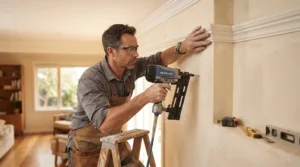
The first month is where most nailer mistakes happen, and most of them are avoidable. Start by setting depth on scrap timber of the same species and thickness as your job, not on the bench. Nails should sit flush with the face, not leave heads proud or punch through.
Use sequential mode until your placement feels automatic. Clear jams with the tool disconnected, using the tool-free nose on models like the DeWalt DCN692 or Paslode IM65 F16. Keep spare nails in the same collation and angle as the magazine expects, because mixed strips are a classic source of misfires.
For gas models such as the Paslode IM350+, keep fuel cells warm before a cold start and follow the manufacturer’s cleaning schedule (Paslode quotes a minimum 25,000 shots on newer second fix models). For battery models such as the HiKOKI NR1890DBCL, let the 30-minute auto-shutdown do its job and avoid leaving a live tool lying about. Finally, store nailers with the magazine empty and the tool disconnected, and never carry one with your finger on the trigger.
Real-World Scenarios: Three Buyers, Three Kits
The self-builder framing a garden room. With a budget under £600 and one weekend, hire a framing nailer if you can. If you must buy, the Tacwise KDH90V plus a modest compressor is the frugal path, provided you already own air tools.
The kitchen fitter doing skirting and trim. You’re fixing cabinet trims, scribes and skirting five days a week, so the Paslode IM65 F16 or DeWalt DCN660N pays for itself in saved sanding and filling time. Choose the DeWalt if you already run 18V batteries, and the Paslode if you want the lightest tool.
The carpenter doing whole-house extensions. You need both stages. A Paslode IM350+ or HiKOKI NR1890DBCL covers framing, while the DeWalt DCN660N or Paslode IM65 F16 covers second fix. Sharing a battery platform (DeWalt for both stages) simplifies charging but costs weight on the framing side.
For a beginner just starting out with DIY, the Ryobi R18N18G-0 at the entry price is the safest test of whether you’ll actually use a nailer.
Nail Guns vs Hammers and Screws: When Each Wins
| Method | Speed | Holding power | Main drawback | Best for |
|---|---|---|---|---|
| Hammer and nails | Slow | Good | Fatigue, bent nails, dented faces | One-off repairs |
| Screws and driver | Medium | Excellent | Slower, pre-drilling on hardwood | Structural joints needing removal |
| First fix nailer | Very fast | Excellent for framing | Weight, cost, safety training | Paslode IM350+, DeWalt DCN692 |
| Second fix nailer | Very fast | Good for trim | Limited penetration | Paslode IM65 F16, DeWalt DCN660N |
The table shows where nail guns win (volume and speed) and where they don’t (removability and adjustability). A screw is still better where a joint may need to come apart later, and a hammer is still better for a handful of nails. For repetitive, high-volume fixing, the tool pays for itself quickly, which is why most professionals eventually stop arguing about it.
Safety, Regulations and Compliance
Nail guns are efficient tools, and they’re also a real injury risk. The Health and Safety Executive’s nail gun guidance says repeat firing features aren’t suitable on nail guns that fire large construction nails: a second nail shouldn’t fire unless the trigger has been fully released and pulled again. It also says safety features must not be defeated or disconnected, and that tools should not be modified other than with manufacturer-approved parts.
Practically, that means running full sequential mode for first fix work, even on tools such as the DeWalt DCN692 and HiKOKI NR1890DBCL that offer bump mode. Wear safety glasses (the Paslode IM350+ ships with EN166-F rated glasses), keep your free hand clear of the nose, and never bypass the contact tip.
For compliance, look for UKCA or CE marking and a declaration of conformity. Paslode second fix kits list a UKCA/CE declaration, for example. If you employ others, general health and safety duties around training and competence apply, so read the HSE page in full rather than relying on a summary.
Long-Term Cost and Maintenance
The purchase price is only half the story. A gas nailer costs a little less to buy per shot but carries ongoing fuel cell costs. A Paslode IM350+ fuel cell is rated around 1,100 shots (at −5°C), so a busy framing week can burn through several. A brushless battery tool such as the HiKOKI NR1890DBCL or DeWalt DCN692 costs more upfront but has no consumable fuel, and brushless motors avoid carbon brush replacement.
Air tools like the Tacwise KDH90V have the lowest running cost but depend on compressor upkeep, oil, hoses and fittings. On the finishing side, the Paslode IM65 F16 cites at least 25,000 shots before cleaning on the latest model, while the Ryobi R18N18G-0 offers minimal maintenance but isn’t built for daily heavy use.
The sensible way to think about total cost is cost per thousand nails over three years, including batteries, gas, servicing and downtime. For casual users, buying cheap and replacing is fine. For daily professionals, a tool that never sits in a repair queue is worth a premium.
Frequently Asked Questions
❓ Can a first fix nail gun do second fix work?
❓ How many nail guns does a self-builder really need?
❓ Is gas or battery better for framing?
❓ Are cordless framing nailers strong enough for engineered timber?
❓ Do I need training to use a nail gun in the UK?
Conclusion
The first fix nail gun vs second fix nail gun debate has a boring but useful answer: they aren’t rivals. One is a sledgehammer with a very good aim, the other is a scalpel with a bit of muscle. Pick by job stage, then by nail gauge, then by power source.
For structural work, the Paslode IM350+ stays the lightweight gas favourite, the DeWalt DCN692 and HiKOKI NR1890DBCL are the gas-free cordless options, and the Tacwise KDH90V is the frugal air choice. For finishing, the Paslode IM65 F16 and DeWalt DCN660N are the serious tools, and the Ryobi R18N18G-0 is the low-cost entry. Whatever you choose, follow the fixing schedule for structural work, use sequential mode where it counts, and check current prices before you commit.
Recommended for You
- First Fix Nailers: 7 Best Value Picks For UK Site Work (2026)
- First Fix Nail Gun: 7 Best Picks UK Tradesmen Rely On (2026)
- Cordless Nail Gun vs Pneumatic Nail Gun: 7 Best Picks UK 2026
Disclaimer: This article contains affiliate links. As an Amazon Associate, I earn from qualifying purchases. If you purchase products through these links, we may earn a small commission at no additional cost to you.
✨ Found this helpful? Share it with your friends! 💬🤗
