
In This Article
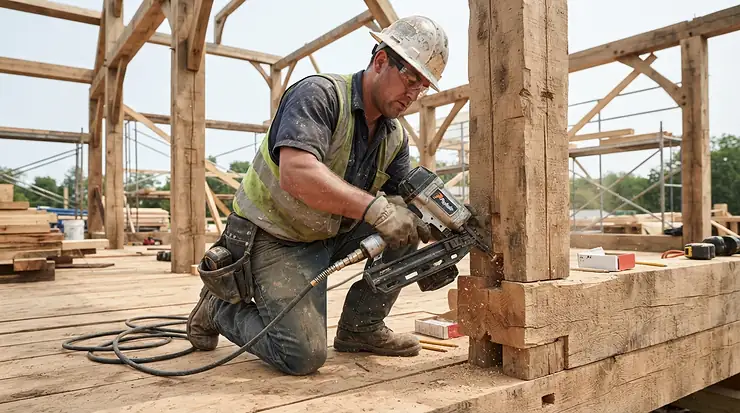
Picture a Saturday in May. Forty joists to fix, a stack of treated softwood on the lawn, and rain forecast for Sunday. Swinging a hammer for every 75mm nail means a few hundred blows before lunch and a forearm that feels like a wrung-out tea towel. A framing nailer for decking turns that slog into a rhythm of short, sharp thumps, and every nail lands at the same depth.
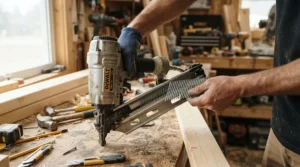
Here’s the twist most buying guides skip. There isn’t one kind of framing nailer for decking. You can run compressed air, a lithium battery with a gas cell, or a fully battery-driven mechanism. Each suits a different garden, budget and timber. Deck construction adds its own quirks: wet treated softwood, awkward angles, and nails that must survive British drizzle for decades. The best tool shifts with the job.
This guide compares seven real, UK-available models using published specifications and whatever reviewer feedback I could verify. It then turns those spec sheets into practical advice. You’ll also find a section on choosing a framing nailer for fence panels, a straight-talking look at weather-resistant fasteners, and a walk-through for outdoor timber projects of every size.
One honesty note up front: I haven’t hands-on tested these tools. Every verdict below is analysis, not a lab report. Prices are shown as ranges only, so check current price and availability before buying.
Quick Comparison: Framing Nailer for Decking Options at a Glance
Here’s the shortlist before we get into detail. All seven drive nails from roughly 50mm to 90mm, the sweet spot for joists, bearers, posts and fence rails.
| Product | Power type | Collation / nail range | Approx. price range | Best For |
|---|---|---|---|---|
| Senco S900FN | Pneumatic | 34°, up to 90mm | Under £200 | Occasional fencing and light frames |
| Senco FramePro 601 | Pneumatic | 34°, 50-90mm | £350-£400 | Regular deck frames with a compressor |
| Bostitch F33PTSM-E | Pneumatic | 33° paper tape, 50-90mm | £450-£550 | Tidy work near visible timber |
| DeWalt DCN692N | 18V brushless | 30-34°, 50-90mm | £300-£350 (body only) | Cordless value if you own XR batteries |
| HiKOKI NR1890DC | 18V air spring | Round head, 50-90mm | £500-£550 (kit) | Round-head nails, no gas |
| Milwaukee M18 FFN-502C | 18V brushless | 30/34°, 50-90mm | £500-£650 (kit) | Dense timber, heavy use |
| Paslode IM360Xi | Gas + lithium battery | 34° paper strip, 50-90mm | £500-£600 (kit) | Long fence runs, no compressor |
Read the table as a map of trade-offs. The Senco S900FN is the cheap way in, but you still need a compressor. The DeWalt DCN692N is the bargain only if you already own the batteries. The Milwaukee M18 FFN-502C and HiKOKI NR1890DC cost more up front but spare you hoses and gas cartridges. Choose the Paslode IM360Xi when portability matters more than running costs.
💬 Just one click — help others make better buying decisions too!😊
What Is a Framing Nailer for Decking?
A framing nailer for decking is a powered tool that drives long, thick nails, typically 50-90mm, into structural timber such as joists, bearers and posts. It is used on the deck’s hidden frame rather than the visible boards, replacing hand hammering with fast, consistent, depth-controlled fixing from compressed air, a battery or a gas cell.
That frame/boards split is worth remembering. Most deck boards are fixed with screws or clips, because boards need to be removable, and a nailer’s job is the skeleton underneath. The idea isn’t new, either: early air-powered nail guns arrived at the start of the 1950s, and Wikipedia’s nail gun entry gives a tidy history.
Framing nailers differ from finish and brad nailers, which fire slender nails for trim. They also differ in collation angle, the tilt of the nail strip. Common UK strips are 30-34° (clipped or offset round head, paper-collated), while some tools use 21° round-head plastic strips. The angles aren’t interchangeable, so check which nails your nearest merchant stocks before you commit to a tool.
Top 7 Framing Nailer for Decking Picks: Expert Analysis
Each model below follows the same pattern: what the specs mean in practice, who it suits, and what the published information doesn’t tell you. Where I couldn’t verify enough independent UK reviews to summarise honestly, I say so rather than inventing sentiment.
1. Senco S900FN — cheapest way into pneumatic framing
The Senco S900FN is for people fixing a garden’s worth of timber, not a housing estate’s.
It sits in Senco’s SemiPro range and fires 34° clipped-head nails up to 90mm from a rear-load magazine. You also get tool-free depth adjustment, an adjustable exhaust and a no-mar pad. In practice that means you can sink 75mm nails into joist-to-bearer junctions, and the exhaust keeps oily air out of your face. The trigger is restrictive (sequential only), which is slower than bump firing but forgiving for beginners.
Based on the spec comparison, this suits one-off builds such as a single deck, a run of fence panels or a shed base. Senco positions the range as light-duty, semi-professional and DIY, with a one-year warranty to match. Daily site abuse isn’t the brief.
I couldn’t find enough independent UK review data to summarise honestly, so treat this as a spec-based take, not a crowd verdict.
Pros:
- ✅ Lowest entry price of the seven
- ✅ Sequential-only trigger suits beginners
- ✅ No-mar pad and adjustable exhaust included
Cons:
- ❌ Needs a compressor and air hose
- ❌ One-year warranty, lighter-duty class
Expect it to sit under £200, before the compressor. That is strong value for an occasional builder.
2. Senco FramePro 601 — short magazine, excellent sightlines
The Senco FramePro 601 is the step up when you build more than one deck and want a tool that feels deliberate in the hand.
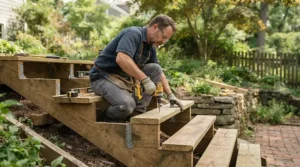
It drives clipped-head fasteners from 50 to 90mm in three diameters (2.9, 3.1 and 3.3mm), so you can match nail thickness to the timber. The short 34° in-line magazine gives a clearer view of the nose. A sawtooth safety digs in for toenailing, and the trigger is selectable between modes. Tool-free depth control, a soft grip and a carry case round out the kit.
What this means on a deck: toenailing joists at an angle is where cheap nailers skate and leave you with bent nails. A gripping nose helps, and the line of sight helps you place nails accurately in a crowded joist junction. Because the trigger is selectable, you can stay in sequential mode for control and switch to bump only when you’re confident.
Verified independent UK review data was thin, so no sentiment claims are made here.
Pros:
- ✅ Three nail diameters for different timbers
- ✅ Sawtooth safety helps grip when toenailing
- ✅ Short magazine improves visibility and manoeuvrability
Cons:
- ❌ Compressor and hose still required
- ❌ Costs far more than the S900FN for similar reach
Expect roughly £350-£400. It’s worth paying if you’ll build repeatedly, but overkill for a single weekend.
3. Bostitch F33PTSM-E — lightweight magnesium body, no-mar tip
The Bostitch F33PTSM-E is the one to look at when the nailer will be working near timber you’ll actually see.
It fires 33° paper-tape nails from 50-90mm (2.5-3.3mm diameter) at an operating pressure of 70-120 PSI (4.8-8.3 bar). The magnesium body brings the weight down to about 3.5kg, and there’s a dial-a-depth control, a no-mar tip and an adjustable exhaust. The listing also describes a CE-compliant sequential trip.
On paper, the lighter body helps in a long session. The no-mar tip reduces bruising where the nose meets visible timber, such as fascias, posts and handrail frames. The listing says its paper-tape nails are compatible with Paslode’s IM350 framer, which suggests a common strip format. Check before buying.
I couldn’t verify independent UK review sentiment for this model, so I’m not summarising any.
Pros:
- ✅ Magnesium body keeps weight around 3.5kg
- ✅ No-mar tip protects visible timber
- ✅ Sequential trip supports safer working
Cons:
- ❌ Compressor and hose required
- ❌ Expensive for a pneumatic nailer
Expect around £450-£550. You’re paying for weight and finish rather than raw power, so it suits tidy carpenters more than first-time builders.
4. DeWalt DCN692N — two-speed cordless, no gas needed
The DeWalt DCN692N is the sensible pick if you already own 18V XR batteries.
It’s a brushless 18V nailer with two power levels, firing 50-90mm nails at 30-34°. DeWalt quotes it driving a 90mm ring-shank nail into softwood and 63mm into hardwood. It has sequential and bump modes, a reversible belt hook and tool-free jam clearing. It’s rated for -20°C to 50°C, and one listing gives its weight as about 4.1kg.
Those spec lines matter. The 63mm hardwood figure tells you this isn’t the tool for dense oak frames, while the two speeds let you save battery and reduce recoil on shorter nails. Because it’s mechanical rather than gas, there are no fuel cells to buy or clean around.
One UK reviewer on ManoMano liked it for cladding and some framing, but found it gets tiring on the arms after a few hours and can’t reach into small spaces. They also pointed out that the bare unit has no battery, charger or nails.
Pros:
- ✅ Gas-free and hose-free cordless freedom
- ✅ Two-speed control for different nail lengths
- ✅ Works in cold conditions down to -20°C
Cons:
- ❌ Gets heavy on the arms over long sessions
- ❌ Body-only, so battery and charger cost extra
Expect roughly £300-£350 body only. That is excellent value inside the DeWalt ecosystem and poor value outside it.
5. HiKOKI NR1890DC — air-spring drive, round-head nails
The HiKOKI NR1890DC has the cleverest mechanism of the cordless set.
It uses HiKOKI’s air spring drive instead of gas, drives 50-90mm nails and is designed for round-head fasteners. The bare tool weighs 3.78kg, with a 50-nail magazine and up to 620 nails on a 5.0Ah battery. There’s a dry-fire lockout, an LED, tool-less depth adjustment and a built-in nail counter.
The nail counter is more useful than it sounds, because it tells you when to reload before a joist run is half-finished. The dry-fire lockout prevents wasted shots into empty timber. Round-head nails are often preferred where pull-through resistance matters, though you must confirm your merchant stocks the matching strip and collation angle before you buy.
I couldn’t verify enough independent UK review data to summarise honestly.
Pros:
- ✅ Gas-free air spring drive keeps running costs down
- ✅ Built-in nail counter and dry-fire lockout
- ✅ Light for a cordless tool at 3.78kg bare
Cons:
- ❌ Round-head strips may be harder to source
- ❌ Premium price for a kit
Expect around £500-£550 for a kit with batteries and charger. It’s good value if round-head nails are what you want.
6. Milwaukee M18 FFN-502C — sub-flush power in dense timber
The Milwaukee M18 FFN-502C is the cordless nailer to consider when the timber is stubborn.
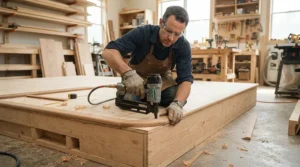
Milwaukee’s literature describes it as consistently seating nails sub-flush in hardwoods. It takes 30° or 34° strips of 50-90mm nails, fires up to 700 nails per 5.0Ah battery, and weighs about 5kg with a battery fitted. Ready to Fire technology removes the ramp-up delay between shots. There’s also a dry-fire lockout, sequential or bump firing, and an LED.
On a deck, the ramp-up point is subtle but real: a tool that fires the instant you pull the trigger feels more like pneumatic than most battery guns. The trade-off is weight. Decks are mostly below-the-waist work, so the heft matters less than it would on a roof, but it will still tire you over a full day.
Independent UK review data was too thin to summarise, so I’m making no sentiment claims.
Pros:
- ✅ Pneumatic-style response without a compressor
- ✅ Seats nails sub-flush in dense timber
- ✅ Kit includes two 5.0Ah batteries and a charger
Cons:
- ❌ Heaviest of the seven at around 5kg
- ❌ Highest kit price in the group
Expect around £500-£650 for the kit. It’s worth it if you’ll use it often or already run M18 batteries.
7. Paslode IM360Xi — no compressor, long-nail confidence
The Paslode IM360Xi is the classic answer to “I don’t want a hose snaking across the lawn”.
It’s a cordless gas framing nailer for 34° paper-strip nails from 50 to 90mm. The listing quotes a weight of 3.6kg, and highlights a quick-release magazine and a re-engineered grip. It runs on a lithium battery plus a gas fuel cell, and the kit includes battery and charger.
In practice, that makes it the lightest of the cordless group and a natural fit for long fence lines and gardens with no outdoor power. The catch is consumables: fuel cells and Paslode-compatible nails are a running cost. Paslode’s earlier IM360Ci was quoted as working down to around -15°C, though you should check the current specification for your model.
I couldn’t find enough verified UK review sentiment to summarise.
Pros:
- ✅ Lightest cordless option at 3.6kg
- ✅ No compressor, hose or mains power needed
- ✅ Quick-release magazine for clearing jams
Cons:
- ❌ Fuel cells add a continuing cost
- ❌ Gas performance can dip in very cold weather
Expect around £500-£600 for a kit. It’s good value for fence runs and bad value for a single small deck.
How to Choose a Framing Nailer for Decking
Choosing well comes down to six decisions. Work through them in order and the shortlist shrinks fast.
- Match the power source to how often you build. Pneumatic tools are the cheapest per shot, but only if you already own a compressor. Cordless and gas tools cost more up front and save setup time.
- Check collation angle and nail availability. A 21° tool can’t fire 34° strips. Before you buy, confirm your local merchant stocks the matching nails in galvanised or stainless.
- Match nail length to the timber. Most deck framing sits in the 63-90mm band. Tools that cap hardwood penetration (like the DeWalt DCN692N at 63mm) need extra thought.
- Weigh weight against duration. A 3.5kg tool and a 5kg tool feel similar for ten minutes and very different after two hours.
- Prefer sequential firing. Sequential mode is slower but significantly safer, especially if you’re new. See the safety section below.
- Budget for the whole system. Add the compressor and hose, extra batteries, fuel cells and nails to the sticker price.
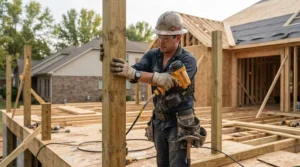
Framing Nailer for Fence Panels: What Changes on a Fence Line
Fences ask different things of a tool. A framing nailer for fence panels is mostly fixing rails to posts and panels to rails, often across a long boundary and often in rough ground. Power points rarely exist out there, which pushes many people toward cordless or gas tools such as the Paslode IM360Xi or the HiKOKI NR1890DC.
Thin rails split easily, so test depth on an offcut first. Aim nails slightly away from the end grain, and set the depth so heads sit flush without crushing the surface. For a framing nailer for fence panels, the nose design matters more than raw power, so look for a grippy tip and a depth dial that’s easy to use with gloves on.
A pneumatic tool such as the Senco S900FN works well for panels near the house, where an extension to the compressor is practical. For long runs, a hose becomes a nuisance and a tripping hazard.
Also check the rules before you build. As Planning Portal’s fence guidance explains, fences generally need no planning permission up to two metres, or one metre beside a highway used by vehicles. Article 4 directions and planning conditions can change that, so check with your local planning authority.
Weather-Resistant Fasteners: Choosing Nails That Outlast the Timber
Your nailer is only as good as the nails you feed it, and this is where many outdoor timber projects quietly fail. Weather-resistant fasteners aren’t an upgrade; they’re a requirement. Bright steel nails in outdoor timber rust within seasons, leaving streaks and weak joints.
For outdoor use, the usual choices are hot-dip galvanised and stainless steel. Hot-dip galvanised is the workhorse for most decks and fences. Stainless is worth the extra cost in coastal gardens, or where copper-based preservatives are used on treated timber, because those chemicals accelerate corrosion of zinc coatings.
The science is worth a glance. A USDA Forest Service study exposed steel and hot-dip galvanised fasteners to wood treated with six preservatives at high humidity for a year to measure corrosion rates. The takeaway for builders is simple: the combination of timber treatment, moisture and metal matters, not any one factor alone.
Practical rules for weather-resistant fasteners:
- Don’t mix metals. Stainless nails in galvanised connectors, or the reverse, can cause galvanic corrosion.
- Reseal cut ends. Treated timber you’ve cut or drilled has exposed, untreated wood.
- Choose ring shanks. They resist pull-out better than smooth shanks in timber that swells and shrinks.
- Check availability first. Collated stainless strips are less widely stocked than galvanised, and your nailer’s angle limits what you can buy.
If you take one thing from this section: match your weather-resistant fasteners to your timber treatment, then pick the nailer that can fire them.
Deck Construction With a Framing Nailer: A Practical Step-by-Step Guide
Most deck construction fails at the setting-out stage, not the nailing stage. Get the frame square and level, and the nailer just makes the work faster. First, check the rules. As Planning Portal explains, decking is generally permitted development if it’s no more than 30cm above the ground and the combined outbuildings and platforms cover no more than 50 per cent of the garden. Always confirm with your local authority.
A sensible sequence:
- Set out and level the bearers. Check diagonals for square before a single nail goes in.
- Test depth on an offcut. Adjust the depth wheel until heads sit just below the surface without tearing the wood.
- Fix joists to bearers. Many builders start with two nails per joist end and toenail at roughly 45°. Follow your design drawings and the joist hanger manufacturer’s instructions.
- Space joists correctly. Spacing commonly sits around 400mm centres, but check your board manufacturer’s guidance.
- Hand over to screws for boards. Most deck boards are screwed or clipped, so your nailer’s job ends at the frame.
Maintenance schedule: wipe down and lubricate after each session, empty batteries or fuel cells before storage, and drain compressor tanks. Common mistakes in the first 30 days include over-driven nails, firing into metal fixings, and forgetting to switch trigger modes.
Outdoor Timber Projects: Three Real-World Scenarios
These are illustrative profiles, not case studies, matched to the products above with reasoning.
Scenario 1: The weekend deck builder. A homeowner is building a modest 3m x 4m deck on a budget, once. They have no compressor. If they already own DeWalt XR batteries, the DeWalt DCN692N body-only is the lowest-cost route. If they don’t, borrowing or hiring is wiser than buying a premium tool for one job.
Scenario 2: The long-fence landowner. A 20m boundary at the edge of a field, no power, one heavy weekend. A tool without a hose is the sensible choice, so the Paslode IM360Xi or HiKOKI NR1890DC fits. The Paslode IM360Xi wins on weight; the HiKOKI NR1890DC wins on avoiding gas cartridges.
Scenario 3: The small landscaping business. Frequent outdoor timber projects (pergolas, raised beds, gates, decks) several times a week. Here the Milwaukee M18 FFN-502C earns its price through repeat use and dense timber performance. A shop with a compressor might prefer the Senco FramePro 601.

Fixing Common Problems: From Proud Nails to Split Rails
Five problems account for most frustration with any framing nailer for decking.
- Nails sitting proud. Turn the depth wheel up, check air pressure (on pneumatic tools) or battery charge, and make sure your nail length suits the timber.
- Split rails or boards. Move the nail away from the end grain, reduce power if the tool allows it, and choose a thinner nail diameter where possible.
- Constant jams. Mismatched collation or damp strips are the usual culprits. Use the correct nails and keep them dry.
- Cordless tools struggling in dense timber. Switch to a higher power mode, use a shorter nail, or step up to a stronger tool such as the Milwaukee M18 FFN-502C.
- Rust streaks. This is almost always the wrong fastener. Switch to weather-resistant fasteners such as hot-dip galvanised or stainless.
Pneumatic vs Cordless vs Gas: Which Framing Nailer for Decking Wins?
No single power source wins everywhere. Pneumatic tools offer the best power-for-the-money and low running costs, but you carry a compressor and trail a hose. Battery-only tools remove all of that and cost more. Gas tools sit in between on weight but add consumables.
| Power type | Upfront cost | Running costs | Portability | Best For |
|---|---|---|---|---|
| Pneumatic | Lowest tool cost, plus compressor | Lowest | Hose-limited | Senco S900FN, Senco FramePro 601, Bostitch F33PTSM-E |
| Battery (brushless / air spring) | Higher | Battery wear only | Excellent | DeWalt DCN692N, HiKOKI NR1890DC, Milwaukee M18 FFN-502C |
| Gas + battery | Higher | Fuel cells | Excellent | Paslode IM360Xi |
Looking at the comparison above, pneumatic tools make sense if you already own a compressor or build often at one site. Battery tools win on convenience, and the DeWalt DCN692N is the budget entry. Gas, in the form of the Paslode IM360Xi, suits people who value light weight and are happy to buy fuel cells.
Long-Term Cost and Maintenance for Outdoor Timber Projects
Sticker price is only the start. A pneumatic setup needs a compressor and hose, which can add a meaningful sum depending on tank size. Battery tools need spare batteries if you work for hours. Gas tools need fuel cells.
| System | Typical starting cost | Ongoing cost | Value verdict |
|---|---|---|---|
| Senco S900FN + compressor | Low-mid | Nails only | Best for occasional builders |
| DeWalt DCN692N (body only) | Low if you own batteries | Nails only | Best if you’re in the ecosystem |
| Milwaukee M18 FFN-502C kit | High | Nails only | Best for frequent use |
| Paslode IM360Xi kit | High | Nails + fuel cells | Best for off-grid fence work |
The table shows why “cheapest tool” and “cheapest system” differ. The Senco S900FN looks inexpensive until you add a compressor, while the DeWalt DCN692N looks pricey for a newcomer but cheap for an existing DeWalt owner. Over several projects, the Milwaukee M18 FFN-502C spreads its cost, whereas the Paslode IM360Xi keeps charging you per fuel cell.
Maintenance matters too. Clean tools after use, lubricate pneumatic tools as the manufacturer advises, and store batteries partly charged and dry. A tool that is looked after will outlast a neglected one by years.
Safety, Regulations and Compliance for Garden Builders
A framing nailer for decking can drive a 90mm nail through timber and into whatever sits behind it, so treat it with respect. Sequential trigger mode, where the nose must touch the work before the trigger fires, is the safest setting. Wear safety glasses with side shields and hearing protection. Disconnect air or remove the battery before clearing jams. Keep your free hand out of the line of fire.
For deck construction and fence work, remember the planning rules covered earlier: decking generally under 30cm above ground, and fences up to two metres (one metre next to a highway). Local conditions, such as conservation areas, can change those limits.
On tool compliance, look for UKCA or CE marking and a declaration of conformity from the supplier. The Bostitch F33PTSM-E listing, for example, mentions a CE-compliant sequential trip. Finally, wear gloves and a dust mask when cutting treated timber, and clean up sawdust properly.
FAQ
❓ Can I use a framing nailer for decking boards?
❓ What nail length suits a framing nailer for decking frames?
❓ Is a cordless framing nailer for decking worth it over pneumatic?
❓ Can a framing nailer for fence panels drive nails into hardwood posts?
❓ Do weather-resistant fasteners cost much more than standard nails?
Conclusion
Choosing a framing nailer for decking is less about finding “the best” and more about matching the tool to your situation. For a one-off build with a compressor to hand, the Senco S900FN is the budget route. For repeated deck construction, the Senco FramePro 601 offers a more refined pneumatic option, and the Bostitch F33PTSM-E suits tidy work near visible timber.
If you’d rather ditch the hose, the DeWalt DCN692N is the sensible pick for existing DeWalt owners, the HiKOKI NR1890DC suits round-head nail users, and the Milwaukee M18 FFN-502C is the heavy-duty choice. For long fence lines with no power, the Paslode IM360Xi is the lightest cordless answer.
Whichever you choose, pair it with weather-resistant fasteners, follow the planning rules, and stay in sequential mode until you’re confident. A good framing nailer for fence panels or decks pays you back in hours saved and joints that hold.
✨ Ready to build something that lasts?
🔍 Click any highlighted product name to check current pricing and availability, then pick the framing nailer for decking that fits your garden, your timber and your budget. Happy building! 🔨
Recommended for You
- Cordless Framing Nailer: 7 Best Proven Picks For UK Sites (2026)
- Brad Nailer Vs Finish Nailer: 7 Proven UK Picks (2026)
- Brad Nailer For Beading: 7 Proven Picks For UK DIY (2026)
Disclaimer: This article contains affiliate links. As an Amazon Associate, I earn from qualifying purchases. If you purchase products through these links, we may earn a small commission at no additional cost to you.
✨ Found this helpful? Share it with your friends! 💬🤗
