In This Article
Brad nailer vs finish nailer comes down to nail thickness. A brad nailer fires thin 18 gauge nails (about 1.25mm) that leave tiny holes and suit light fixing. A finish nailer fires thicker 16 or 15 gauge nails (roughly 1.6–1.8mm) that grip harder in skirting boards, architraves and heavier mouldings. Choose by the job, not the logo.
That sounds tidy. It isn’t, quite. UK trade counters blur the labels: one major merchant lists the Paslode IM65A as an “angled brad nailer” even though it fires 16 gauge nails. So the brad nailer vs finish nailer question is partly a vocabulary problem, and partly a physics one.
The physics is easy to state. Bob Vila’s nailer guide puts an 18 gauge brad at about 0.0475 inches and a 16 gauge finish nail at 0.0625 inches. That is roughly a third thicker, and it explains almost everything that follows: hole size, splitting risk and nail gauge and hold strength.
This guide covers seven real nailers across budget, mid-range and premium. It also tackles the three jobs readers ask about most: delicate trim work, a brad nailer for furniture making, and a brad nailer for picture framing. The analysis rests on published specifications and review data, not hands-on testing. Where reliable review data doesn’t exist, the article says so.
Quick Comparison: Brad Nailer vs Finish Nailer at a Glance
| Feature | Brad nailer | Finish nailer |
|---|---|---|
| Typical gauge | 18 (about 1.25mm) | 16 or 15 (about 1.6–1.8mm) |
| Typical UK nail length | 15–54mm | 25–64mm |
| Hole left behind | Tiny; often hidden under paint | Larger; usually needs filling |
| Hold strength | Light; relies on glue for structure | Strong; holds heavier trim alone |
| Best for | Makita AF506, DeWalt DCN680, Milwaukee M18 FN18GS | DeWalt DCN660, Paslode IM65A, HiKOKI NT1865DSA |
Read the table as a trade-off, not a league table. The Makita AF506 and DeWalt DCN680 give up some holding power in exchange for tiny holes, which suits delicate trim work and glued furniture joints. The DeWalt DCN660 and Paslode IM65A accept bigger holes because skirting and architraves need nail gauge and hold strength more than invisibility. Most owners who do both jobs end up with one of each.
💬 Just one click — help others make better buying decisions too!😊
Top 7 Brad Nailer vs Finish Nailer Picks: Expert Analysis
These seven span power sources (battery, gas, compressed air) and both camps of the brad nailer vs finish nailer divide. Prices are ranges at the time of research and may vary, so check current price and availability on amazon.co.uk before buying.
1. Einhell TE-CN 18 Li — among the cheapest ways to go cordless
This is a nailer and stapler in one body, running on Einhell’s Power X-Change 18V batteries, which is handy if you already own the garden tools.
It fires 18 gauge nails from 15mm to 32mm at up to 20 shots a minute through a geared mechanism. It weighs about 2.1kg. That 32mm ceiling means thin beading, craft projects and small frames, not skirting boards.
Based on the spec sheet, this is a light-repair and hobby tool rather than a daily workhorse. The geared mechanism is slower than the flywheel and pneumatic rivals below, which matters most in hardwood. The short nail range does suit a brad nailer for picture framing on narrow mouldings.
Verified review data is thin. The one detailed retailer review found during research calls it a cheap trim nailer, but notes the last couple of millimetres sometimes need a tap with a hammer. The same retailer shows an overall four-star rating.
Pros:
- ✅ Nailer and stapler combined in one body
- ✅ Shares Einhell Power X-Change batteries
- ✅ Light at roughly 2.1kg
Cons:
- ❌ 32mm maximum nail length limits its uses
- ❌ Reports of nails needing a final tap
Price: from around £80, rising with a battery kit; check current price. Verdict: sensible for occasional tinkering, not for daily use.

2. Makita AF506 — slim nose, featherweight pneumatic value
The slim nose is the headline. It lets you see exactly where the brad will land, which is half the battle in delicate trim work.
It drives 18 gauge nails from 15mm to 50mm at 70–120 psi (4.9–8.3 bar) from a 100-nail magazine. At about 1.3kg it is more than a kilo lighter than the cordless options here. Tool-less depth adjustment, quick-release jam clearing and a built-in air duster round out the spec.
Light weight is the real benefit. Overhead cornice, picture rail and long glue-up sessions are far less tiring. The catch is the compressor and hose: the nailer is cheap, the air supply isn’t. If you already own a compressor, this is arguably the best brad nailer for furniture making on a budget.
No consistent UK review pool could be verified across the retailer listings consulted. Read the verified-purchase comments on the amazon.co.uk listing rather than trusting a headline star rating.
Pros:
- ✅ Lightest in this round-up at about 1.3kg
- ✅ Slim nose for precise placement
- ✅ Tool-less depth and jam clearing
Cons:
- ❌ Needs a compressor and air line
- ❌ Straight 18 gauge only, so no heavy trim
Price: around £85–£115 range. Verdict: the value pick if you own air already.
3. DeWalt DCN680 — best all-round cordless 18 gauge
This is a brushless 18V XR brad nailer with no gas, compressor or hose.
It fires 18 gauge (1.25mm) nails from 15mm to 54mm from a 110-nail magazine. It offers sequential and bump modes (up to four nails a second) and a thumb-wheel depth dial. Listings quote 2.4–2.6kg and an operating range of −20°C to 50°C. That range matters in an unheated garage in January, when gas-powered tools sulk.
If you already own DeWalt 18V XR batteries, the bare unit makes sense. Use sequential mode for delicate trim work and bump mode for repetitive carcass backs. The compromise is weight: fine for trim, noticeable at ceiling height.
A trustworthy aggregate rating couldn’t be verified from UK retailer pages. Bob Vila’s 2026 roundup names the US-market sibling its best cordless brad nailer, but check the amazon.co.uk listing for UK buyer feedback.
Pros:
- ✅ Pneumatic-style pace without the hose
- ✅ Works from −20°C to 50°C
- ✅ Tool-free jam and stall clearing
Cons:
- ❌ Heavier than pneumatic alternatives
- ❌ Bare unit means buying batteries separately
Price: roughly £290–£450 for the bare unit; kits cost more. Verdict: the sensible default for most cordless buyers.
4. Milwaukee M18 FN18GS — sub-flush seating in hardwoods
Its “Ready to Fire” drive removes the ramp-up lag between nails, which helps keep thin mouldings from wandering.
It fires 18 gauge straight nails (listings quote 16–54mm) from a 110-nail magazine. Milwaukee claims up to 1,200 nails per 2.0Ah battery. It has interchangeable noses stored on the tool, a small contact bracket for shallow-angle nailing, and a dry-fire lockout.
On paper, the pitch is brads that sink cleanly below the surface in oak or beech. That leaves room for filler and is exactly what a brad nailer for furniture making wants. The small contact bracket also suits narrow delicate trim work. Weight wasn’t consistently listed, so check the specification before buying.
Nine reviews at one UK tool store average five stars, with brief comments about it being heavy-duty and working as expected. That is pleasant but thin evidence.
Pros:
- ✅ Seats brads sub-flush in hardwoods
- ✅ Interchangeable noses stored on board
- ✅ Dry-fire lockout protects the workpiece
Cons:
- ❌ Premium pricing for a brad nailer
- ❌ Nail range tops out around 54mm
Price: a consistent UK price couldn’t be verified; expect the premium end, and check current price. Verdict: worth it if you work mostly in hardwood.
5. DeWalt DCN660 — cordless 16 gauge for skirting and architraves
This is a brushless 18V XR finish nailer. Retailer copy says it drives a 63mm nail into softwood and a 50mm nail into hardwood.
It fires 16 gauge (1.6mm) nails from 32mm to 63mm from a 110-nail magazine angled at 20°. DeWalt’s service page lists 48J of impact energy. Weight varies by listing from about 2.4kg to 2.7kg. Sequential and bump modes plus LED fault lights are included.
The angled magazine tucks into corners that straight guns can’t reach. Choosing this over the DeWalt DCN680 trades tiny holes for real grip, and skirting and architraves rarely need less. In the nail gauge and hold strength debate, this is the “hold” side.
No verified aggregate review score was found. Retailer copy claims it is lighter and quieter than its predecessor, but those are manufacturer claims, not independent findings.
Pros:
- ✅ Strong hold for skirting and architraves
- ✅ Angled magazine reaches into corners
- ✅ No gas cartridges to buy
Cons:
- ❌ Larger holes need filling
- ❌ Bare-unit price climbs with batteries
Price: roughly £240–£420 for the bare unit; kits cost more. Verdict: the cordless finish nailer for second-fix regulars.
6. Paslode IM65A — the trade second-fix classic
This is a gas-and-battery impulse system with a no-mar tip and last-nail lockout.
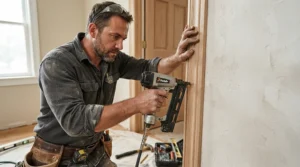
It fires 16 gauge angled nails from 32mm to 64mm with 30 joules of drive power. Paslode quotes up to 10,000 shots per battery charge, and listings suggest fuel cells last roughly 1,000–2,000 shots (they differ, so check the manual). Its applications list covers architraves, skirting, tongue-and-groove panelling, door stops and stair rails.
There’s no hose and no compressor, but fuel cells are a recurring cost. It earns its keep if second-fix is weekly work and is overkill for a one-off wardrobe.
One marketplace listing shows a 4.9 average from 57 ratings, 52 of them five-star. Reviewers describe it as easy to use and trouble-free from the first day. That is a single listing, so treat it as indicative only.
Pros:
- ✅ Proven trade pedigree for second-fix work
- ✅ Fast-charging lithium battery
- ✅ No-mar tip and last-nail lockout
Cons:
- ❌ Ongoing fuel cell costs
- ❌ Premium upfront price
Price: roughly £430–£580 range for a complete kit with battery, charger and case. Verdict: a professional-grade purchase for professional-volume work.
7. HiKOKI NT1865DSA — pneumatic feel without the compressor
An air-spring drive compresses air rather than spinning a flywheel, giving a smooth, pneumatic-like feel.
It fires 16 gauge straight nails (0° collation) from 25mm to 64mm from a 100-nail magazine at about three nails a second. Selectable sequential or contact firing is included, with an LED for dark corners. It weighs 3.0kg with a battery.
Straight collation suits face frames and beading. The 25mm minimum also handles thinner stock than the 32mm floor of the DeWalt DCN660. The price is weight: 3.0kg is the heaviest figure in this round-up.
No review pool was verified, though UK retailers list both bare and kit versions in stock.
Pros:
- ✅ Air-spring drive for a smooth feel
- ✅ 25mm minimum suits thinner stock
- ✅ LED lighting for dark corners
Cons:
- ❌ Heaviest in this round-up at 3.0kg
- ❌ Pricey for hobby use
Price: around £350–£420 bare; £450–£540 with two 2.0Ah batteries. Verdict: a premium straight finisher for joiners and fitters.
Spec Comparison: How the Seven Nailers Stack Up
| Nailer | Power and gauge | Nail length | Weight | Price range | Review signal | Best for |
|---|---|---|---|---|---|---|
| Einhell TE-CN 18 Li | Battery, 18 | 15–32mm | About 2.1kg | From around £80 | One detailed review; four stars | Small frames, craft |
| Makita AF506 | Air, 18 | 15–50mm | About 1.3kg | £85–£115 | Not verified | Furniture on a budget |
| DeWalt DCN680 | Battery, 18 | 15–54mm | 2.4–2.6kg | £290–£450 bare | Not verified | All-round cordless |
| Milwaukee M18 FN18GS | Battery, 18 | 16–54mm | Check spec | Premium; check price | Nine store reviews, positive | Hardwood furniture |
| DeWalt DCN660 | Battery, 16 | 32–63mm | 2.4–2.7kg | £240–£420 bare | Not verified | Skirting, architraves |
| Paslode IM65A | Gas and battery, 16 | 32–64mm | Check spec | £430–£580 kit | 4.9 from 57 ratings | Daily second-fix |
| HiKOKI NT1865DSA | Battery, 16 | 25–64mm | 3.0kg with battery | £350–£420 bare | Not verified | Straight finishing |
Two patterns stand out. Brad nailers cluster at the lighter, cheaper end, with the Makita AF506 the obvious value play and the Milwaukee M18 FN18GS the hardwood specialist. Finish nailers cost more and weigh more because they push a thicker nail, and the Paslode IM65A only pays back its price through volume. Note how few verified review signals exist: for most of these tools, spec-based reasoning is the best evidence available.

Brad Nailer vs Finish Nailer Setup Guide: Your First 30 Days
A new nailer rewards ten minutes of setup. Skip it and you’ll be filling holes by the weekend.
Week one: calibrate on offcuts. Match the nails to the gun first, since gauge, length and collation angle must all agree with the manual. Then set the depth dial on scrap of the same material. For a pneumatic model like the Makita AF506, start near the lower end of its 70–120 psi window and raise pressure only until nails sit flush. For a cordless DeWalt DCN680 or DeWalt DCN660, use sequential mode while you learn.
Weeks two to four: build habits. Pneumatic tools want a few drops of oil as the manual specifies and a drained compressor tank. Gas models like the Paslode IM65A need periodic cleaning and fuel cells. Battery models need little beyond keeping the nose clear.
Safety is not optional. HSE’s guidance on nail guns warns that built-in safety features can be defeated, accidentally or deliberately, and that eye protection would have prevented most nail gun eye injuries. Never modify the tool, and keep fingers and your other hand out of the nail’s path.
Common first-month mistakes:
- Nailing near the end of a board without pre-drilling
- Using bump mode too early
- Mixing nail brands without checking collation
- Skipping depth tests when switching timber
Real-World Scenarios: Matching the Nailer to the Job
Here are three illustrative profiles to show the reasoning, not real customers.
If you’re a weekend furniture maker building birch ply carcasses once or twice a month with a budget around £150 and a compressor in the garage, the Makita AF506 with glue is the logical fit. Glue provides the strength while brads simply clamp the joint, which is how a brad nailer for furniture making should be used.
If you’re a self-employed joiner fitting skirting and architraves most weeks across renovations, pick a finish nailer. The Paslode IM65A suits long days and a gas habit. The DeWalt DCN660 suits you if you already own XR batteries. Frequency of use justifies the higher cost either way.
If you’re a hobby framer making a couple of dozen frames a year from narrow oak mouldings, the Einhell TE-CN 18 Li handles small brads for little outlay. Pair it with careful glue-ups, since picture frame joinery depends on the glue line, not the brad. If framing becomes a business, an underpinner is the better investment.
Rule of thumb: if the job is visible and delicate, go 18 gauge. If the job holds weight or must survive years of door slams, go 16.
How to Choose Between a Brad Nailer vs Finish Nailer
- Check material thickness. Thin mouldings and ply panels favour 18 gauge, because a thicker nail splits fragile edges.
- Decide what the hole must look like. If it will be painted and filled anyway, 16 gauge is fine. If it must vanish, choose a brad nailer.
- Weigh nail gauge and hold strength. Heavier or load-bearing trim needs the thicker nail. Glued joints can get away with brads.
- Choose the power source. Pneumatic is lightest and cheapest if you own air. Battery suits one-off jobs. Gas suits daily second-fix.
- Pick straight or angled. Angled magazines reach corners. Straight ones suit face frames and furniture.
- Check the nail-length range. A 32mm floor rules out small frames, while a 54mm ceiling rules out thick skirting through plaster.
- Budget for consumables. Nails, fuel cells and batteries add up over a project.
Nail Gauge and Hold Strength: What the Numbers Really Mean
Gauge numbering runs backwards: the higher the number, the thinner the nail. Nail gauge and hold strength are therefore inversely related. An 18 gauge brad slips in easily but grips lightly, while a 16 gauge finish nail resists pull-out far better.
HGTV’s comparison notes that 16 gauge nails cost nearly double their 18 gauge cousins per thousand. That’s a useful reality check: finish nails buy extra grip, but at a price per nail as well as a larger hole.
Length matters as much as thickness when you think about nail gauge and hold strength. A retailer rule of thumb is to choose a nail about two and a half times the thickness of the material you’re fixing. A longer brad can out-hold a short finish nail.
Glue changes everything. In glued joints the brad’s job is clamping, not carrying load, so the practical question about nail gauge and hold strength becomes “how long until the glue sets?” Use the Makita AF506 or DeWalt DCN680 for that. Where there’s no glue, as with skirting nailed into timber, the DeWalt DCN660 and Paslode IM65A earn their weight.
Brad Nailer for Furniture Making: Where 18 Gauge Shines
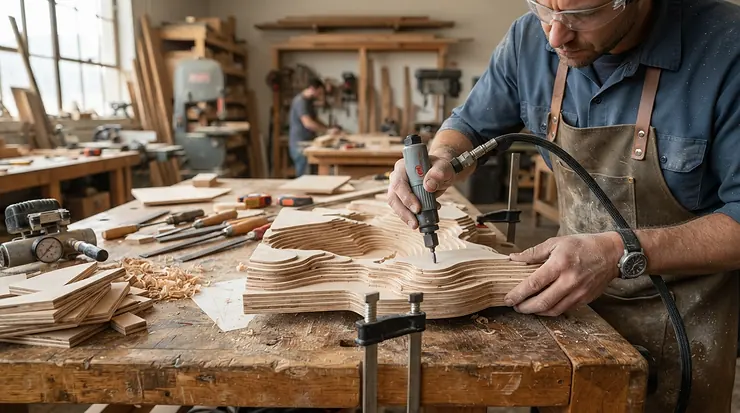
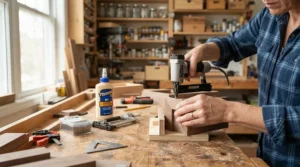
A brad nailer for furniture making is a clamp with a trigger. Glue the joint, fire two or three brads to hold it, and move on while the glue cures. That workflow speeds up carcasses, drawer boxes and face frames dramatically.
Where does it fit? Cabinet backs, drawer bottoms, thin edge strips and trim all suit brads. Where doesn’t it? Chair joints, shelf brackets and anything bearing weight need proper joinery, such as dowels, screws or mortices. Using a brad nailer for furniture making as the only fastener on a load-bearing joint is a recipe for wobble.
Hardwood demands more power. The Milwaukee M18 FN18GS is built to seat brads sub-flush in oak and beech, which leaves room for filler. The Makita AF506 is lighter and cheaper but needs air, and the DeWalt DCN680 covers the cordless middle ground.
Pre-drill near board ends and test every species on offcuts. Fine-grained hardwoods can deflect a nail or split.
Brad Nailer for Picture Framing and Picture Frame Joinery
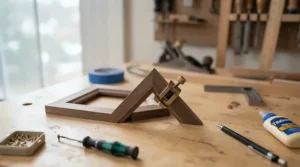
Professionals rarely use a brad nailer for picture framing as the main joint. Specialist suppliers describe an underpinner firing V-nails upward into the mitre, with V-nail height around three-quarters of the moulding height. For picture frame joinery at scale, that is the standard tool.
So why consider a brad nailer for picture framing at all? Because most hobbyists don’t own an underpinner. Narrow frames can be glued, clamped and then reinforced with a small brad. The Einhell TE-CN 18 Li, Makita AF506 and DeWalt DCN680 all accept 15mm brads, which suits shallow mouldings.
Glue discipline decides success. End grain absorbs glue and starves the joint, so woodworkers advise sizing the mitre with diluted PVA first and then applying full-strength glue. Band or corner clamps hold the frame square while it cures.
For very thin mouldings, a 23 gauge pin nailer leaves almost no mark and is often better than an 18 gauge brad. For thicker frames, an 18 gauge brad nailer for picture framing holds more. Side-nailing hardwood mitres can open the joint, so pre-drill or use a brad no larger than the pilot hole.
A finish nailer is too blunt for picture frame joinery and risks splitting. Reserve it for deep box frames nailed from the back.
Delicate Trim Work: Why 18 Gauge Usually Wins (And When It Doesn’t)
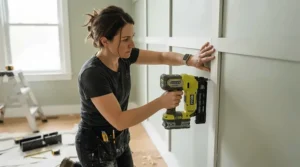
Delicate trim work, such as beading, quarter round, shoe moulding and slim architraves, punishes thick nails. A 16 gauge shank can split a narrow moulding right along the grain. An 18 gauge brad slips through and leaves a hole smaller than a pencil dot.
That is why the Makita AF506 and Milwaukee M18 FN18GS are natural picks for delicate trim work. The Makita AF506‘s slim nose lets you see the target, and the Milwaukee M18 FN18GS‘s small contact bracket helps on narrow stock.
But beware the limit. Skirting boards and door linings need grip, and brads can pull out as timber moves. For those, switch to a 16 gauge such as the DeWalt DCN660 or HiKOKI NT1865DSA.
The pragmatic answer for many fitters is a two-tool kit. Use 18 gauge for delicate trim work and decorative mouldings, and 16 gauge for architraves and anything structural. If you can only buy one, the brad nailer vs finish nailer choice depends on whether your trim is more fragile or more heavy.
Brad Nailer vs Finish Nailer vs Alternatives: Cost and Long-Term Value
| Method | Finish | Hold | Speed | Best for |
|---|---|---|---|---|
| Hammer and panel pins | Variable; risk of dents | Light | Slow | Occasional repairs |
| Brad nailer | Tiny holes | Light, glue-assisted | Fast | Makita AF506, DeWalt DCN680 |
| Finish nailer | Larger holes, fill needed | Strong | Fast | DeWalt DCN660, Paslode IM65A |
| Glue and clamps only | Cleanest | Strong when cured | Slow | Picture frame joinery, fine furniture |
Hand tools win on cost and finish, but not on speed. A brad nailer or finish nailer wins on throughput, and glue plus clamps wins when appearance matters most. For picture frame joinery in particular, glue still does the heavy lifting.
Total cost of ownership differs by power source. Pneumatic needs a compressor and hose, but the tool is cheap and light. Battery models cost more upfront but share batteries with other tools. Gas models like the Paslode IM65A add fuel cells as a running cost. Nails matter too, since 16 gauge costs more per thousand than 18 gauge.
For occasional use, the Makita AF506 or Einhell TE-CN 18 Li minimise outlay. For regular use, the extra spent on the DeWalt DCN680 or Paslode IM65A is repaid in time saved.
Safety, Regulations and Buying Safely in the UK
Power tools sold in Great Britain should carry UKCA or CE marking and meet the Supply of Machinery (Safety) Regulations 2008. This isn’t paperwork for its own sake. An OPSS report on gov.uk describes a pneumatic push-out nail gun sold through an online marketplace that lacked any mechanism to prevent unintentional operation, and its import was rejected at the border. Browse the OPSS product recalls and alerts page before buying unfamiliar brands.
Practical safeguards are straightforward. Buy from reputable listings, check the manual covers your gauge and nail range, and avoid no-name tools with vague specifications. Established models such as the Makita AF506, which meets EN ISO 11148-13, and the DeWalt DCN680 come with documented specifications and UK warranty routes.
Wear eye protection every time. Add hearing protection for pneumatic work, because the Makita AF506 is rated at 109 dB(A) sound power. Keep both hands clear of the nail path and never defeat the safety contact tip. Choosing sequential mode, as on the DeWalt DCN660, reduces accidental firing while you learn.
Frequently Asked Questions
❓ Can a brad nailer for furniture making handle load-bearing joints?
❓ Is a cordless brad nailer worth it over pneumatic for occasional DIY?
❓ Which is better for small frames: a brad or pin nailer?
❓ Can I use 15 gauge nails in a 16 gauge finish nailer?
❓ Do cordless finish nailers need servicing like gas ones?
Conclusion
The brad nailer vs finish nailer decision isn’t about which tool is better. It is about which compromise you can live with. Brads give you tiny holes and gentle handling, while finish nails give you grip. Nail gauge and hold strength pull against each other, and your job decides the winner.
For delicate trim work, glued furniture and small frames, an 18 gauge model is the natural fit. The Makita AF506 is the value pick if you own a compressor, the DeWalt DCN680 is the cordless default, and the Milwaukee M18 FN18GS suits hardwood. A brad nailer for furniture making and a brad nailer for picture framing both follow the same logic: glue provides the strength and brads provide the clamp, with picture frame joinery leaning hardest on that glue line.
For skirting, architraves and stair rails, move up to 16 gauge. The DeWalt DCN660 is the battery route, the Paslode IM65A the daily-driver gas route, and the HiKOKI NT1865DSA the straight-collation option. The Einhell TE-CN 18 Li is a budget stopgap for light fixing.
Whatever you choose, check current price and availability, and wear eye protection.
Recommended for You
- Brad Nailer For Beading: 7 Proven Picks For UK DIY (2026)
- Cordless Brad Nailer: 7 Best Proven Picks For UK Hobbyists (2026)
- Second Fix Nailer Vs Brad Nailer: 7 Proven Picks (2026)
Disclaimer: This article contains affiliate links. As an Amazon Associate, I earn from qualifying purchases. If you purchase products through these links, we may earn a small commission at no additional cost to you.
✨ Found this helpful? Share it with your friends! 💬🤗
