
In This Article
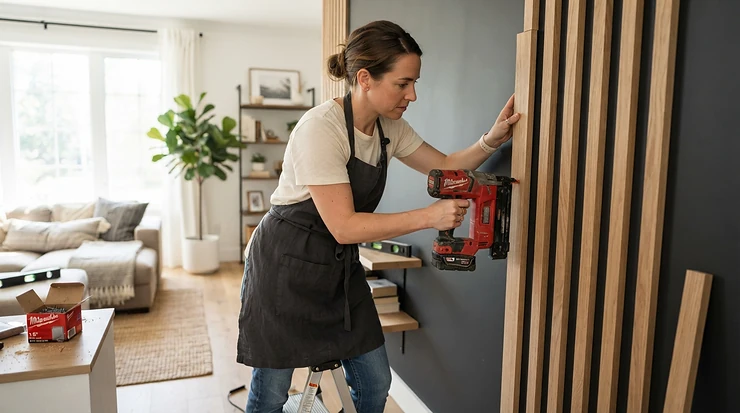
A cordless finish nailer is a hand-held tool that fires slim, headed nails into timber using a battery (and, on a few models, a small gas fuel cell) instead of an air hose and compressor. The 16 gauge version drives nails roughly 1.6mm thick. That makes it the sweet spot for skirting, architrave, face frames and cabinet carcases: strong enough to hold, slim enough to vanish under filler.
Not so long ago, going cordless meant accepting a compromise. You got a heavy tool, a slow recovery between shots and a nagging feeling that the pneumatic gun in the van would have done it better. That’s changed. The current crop of battery-driven machines uses brushless motors, air-spring drives or flywheel mechanisms to sink nails sub-flush with very little ceremony. A cordless finish nailer now makes sense for the joiner fitting a kitchen on a Tuesday and for the weekend renovator who is tired of tripping over hose.
One caution before we start shopping. HSE’s own research into battery-powered versus traditionally powered tools found that noise and vibration from cordless kit can be higher or lower than from the old-school equivalent. “Cordless” is not shorthand for “gentle on your ears and wrists”, so we’ll look at those numbers as we go.
This guide covers seven real, UK-available models, built from manufacturer specs, retailer data and the genuine review material I could verify. Where I couldn’t verify a review pool, I say so rather than invent one. Prices are ranges only, because they move constantly. Check current prices before you buy.
Cordless Finish Nailer Quick Comparison: The 7 Picks at a Glance
| Model | Nail layout | Power system | Standout trait | Price range | Best For |
|---|---|---|---|---|---|
| DeWalt DCN660N | 20° angled, 32–63mm | 18V XR brushless | Balanced all-rounder | £250–£350 | XR-battery households and site carpenters |
| Milwaukee M18 FN16GA | 20° angled, 32–63mm | M18 FUEL brushless | Hardwood sub-flush claim, onboard nose pieces | £350–£450 | Hardwood trim and demanding daily use |
| Makita DBN600 | Straight, 25–64mm | 18V LXT | Compact nose, 110-nail magazine | £350–£470 | Cabinet fitters and LXT owners |
| Bosch GNH 18V-64 M | 20° angled, 32–64mm | 18V Professional | Quieter rated output, easy mode selection | £350–£500 | Noise-conscious pros on Bosch/AMPShare batteries |
| HiKOKI NT1865DM | Straight (angled DMB variant), 25–65mm | 18V brushless, air-spring drive | Pneumatic-style feel | £300–£450 (bare angled variants) | Joiners who miss the feel of a pneumatic |
| Paslode IM65A F16 | 20° angled, 32–63mm | Gas fuel cell + lithium battery | Light and fast | £450–£650 | High-volume second fix |
| Ryobi R16GN18-0 | 16G, 19–64mm | 18V ONE+ | Lowest entry cost | £150–£270 | DIYers and budget-conscious buyers |
Looking at the table, the DeWalt DCN660N and Makita DBN600 are the safest middle-of-the-road buys if you already own either battery system. The Ryobi R16GN18-0 undercuts everything by a distance, but its headline run-time claim is quoted in pine rather than hardwood, so read that as a hint. The Paslode IM65A F16 is the odd one out because it needs fuel cells.
💬 Just one click — help others make better buying decisions too!😊
Top 7 Cordless Finish Nailer Picks: Expert Analysis
1. DeWalt DCN660N — best all-round 18V XR workhorse
The appeal here is balance: brushless power in a body that doesn’t punish your wrist by lunchtime.
The 18V XR brushless motor drives 16 gauge angled nails from 32mm to 63mm. It has a thumb-wheel depth dial and two modes: sequential for precise placement, and bump, which Toolstation’s listing puts at up to four nails a second. That nail range matters more than it looks. The shortest nail it accepts is 32mm, so thin cabinet backs and delicate beading are better served by a shorter-nail tool. The spec sheet quotes 92dB, so keep ear defenders handy. Because the drive is mechanical rather than gas-fuelled, DeWalt claims steady performance in cold weather, which suits an unheated house shell in January.
This is the one to shortlist if you already own XR batteries and want a single machine for skirting, architrave and the odd kitchen. Based on the spec comparison, it trades the short-nail flexibility of the Makita DBN600 and Ryobi R16GN18-0 for a more conventional trim-carpenter’s range.
UK retailer reviews I could verify skew positive, praising it as light, quick and easy to use. One long-term owner said an older, heavier DeWalt pinner drove better into hardwood. A US field test of the 20V Max sibling liked the depth gauge, the headlamp-style LED and the relatively low noise, but noted only one battery in the box, so check what your UK kit includes.
Pros:
- ✅ Brushless motor with sequential and bump modes
- ✅ Tool-free depth dial for quick adjustments
- ✅ Mechanical drive, no fuel cells to buy
Cons:
- ❌ Shortest nail is 32mm, so delicate work is limited
- ❌ Some owners question hardwood performance
Expect around £250–£350 for the bare tool at the time of research. Check current price. Strong value for anyone already on XR batteries.
2. Milwaukee M18 FN16GA — best for hardwood and fussy finishes
Milwaukee’s pitch is consistent sub-flush seating in hardwoods, and the onboard nose pieces are a thoughtful touch.
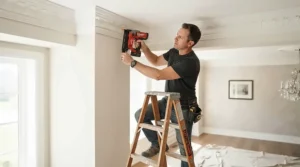
The Milwaukee M18 FN16GA fires 16 gauge nails at a 20° pitch. Screwfix lists a 32–63mm range, up to 180 nails a minute and up to 700 shots per charge on the 2.0Ah kit battery. Charging takes about 26 minutes. The multiple onboard nose pieces let you swap between a no-mar tip for finished surfaces and a different profile for tighter spots. That saves you hunting through the toolbox. Milwaukee also sells a straight-nail sibling, the M18 FN16GS, with a 25–64mm range, a 110-nail magazine and a claimed 1,200 nails on a 5.0Ah pack.
Analytically, this suits joiners fitting oak, ash or dense MDF who can’t tolerate nails standing proud. If you’re weighing it against the DeWalt DCN660N, the extra spend buys a harder-hitting reputation and the broad M18 battery ecosystem. The stockist pages I checked carried no customer reviews yet, so I won’t claim a consensus. Treat the sub-flush performance as a manufacturer claim until you’ve seen more owner reports.
Pros:
- ✅ Onboard nose pieces for different surfaces
- ✅ Wide M18 battery compatibility
- ✅ Fast charging with the kit batteries
Cons:
- ❌ Premium pricing against rivals
- ❌ No verified review pool to lean on
Roughly £350–£450 for the bare tool, with kits above that. Check current price. Worth it for hardwood-heavy work.
3. Makita DBN600 — best straight-nail option for compact access
The standout is the compact nose, with a centre height Screwfix lists at 35mm, which helps you reach tight corners.
The Makita DBN600 drives straight 16 gauge nails from 25mm to 64mm and holds 110 in the magazine. Retailers quote around 800 shots from a 4.0Ah battery. It has tool-free depth adjustment, tool-free jam clearing, an anti-dry-fire mechanism and a rocker switch for sequential or bump mode. One catch: it’s heavy, listed at 3.4–3.8kg depending on battery. Noise is quoted at 89dB(A). Retailers pitch it squarely at cabinet makers and joiners.
The 25mm minimum nail is the real advantage for cabinetry, because you can pin thin panels and mouldings without blowing through the back. The weight is the trade-off over an overhead skirting run. Makita’s own site also lists a newer DBN601 with faster firing, so check UK availability before committing. I couldn’t verify a trustworthy aggregate review score for the DBN600, so I’ll leave sentiment out rather than guess.
Pros:
- ✅ Short 25mm nails suit delicate cabinet work
- ✅ Large 110-nail magazine
- ✅ Tool-free depth and jam clearing
Cons:
- ❌ Heavy, up to roughly 3.8kg with battery
- ❌ Noticeably noisy at 89dB(A)
Expect around £350–£470 for the bare tool. Check current price. Ideal for LXT owners fitting cabinets.
4. Bosch GNH 18V-64 M — best for lower rated noise and multi-brand batteries
Bosch quotes a sound pressure level of 84dB(A), the lowest figure of the group.
The Bosch GNH 18V-64 M fires 16 gauge, 1.6mm nails at 20° in lengths from 32mm to 64mm. The magazine holds 105. It weighs 2.9kg without a battery and offers single or contact firing, selected on an HMI panel. A dry-fire lockout protects your workpiece. It’s compatible with the Bosch Professional 18V range and the AMPShare alliance, so batteries from partner brands can work. Bosch also offers a newer GNH 18V-64-2 M, which it describes as brushless with a thumb-actuated switch and very low recoil.
For anyone working in occupied homes or alongside other trades, the lower noise figure is a practical advantage. It’s also lighter than the Makita DBN600, which matters on staircase and panelling runs. Stockist pages I checked listed no customer reviews yet, so the praise here rests on specs. Registering the tool within four weeks unlocks a three-year warranty.
Pros:
- ✅ Lowest quoted noise level of the seven
- ✅ Lighter than the Makita at 2.9kg bare
- ✅ Works with AMPShare partner batteries
Cons:
- ❌ Minimum 32mm nail length
- ❌ No verified review pool yet
Typically £350–£500 for the bare tool. Check current price. Good for noise-conscious professionals.
5. HiKOKI NT1865DM — best for a pneumatic-style feel
The air-spring drive is the headline: HiKOKI says it mimics its pneumatic range, with little ramp-up and low recoil.
The HiKOKI NT1865DM is a brushless, 18V straight finish nailer with a 25–65mm nail range, a 100-nail magazine and a rate of up to three nails a second. Claimed run time varies by listing, from about 1,100 to 1,500 nails a charge. Features include tool-free depth adjustment, a tool-free nose release, an LED light and a selective actuation switch. There is also an angled variant, the NT1865DMB. Retailers list a weight of about 1.8kg for the bare tool, though listings are inconsistent, so verify before relying on it. Brushless HiKOKI tools qualify for an extended five-year warranty when registered.
The air-spring system is the draw for joiners who miss the way a pneumatic recoils and recovers. It should also mean fewer wear parts to worry about. I found no robust review pool for this model, so treat run-time claims as manufacturer figures.
Pros:
- ✅ Air-spring drive for a pneumatic-style feel
- ✅ Wide 25–65mm nail range
- ✅ Extended warranty on registration
Cons:
- ❌ Straight-body listings can run expensive
- ❌ Inconsistent weight data across retailers
Expect roughly £300–£450 for bare angled variants, with straight models often higher. Check current price. A strong pick for pneumatic loyalists.

6. Paslode IM65A F16 — best for fatigue-free all-day trim
At around 2kg, this is the lightest machine here, and that shows over a full day of nailing.
The Paslode IM65A F16 is a gas-and-battery tool: a 7.4V lithium battery supplies the spark and a fuel cell supplies the drive. It fires 16 gauge angled brads from 32mm to 63mm with a 100-nail magazine and 30 joules of impact force. Paslode claims 2–3 fixings a second, roughly 1,000 shots per fuel cell and up to 10,000 shots per battery charge. Charging takes about 90 minutes, with 80% reached in roughly 25 minutes. It fires in sequential mode only, which is arguably a benefit for fine work. Noise is quoted at 92dB(A) and vibration at 2.8 m/s².
The catch is running cost. Every 1,000 nails needs another fuel cell, which battery-only rivals avoid. For a trade user fitting hundreds of metres of skirting a week, that’s a business expense they accept for the weight saving. For a weekend user, it’s a nag. I couldn’t verify a review pool I’d trust, so sentiment is left out.
Pros:
- ✅ Lightest tool here at around 2kg
- ✅ Huge claimed shots per battery charge
- ✅ Sequential-only firing suits precise work
Cons:
- ❌ Ongoing cost of fuel cells
- ❌ Cold-weather and gas quirks versus battery-only tools
Typically £450–£650 for the tool with battery and charger. Check current price. Best for high-volume second fix.
7. Ryobi R16GN18-0 — best budget way into a cordless finish nailer
The big win is entry cost, plus access to the huge ONE+ battery ecosystem if you already own some.
The Ryobi R16GN18-0 uses Ryobi’s AirStrike system to drive 16 gauge (1.6mm) nails from 19mm to 64mm. That short 19mm minimum is the most flexible in this roundup. It has tool-free depth adjustment, a dry-fire lockout, tool-free jam release, a grip-activated LED and a belt hook. Ryobi claims up to 1,000 64mm nails into pine on a single 5Ah battery. Note it’s sold as a bare tool.
The honest read is that Ryobi quotes its headline figure in pine, whereas Milwaukee M18 FN16GA talks about hardwoods. For skirting in softwood, MDF architrave and light cabinetry, it looks perfectly capable on paper. For daily professional use in oak, I’d be cautious. I couldn’t verify a UK review pool I’d stand behind, so I’ll make no claims about owner sentiment.
Pros:
- ✅ Lowest entry price of the seven
- ✅ Shortest nail range from 19mm
- ✅ Works with all ONE+ batteries
Cons:
- ❌ Headline run claim measured in pine, not hardwood
- ❌ Bare tool, so battery and charger cost extra
Roughly £150–£270, depending on retailer and promotion. Check current price. A sensible budget pick.
Spec Snapshot
| Model | Nail range | Weight (as listed) | Headline claim | Best For |
|---|---|---|---|---|
| DeWalt DCN660N | 32–63mm | Not listed | Up to 4 nails/sec in bump mode | Mixed second-fix work |
| Milwaukee M18 FN16GA | 32–63mm | Not listed | Up to ~700 shots on 2.0Ah | Hardwoods |
| Makita DBN600 | 25–64mm | 3.4–3.8kg | ~800 shots on 4.0Ah | Cabinet fitting |
| Bosch GNH 18V-64 M | 32–64mm | 2.9kg bare | 84dB(A) sound pressure | Quieter working |
| HiKOKI NT1865DM | 25–65mm | ~1.8kg (listings vary) | Up to 1,100–1,500 nails/charge | Pneumatic feel |
| Paslode IM65A F16 | 32–63mm | ~2kg | 10,000 shots/battery charge | All-day trim |
| Ryobi R16GN18-0 | 19–64mm | Not listed | ~1,000 64mm nails in pine (5Ah) | Budget DIY |
The pattern is clear. Cabinet-focused buyers should look at the 25mm-and-under entries, namely the Makita DBN600, HiKOKI NT1865DM and Ryobi R16GN18-0. Trim carpenters who live in 32mm-and-up territory will find the DeWalt DCN660N, Milwaukee M18 FN16GA and Bosch GNH 18V-64 M more than adequate. And weight claims that look too good, like the HiKOKI’s, deserve a double-check.
How to Choose a Cordless Finish Nailer
Choosing a cordless finish nailer is mostly about matching nail range, weight and battery platform to the work you actually do.
- Pick your battery platform first. Bare tools are far cheaper if you already own 18V batteries, and a mismatched platform quietly adds the cost of a second battery system.
- Check the shortest nail it accepts. Cabinet backs, beading and thin mouldings need 25mm or less. Skirting and architrave are happy at 32mm and up.
- Decide straight or angled. Angled magazines get into corners, while straight guns often have a more compact nose. The right answer depends on your typical workspace.
- Weigh the tool. A tool at 3.8kg feels very different from one at 2kg after an hour above head height.
- Look at the noise figure. Anything near 90dB(A) means hearing protection is non-negotiable.
- Count the running costs. Gas tools need fuel cells, and battery-only tools don’t.
16 Gauge Finish Nailer vs 18 Gauge Brad Nailer: Which Should You Reach For?
A 16 gauge finish nailer drives a thicker nail than an 18 gauge brad nailer. Makita’s own listing describes its 16 gauge as 1.3 × 1.6mm, which is a noticeably beefier fastener than a brad. That extra diameter gives more holding power in heavy trim, face frames and door linings.
The trade-off is a slightly bigger hole to fill. For delicate beading or very thin mouldings, an 18 gauge brad nailer is gentler and less likely to split the timber. For most people, though, a single 16 gauge finish nailer covers the majority of second-fix jobs. If you’re buying only one, the 16 gauge finish nailer is the more versatile choice.
Where buyers go wrong is assuming “finish nailer” always means 16 gauge. Some lines use 15 gauge angled guns, which fire a different nail. Always match the nailer to the nail, not the other way round.
16 Gauge Nails: Length, Finish and Collation Explained
The right 16 gauge nails are as important as the tool. Three things matter: length, collation angle and finish.
Length: the nailers above accept anywhere from 19mm up to around 65mm. A common rule of thumb is that the nail should go through the trim and sink at least roughly twice the trim’s thickness into the substrate, though your material and application may differ.
Collation angle: straight and 20° angled nails are not interchangeable. A tool built for 20° angled strips will jam on straight ones, so check the spec before you buy a box.
Finish: galvanised nails suit most interior work. Stainless is the safer choice where moisture or tannin-rich timber like oak might cause staining. Retailer listings for compatible 16 gauge nails commonly offer both.
Stick to your nailer manufacturer’s recommended nails where possible. Cheap, inconsistent 16 gauge nails are a classic cause of jams.
Finish Nailer for Cabinetry: What to Look For
A good finish nailer for cabinetry rewards precision over raw speed. Prioritise a short minimum nail length, because cabinet backs, drawer fronts and applied mouldings are thin. The Makita DBN600, HiKOKI NT1865DM and Ryobi R16GN18-0 all go down to 25mm or below.
Look for a no-mar tip, ideally with spare tips. The Milwaukee M18 FN16GA brings several onboard nose pieces for exactly this reason. Depth adjustment should be tool-free and easy to read, because test-firing into an offcut is the only way to dial in a clean finish on veneered ply.
Sequential mode is usually the better choice for cabinetry, since bump firing can double-fire on thin stock. The Paslode IM65A F16 is sequential only, which some finish carpenters actively prefer.
A finish nailer for cabinetry is also a glue partner, not a replacement. The nails hold the joint while the adhesive cures, and that is where their real value lies.
Cabinetry Joinery: Where 16 Gauge Nails Earn Their Keep
In cabinetry joinery, a 16 gauge nail is usually a clamp substitute. Glue does the permanent work, while the nails hold parts aligned and under pressure while it sets. That’s the logic behind using one for face frames, where you glue a rail to a stile and tack it through the back.
Carcase assembly is another good fit. Fixing a plywood cabinet side to a top or base with glue and nails speeds up the process considerably. Rear panels and applied mouldings are similar, as long as you keep nails from breaking through the face.
For cabinetry joinery, a straight-nail tool like the Makita DBN600 offers a compact nose that helps in confined spaces. The trade-off is a shot count to watch: always test on an offcut of the same material first, because a nail that sinks perfectly in softwood may stand proud in a dense hardwood.
Fine Finish Carpentry with a Cordless Finish Nailer
Fine finish carpentry rewards patience. Skirting boards, architraves, window linings, dado rails and staircase mouldings all benefit from nails that disappear under filler. Retailer guidance for tools like the Makita DBN600 lists exactly these applications.
In fine finish carpentry, angled nailers like the DeWalt DCN660N and Bosch GNH 18V-64 M can reach into corners that straight-magazine guns struggle with. On the other hand, a very light tool like the Paslode IM65A F16 reduces the shake and fatigue that cause wandering nails late in the day.
A few habits matter more than any tool choice. Always nail into studs or solid backing rather than just plasterboard. Pre-mark your fixing points. And set your depth so the nail head sits just below the surface, ready for filler, without crushing the timber. A cordless finish nailer gives you freedom of movement, but the finish still depends on your preparation.
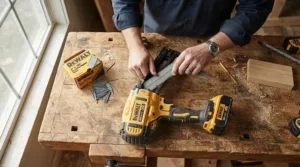
Cordless Finish Nailer vs Pneumatic and Gas Fuel-Cell Tools
| Type | Running cost | Portability | Feel | Best For |
|---|---|---|---|---|
| Battery-only cordless (DeWalt DCN660N, Makita DBN600) | Lowest, just electricity | Excellent | Mechanical or air-spring | Mixed site and workshop use |
| Gas fuel-cell cordless (Paslode IM65A F16) | Higher, fuel cells | Excellent | Light and quick | High-volume daily trim |
| Pneumatic (compressor and hose) | Low per nail, compressor upkeep | Limited by hose | Instant, minimal ramp-up | Fixed workshop |
Looking at the comparison above, battery-only machines have closed the gap on convenience and are now the default for most buyers. Gas models still win on weight, as the Paslode IM65A F16 shows. Pneumatics remain a fine choice in a fixed workshop, but the hose and compressor make them awkward on site.
Don’t assume cordless wins on noise or vibration, either. HSE’s guidance on hand-arm vibration at work explains why exposure over time matters, and tool emission figures are worth comparing before you buy.
Long-Term Cost and Maintenance
| Tier | Models | Typical range | Value take | Best For |
|---|---|---|---|---|
| Budget | Ryobi R16GN18-0 | £150–£270 | Cheapest entry, best with existing ONE+ batteries | DIY and light cabinetry |
| Mid-range | DeWalt DCN660N, Makita DBN600, HiKOKI NT1865DM | £250–£470 | Best balance for platform owners | Regular trade and serious DIY |
| Premium | Milwaukee M18 FN16GA, Bosch GNH 18V-64 M, Paslode IM65A F16 | £350–£650 | Specialist strengths: hardwood, noise, weight | Daily professional use |
The real cost isn’t the sticker price, it’s what follows. Battery-only tools avoid fuel cells entirely, so total cost tracks the batteries and nails you buy. The Paslode IM65A F16 needs a fuel cell roughly every 1,000 shots, which adds up over a busy year. If you already own a battery platform, buying a bare tool is almost always the cheapest route.
Maintenance is light across all of them. Keep the nose clean, clear jams with the tool-free release, store the tool in its case and register warranties promptly. Several brands extend cover only if you register within a few weeks.
✨ Ready to Shortlist Your Nailer?
🔍 Take your fine finish carpentry and cabinetry joinery to the next level with these carefully selected tools. Click any highlighted product name to check current pricing and availability. A well-chosen nailer will help you create clean, professional results your
clients will notice! 🔨
Your First 30 Days: Setup and Maintenance Guide
Week one: set up properly. Charge your batteries fully, load a strip of nails to the manufacturer’s guidance, and set the depth dial to its shallowest setting. Fire into an offcut of the real material and increase depth one click at a time until the head sits just below the surface.
Test both modes. Try sequential and bump on scrap. For fine work, stay in sequential, where the nailer fires only when you’ve pressed the nose and pulled the trigger in order.
Week two: build habits. Keep your free hand well clear of the nose. Never carry the tool with a finger on the trigger. Wear eye and hearing protection every time, particularly given the 84–92dB(A) figures quoted across these tools.
Weeks three and four: maintenance and common mistakes. Wipe dust from the nose and magazine, check the no-mar tip for wear and learn how the jam-release works before you need it. The classic first-month mistakes are loading the wrong nail angle, running the magazine fully empty, and setting the depth too deep and crushing the surface. A little discipline early saves a lot of filler later.
Real-World Scenarios: Which Cordless Finish Nailer Fits Which Job?
The kitchen fitter. Fitting cabinets, plinths and cornice most weeks, with a bag of 18V batteries in the van. The Makita DBN600 fits neatly if you’re on LXT: short 25mm nails for thin panels, a compact nose for tight corners, and a large magazine for long runs. Budget around £350–£470 for the bare tool.
The second-fix carpenter. Skirting and architrave through whole houses, five days a week. Here, weight is the enemy. The Paslode IM65A F16 at about 2kg, or the Bosch GNH 18V-64 M at 2.9kg bare, reduces fatigue. The Paslode’s fuel cells are simply a cost of doing business.
The weekend renovator. A few rooms of trim a year, with a ONE+ drill already in the shed. The Ryobi R16GN18-0 is the sensible spend, at roughly £150–£270, as long as the work is softwood or MDF.
The hardwood specialist. Staircases, oak mouldings and bespoke joinery. Look at the Milwaukee M18 FN16GA for its sub-flush hardwood claim, or the DeWalt DCN660N if you want a more affordable all-rounder.
Safety, Noise and UKCA Marking
Nailers are not forgiving of carelessness. Always wear eye protection and hearing defenders, keep fingers away from the nose, and disconnect the battery before clearing a jam or changing parts.
Noise is a genuine concern. The quoted figures here range from 84dB(A) on the Bosch GNH 18V-64 M to 92dB(A) on the Paslode IM65A F16, with the DeWalt DCN660N also listed at 92dB. Those are figures at which hearing protection is sensible, not optional.
On regulations, GOV.UK explains that the UKCA marking is the conformity mark for products placed on the Great Britain market. It also notes that CE-marked goods can still be accepted, and that products for the EU need CE. As a buyer, check the tool carries a recognised conformity mark and that you’re buying from a reputable UK stockist with proper warranty support.
FAQ
❓ Is a cordless finish nailer powerful enough for hardwood cabinetry?
❓ Do I need fuel cells for a battery-powered 16 gauge finish nailer?
❓ Are 16 gauge nails interchangeable between nailer brands?
❓ Is a cordless finish nailer worth it over a pneumatic for occasional DIY?
❓ Should I buy a bare tool or a kit?
Conclusion
The best cordless finish nailer for you is the one that matches your batteries, your timber and your daily workload. For most people on a major 18V platform, that means the DeWalt DCN660N or Makita DBN600. Hardwood specialists should look closely at the Milwaukee M18 FN16GA, and anyone sensitive to noise or weight has good reasons to consider the Bosch GNH 18V-64 M, HiKOKI NT1865DM or Paslode IM65A F16. The Ryobi R16GN18-0 is the budget way in, provided your work stays in softer materials.
Whatever you choose, stay grounded in three things. Match your nails to the tool, test depth on offcuts before every new job, and treat noise and vibration as real factors rather than footnotes. A 16 gauge tool is a brilliant all-rounder for cabinetry joinery and fine finish carpentry, but it’s still a tool that rewards preparation.
Specs and prices shift, so confirm current details before you buy, and double-check which batteries and nail types your chosen model needs.
Recommended for You
- Framing Nailer Vs First Fix Nailer: 7 Proven Picks For UK (2026)
- Framing Nailer For Decking: 7 Proven Picks For UK Builds (2026)
- Cordless Framing Nailer: 7 Best Proven Picks For UK Sites (2026)
Disclaimer: This article contains affiliate links. As an Amazon Associate, I earn from qualifying purchases. If you purchase products through these links, we may earn a small commission at no additional cost to you.
✨ Found this helpful? Share it with your friends! 💬🤗
