
In This Article
Framing nailer vs first fix nailer sounds like a showdown, but in most UK tool shops the two names describe the same machine: a heavy-duty nail gun that drives 50-90mm nails into structural timber. The real decision is which power source, nail type and firing mode suit your build.
That’s good news and mildly annoying news. Good, because you’re not picking between two rival technologies. Annoying, because the label on the box won’t tell you which one to buy.
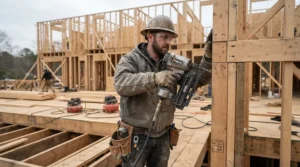
Here’s why it matters. BM TRADA describes timber frame construction as studs and rails plus structural sheathing, carrying every load down to the foundations. It also notes that platform frame is the most common method in the UK. Every joint in that frame is a nail. A gun that drives them consistently turns a punishing weekend into a comfortable afternoon.
So here’s the plan. I’ve compared seven real, UK-available nailers, from budget pneumatic to premium cordless. I weighed them against the jobs most readers actually do: sheds, stud walls, roof battens and full frames. Everything below comes from manufacturer specs, retailer listings and the genuine review feedback I could verify. I haven’t hand-tested any of these tools, and I won’t dress up spec-sheet reasoning as workshop experience.
One housekeeping note. Prices are ranges only and move constantly, so check current pricing before you buy. Where I couldn’t verify real customer reviews, I say so rather than guess.
Framing Nailer vs First Fix Nailer: Is There Actually a Difference?
Short answer: mostly no. UK suppliers routinely treat the two names as synonyms. One major hire network describes first fix nail guns as “also referred to as framing nailers”, and a popular UK buying guide files framing nailers under the first fix label. Where differences do exist, they’re about nail design and the way the words are used.
- Collation and nail type. UK-market guns usually take 30-34° paper-tape or wire-weld collated nails, clipped-head or offset-round-head, 50-90mm long. US-style framing guns often take 21° plastic-collated round-head nails instead. The Bostitch F21PL-E, for instance, is listed for 45-90mm plastic-collated framing nails. Your nailer and your nails must match, so check this first.
- Scope of the term. “Framing” names a task. “First fix” names a stage of building: rough, structural, hidden work. A first fix nailer therefore covers framing plus battens, subfloors, decking and fencing.
- The genuine contrast is second fix. Hire firms list second fix nailers as brad nailers firing 16 gauge nails between 15mm and 64mm. They leave tidy holes. Framing nailers leave dents and chips, which is fine behind plasterboard and cladding.
On paper, then, framing nailer vs first fix nailer is a naming quirk. In practice, the question that decides your purchase is first fix versus second fix, followed by cordless versus gas versus air.
Quick Comparison: Framing, First Fix and Second Fix Nailers
| Tool type | Typical fixings | Finish left behind | Best For |
|---|---|---|---|
| Framing nailer | 50-90mm, 30-34° paper-collated (or 21° plastic-collated in US-style guns) | Dents and chips | Stud walls, joists, rafters: DeWalt DCN930N, Paslode IM350+ |
| First fix nailer | Same tools, sold under the UK trade label for rough, hidden work | Same as above | Battens, subfloors, fencing: DeWalt DCN692N, Tacwise KDH90V |
| Second fix nailer | 16 gauge brads, 15-64mm (hire-shop spec) | Small, tidy holes | Skirting, architrave, trims: DeWalt DCN660 (outside our seven) |
Looking at the table, the first two rows are the same hardware under different job titles. The only real fork in the road is the third row. If you need to fix architrave, a framing gun will wreck it. If you need to nail a stud wall, a second fix gun won’t hold it.
💬 Just one click — help others make better buying decisions too!😊
Top 7 Framing Nailers (First Fix): Expert Analysis
These seven span budget, mid-range and premium, and cover cordless, gas and pneumatic power. Prices are ranges, and specs come from manufacturer and retailer listings.
1. DeWalt DCN930N — gas-free power in a compact body
DeWalt’s newest cordless framer aims to replace gas and hoses with a single 18V XR battery.
The brushless motor drives 50-90mm nails at 30-34°. It’s compact enough to fit between 400mm centres, which is standard stud and joist spacing. Listings show roughly 3.9kg bare, a touch lighter than its predecessor. The magnesium magazine and nose designed for toe-nailing suit overhead and corner work. It can fire up to two nails a second.
Based on the spec comparison, this is the sensible pick if you already own DeWalt 18V batteries, because the battery is the expensive part. DeWalt says it sinks 90mm ring-shank nails flush in medium-density wood. Note that wording: dense hardwood and engineered timber are a tougher test, so don’t assume the claim covers them.
On reviews, UK listings I checked showed none yet, so I can’t summarise real-world feedback. Treat DeWalt’s claims as claims until owners weigh in.
Pros:
- ✅ No fuel cells, hose or compressor needed
- ✅ Fits between 400mm centres
- ✅ Magnesium magazine and toe-nailing nose
Cons:
- ❌ Bare tool: batteries and charger cost extra
- ❌ No verified owner reviews found yet
Expect to pay around £350-£420 for the bare tool, which is fair value if you’re already on the 18V platform.
2. Paslode IM350+ — lightest in its class at 3.3kg
Gas nailers still dominate UK timber frame sites, and this seventh-generation model shows why.
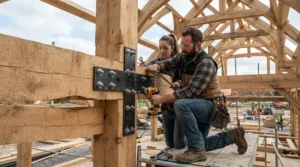
Listings quote 82 joules of power, a 3.3kg weight and a 55-nail magazine. A fuel cell gives roughly 1,100 fixings, and the lithium battery claims up to 9,000 shots per charge. The trigger is sequential only, which is safer by design. That weight advantage over cordless rivals (4kg and above) is felt hardest on overhead rafters and repeated toe-nailing.
Honest analysis suggests the 82J figure sits below the 105J quoted for DeWalt’s older DCN692N. But brands measure differently, so don’t compare joules across technologies like for like. I’ve left out Paslode’s IM360Ci because several UK retailers list it as discontinued.
On reviews, one merchant page showed 4.9 from seven reviews, a small sample. Forum users and reviewers praise its durability. One timber frame worker said it was the only gun to survive six months of that work. The recurring complaints are cold-weather misfires, stale gas cells, regular cleaning and jams with non-Paslode nails.
Pros:
- ✅ Lightest nailer here at 3.3kg
- ✅ Fast recharge: 200 shots in two minutes
- ✅ Long-standing reputation on timber frame sites
Cons:
- ❌ Fuel cells and regular cleaning required
- ❌ Reviewers report cold-weather temperament
Prices run roughly £450-£650 depending on retailer, plus ongoing fuel cell costs. It’s best for full-time framers who value weight above all.
3. Milwaukee M18 FFN-502C — zero ramp-up before the first nail
Milwaukee’s pitch is a cordless gun that fires the instant you pull the trigger.
Its “Ready to Fire” system removes the ramp-up delay between shots. A nitrogen spring and brushless motor drive 50-90mm nails at 30° or 34°. Milwaukee claims up to 700 nails on one 5.0Ah battery. The kit includes two batteries, a charger and a case. It weighs around 5.1kg with a battery fitted, the heaviest here, and vibration is quoted at 5.9 m/s².
What the spec sheet implies is that this suits bursts of nailing with pauses, such as marking and repositioning on a roof, because there’s no wait after each pause. Equally, 5kg-plus feels very different by the end of a long wall-panel day, so weight deserves a hands-on check at a trade counter.
On reviews, I couldn’t verify enough UK customer feedback to summarise honestly. Check recent reviews on the specific kit you’re considering.
Pros:
- ✅ Instant firing with no ramp-up delay
- ✅ Kit includes two 5.0Ah batteries
- ✅ Dry-fire lockout and LED work light
Cons:
- ❌ Heaviest nailer in this comparison
- ❌ Verified UK reviews hard to find
Expect roughly £500-£700 for the two-battery kit. It’s solid value for anyone who’s already invested in the M18 system.
4. HiKOKI NR1890DBCL — air-spring drive for gentler recoil
HiKOKI skips gas and flywheels, using a compressed air spring to drive each nail.
It fires 2.9-3.3mm nails, 50-90mm long, up to two a second. A selector button switches between sequential and bump modes. Magazine capacity is 47 nails, so expect more reloads than a 55-nail gun. Weight is listed at roughly 4.2-4.5kg depending on supplier. Extras include a pivoting rafter hook, a low-battery indicator and a 30-minute auto-shutdown. HiKOKI’s UK scheme offers a three-year warranty, extendable by two years if you register a qualifying cordless tool.
Reading between the specs, the air-spring design promises less recoil and cleaner flush driving, which should cut fatigue on long panel runs. The longer warranty is also a quiet value point for owner-operators.
On reviews, I found no verifiable UK reviews beyond retailer listings, so I can’t summarise sentiment.
Pros:
- ✅ Air-spring drive with gentler recoil
- ✅ Up to five years’ warranty with registration
- ✅ Auto-shutdown and low-battery indicator
Cons:
- ❌ 47-nail magazine means more reloading
- ❌ UK prices vary wildly between retailers
Some two-battery kits were listed well above £1,000 ex VAT at the time of research, so compare retailers and kit contents carefully.
5. DeWalt DCN692N — two-speed flexibility at a lower price
The older sibling of the DCN930N is still on sale and still popular.
A two-speed switch lets you trade power for runtime. Use the lower setting for 50mm nails and the higher one for 90mm. Listings quote 105 joules, 90mm ring-shank nails into softwood and 63mm into hardwood, a 55-nail magazine and 4.1kg weight. It’s rated for -20°C to 50°C, which is handy if you work outdoors through winter.
What most buyers overlook is that the speed switch matters on mixed jobs. One reviewer used 50mm nails on the lowest setting to fix feather board to 2×2 frames. That’s the kind of lighter-duty versatility many gas guns can’t match.
Reviewer sentiment is mixed but real. An eBay buyer praised the no-gas, no-cleaning convenience and called it a bargain. A ManoMano reviewer found it heavy on the arms after a few hours and too bulky for tight spaces. Another eBay reviewer reported problems that increased with use.
Pros:
- ✅ Two-speed control for different nail lengths
- ✅ No gas cells or cleaning routine
- ✅ Wide operating temperature range
Cons:
- ❌ Reviewers report arm fatigue over long sessions
- ❌ Too bulky for tight spaces
Expect around £250-£350 bare. It’s the best value cordless option if you can live with the weight.
6. Tacwise KDH90V — budget pneumatic with proper first fix range
If you already own a compressor, this is the cheapest route into a serious framing gun.
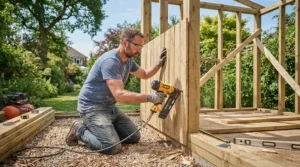
It fires 34° paper-collated nails, 50-90mm long, 2.8-3.7mm in diameter. It weighs 3.8kg and offers both sequential and contact-trip modes. Operating pressure is 70-120 psi, and vibration is quoted at 4.7 m/s². The bottom-loading, open magazine lets you check nail levels at a glance, and it comes in a carry case.
Analytically, the gun is only half the cost. A compressor and hose sit on top, and a hose on a pitched roof is a snagging hazard. Weight is among the lowest here, and pneumatic power avoids battery and gas headaches entirely.
I found no verifiable customer review data for this model, so I won’t characterise owner sentiment. For comparison, Screwfix lists the Rapid PFN3490 at 4kg and 2.61 litres of air per shot, a reminder to check compressor capacity.
Pros:
- ✅ Lowest upfront cost in this comparison
- ✅ Light at 3.8kg
- ✅ Open magazine shows nail count
Cons:
- ❌ Compressor and hose required
- ❌ Hose limits roof and ladder work
Expect around £200-£220. It’s good value if you already own air kit, and poor value if you’d have to buy a compressor too.
7. Bostitch GF33PT-U — budget gas with cross-brand compatibility
Bostitch’s gas nailer targets buyers who want gas performance without paying Paslode prices.
The listing says it fires 50-90mm nails and works with other manufacturers’ gas and nails. It also offers depth control, a low-nail lockout and an overmoulded grip. Cross-compatibility is the real selling point, because you aren’t tied to one brand’s consumables.
On paper, the same gas caveats apply as with the Paslode: cleaning, fuel cell storage and cold-weather behaviour. The listing I found didn’t state weight or joules, so check the full spec before buying. A gun that hides its numbers deserves a closer look at a trade counter.
I found no verifiable reviews, so I can’t summarise sentiment honestly.
Pros:
- ✅ Works with other brands’ gas and nails
- ✅ Low-nail lockout protects the tool
- ✅ Budget-friendly entry to gas framing
Cons:
- ❌ Key specs missing from listings checked
- ❌ Gas upkeep and cold-weather caveats apply
Expect mid-£200s. It’s a sensible budget gas gamble, but unproven compared with the Paslode.
Top 7 at a Glance
| Product | Power | Weight | Price range | Best For |
|---|---|---|---|---|
| DeWalt DCN930N | 18V cordless | About 3.9kg bare | £350-£420 (bare) | Existing DeWalt 18V users |
| Paslode IM350+ | Gas + battery | 3.3kg | £450-£650 | Full-time framers, overhead work |
| Milwaukee M18 FFN-502C | 18V cordless | About 5.1kg with battery | £500-£700 (kit) | M18 system owners |
| HiKOKI NR1890DBCL | 18V cordless | About 4.2-4.5kg | Varies widely | Low recoil, long warranty |
| DeWalt DCN692N | 18V cordless | 4.1kg | £250-£350 (bare) | Mixed jobs on a budget |
| Tacwise KDH90V | Pneumatic | 3.8kg | £200-£220 | Owners with a compressor |
| Bostitch GF33PT-U | Gas + battery | Not stated | Mid-£200s | Budget gas buyers |
The table shows two clear clusters. The Paslode IM350+ and Tacwise KDH90V are lightest, while the Milwaukee M18 FFN-502C is heaviest. If budget rules, the Tacwise KDH90V and DeWalt DCN692N are the cheapest routes in, though the former needs a compressor. For all-round value, the DeWalt DCN930N is the sensible pick for anyone already on the 18V platform.
✨ Don’t Miss These Top Picks!
🔍 Take your next build to the next level with these carefully selected nailers. Click any highlighted product name to check current pricing and availability, and match the nailer to your timber, your nails and your day-to-day workload!
How to Choose a Framing Nailer vs First Fix Nailer
Since framing nailer vs first fix nailer is largely a naming quirk, the useful question is how to choose between the real variants. Work through these steps in order.
- Start with the nail, not the tool. Decide between 30-34° paper-collated and 21° plastic-collated nails. Your supplier’s stock and your gun must match.
- Pick your power source. Cordless suits mixed jobs and zero upkeep. Gas wins on weight. Pneumatic wins on price if you already own a compressor.
- Decide on firing mode. A US surveillance study of residential carpenters, published in Injury Prevention, found a sequential trigger would likely have prevented 65% of injuries from contact-trip tools. It also found over 70% of injuries came from through-nailing or toe-nailing rather than flat nailing. Sequential is the safer default for corners and studs.
- Weigh it. Anything over 4.5kg gets heavy overhead. Handle the gun before you commit.
- Check nail range and depth adjustment. 50-90mm covers most framing. Tool-free depth adjustment saves time.
- Consider the ecosystem. If you already own 18V batteries, a bare cordless nailer is the cheapest route.
- Hire before you buy. Several UK hire networks rent first fix nailers by the day, which suits one-off projects.
Best Framing Nailer for Sheds
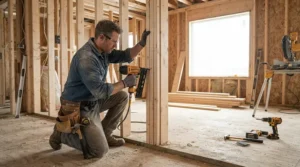
The best framing nailer for sheds is rarely the most expensive one. Most garden sheds are built from modest timber sections, so you won’t need 90mm nails or a premium tool.
A common carpentry rule of thumb is that nail length should be roughly two and a half times the thickness of the thinner timber. So a 38mm member usually calls for around 90mm at most, and often less. That means the extra power of a premium gun is rarely used on a shed build.
For a one-off shed, hire is hard to beat. National hire networks rent first fix guns for 50-90mm clipped-head nails, with no purchase, no gas and no storage. If you’ll build several sheds, summerhouses or fences, a DeWalt DCN692N is the sensible buy. It’s affordable, flexible on nail length and needs no upkeep. If you already own a compressor, the Tacwise KDH90V is cheaper still.
What the spec sheet won’t tell you is that a gun is only as good as its nails. Use ring-shank or galvanised fixings for anything outdoors, and always match them to your gun.
Best Framing Nailer for Timber Construction
The best framing nailer for timber construction depends on scale. Occasional builders need a different tool from someone framing houses.
On timber frame construction sites, weight and cycle rate dominate the conversation. The Paslode IM350+ is the traditional choice because it’s light and quick to recharge. Cordless guns like the DeWalt DCN930N, Milwaukee M18 FFN-502C and HiKOKI NR1890DBCL suit crews who want no gas, no cleaning and one battery platform.
Platform frame is the most common UK method according to BM TRADA, which means repetitive nailing of studs, rails and sheathing. That favours consistent depth, reliable lockout when the magazine runs low and a comfortable grip. For self-builders, there’s a practical caveat: engineered timber frame designs specify nail type, size and spacing. Follow the designer’s nailing schedule, not a retailer’s general advice.
Hardwoods and engineered timber also push guns harder. DeWalt quotes 63mm into hardwood for the DeWalt DCN692N, so match tool power to your timber, not just your nail length.
Structural Fixing Strength: What Nails Can and Can’t Do
Structural fixing strength depends on more than the gun. Nail type, length, spacing and timber density all matter more than brand.
Nails generally perform better resisting sideways (shear) loads than being pulled straight out. Ring-shank nails improve withdrawal resistance, which is why DeWalt quotes ring-shank figures for its drive depth. A gun that sinks a nail flush every time gives consistent holding. A gun that leaves nails proud or overdrives them does not.
| Method | Speed | Holding behaviour | Best For |
|---|---|---|---|
| Hand nailing | Slow, tiring | Depth varies with technique | Small repairs |
| Framing nailer | Fast, consistent | Strong in shear; ring-shank improves withdrawal | Frames and sheathing: Paslode IM350+, DeWalt DCN930N |
| Screws | Slower, costlier | Generally better withdrawal resistance, removable | Adjustable or load-reversing joints |
The table shows nailing isn’t strictly stronger than screwing. It’s faster, and consistent depth is its real structural advantage. For fast, repeatable framing, a gun like the Milwaukee M18 FFN-502C wins on speed. For joints that must resist pulling, check the designer’s specification rather than assuming a nail will do.
Job Site Versatility: Cordless vs Gas vs Pneumatic
Job site versatility is where the three power sources diverge most.
Cordless guns like the DeWalt DCN692N are the easiest to live with. No hose, no gas, no cleaning. The DCN692N is rated for -20°C to 50°C, so winter work is realistic. The trade-off is weight, since the heaviest cordless gun here is the Milwaukee M18 FFN-502C at around 5.1kg.
Gas guns like the Paslode IM350+ are the lightest and quickest to recharge. Reviewers repeatedly flag cold-weather misfires, so keep spare cells warm in a jacket pocket. You’ll also need fuel cells in the van and a regular cleaning routine.
Pneumatic guns like the Tacwise KDH90V are cheap and light but tied to a compressor. That’s fine in a workshop or on a ground-level fence line. It’s awkward on scaffolding or a roof.
Ask where you’ll spend most of your time. Roofs and ladders favour cordless or gas. Workshops favour air. Garden projects favour whatever you can hire cheaply.
Long-Term Cost and Maintenance
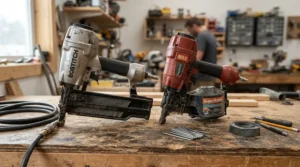
Purchase price is only the start. Total cost of ownership differs sharply between power types.
Cordless guns carry the highest upfront price but almost no running cost. If you already own batteries, a bare DeWalt DCN930N or DeWalt DCN692N can be cost-effective within a single project season. Gas guns add fuel cells and cleaning kits to every job. The Paslode IM350+ includes a two-year warranty if you register it, and its manufacturer advises regular cleaning to keep it firing reliably. Pneumatic guns need oil, hoses and a compressor, which can outweigh the saving on the gun itself.
Warranty matters here. The HiKOKI NR1890DBCL offers up to five years with registration, while the Paslode IM350+ offers two. If you’ll use a gun daily, longer cover is real money saved.
The sensible approach is to estimate your yearly nail count and project length. Light users should hire or buy budget. Heavy users should pay for reliability, because downtime on site costs more than any price difference.
Safety and Regulations Guide
Nail guns are powerful tools, and the injury data is sobering. The HSE’s nail gun guidance says nail gun incidents now feature in high numbers in its woodworking accident statistics. HSE analysis also found that built-in safety features can be defeated, accidentally or intentionally.
The practical rules are simple:
- Wear eye protection. HSE notes the vast majority of nail gun eye injuries would have been prevented by it.
- Train every operator before they pick up a gun.
- Never modify a nailer except with manufacturer-approved parts.
- Disconnect the airline, or remove the battery, gas canister and nails, before maintenance.
- Never point a loaded gun at anyone, and keep your finger off the trigger when carrying it.
Where regulations are concerned, check that any tool you buy carries the appropriate UKCA or CE marking and comes with the manufacturer’s instructions. If you employ others, your duty of care includes training and suitable PPE.
Practical Usage Guide: Your First 30 Days
Buying the gun is the easy bit. Here’s how to get the best from it.
- Test on offcuts. Set depth adjustment on scrap timber before touching the real job. Nails should sit flush, not proud or buried.
- Match your nails. Use the collation angle and nail diameter the manufacturer specifies. Mismatched nails cause jams.
- Start in sequential mode. The US National Institute for Occupational Safety and Health says injury risk is twice as high with contact-trip triggers than sequential ones. Switch to bump only for flat, open nailing.
- Rotate batteries. Keep one on charge so you never wait mid-job.
- Keep gas warm. For gas guns, store spare cells in a warm pocket in winter.
- Clean on schedule. Gas guns need regular cleaning. Cordless guns need little, but wipe off dust and check the magazine.
- Check lockout. Before relying on dry-fire lockout, confirm it works on a scrap board.
Common first-month mistakes include driving nails too close to timber edges, which splits the wood. Others are overdriving into soft timber and carrying the gun with a finger on the trigger.
Real-World Scenarios: Which Nailer for Which Builder?
Specs make more sense when you match them to a person.
The weekend shed builder. Budget is tight, use is a few days a year, and the work is outdoors on weekends. Hire a first fix gun for the build. If you plan repeat projects, a bare DeWalt DCN692N on borrowed or existing 18V batteries is the economical buy.
The timber frame self-builder. You’re framing walls over several weeks in a mix of weather. A cordless gun like the DeWalt DCN930N or Milwaukee M18 FFN-502C avoids gas faff, and the batteries power your other tools. Follow the designer’s nailing schedule precisely.
The full-time carpenter or roofer. You use a gun daily, often overhead, in all weather. The Paslode IM350+ remains the weight-conscious choice, while the HiKOKI NR1890DBCL is the pick if recoil and warranty length matter more. For this user, paying for reliability makes sense because downtime costs more than the price gap.
The fencing and decking contractor. You work mostly at ground level, so hose length isn’t a problem. A Tacwise KDH90V with a decent compressor keeps costs down.
Frequently Asked Questions
❓ Can I use a framing nailer for skirting boards?
❓ Is a cordless framing nailer better than a gas one?
❓ How much does a good first fix nailer cost in the UK?
❓ Can I hire a first fix nailer instead of buying one?
❓ What nails does a first fix nailer use?
Conclusion
So, framing nailer vs first fix nailer: they’re the same family of tool, differing mainly in name, nail collation and the job in front of you. The choices that actually shape your build are power source, firing mode, weight and how much you’ll use it.
For existing 18V users, the DeWalt DCN930N is the sensible cordless pick. For weight-conscious pros, the Paslode IM350+ remains the benchmark. The Milwaukee M18 FFN-502C and HiKOKI NR1890DBCL reward owners of those platforms. The DeWalt DCN692N is the value cordless option, and the Tacwise KDH90V and Bostitch GF33PT-U are budget routes with trade-offs. For a one-off shed, hire first.
Whatever you buy, match your nails to your gun, favour sequential firing, wear eye protection and follow any designer’s nailing schedule. A good nailer won’t build the frame for you, but it will make every joint faster and more consistent.
Recommended for You
- Framing Nailer For Decking: 7 Proven Picks For UK Builds (2026)
- Cordless Framing Nailer: 7 Best Proven Picks For UK Sites (2026)
- Brad Nailer Vs Finish Nailer: 7 Proven UK Picks (2026)
Disclaimer: This article contains affiliate links. As an Amazon Associate, I earn from qualifying purchases. If you purchase products through these links, we may earn a small commission at no additional cost to you.
✨ Found this helpful? Share it with your friends! 💬🤗
