
In This Article
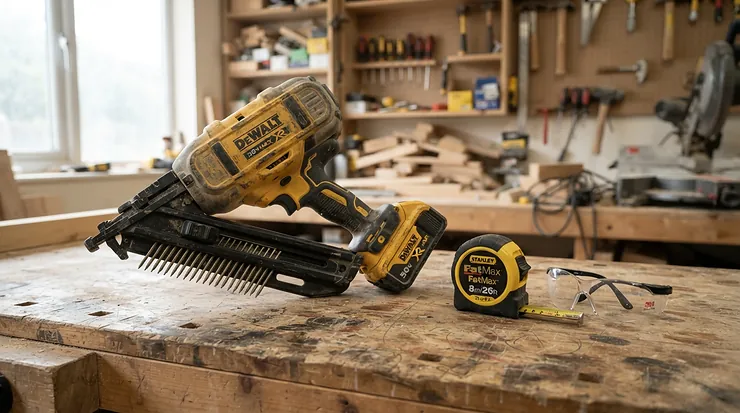
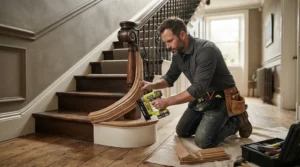
A finish nailer for skirting boards is a handheld fastening tool, cordless, gas-assisted or air-powered, that fires slim 16-gauge nails (about 1.6 mm thick) through trim and into the wall behind. The holes are small enough to fill and paint over. It swaps hammer, nail punch and bruised thumb for a single squeeze of the trigger.

Skirting is deceptively fiddly work. A skirting board, or baseboard, hides the untidy joint where wall meets floor and protects plaster from hoovers and football boots. It also has to survive a decade of knocks. Hammering it home means dozens of nails per room, each one a chance to dent the timber, split an MDF end or leave a crescent-moon bruise on freshly primed paintwork. A good nailer gives you a clean, repeatable sink depth every time.
This guide compares seven real tools, from a sub-£100 air gun to trade-grade cordless kit. It also covers the budget power tool kits worth considering if you’re starting from scratch. Along the way you’ll get a practical walkthrough of skirting board installation, a buying framework, and the safety basics. Prices below are ranges only, as they move constantly, so check current price on Amazon before you commit.
Quick Comparison: Seven Finish Nailer for Skirting Boards Options at a Glance
| Product | Power Type | Nail Range | Best For |
|---|---|---|---|
| DeWalt DCN660 | 18V XR brushless cordless | 32–63 mm, angled | DeWalt DCN660 suits pros already on the XR battery system |
| Milwaukee M18 FN16GA | M18 FUEL cordless | 32–64 mm, angled | Milwaukee M18 FN16GA suits tight corners and hardwoods |
| Paslode IM65A F16 | Gas cell + lithium battery | 16–63 mm, angled | Paslode IM65A F16 suits high-volume site work |
| Makita DBN600 | 18V LXT cordless | 25–64 mm | Makita DBN600 suits tight spaces and Makita owners |
| Bosch GNH 18V-64 M | 18V cordless | 32–64 mm, angled | Bosch GNH 18V-64 M suits those on the Bosch Professional 18V system |
| Ryobi R16GN18-0 | 18V ONE+ cordless | 19–64 mm | Ryobi R16GN18-0 suits homeowners building a kit |
| Meite T64A | Pneumatic (air) | 32–64 mm | Meite T64A suits budget buyers with a compressor |
Read the table by who you are, not by brand loyalty. The DeWalt DCN660, Milwaukee M18 FN16GA, Makita DBN600 and Bosch GNH 18V-64 M all share one big advantage: they run off batteries you may already own. The Ryobi R16GN18-0 and Meite T64A are where the real money-saving lives. The Paslode IM65A F16 is the specialist, built for people nailing for hours a day.
💬 Just one click — help others make better buying decisions too!😊
Top 7 Finish Nailer for Skirting Boards: Expert Analysis
Every pick below is judged on real spec-sheet data and what it means on the wall. I haven’t used any of these tools myself, so you won’t find invented test anecdotes, only reasoning grounded in published specifications.
1. DeWalt DCN660 — best all-round cordless for tradespeople
The headline here is simplicity. Slot in an 18V XR battery and the DeWalt DCN660 is ready, with no gas cell, hose or compressor. A brushless motor drives 16-gauge angled nails from 32 to 63 mm, which covers slim MDF skirting and chunky tall boards over plasterboard alike. The thumb-wheel depth dial lets you sink heads just below the surface without tools. Sequential mode fires one nail per deliberate squeeze, while bump mode manages up to four nails a second.
Based on the spec comparison, use sequential on visible mitres and bump on long, boring runs. Because it’s mechanical rather than gas-driven, performance stays consistent in a cold unheated hallway in January. If you already own XR batteries, the bare unit is a sensible buy, but if you don’t, budget for batteries and a charger.
On reviews, I couldn’t verify a large, independent sample for this exact model. The star ratings I found on retailer pages were generic placeholders. Read recent Amazon feedback on jams and weight before buying.
Pros:
- ✅ Brushless motor with tool-free depth adjustment
- ✅ Sequential and bump modes for control or speed
- ✅ No gas, hose or compressor needed
Cons:
- ❌ Batteries and charger sold separately on bare unit
- ❌ Premium price for occasional DIY use
Price: premium bracket, with a big gap between bare tool and full kit. Check current price. Verdict: excellent value only if you’re staying in the XR ecosystem.
2. Milwaukee M18 FN16GA — best for tight corners and hardwoods
The Milwaukee M18 FN16GA pairs a brushless Powerstate motor with a small contact bracket, letting you nail at a sharper angle. That matters at awkward internal corners and behind radiator pipes. It fires 16-gauge, 20-degree angled nails from 32 to 64 mm from a 110-nail magazine. A “ready to fire” system removes the ramp-up delay between shots, so nails land with a crisp, consistent rhythm instead of a lazy chug. Alternative nose shapes live on the tool, and an LED lights the work area. That helps when you’re nailing behind a door in a dim hallway.
Milwaukee quotes up to 1,200 nails per charge on a 2.0Ah battery in its datasheet, while a retailer listing says 700. Treat both as best-case figures that depend on nail length and material. Either way, a typical room won’t flatten a battery. At around 3.3 kg with a 2.0Ah pack, it’s a little hefty for overhead crown work, though fine for skirting at floor level.
Review sentiment: not verifiable at scale during research, so check the Amazon reviews tab.
Pros:
- ✅ Dry-fire lockout protects boards from blank shots
- ✅ Narrow work contact for acute-angle nailing
- ✅ Fires up to 3 nails a second
Cons:
- ❌ Heavier than a brad nailer or Ryobi alternative
- ❌ Claimed nails-per-charge varies between listings
Price: around £400–£450 for a 2 x 2.0Ah kit at one UK retailer at the time of research. Verdict: strong value for M18 owners.
3. Paslode IM65A F16 — best for all-day, high-volume fitting
The Paslode IM65A F16 uses a small gas cell plus a lithium battery, the classic site-carpenter combination. Paslode quotes up to 10,000 shots per battery charge, roughly five gas cells’ worth. The angled magazine takes 16-gauge brads from 16 to 63 mm, and a no-mar tip keeps primed MDF pristine. There’s also a depth dial and easy jam access.
What the spec sheet won’t tell you is the real trade-off: gas cells are a running cost and an extra thing to remember. The tool is built for people fitting skirting day after day. For a weekend renovator, that routine will probably feel like a faff compared with a plain battery gun.
On reviews, I couldn’t verify an independent sample for this model. As a heavily professional tool, it appears in trade-supplier ranges more than in mainstream consumer reviews.
Pros:
- ✅ Up to 10,000 shots per battery charge
- ✅ Quick 90-minute battery charge time
- ✅ Angled nose suits tight corners
Cons:
- ❌ Gas cells add running costs and logistics
- ❌ Overkill for occasional home projects
Price: around £450–£550 range at one trade supplier. Check current price. Verdict: great for professionals, poor value for one-room DIYers.
4. Makita DBN600 — best for confined spaces on LXT batteries
Makita’s party piece is geometry. The Makita DBN600 has a compact centre height of 35 mm, which lets you reach the bottom corner of a room with the nose at an angle. Its 18V LXT motor and built-in air-spring mechanism deliver a nailing feel similar to a pneumatic tool, without the hose. It takes straight 16-gauge nails from 25 to 64 mm in a 110-nail magazine. Makita quotes roughly 800 shots per 4.0Ah battery.
Weight is listed at 3.2 kg bare and up to 3.8 kg with a battery, so it’s not a featherweight. Sound pressure is around 89 dB(A), so hearing protection is non-negotiable. A newer brushless sibling, the DBN601, is lighter and takes a wider nail range from 19 mm.
Review sentiment couldn’t be verified at scale. I’d suggest checking recent buyer comments on jam frequency.
Pros:
- ✅ Very low centre height for corners
- ✅ Tool-free depth adjustment and jam clearing
- ✅ Built-in LED and nail-view window
Cons:
- ❌ Heavier than newer brushless alternatives
- ❌ Bare unit prices run high
Price: around £480–£580 range for the bare unit at one trade supplier. Check current price. Verdict: worth it for Makita owners, otherwise look at the DBN601 or a rival.
5. Bosch GNH 18V-64 M — best for Bosch Professional 18V owners
The Bosch GNH 18V-64 M drives 1.6 mm nails up to 64 mm from a 105-nail magazine. It fires up to 200 nails a minute and runs on the Bosch Professional 18V battery system. It’s also compatible with the AMPShare cross-brand battery alliance, so a pack from a partner brand may fit. A well-balanced body (2.9 kg without battery) and a stand-friendly design make breaks less annoying. The dry-fire lockout stops blank shots from marking your skirting.
One retailer spec table lists this tool as brushed, which is worth knowing if long-term wear matters to you. Sound pressure is around 84 dB(A), which is quieter on paper than some rivals but still demands ear defenders. In practice, claimed shots per charge (about 720 on a 4.0Ah pack) are plenty for a house-wide job.
On reviews, I found no robust independent sample, so check Amazon feedback for the same model.
Pros:
- ✅ Lightest of the premium cordless group
- ✅ Dry-fire lockout and single/contact firing
- ✅ AMPShare battery compatibility
Cons:
- ❌ Listed as brushed at one retailer
- ❌ Pricey as a bare tool
Price: around £400–£500 range for the bare unit. Check current price. Verdict: sensible if you’re already invested in Bosch Professional.
6. Ryobi R16GN18-0 — best entry point for homeowners
If you want one tool to install skirting this month and tackle shelves next, the Ryobi R16GN18-0 is the sane choice. It’s a bare tool on the 18V ONE+ system, fires 16-gauge nails from 19 to 64 mm, and uses AirStrike technology to avoid a compressor, hose or gas cartridge. Ryobi claims up to 1,000 64 mm nails into pine on a 5Ah battery. A tool-less depth dial, dry-fire lockout and grip-activated LED round out the features.
The ONE+ platform, which Ryobi says spans more than 200 tools, is the real draw. If you already own a ONE+ drill, you’ve likely got batteries sitting idle. Ryobi also advertises a three-year warranty on its tools, which matters to home users.
Review sentiment: not verifiable at scale during research. Consumer forum threads exist, but I’d check Amazon for recent comments on sink depth in dense hardwood.
Pros:
- ✅ Works with the wider ONE+ battery range
- ✅ Tool-free depth setting and jam release
- ✅ Dry-fire lockout and handy LED
Cons:
- ❌ Bare tool, so batteries cost extra
- ❌ Less proven for all-day professional use
Price: around £160–£265 range depending on promotions. Check current price. Verdict: the best-value cordless route for domestic projects.
7. Meite T64A — best pneumatic gun for the tightest budget
The Meite T64A is a pneumatic 16-gauge finish nailer that takes 32–64 mm nails with a 100-nail magazine. At about 1.75 kg, it’s the lightest tool in this list, because the power lives in your compressor, not the tool. Operating pressure is 70–120 PSI (roughly 4.8–8.3 bar). A quick-release nose handles jam clearing, a tool-free dial sets depth, and a rubberised tip protects trim surfaces.
Here’s what to weigh: the gun is cheap, the compressor and hose are not. If you already own a small compressor, this is the cheapest route to clean skirting. If you don’t, a cordless tool may be better value overall. Always disconnect the air line before clearing a jam.
Review sentiment: I couldn’t verify an independent sample for this specific model, so treat the manufacturer’s claims with sensible scepticism.
Pros:
- ✅ Lightest tool in this round-up
- ✅ Tool-free depth and jam clearing
- ✅ Very low purchase price
Cons:
- ❌ Needs a compressor and air hose
- ❌ Less proven brand than the big names
Price: under £100 range. Check current price. Verdict: strong value if you already own a compressor.
Top 7 Comparison: Specs and Value
| Product | Standout Spec | Price Range | Best For |
|---|---|---|---|
| DeWalt DCN660 | Up to 4 nails/sec in bump mode | Premium, check current price | Pros on XR batteries |
| Milwaukee M18 FN16GA | Ready-to-fire, 110-nail magazine | Around £400–£450 kit | Tight corners, hardwoods |
| Paslode IM65A F16 | Up to 10,000 shots/charge | Around £450–£550 | High-volume site work |
| Makita DBN600 | 35 mm centre height | Around £480–£580 bare | Confined spaces, Makita fans |
| Bosch GNH 18V-64 M | 200 nails/min, 2.9 kg bare | Around £400–£500 bare | Bosch Professional owners |
| Ryobi R16GN18-0 | 19–64 mm nails, ONE+ system | Around £160–£265 bare | Homeowners building a kit |
| Meite T64A | 70–120 PSI, ~1.75 kg | Under £100 | Budget buyers with compressor |
Price tells only half the story, because battery and compressor costs lurk behind the headline numbers. The Ryobi R16GN18-0 and Meite T64A look cheapest, but the Meite T64A only stays cheap if you already own air gear. The premium cordless models, such as the Milwaukee M18 FN16GA and Bosch GNH 18V-64 M, make financial sense chiefly when a battery platform is already on your shelf.
Skirting Board Installation: A Practical Step-by-Step Guide
Good skirting board installation starts well before the first nail. Order matters: fit new boards after laying hard flooring such as laminate or tile, but before carpet, so the carpet can tuck against a clean edge. The Homebuilding guide to fitting skirting boards makes the same point and recommends fitting external mitres in pairs so you can tweak them to meet properly.
Here’s a workflow that suits any finish nailer for skirting boards:
- Measure and mark studs. Use a stud detector so nails go into timber, not hollow plasterboard.
- Cut corners accurately. External corners get 45-degree mitres; internal corners are better scribed (cut to the profile of the adjoining board) because they hide shrinkage.
- Set depth on scrap first. Nail into an offcut until heads sit just below the surface.
- Choose sequential mode for visible runs. It prevents accidental double-fires.
- Nail at stud positions. Use two angled nails per stud, one high and one low.
- Fill, caulk and paint. Decorator’s caulk closes the hairline gap between board and wall.
Rule of thumb: a 19 mm board over 12.5 mm plasterboard leaves about 30 mm of a 63 mm nail biting into the stud. That’s usually enough for a firm hold. Walls that are not timber-framed, such as masonry, call for grab adhesive, with nails just holding the board while it cures.
Real-World Scenarios: Which Finish Nailer for Skirting Boards Fits You?
Specs mean little until they meet an actual house. Here are three buyer profiles and a matching pick, with reasoning rather than invented testimonials.
Scenario 1: The first-time renovator. You’re re-skirting a hallway and landing, about 18 metres of MDF, once. Budget is tight and you own a ONE+ drill. The Ryobi R16GN18-0 fits neatly, because your existing batteries cover most of the cost. Frequency of use: once or twice a year.
Scenario 2: The landlord with three flats. You’re refreshing flats between tenants and have a small compressor in the garage already. The Meite T64A is the thrifty path, with hose and compressor already paid for. Environment: occupied-flat noise limits mean quiet-ish compressor hours only.
Scenario 3: The full-time joiner. You fit skirting five days a week across new-builds. Here the Paslode IM65A F16, DeWalt DCN660, or Milwaukee M18 FN16GA make sense, mostly depending on which battery platform your van already runs. The time saved by never dragging a hose pays back quickly.
If you’re somewhere between scenarios one and three, the Bosch GNH 18V-64 M or Makita DBN600 offer a middle path, provided you’re already on those batteries. Choosing a nailer around your existing batteries is the single most reliable money-saving move in this whole category.
Problem → Solution: Fixing Common Nailing Headaches
Even the best finish nailer for skirting boards can misbehave. These are the most common problems and what to try.
- Nails sitting proud. Increase depth setting, check battery charge (or air pressure on pneumatic guns), and try a shorter nail in softer boards.
- MDF ends splitting. Keep nails at least 25 mm from the board end, angle them slightly, and prefer 16-gauge over thicker nails.
- Marks on primed paint. Fit the no-mar tip supplied with tools such as the DeWalt DCN660, Paslode IM65A F16 or Meite T64A, and keep the nose square to the surface.
- Gaps between board and wall. Walls are rarely straight. Nail at studs, then fill the hairline gap with decorator’s caulk.
- Jams. Disconnect the battery or air line first, then use the tool-free release found on models like the Ryobi R16GN18-0 and Makita DBN600. Avoid prying with a screwdriver.
How to Choose a Finish Nailer for Skirting Boards
Short answer: pick the power source first, nail length second, and brand third.
- Match your battery platform. If you own XR, M18, LXT, Bosch 18V or ONE+ batteries, buy the bare tool from that family.
- Choose 16-gauge. It balances holding power with small, easy-to-fill holes.
- Check nail length. A 32–64 mm range covers most skirting thicknesses over plasterboard.
- Prefer sequential mode. Bump mode is faster but riskier on visible work.
- Look for a no-mar tip. Painted MDF punishes sloppy contact.
- Weigh angled versus straight magazines. Angled magazines usually reach tighter corners.
- Count the hidden costs. Batteries, chargers, gas cells, compressors and hoses all matter.
A hobbyist’s mistake is paying for speed they’ll never use. Fitting skirting in one house over a long weekend doesn’t need 10,000 shots per charge.
Budget Power Tool Kits: Smart Ways to Start Without Overspending
Budget power tool kits are tempting, but the cheapest box isn’t always the cheapest outcome. The smart play is to buy into one battery system with a wide range, then add a nailer as a bare tool. Ryobi says its ONE+ platform covers over 200 tools, so a drill, a sander and the Ryobi R16GN18-0 can share batteries rather than each demanding its own.
Think in terms of total cost. A bare cordless nailer looks cheaper than a kit, but you may then need battery and charger. A pneumatic gun like the Meite T64A looks cheapest of all until you price a compressor and hose.
A realistic approach for first-timers:
- Own nothing yet? Start with a ONE+ starter kit, then add the Ryobi R16GN18-0 as a bare tool.
- Own a compressor? The Meite T64A is the lean option.
- Already invested in a pro platform? Add the matching bare nailer.
If you only fit skirting once, consider whether hiring or borrowing makes more sense than buying. For anything more regular, budget power tool kits that grow with you give the best return.
Cordless vs Pneumatic vs Gas: Which Power Type Wins?
Each approach to a finish nailer for skirting boards has its own personality.
| Power Type | Example | Benefits | Best For |
|---|---|---|---|
| Cordless battery | DeWalt DCN660, Ryobi R16GN18-0 | No hose, no gas, instant start | Most DIYers and many pros |
| Pneumatic | Meite T64A | Light tool, low price | Budget buyers with compressors |
| Gas + battery | Paslode IM65A F16 | Extremely high shots per charge | Full-time fitters |
Cordless tools are the sweet spot for most people because they eliminate set-up faff. Pneumatic guns keep the tool light and cheap but make you a hose-wrangler. Gas systems like the Paslode IM65A F16 bring serious stamina but add fuel logistics. For a typical home renovation, cordless wins; for a once-a-year job where a compressor already lives in the garage, air is a perfectly respectable choice.

Features That Actually Matter (And Those That Don’t)
Marketing loves headline numbers, but some features carry far more weight than others on a skirting board job.
Features worth paying for:
- Tool-free depth adjustment. Skirting thickness varies, and so does wall hardness.
- No-mar tips. Protect pre-primed boards.
- Dry-fire lockout. Prevents blank shots that dent timber.
- Compact nose. Helps in corners, as shown by the Makita’s 35 mm centre height.
Features you can mostly ignore:
- Huge nails-per-charge claims. A typical house won’t test them.
- Maximum firing speed. Sequential precision matters more than raw speed on skirting.
- Extra accessories. A nose adapter is handy, but a fancy case doesn’t improve your nailing.
Decoding specs is simple: ask what a number means on the wall. Sound level, for example, tells you about hearing risk, not nail quality.
Common Mistakes When Buying a Finish Nailer for Skirting Boards
Most regrets come from the same handful of errors. Skirting is also forgiving once you know the basics, as Designing Buildings’ guide to fitting skirting boards shows with its advice on scribing internal corners.
- Buying 18-gauge brad nailers instead. Thinner brads suit delicate trim but may hold heavy skirting less securely.
- Ignoring battery compatibility. A “cheap” tool on the wrong platform can cost more than a pricier one on your existing batteries.
- Forgetting the compressor. The Meite T64A price excludes air supply.
- Paying for pro stamina you won’t use. The Paslode IM65A F16 shines in bulk work, not in a spare room.
- Skipping eye and ear protection. Cheap to buy, expensive to ignore.
- Not testing depth on scrap. One test shot saves a dozen fills.
Long-Term Cost & Maintenance: What a Finish Nailer Really Costs
| Type | Upfront | Running Costs | Best For |
|---|---|---|---|
| Cordless (e.g. Ryobi R16GN18-0) | Mid; batteries extra | Electricity, battery replacement | Regular home use |
| Pneumatic (e.g. Meite T64A) | Low gun, extra compressor | Compressor upkeep, check manual for oil | Existing compressor owners |
| Gas (e.g. Paslode IM65A F16) | High | Gas cells | Daily professional use |
Running costs matter most for gas, because fuel cells recur. Cordless tools are cheap to run but need occasional battery replacement over several years. Pneumatic guns are cheap to run but demand compressor maintenance. If you fit skirting in a handful of rooms per year, the lowest total cost of ownership is almost always a bare cordless tool on a battery system you already use.
Maintenance is blessedly simple: keep the nose clean, check the magazine for dust, and store the tool somewhere dry. Always follow your manufacturer’s manual for lubrication, as requirements differ by model.
Safety, Regulations and Compliance Guide for Nail Gun Users
Nail guns look friendly but demand respect. The Health and Safety Executive notes that nail gun incidents feature in high numbers in its woodworking accident statistics. It also advises that the vast majority of eye injuries would have been prevented by eye protection, and that safety features must never be defeated or modified.
Practical rules:
- Wear eye protection every time. No exceptions, even for “just one nail”.
- Wear ear defenders. Listed sound levels, such as the Makita’s 89 dB(A), are loud enough to matter over a full day.
- Keep hands clear of the nose. Hold boards so a deflected nail can’t reach you.
- Disconnect before clearing jams. Remove the battery or air line first.
- Use sequential firing on visible work. It reduces accidental discharges.
Look for UKCA or CE marking on tools sold in Britain, and keep the instruction manual. If you employ others to fit skirting, workplace noise and equipment rules apply, so check current HSE guidance.
Frequently Asked Questions
❓ What size nails should I use in a finish nailer for skirting boards?
❓ Can I use a brad nailer for skirting board installation?
❓ Are budget power tool kits good enough for nailing skirting?
❓ Do I need a compressor for skirting board installation?
❓ How many nails do I need per length of skirting board?
Conclusion
There’s no single winner, only the right tool for your situation. If you live on an existing battery platform, the matching bare nailer is almost always the smartest buy. That points to the DeWalt DCN660, Milwaukee M18 FN16GA, Makita DBN600 or Bosch GNH 18V-64 M, depending on your batteries. Homeowners starting from scratch should look hard at the Ryobi R16GN18-0, while anyone with a compressor already should consider the Meite T64A. Full-time fitters who value endurance over simplicity may favour the Paslode IM65A F16.
Whatever you pick, remember that technique matters as much as the tool. Test depth on scrap, nail at studs, protect your eyes and ears, and take your time on skirting board installation. Pair that with sensible budget power tool kits that grow with your projects, and you’ll get crisp, professional-looking results without overspending.
Before you buy, check current price and read recent Amazon customer reviews for the specific model. Review sentiment and prices change constantly, so verify rather than assume.
🚀 Ready to ditch the hammer?
🔨 Pick the nailer that suits your batteries and your budget, click through to check current pricing and availability, and give your skirting the crisp, neat finish it deserves. Your future self (and your thumbs) will thank you!
Recommended for You
- Cordless Finish Nailer: 7 Proven 16 Gauge Picks For UK Joiners (2026)
- Framing Nailer Vs First Fix Nailer: 7 Proven Picks For UK (2026)
- Framing Nailer For Decking: 7 Proven Picks For UK Builds (2026)
Disclaimer: This article contains affiliate links. As an Amazon Associate, I earn from qualifying purchases. If you purchase products through these links, we may earn a small commission at no additional cost to you.
✨ Found this helpful? Share it with your friends! 💬🤗
