
In This Article
Somewhere in a shed in Sheffield right now, someone is standing over a rusted gate hinge with a corded grinder, cursing an extension lead that’s three metres too short. That’s the exact itch a cordless angle grinder scratches. No trailing cable to snag on scaffold poles, no hunting for the nearest socket on a job that’s four gardens from the van — just squeeze the trigger and go.
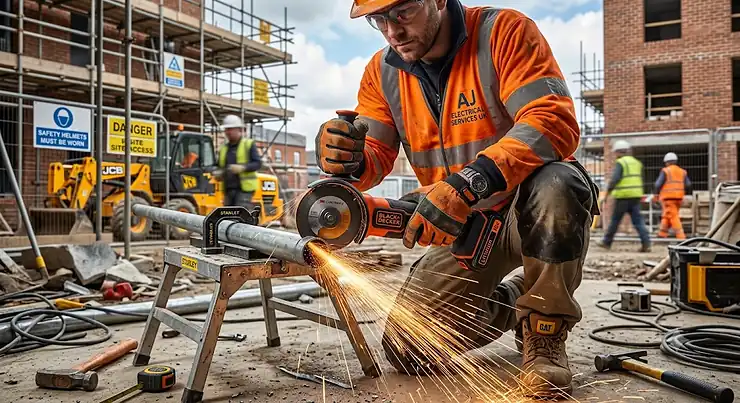
But “cordless” used to mean “compromised.” Not any more. A cordless angle grinder in 2026 runs on the same 18V or 20V battery platforms powering your drill and impact driver, and thanks to brushless motor tech, the power gap between battery and mains models has all but closed for anything short of industrial fabrication work. The catch is that not every model marketed at DIYers is actually fit for a tradesman’s daily grind — literally.
This guide walks through seven real, currently available cordless angle grinders spanning budget DIY kit to proper site-ready tools, with honest analysis of who each one suits. We’ll also dig into the safety features that genuinely matter — disc guard safety and kickback protection chief among them — because with a tool spinning a disc at 8,000-plus RPM inches from your hands, the spec sheet isn’t just marketing fluff. It’s the difference between a clean cut and a trip to A&E.
Quick definition: a cordless angle grinder is a handheld, battery-powered power tool that spins an abrasive or cutting disc at high speed for grinding, cutting, and finishing metal, masonry, and tile — prized for the portability that a mains lead simply can’t offer on site. For a broader technical history of the tool family, Wikipedia’s angle grinder entry is a useful primer.
Quick Comparison Table
| Model | Motor | Disc Size | Price Range | Best For |
|---|---|---|---|---|
| Ryobi ONE+ R18AG-0 | Brushed | 115mm | Under £75 (body) | Occasional DIY jobs |
| Ozito PXC PXAGS-500 | Brushed | 115mm | Under £50 (body) | Ultra-tight budgets |
| Erbauer EAG18-Li EXT | Brushless | 115mm | £55-90 (body) | Value-conscious DIYers |
| Bosch GWS 18V-10 | Brushless | 125mm | £130-180 (body) | Weekend trade & serious DIY |
| Makita DGA452Z | Brushless | 115mm | £110-150 (body) | All-round tradesmen |
| DeWalt DCG405N | Brushless | 125mm | £150-200 (body) | Daily professional use |
| Milwaukee M18 FUEL 115mm | Brushless | 115mm | £180-250 (body) | Heavy-duty pro fabrication |
Note on pricing: these are body-only price bands gathered at the time of research — battery-inclusive kits cost considerably more, and prices shift with retailer promotions, so always check current price before buying.
Looking at the spread, the real story isn’t which grinder is “best” — it’s which price bracket buys you a brushless motor. Below roughly £90 you’re mostly still choosing between brushed motors that work fine occasionally but wear faster under sustained use, while the mid-to-premium tier from Bosch upward is where brushless efficiency, smarter kickback protection, and tougher housings start justifying their asking price. The Milwaukee M18 FUEL sits at the top for a reason — it’s aimed at people who’ll use the tool five days a week, not five times a year.
💬 Just one click — help others make better buying decisions too!😊
Top 7 Cordless Angle Grinders: Expert Analysis
1. Ryobi ONE+ R18AG-0 — cheapest way into the ONE+ battery ecosystem
The standout here isn’t the grinder itself — it’s what it plugs into. If you already own Ryobi ONE+ garden tools or a drill, this angle grinder becomes essentially free of the “another battery to charge” tax.
The R18AG-0 runs an 18V brushed motor driving a 115mm disc, with a three-position auxiliary handle and a tool-less wheel guard for quick accessory swaps. A brushed motor means more friction and heat under load than the brushless models further down this list, so it isn’t the tool to reach for on back-to-back cutting jobs — but for the odd bracket trim or rust removal session, that distinction barely registers.
Based on the spec comparison, this is squarely a homeowner’s tool rather than a tradesman’s daily driver: the two-stage non-lockable switch is a genuine safety plus for occasional users, preventing accidental start-up when the tool’s picked up out of a toolbox, though it does mean you can’t lock the trigger on for longer continuous cuts. Reviewers consistently note that build quality feels solid for the price and that vibration is noticeably lower than older Ryobi grinders, though several mention the battery life on smaller Ah packs runs out faster than expected during metal cutting. What reviewers don’t dwell on, but the spec sheet implies, is that pairing this with only a small 2.0Ah battery will leave you swapping batteries mid-job on anything beyond light work.
Pros:
- ✅ Slots into the huge Ryobi ONE+ battery platform
- ✅ Tool-less guard adjustment speeds up disc changes
- ✅ Genuinely low price for a name-brand grinder
Cons:
- ❌ Brushed motor runs hotter under sustained use
- ❌ No trigger lock for longer continuous cutting
Body-only pricing sits under £75, though starter kits bundled with a battery and charger run closer to £150-170. For anyone already in the ONE+ ecosystem, this is close to unbeatable value; for a first cordless tool bought from scratch, the mid-range brushless options below offer more longevity per pound.

2. Ozito PXC PXAGS-500 — lowest realistic entry price on this list
The Ozito PXC PXAGS-500 exists for one clear reason: to be the cheapest angle grinder you can trust not to fall apart on the first outing.
Running on Ozito’s PXC 18V battery platform (shared with the brand’s budget garden tools), this is a 115mm brushed grinder with a basic side handle and a fixed-position disc guard. The spec sheet reads modestly — this is a light-duty motor built for occasional grinding, not extended metal fabrication — and that’s exactly what it delivers when used within its limits.
What most buyers overlook about entry-level grinders like this one is that the limiting factor usually isn’t the motor, it’s the battery: a small-capacity pack drains quickly under any real load, so runtime expectations should be modest from the outset. This is the right tool for someone who needs to deburr a few welds, cut through the odd bolt, or grind back a bit of rust once or twice a year — not for a tradesperson billing hours. Aggregated reviewer sentiment for the PXC range skews positive on value but frequently flags that battery packs and chargers are sold separately, inflating the real cost of getting started. Where verifiable review data on this specific model is thinner than for the bigger brands, that itself is a signal worth weighing — a smaller, less-reviewed model carries more uncertainty about long-term reliability than a grinder with thousands of data points behind it.
Pros:
- ✅ Among the lowest entry prices for a battery grinder
- ✅ Lightweight, easy for occasional users to control
- ✅ Compatible with Ozito’s wider PXC tool range
Cons:
- ❌ Battery and charger typically sold separately
- ❌ Thinner independent review coverage than major brands
Expect a price under £50 for the bare tool, with battery kits pushing that closer to the £80-100 range. This is a sensible pick only if you already own PXC batteries or genuinely need the cheapest possible entry point — for regular use, stepping up to a brushless model pays for itself in fewer replaced tools.
3. Erbauer EAG18-Li EXT — best brushless motor under £100
Here’s where the value proposition changes shape entirely: the Erbauer EAG18-Li EXT brings a brushless motor into budget territory, and that’s a genuinely significant upgrade over the two grinders above it.
Erbauer, Screwfix’s own trade-focused brand, built this 115mm grinder around its EXT 18V battery platform with a service-free brushless motor, a 2-in-1 tool-free guard, and a metal dust shield protecting internal components from grinding debris. In practice, a brushless motor means less friction, less heat, and meaningfully longer runtime per charge than the brushed alternatives at a similar price — this is the spec that actually matters more than headline wattage claims.
Honest analysis here: this sits in an unusual sweet spot, offering trade-brand safety features — soft start, restart protection, and overload protection — typically reserved for pricier tools, while undercutting Makita and Bosch on price by a wide margin. It suits DIYers who’ve outgrown a basic grinder and tradespeople who want a capable backup tool without touching their main battery platform. Reviewers on trade forums and retailer sites consistently praise the build quality relative to price and the smoothness of the brushless motor, though a recurring theme in aggregated feedback is that Erbauer’s battery range, while improving, still trails Makita and DeWalt on raw capacity options. The restart protection feature — which stops the tool firing back up automatically after a power cut or battery reinsertion — is the kind of detail that rarely makes it into marketing copy but genuinely reduces accidental start-up risk.
Pros:
- ✅ Brushless motor at a genuinely budget price point
- ✅ Restart protection and overload protection included
- ✅ 2-in-1 guard works for both grinding and cutting
Cons:
- ❌ EXT battery range has fewer high-capacity options
- ❌ Less nationwide service network than the big brands
Body-only pricing typically falls between £55 and £90 depending on retailer promotions, making this arguably the best-value brushless grinder on this whole list. If your budget caps out below £100 and you want a motor that’ll still be running strong in three years, start here.
4. Bosch GWS 18V-10 — best balance of DIY comfort and trade capability
The Bosch GWS 18V-10 is the grinder for someone who’s stopped calling themselves “just a DIYer” but hasn’t quite committed to full trade-grade pricing either.
Bosch fits this model with a brushless motor and steps the disc size up to 125mm, giving a slightly larger cutting and grinding surface than the 115mm tools further down the budget end of this list — useful when you’re working larger stock or want fewer passes on a long weld seam. The electronic overload protection cuts power before the motor overheats, which on paper sounds minor but in practice is what keeps a grinder alive through a full weekend of use rather than one intense afternoon.
Based on the spec comparison, this model is engineered as a genuine crossover tool: robust enough for light trade use, refined enough that a confident DIYer won’t feel like they’ve bought over their skill level. Aggregated review sentiment consistently highlights the smoothness of the trigger action and the tool’s balance in-hand, with a recurring complaint that the connected “SC” variants with Bluetooth tracking add cost some buyers don’t feel they need. What the spec sheet won’t tell you, but user reports suggest, is that the vibration dampening on the auxiliary handle noticeably reduces hand fatigue during longer cutting sessions compared to entry-level grinders — a detail that matters far more over an eight-hour day than any single spec figure.
Pros:
- ✅ Larger 125mm disc capacity than most rivals here
- ✅ Vibration-dampened handle reduces fatigue over long sessions
- ✅ Bosch Professional 18V battery system compatibility
Cons:
- ❌ Connected “SC” versions add cost some won’t need
- ❌ Sits above pure-budget pricing for occasional users
Expect body-only pricing in the £130-180 range, with the non-connected base variant sitting toward the lower end. For anyone doing regular home renovation or light trade work who wants headroom to grow into, this is a genuinely strong middle-ground pick.
5. Makita DGA452Z — the all-rounder tradesmen keep buying twice
Ask ten builders what cordless grinder they’d replace like-for-like if it broke tomorrow, and a fair few will say the Makita DGA452Z. That kind of repeat-purchase loyalty tells you more than any spec sheet.
This 115mm grinder runs Makita’s brushless motor on the LXT 18V platform, weighs a manageable 1.3kg without a battery fitted, and balances well once a battery is clipped in — a detail that matters more than raw weight figures once you’re holding the tool overhead or at an awkward angle for twenty minutes straight. The trigger lacks a lock-off feature, meaning your finger stays on it throughout use, which some users find limiting on longer continuous cuts but others appreciate as an inherent safety default.
Honest analysis: Makita’s reputation here is earned through sheer market longevity within the LXT ecosystem — buy this and you’re also buying access to one of the largest cordless battery platforms in the trade, spanning drills through to garden tools. Reviewers consistently praise the build quality and describe it as “built like a tank,” with a recurring theme that vibration is higher than premium rivals like DeWalt at roughly 7.2 m/s² but still well within comfortable working limits for most tasks. A commonly cited drawback in aggregated reviews is that the grinder ships in a cardboard box with no carry case, which feels like a minor omission at this price point, and that once fitted with a larger 4Ah or 5Ah battery the tool becomes noticeably heavier than the lightest rivals in its class.
Pros:
- ✅ Excellent balance and control once battery is fitted
- ✅ Backed by Makita’s vast LXT battery ecosystem
- ✅ Reputation for genuine long-term durability
Cons:
- ❌ No trigger lock-off for extended continuous use
- ❌ No carry case included in the box
Typical body-only pricing runs £110-150, positioning it as a mid-range tool with premium-brand trust behind it. If you’re already invested in Makita’s LXT platform, this is close to a default buy; if you’re starting fresh, it’s still one of the safest bets on this list.

6. DeWalt DCG405N — the professional’s benchmark
If there’s a grinder tradespeople describe as “the one to beat,” it’s the DeWalt DCG405N. This is a tool built with the assumption that it’ll be switched on every working day, not occasionally pulled from a drawer.
The DCG405N pairs a brushless motor with DeWalt’s XR 18V battery platform, driving a 125mm disc with noticeably lower vibration than budget and mid-range rivals — a genuine engineering advantage rather than a marketing claim, since lower vibration directly reduces hand-arm vibration exposure over a working day. The kickback brake and electronic clutch combination is engineered to cut power the instant the disc catches or binds, rather than relying purely on the operator’s grip strength to absorb the jolt.
Based on aggregated review data and spec comparison, this tool earns its premium pricing through the combination of comprehensive safety engineering and XR battery compatibility across dozens of other DeWalt tools — for UK contractors already on the XR platform, that cross-compatibility alone can justify the spend. Reviewers consistently rate the build quality and safety feature set as best-in-class among 18V cordless options, with the most common criticism being that, as a bare unit, the true cost only becomes clear once batteries and a charger are added to the basket. What most buyers overlook when comparing sticker prices across brands is that DeWalt’s total cost of ownership often comes out favourably once you factor in shared batteries across an entire tool kit rather than buying one grinder in isolation.
Pros:
- ✅ Genuinely lower vibration than most 18V rivals
- ✅ Strong kickback brake and electronic clutch system
- ✅ Huge cross-compatible XR battery ecosystem
Cons:
- ❌ Premium pricing, especially once batteries are added
- ❌ Overkill for occasional or light DIY use
Body-only pricing typically sits in the £150-200 range. For daily professional use where downtime costs money, this remains the benchmark against which cheaper grinders are usually measured.
7. Milwaukee M18 FUEL 115mm — the heavy-duty pick for serious fabrication
At the top of this list sits the Milwaukee M18 FUEL 115mm, a grinder built for people who cut and grind metal for a living rather than a weekend.
Milwaukee’s POWERSTATE brushless motor is engineered to deliver output comparable to many corded grinders, with variable speed control letting you dial down torque for finishing work and crank it up for aggressive material removal. The REDLINK PLUS electronics monitor temperature and load in real time, which on paper translates into a tool that resists stalling under exactly the kind of sustained pressure that kills cheaper motors.
Honest take: this is the grinder for tradespeople who measure a tool’s value in years of daily abuse rather than pounds spent, and Milwaukee’s app-connected features — while genuinely useful for fleet tracking on larger job sites — are also the one part of the package some tradespeople say they’d happily skip for a lower price. Reviewers consistently describe the build quality and safety feature set as justifying the premium, with variable speed control and smooth power delivery cited repeatedly as standout traits. The most common criticism in aggregated feedback isn’t performance — it’s that the connected features require app setup that some users find an unnecessary extra step for a tool they just want to switch on and use.
Pros:
- ✅ Corded-rivalling power from the POWERSTATE motor
- ✅ Real-time overload and temperature monitoring
- ✅ Variable speed control for finishing and heavy cutting
Cons:
- ❌ Highest price point on this list
- ❌ Connected app features feel unnecessary to some
Body-only pricing runs roughly £180-250, at the premium end of the cordless angle grinder market. If your work genuinely demands corded-level performance without the cable, this is the closest cordless gets to that standard.
Practical Usage Guide: Setup, First 30 Days & Maintenance
Getting a new cordless angle grinder from box to job site safely starts before you ever pull the trigger. Charge the battery fully before first use, and check it seats with a firm click — a loose-fitting battery is one of the more common causes of intermittent power loss reported by first-time cordless grinder owners. Fit the disc guard before anything else; every model on this list ships with the guard removable for disc access, and it should go back on before the first test run, not “after you’ve had a quick go.”
During the first 30 days, resist the urge to push a new tool to its limits immediately. Run the grinder unloaded for 30 seconds after any disc change to confirm it spins true without wobble — a wobbling disc is a warning sign of incorrect fitting, not something to work through. A common early mistake is using a grinding disc for cutting work or vice versa; the two are engineered for different stresses, and using the wrong one materially raises the risk of the disc shattering under load.
Maintenance from there is straightforward but easy to neglect. Clear vents of dust build-up regularly, particularly if you’re grinding masonry or working in dusty environments, since blocked airflow is a leading cause of premature motor wear on brushed models especially. Store batteries at partial charge rather than fully depleted if the tool won’t be used for weeks, and inspect discs before every session for cracks, chips, or uneven wear — a damaged disc is not a “finish the job first” problem, it’s a “stop now” problem.
Real-World Scenarios: Who Should Buy Which Grinder
Picture three different buyers walking into this decision. First, a college student living in a rented flat, doing the occasional bike repair or flat-pack modification — for them, the Ozito PXC PXAGS-500 or Ryobi ONE+ R18AG-0 covers everything they’ll realistically need, and spending more would be money left on the table.
Second, a self-employed handyman doing five or six jobs a week across kitchens, gardens, and the odd bit of metalwork — budget around £400-600 across a season for tools and consumables, and the Erbauer EAG18-Li EXT or Bosch GWS 18V-10 hits the sweet spot of brushless reliability without premium-brand pricing. This buyer needs a tool that survives being thrown in a van toolbox daily, but doesn’t need Milwaukee-level output for the work they’re actually doing.
Third, a full-time fabricator or contractor cutting rebar, trimming steel studwork, or doing structural metalwork five days a week — for this profile, the DeWalt DCG405N or Milwaukee M18 FUEL 115mm isn’t a luxury, it’s the tool that determines whether the job gets done on schedule. Downtime from a failed motor costs this buyer far more than the price difference between a mid-range and premium grinder, which is exactly why professionals gravitate toward the top of this list despite the higher upfront spend.

How to Choose a Cordless Angle Grinder
- Match disc size to your typical work. 115mm grinders are lighter and more manoeuvrable for detail work; 125mm gives a slightly larger cutting surface for bigger stock, at a small weight penalty.
- Prioritise brushless motors if budget allows. They run cooler, last longer per charge, and typically outlive brushed equivalents by a wide margin under regular use.
- Check battery platform compatibility first. If you already own tools on a given 18V system, staying within that ecosystem saves significant money over buying a rival brand’s battery from scratch.
- Weigh vibration ratings for extended use. A tool with a lower m/s² rating meaningfully reduces fatigue and long-term hand-arm vibration exposure across a working day.
- Confirm the safety feature set. Restart protection, overload protection, and a properly adjustable disc guard aren’t optional extras — treat any grinder lacking these as unsuitable for regular use. Official HSE guidance on selecting lower-vibration equipment is worth a read if you’re buying for regular or professional use.
- Consider trigger design for your work style. A lock-on switch suits long continuous cuts; a non-lockable “deadman” switch suits users who prioritise accidental-start protection over convenience.
- Factor in total cost, not just body price. A cheap bare tool paired with an expensive battery purchase can end up costing more than a slightly pricier kit sold with battery and charger included.
Disc Guard Safety: What Actually Matters
The disc guard on a cordless angle grinder isn’t a bureaucratic add-on — it’s the single component standing between a shattered disc fragment and your face. A properly positioned guard shields roughly half the disc, sitting between the operator and the spinning wheel, and every model on this list includes one as standard, though the quality of adjustment mechanisms varies noticeably between budget and premium tools.
Tool-less guards, found on the Bosch GWS 18V-10, Makita DGA452Z, and Erbauer EAG18-Li EXT, let you reposition the guard for different tasks — grinding versus cutting — without reaching for a spanner, which matters more than it sounds because a guard that’s awkward to adjust gets skipped or left in the wrong position under time pressure. Never operate a grinder with the guard removed entirely, even briefly, and never position it rotated away from you for a “better view” of the cut — that’s one of the more common ways operators end up in the direct line of flying debris. If you take away one thing from this section, make it this: the guard’s job is to be between you and the disc, always, without exception, regardless of how confident you feel about the cut.
Kickback Protection: The Feature That Prevents Serious Injury
Kickback happens when a spinning disc catches, binds, or jams against the material being worked, and the reaction thrusts the entire tool violently back or sideways toward the operator — it’s widely recognised as the single most common cause of serious angle grinder injuries. Understanding why it happens matters as much as the protective features that mitigate it.
Modern cordless grinders combat this with a combination of electronic and mechanical safeguards. Restart protection — present on the Erbauer EAG18-Li EXT, DeWalt DCG405N, and Milwaukee M18 FUEL 115mm — stops the tool firing back up automatically if power is interrupted mid-task, preventing an unexpected restart from catching you off guard. Overload and torque-sensing electronics, most developed on the DeWalt and Milwaukee units here, detect a sudden spike in resistance and cut power before the bind escalates into a full kickback event. According to workplace safety guidance, a firm two-handed grip using the auxiliary handle at all times is one of the most effective controls available to any operator, regardless of which safety electronics the tool itself includes — the technology reduces risk, but it doesn’t remove the need for proper technique.
Brushless Motor Benefits Explained
“Brushless” gets thrown around as a marketing buzzword, but the underlying engineering genuinely changes how a grinder performs. A brushed motor relies on physical carbon brushes making contact with a rotating commutator — friction that generates heat, wears the brushes down over time, and caps efficiency. A brushless motor uses electronic controllers instead, eliminating that friction point entirely.
In practice, this means three concrete advantages: longer runtime per battery charge because less energy is lost to friction and heat, extended tool lifespan since there are no brushes to wear out and eventually replace, and typically more consistent power delivery under load. The trade-off is upfront cost — brushless motors add complexity and expense to manufacture, which is exactly why the Ryobi ONE+ R18AG-0 and Ozito PXC PXAGS-500 stay brushed to hit their budget price points, while the Erbauer EAG18-Li EXT stands out precisely for bringing brushless tech below £100. For anyone using a grinder more than a handful of times a year, the brushless premium tends to pay for itself through reduced replacement frequency alone.
Cordless vs Corded Angle Grinders
The instinctive assumption is that corded means more power, full stop — but that gap has narrowed considerably. Corded angle grinders still generally offer higher sustained wattage for continuous heavy-duty cutting, uninterrupted by battery depletion, which matters most in industrial or prolonged fabrication settings. Cordless models trade a small amount of peak sustained output for portability, no trailing cable hazard, and increasingly comparable short-to-medium burst performance thanks to brushless motors.
For most UK trade and DIY scenarios — cutting rebar on a site with no power point nearby, trimming metal fencing in a garden, or working on a roof where trailing a cable is genuinely dangerous — the cordless convenience outweighs the marginal power difference. A UK research report comparing battery-powered and traditionally powered hand tools found that noise and vibration output from cordless tools isn’t automatically lower than corded equivalents — it can go either way depending on the specific model, which is a useful reminder that “cordless” alone doesn’t guarantee lower vibration exposure — the individual tool’s engineering still matters more than its power source. Corded grinders remain the better choice for workshop-based, high-volume industrial cutting where a mains socket is always within reach and sustained output trumps portability.
Long-Term Cost & Maintenance
The sticker price on a bare grinder tells only part of the cost story. Replacement discs, typically £2-8 each depending on type and material, add up quickly for anyone using a grinder regularly — budgeting for consumables matters as much as the initial tool purchase. Batteries represent the other significant ongoing cost: a single 18V 4Ah battery commonly runs £40-70 depending on brand, and anyone starting from scratch on a battery platform should factor at least two batteries into their total budget so one can charge while the other’s in use.
Brushless motors shift this calculation favourably over a multi-year horizon. Because there are no brushes to wear out and replace, a well-maintained brushless grinder from brands like DeWalt, Makita, Bosch, or Milwaukee can reasonably be expected to outlast two or three cheaper brushed models bought sequentially — meaning the higher upfront cost often works out cheaper per year of service. Factor in shared battery platforms too: buying into an ecosystem you already own tools on effectively reduces the true cost of each additional tool, since you’re not paying for a battery and charger every single time.
Safety, Regulations & Compliance Guide
UK power tools sold for both trade and DIY use must carry CE or UKCA marking confirming they meet relevant safety standards, and reputable retailers won’t stock grinders without it — a useful sanity check if you’re ever tempted by an unfamiliar budget brand online. For anyone using a cordless angle grinder regularly as part of paid work, UK health and safety guidance on hand-arm vibration is directly relevant: vibration transmitted into the hands and arms from hand-held power tools is a recognised occupational hazard, and regular, frequent exposure over time can lead to permanent conditions such as hand-arm vibration syndrome. You can read the full official guidance on the HSE’s hand-arm vibration pages.
Practically, that means limiting continuous grinding sessions, taking regular breaks, and choosing tools with genuinely lower vibration emissions where sustained daily use is expected — a point directly relevant when comparing the DeWalt DCG405N‘s noticeably lower vibration figures against budget alternatives. Always wear proper PPE — safety glasses or a face shield, hearing protection, and gloves — and never bypass a disc guard for convenience, regardless of how routine the task feels.
✨ Don’t Miss These Exclusive Deals!
🔍 Take your workshop to the next level with these carefully selected cordless angle grinders. Click on any highlighted item to check current pricing and availability. These tools will help you tackle metalwork, DIY repairs, and trade jobs with real confidence!
Features That Actually Matter (And Those That Don’t)
Cutting through the marketing noise: motor type (brushed vs brushless) matters enormously for longevity and runtime, and it’s the single spec worth prioritising above almost anything else on a budget. Kickback protection and overload electronics matter for safety and tool survival under load — these aren’t nice-to-haves on a tool spinning discs at high speed. Battery platform compatibility matters hugely for total cost of ownership if you already own other tools.
What matters less than the marketing suggests: peak RPM figures, since most grinders in a given disc size cluster within a similar range and the practical difference rarely shows up in real-world cutting speed. App connectivity and Bluetooth tracking, while genuinely useful for larger fleets managing dozens of tools, add cost that solo tradespeople and DIYers can usually skip without losing anything functional. Colour-coded branding and cosmetic design differences between otherwise similar models are, unsurprisingly, irrelevant to how well the tool actually performs.
Problem → Solution: Common Cordless Grinder Issues
Problem: Battery drains faster than expected. This is almost always down to pack capacity mismatched to workload — pairing a small 2.0Ah battery with sustained cutting work will always disappoint. Solution: step up to a 4Ah or 5Ah battery, or budget for a second pack to swap mid-job.
Problem: Disc wobbles after fitting. Usually caused by incorrect flange seating or a bent flange from a previous impact. Solution: remove the disc, inspect the flange for damage, reseat carefully, and run the grinder unloaded before returning to work.
Problem: Motor bogs down under load. On brushed models, this often signals worn brushes or a motor working beyond its comfortable duty cycle. Solution: allow cool-down breaks between heavy tasks, or consider upgrading to a brushless model like the Erbauer EAG18-Li EXT if this happens regularly.
Problem: Grinder feels unbalanced or tiring to hold. Often a mismatch between battery size and tool ergonomics — a large 5Ah battery on a lightweight body shifts the centre of gravity noticeably. Solution: the Makita DGA452Z is specifically praised in reviews for staying balanced with larger batteries fitted.
Problem: Uncertainty about which disc to use. Using a cutting disc for grinding (or vice versa) significantly raises kickback risk. Solution: always match the disc type to the task, and check the disc’s rated maximum RPM against your tool’s spec before fitting.
Buyer’s Decision Framework
If you’ll use the grinder fewer than ten times a year, choose a budget brushed model like the Ozito PXC PXAGS-500 because the cost savings outweigh the longevity difference at that usage level. If you’re a regular DIYer doing home projects most weekends, choose a budget-brushless option like the Erbauer EAG18-Li EXT because the runtime and lifespan gains justify the modest price step-up. If you’re a working tradesperson using the tool several times weekly, choose a mid-range model like the Bosch GWS 18V-10 or Makita DGA452Z because reliability under repeated daily use becomes the deciding factor over pure price. If downtime genuinely costs you money on a job site, choose a premium model like the DeWalt DCG405N or Milwaukee M18 FUEL 115mm because the safety engineering and durability directly protect your earnings.
Cordless Angle Grinders for Tradesmen
For tradesmen specifically, the calculation shifts away from price-per-tool and toward reliability-per-workday. Battery platform lock-in becomes strategic rather than incidental — choosing DeWalt XR or Makita LXT because your drills, saws, and impact drivers already run on that system means every new tool purchase gets cheaper, since you’re not buying a fresh battery and charger each time. The DeWalt DCG405N and Milwaukee M18 FUEL 115mm both target this buyer directly, with safety electronics and vibration control engineered for daily rather than occasional exposure.
Site conditions also change what “best” means. A tradesman working outdoors in variable weather values a sealed, dust-resistant housing more than a DIYer working in a dry garage ever would — the Erbauer EAG18-Li EXT‘s dust shield and the premium models’ overload protection both speak to that reality. Reviewers who identify as tradespeople consistently mention durability and warranty support as deciding factors over headline specs, a pattern that reinforces why professional-tier brands maintain their premium pricing even as budget alternatives close the performance gap.
What to Expect: Real-World Performance
Specs on a box rarely translate directly into how a tool feels in daily use, so here’s the practical translation. A 115mm brushless grinder like the Bosch GWS 18V-10 or Makita DGA452Z will comfortably handle cutting through mild steel box section, trimming rebar, and general metal fabrication without labouring — expect smooth, consistent power rather than the surging feel some cheaper brushed motors exhibit under load. Battery runtime on a 4Ah pack typically supports 20-40 minutes of active cutting time depending on material and disc type, though that figure drops noticeably with harder materials or thicker cross-sections.
Vibration is the sensation that surprises first-time cordless grinder buyers most — even “low vibration” models transmit a noticeable buzz through the hands after extended use, which is exactly why the auxiliary handle and proper two-handed grip aren’t optional extras. Noise levels sit broadly similar across brushless models regardless of price tier, meaning hearing protection remains necessary even on premium tools. The genuine differentiator between budget and premium in daily use isn’t raw cutting speed — it’s how consistently that performance holds up across the fifth, twentieth, and hundredth use.
Cordless Angle Grinder Reviews: What Aggregated Feedback Reveals
Pulling review themes together across all seven models, a consistent pattern emerges: brushless motors correlate strongly with positive long-term satisfaction, while brushed budget models generate more mixed feedback specifically around battery life and motor longevity under regular use. Build quality complaints cluster disproportionately around the cheapest options, while premium models draw criticism almost exclusively around price rather than performance — a telling distinction.
Safety feature satisfaction also tracks closely with price tier. Reviewers of the DeWalt DCG405N and Milwaukee M18 FUEL 115mm frequently cite confidence in the kickback protection and overload systems as justifying the spend, particularly among users who’ve previously experienced a kickback event on a lesser-equipped tool. Where verifiable, detailed reviews are sparser — as with the Ozito PXC PXAGS-500 — that itself is worth factoring into a purchase decision, since a smaller review pool means less certainty about long-term reliability trends.

Frequently Asked Questions
❓ What size cordless angle grinder do I need?
❓ Is a brushless cordless angle grinder worth the extra cost?
❓ How long does a cordless angle grinder battery last per charge?
❓ Can a cordless angle grinder cut through steel?
❓ What safety features should I check before buying a cordless angle grinder?
Conclusion
Choosing a cordless angle grinder ultimately comes down to matching the tool to how often — and how hard — you’ll actually use it. Occasional users genuinely don’t need to spend beyond the Ryobi ONE+ R18AG-0 or Ozito PXC PXAGS-500, while regular DIYers get outsized value from the brushless Erbauer EAG18-Li EXT stepping them up without breaking the bank. Tradespeople doing this daily should look toward the Bosch GWS 18V-10 and Makita DGA452Z for dependable mid-range performance, or the DeWalt DCG405N and Milwaukee M18 FUEL 115mm where safety engineering and durability directly protect billable hours.
Whichever model you land on, the safety fundamentals stay constant: never skip the disc guard, always use the auxiliary handle, match the disc to the task, and respect kickback as a genuine hazard rather than a rare edge case. Get those right, and any of the seven grinders covered here will serve you well for years of cutting, grinding, and finishing work.
✨ Ready to Upgrade Your Toolkit?
🔍 Check current pricing on today’s top cordless angle grinders and find the perfect match for your next project. Your future self — with less arm fatigue and fewer trips to the hardware shop — will thank you!
Recommended for You
- Reciprocating Saw For Tree Pruning: 7 Best Picks Ranked (2026)
- 7 Best Multi-Voltage Reciprocating Saw Picks UK 2026
- Best Cordless Reciprocating Saw for Pipe Cutting 2026: 7 Top Picks
Disclaimer: This article contains affiliate links. As an Amazon Associate, I earn from qualifying purchases. If you purchase products through these links, we may earn a small commission at no additional cost to you.
✨ Found this helpful? Share it with your friends! 💬🤗
