In This Article
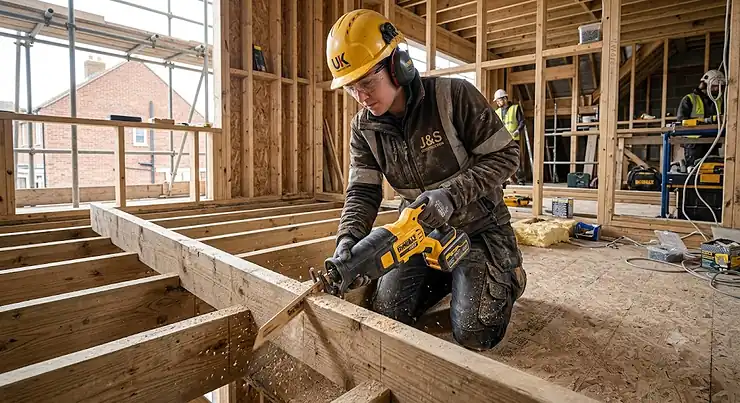
Buy the wrong reciprocating saw and you don’t just waste money — you end up buying a second, third and fourth battery to feed it. That’s the trap most people fall into with a multi-voltage reciprocating saw: they focus entirely on the tool and ignore the ecosystem it drags along behind it. A recip saw is a workhorse. It rips through nail-studded timber, hacks copper pipe out of a wall cavity, trims tree roots, and dismantles a shed in an afternoon. But “multi-voltage” covers several genuinely different engineering approaches — from a single tool that automatically switches between 18V and 54V, to twin-battery 36V setups, to platforms that share batteries across an entire brand’s tool range. Get that distinction wrong and you’ll be stuck with a battery collection that doesn’t fit anything else you own.
This guide is built from real specifications, real UK retailer listings, and genuine aggregated review sentiment — not marketing copy lifted from a product page. We’ve pulled together seven actual saws you can buy on amazon.co.uk today, spanning budget, mid-range and premium, and we’ve weighed each one against the questions that actually decide whether you’ll be happy with it in six months: how much genuine cutting power you get, whether the batteries interchange with tools you already own, and what it actually costs to keep the thing running. A reciprocating saw, in the simplest possible terms, is a handheld power saw that cuts using a push-pull blade motion rather than a spinning disc — brilliant for demolition, plumbing and rough carpentry where precision matters less than raw cutting speed. As the Wikipedia entry on reciprocating saws notes, the tool traces its origins back to Milwaukee’s original “Sawzall,” first produced in 1951. We’ll cover which of today’s cordless versions earns that reputation and which ones fall short.
Quick Comparison Table
| Saw | Voltage System | Battery Included? | Best For |
|---|---|---|---|
| DeWalt DCS389 | 18V/54V XR FlexVolt (auto-switching) | No (tool only) | Best for genuine multi-voltage power switching |
| Milwaukee M18 FUEL Super Sawzall | 18V (HIGH OUTPUT battery) | Kit versions available | Best for sustained demolition work |
| Makita DJR360 | Twin 18Vx2 (36V) | No (tool only) | Best for existing Makita LXT owners |
| Bosch GSA 18V-32 | 18V Professional (AMPShare) | No (tool only) | Best for cross-brand battery flexibility |
| Einhell TE-AP 18/28 Li BL | 18V Power X-Change | No (tool only) | Best value ecosystem for mixed tool needs |
| Ryobi ONE+ RRS1801M | 18V ONE+ | Kit versions available | Best budget entry point |
| ONEVAN 32mm (Makita-compatible) | 18V/20V (uses Makita batteries) | No | Best lesser-known cross-platform pick |
Looking at the spread above, the DeWalt DCS389 sits at the top for anyone who genuinely needs a tool that reconfigures its own voltage depending on the battery inserted, while the Bosch GSA 18V-32 and the ONEVAN 32mm model solve a completely different problem — squeezing more use out of batteries you already own across brands. Budget-conscious buyers shouldn’t dismiss the Ryobi ONE+ RRS1801M or Einhell TE-AP 18/28 Li BL, since both plug into enormous, low-cost tool ecosystems rather than a single specialist saw. The real decision, as we’ll get into below, is less about which saw cuts fastest and more about which battery platform you’re willing to commit to for the next five years.
💬 Which one’s calling your name so far? Scroll on — the full breakdown is coming up next.🤗
Top 7 Multi-Voltage Reciprocating Saws: Expert Analysis
1. DeWalt DCS389 — auto-switches between 18V and 54V
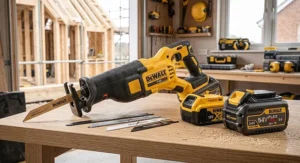
The clever bit about the DeWalt DCS389 isn’t the motor, it’s the battery contact strip — insert an 18V pack and the saw runs at 18V; swap in a 54V FlexVolt pack and it automatically reconfigures to run at 54V, no dial, no adapter, no fuss. Under the bonnet you’re looking at a brushless motor delivering a no-load speed of 3,000 strokes per minute, and DeWalt’s own testing shows up to 19% more power when the DCS389 is used with a 9Ah battery compared with its predecessor, the DCS388. In practical terms, that translates to noticeably less bogging down when you hit a knot in old joist timber or a stubborn cast-iron waste pipe — the kind of moment where a lesser 18V saw stalls and you end up wrestling the blade free. Based on the spec comparison with rival flagship saws, this is the closest thing on the UK market to genuinely tool-free voltage switching, which is exactly what “multi-voltage” ought to mean rather than just “compatible with more than one battery.” Reviewers consistently note that the pivoting shoe helps stabilise the saw against the workpiece during aggressive cuts, and tradespeople doing demolition and large pipe cutting single out the sheer stamina of the tool through thick material as its standout trait. This saw is for anyone already invested in — or planning to invest in — the DeWalt 18V/54V XR FlexVolt ecosystem, since the FlexVolt batteries also power DeWalt’s mitre saws, grinders and even some SDS hammers, so the investment isn’t wasted if you eventually outgrow the recip saw itself.
Pros:
- ✅ Genuinely auto-switches voltage with no manual settings
- ✅ Up to 19% more power versus the previous-generation model
- ✅ Pivoting shoe adds stability on awkward cuts
Cons:
- ❌ Sold body-only — battery and charger cost extra
- ❌ FlexVolt 54V batteries carry a premium price versus standard 18V packs
Expect this one to sit in the mid-£150s to low-£200s range for the bare tool, with a genuine 54V 6.0Ah battery adding significantly on top — check current price before buying, as retailer stock and bundle deals shift regularly. Given the power ceiling and the auto-switching trick, it’s strong value for anyone who already owns FlexVolt batteries, though it’s a harder sell as a first purchase into the platform.
2. Milwaukee M18 FUEL Super Sawzall — corded-level demolition power
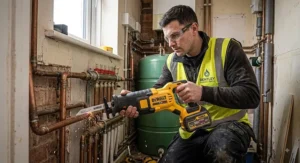
Milwaukee doesn’t chase multi-voltage switching with the Super Sawzall; instead it squeezes corded-saw performance out of a single 18V platform, and the standout feature here is the sheer stroke length. At 1-1/4 inches, the stroke removes noticeably more material per pass than the shorter-stroke saws in this list, which matters enormously once you’re cutting thick timber or dense composite decking boards. The POWERSTATE brushless motor delivers 3,000 strokes per minute and higher speeds under load for corded cutting performance, and paired with the HIGH OUTPUT HD12.0 battery, Milwaukee’s own figures put it at up to 150 cuts in 2×12 SPF timber on a single charge. What most buyers overlook about this saw is that its 5-speed dial isn’t just a gimmick — dropping speed for metal cutting genuinely extends blade life, something reviewers in trade forums flag repeatedly as a reason blades on this saw seem to outlast those on fixed-speed rivals. This is the saw for tradespeople who live in the M18 ecosystem already — electricians, plumbers and HVAC engineers who need one saw that simply doesn’t quit mid-shift, according to Milwaukee’s own positioning of the platform for those trades. Aggregated user feedback across retailer review sections consistently praises the RAPIDSTOP blade brake for cutting down on accidental nicks when releasing the trigger near your other hand, a small detail that adds up over a long working day.
Pros:
- ✅ Corded-saw cutting speed from an 18V battery platform
- ✅ 1-1/4″ stroke length shifts more material per pass
- ✅ RAPIDSTOP blade brake improves everyday safety
Cons:
- ❌ HIGH OUTPUT HD12.0 battery is heavy and pricey on its own
- ❌ Bare-tool pricing sits at the premium end of the 18V category
Bare-tool pricing tends to fall in the £150-£220 range depending on retailer stock, climbing into the mid-£300s for a kit with the HD12.0 battery and charger — always check current price rather than relying on a headline figure, as Milwaukee kit configurations change often. For anyone already on the M18 platform, the value case is straightforward: no new charger, no new battery standard, just raw cutting performance added to a system you’re already running.
3. Makita DJR360 — twin 18V batteries deliver true 36V
Where DeWalt uses a single clever battery, the Makita DJR360 takes the brute-force route: two standard 18V LXT batteries slotted in series to drive a 36V brushless motor. The standout feature is that you don’t need a dedicated 36V battery at all — if you already own a stack of Makita 18V packs from drills, impact drivers or angle grinders, this saw simply borrows two of them. The brushless motor optimises battery energy use for up to 50% longer run time per charge compared with brushed equivalents, and the saw reaches a genuinely quick 3,000 strokes per minute. On paper this means you’re getting flagship-level power without buying into a whole separate voltage tier, which is precisely why this model shows up so often in Makita-owning tradespeople’s kit lists rather than a purpose-built 40V XGT saw. The trade-off, and it’s worth being upfront about it, is that running two 18V batteries at once burns through your existing battery stock twice as fast as a single-battery tool — something the spec sheet won’t tell you, but anyone who’s run this saw hard through a full day of demolition will confirm. Reviewers on UK trade retailer sites consistently flag the tool-less blade change and retractable joist hook as genuinely useful daily-use features, not just box-ticking additions. This saw suits established Makita LXT owners far more than someone starting from scratch, since two fresh 18V batteries cost roughly the same as one dedicated 36V pack from a rival brand, without adding a new charger standard to your workshop.
Pros:
- ✅ Runs on two ordinary 18V LXT batteries you may already own
- ✅ Up to 50% longer runtime versus brushed motor equivalents
- ✅ Tool-less blade change and retractable joist hook
Cons:
- ❌ Draws down two batteries simultaneously, doubling charge cycles used
- ❌ Sold body-only with no bundled batteries or charger
Body-only pricing generally sits in the £180-£230 range depending on retailer, with case-included versions at the higher end — prices move around, so it’s worth comparing current listings rather than assuming a fixed figure. For existing LXT owners the value proposition is excellent; for anyone starting fresh, it’s a more expensive route into 36V power than committing to a dedicated FlexVolt or M18 flagship.
4. Bosch GSA 18V-32 — the cross-brand battery specialist
The Bosch GSA 18V-32‘s standout feature isn’t its cutting speed, impressive as that is — it’s AMPShare, Bosch’s cross-brand battery alliance that lets this saw’s batteries also run tools from partner manufacturers outside the Bosch range entirely. The saw is compatible with all Bosch Professional 18V batteries and chargers, and also compatible with AMPShare, the multi-brand battery alliance, which is a genuinely unusual proposition in a market where most brands actively lock you into their own ecosystem. On the cutting side, the BITURBO brushless motor delivers corded-level power with what independent UK trade reviewers describe as the standout feature within the Bosch 18V Professional range being its FlexiClick head, which lets tradespeople handle awkward angles, overhead cutting and tight service voids that a fixed-head saw simply can’t reach. Here’s what to weigh: this saw earns its keep on jobs that involve genuinely awkward access — loft conversions, service voids behind stud walls, tight plant rooms — rather than straightforward flat-out demolition, where a fixed-head saw with a longer stroke might actually get through material faster. What most buyers overlook is that AMPShare compatibility works both ways: not only can Bosch batteries run selected tools from partner brands, but it future-proofs your investment if you’re not yet fully committed to one manufacturer. Aggregated review sentiment from UK trade users highlights vibration control as a genuine standout, with several noting reduced hand fatigue over long sessions compared with older Bosch reciprocating saws.
Pros:
- ✅ AMPShare battery alliance works across multiple tool brands
- ✅ FlexiClick head genuinely opens up awkward-angle cutting
- ✅ Vibration Control noticeably reduces fatigue on long jobs
Cons:
- ❌ Sold body-only, and Bosch Professional batteries carry a premium
- ❌ FlexiClick versatility costs more than the fixed-head GSA 18V-28
Expect body-only pricing in the £180-£280 range depending on whether you choose the FlexiClick head version, with the simpler BITURBO GSA 18V-28 sitting a little lower — check current price, as Bosch Professional stock and case bundles fluctuate across UK retailers. For tradespeople who already carry a mixed toolkit across brands, the AMPShare angle alone can justify the premium over a closed-ecosystem rival.
5. Einhell TE-AP 18/28 Li BL — the biggest bang-for-buck ecosystem
The Einhell TE-AP 18/28 Li BL‘s standout feature is scale: it’s part of Power X-Change, a system where, as Einhell puts it, every rechargeable battery in the range can be combined with any Power X-Change device — and that range now spans well over 250 tools, including garden equipment, meaning one battery drawer covers your hedge trimmer, pressure washer and this saw alike. The brushless motor keeps this in genuinely capable territory rather than budget-bin performance, and reviewers consistently point out that Power X-Change is also fully shared with Ozito, Einhell’s UK budget sub-brand sold through major DIY retailers, effectively doubling your realistic tool options on the same battery. Based on the spec comparison with premium-brand rivals, you won’t match a Milwaukee M18 FUEL for raw demolition stamina, but for general DIY, light trade work and garden maintenance the gap closes considerably once you factor in genuine day-to-day usability. What most buyers overlook is the ability to mix battery capacities freely within a single tool — you’re not locked into buying matched pairs, so a spare 2.0Ah pack from an old drill can happily power this saw in a pinch. Aggregated customer sentiment on major UK retail sites frequently praises the toolless blade change and adjustable soleplate, with several reviewers noting the saw feels considerably more refined than its price bracket suggests.
Pros:
- ✅ Power X-Change batteries run 250+ tools including garden kit
- ✅ Fully cross-compatible with the budget Ozito sub-brand too
- ✅ Any 18V PXC battery works, regardless of capacity
Cons:
- ❌ Falls short of premium-brand saws on raw demolition power
- ❌ Bare-tool listings vary in stock across UK retailers
Bare-tool pricing generally sits in the £90-£150 range, making it one of the most accessible ways into brushless multi-battery cutting power — as always, use current listed prices rather than a fixed figure, since Power X-Change deals rotate frequently. For anyone building a first cordless tool collection from scratch rather than adding to an existing brand loyalty, this is arguably the strongest value case on this entire list.
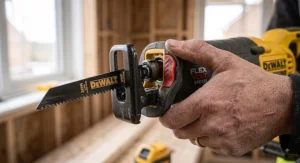
6. Ryobi ONE+ RRS1801M — the largest battery platform, bar none
The Ryobi ONE+ RRS1801M‘s standout feature is context rather than raw spec: it plugs into what’s widely reported as the largest cordless battery platform by tool count, with over 300 tools using the same 18V ONE+ battery, covering everything from drills to inflators to garden blowers. On its own merits the saw is a competent, unglamorous performer — a maximum cutting depth of up to 180mm and a 22mm stroke length, with anti-vibration technology aimed at comfortable extended use, and Ryobi’s own figures put a 5.0Ah battery at roughly 92 cuts in 50x100mm pine timber per charge. Here’s what to weigh: this isn’t a demolition-site saw built to outlast a corded rival — it’s a homeowner and light-DIY tool that happens to share a battery with the lawnmower, the shop vac and the drill you probably already own. Based on the spec comparison with trade-focused rivals on this list, the RRS1801M loses on stroke length and raw power but wins decisively on ecosystem breadth and starting price, which matters enormously to anyone assembling a first cordless toolkit on a budget. Reviewers consistently flag the tool-less blade clamp and adjustable shoe as genuinely useful touches that punch above the saw’s budget positioning, and the sheer number of ONE+ compatible tools means a household rarely needs more than two or three ONE+ batteries in rotation to keep everything running.
Pros:
- ✅ Shares batteries with 300+ ONE+ tools across the Ryobi range
- ✅ Tool-less blade clamp and adjustable shoe for everyday use
- ✅ Genuinely low entry price for a brushed-ready-for-brushless ecosystem
Cons:
- ❌ Shorter stroke length limits speed through thick material
- ❌ Not built for sustained heavy trade demolition work
Bare-tool pricing sits around the £60-£90 mark, with starter kits including a battery and charger typically in the £90-£130 range — prices shift with retailer promotions, so check current listings before buying. For anyone who already owns a Ryobi drill, mower or garden tool, adding this saw is close to a no-brainer purely on ecosystem economics.
7. ONEVAN 32mm Brushless Reciprocating Saw — the lesser-known cross-platform pick
The ONEVAN 32mm Brushless Reciprocating Saw‘s standout feature is refreshingly simple: it’s built to run directly on Makita 18V batteries — compatible with the common 18V B-series packs including BL1850B, BL1840B, BL1830B and BL1820B — without you needing to buy a Makita-branded saw at all. This is squarely a budget-and-battery-compatibility play rather than a premium spec sheet: it won’t match the DeWalt DCS389 or Milwaukee Super Sawzall on stroke length or sustained power, but for occasional cutting jobs it offers a genuinely useful route to squeezing more value from batteries you already own. The brushless motor and tool-less blade clamp put it a notch above the cheapest own-brand alternatives, and an integrated LED work light keeps the cutting area lit for accuracy in low-light spaces such as lofts or under-floor voids. What most buyers overlook with saws like this is the compatibility caveat: it explicitly does not work with older Makita G-series or NiCad packs, so it’s worth double-checking your exact battery model before ordering. Aggregated buyer feedback on this category of cross-compatible tool tends to be mixed but broadly positive for light use, with common praise for the low price point and common criticism aimed at motor stamina under sustained heavy load — an honest trade-off given the price bracket. This is the pick for anyone with a drawer of spare Makita batteries and no interest in adding another premium tool brand to the mix, particularly weekend DIYers rather than daily trade users.
Pros:
- ✅ Runs directly on common Makita 18V B-series batteries
- ✅ Integrated LED light aids visibility in dark, tight spaces
- ✅ Considerably cheaper than an equivalent branded Makita saw
Cons:
- ❌ Not compatible with older Makita G-series or NiCad packs
- ❌ Motor stamina trails premium brands under sustained heavy use
Typical pricing sits in the budget bracket, generally under £60 for the tool alone — always check current price and confirm battery compatibility against your specific pack model before ordering, since cross-brand compatible tools vary between listings. For light, occasional cutting on an existing Makita battery collection, it’s a sensible way to avoid an unnecessary premium purchase.
✨ Don’t Miss These Exclusive Deals!
🔍 Take your multi-voltage reciprocating saw shortlist to the next level — check current pricing and stock on any of the seven picks above before you commit. Availability and bundle deals shift often, so it’s worth a quick look before checkout.
Practical Usage Guide: Setting Up and Getting the Most From Your Saw
Getting a new multi-voltage reciprocating saw home is only half the job — how you set it up in the first 30 days shapes how long it lasts. Start by fully charging every battery you intend to use before first use, even if the pack shows partial charge out of the box; lithium-ion cells perform and report their capacity most accurately after a complete initial charge cycle. Fit the correct blade for the material before you pull the trigger — wood blades have coarser teeth designed to clear chips quickly, while metal-cutting blades use finer teeth to avoid snagging, and running the wrong one is the single most common reason new users report a “weak” or “juddering” saw when the tool itself is perfectly fine. Most of the saws on this list include a toolless blade clamp, so get comfortable swapping blades one-handed before you’re mid-job and need to switch from a wood blade to a metal one on a nail-embedded stud.
A common mistake in the first month is letting the shoe (the flat plate at the base of the blade) float loosely against the workpiece — press it firmly against the material before starting the cut, since the shoe absorbs the saw’s natural push-pull vibration and prevents the blade from wandering or snapping under lateral pressure. For maintenance, wipe sawdust and metal filings out of the blade clamp weekly if you’re using the saw regularly, since trapped debris is a leading cause of toolless clamps jamming over time. Store batteries at roughly 40-60% charge if the saw won’t be used for more than a month, as manufacturers including Makita and Bosch note that storing lithium-ion packs fully charged or fully depleted for extended periods accelerates capacity loss. Finally, an optimisation trick that doesn’t appear in any manual: on twin-battery saws like the Makita DJR360, rotate which pair of batteries you use so wear is spread evenly, rather than always reaching for the same “good” pack and letting a spare sit unused and slowly self-discharge.
Real-World Scenarios: Matching the Saw to Your Situation
Picture a first-time renovator tackling a single bathroom refit — ripping out an old bath panel, cutting copper pipe stubs, and trimming a stud wall. Budget matters more than raw stamina here, and usage is occasional rather than daily, so the Ryobi ONE+ RRS1801M or Einhell TE-AP 18/28 Li BL make far more sense than a premium trade saw that will spend 90% of its life in a drawer. Now picture a self-employed plumber running eight to ten call-outs a week, cutting through old cast-iron soil pipes and modern plastic alike, where a dead battery mid-job costs real money in lost time — that’s exactly the profile the Milwaukee M18 FUEL Super Sawzall or DeWalt DCS389 are built for, with the stamina and stroke length to shrug off a full working day without complaint. Finally, consider a general builder who already owns a full Makita 18V drill, impact driver and angle grinder set from years of accumulated purchases — for them, the Makita DJR360 is close to a free upgrade, since the batteries they already own do the heavy lifting, while switching to a rival brand’s flagship saw would mean an entirely new battery and charger investment just to add one tool.
How to Choose a Multi-Voltage Reciprocating Saw
Working through the decision in order saves you from buying on stroke length alone and regretting the battery bill afterwards.
- Identify your existing battery platform first. If you already own 18V tools from a given brand, check whether that brand’s recip saw uses the same batteries before looking at anything else — this single step usually eliminates half the market immediately.
- Decide how genuinely “multi-voltage” you need the tool to be. Auto-switching saws like the DeWalt DCS389 suit buyers who want one tool across light and heavy jobs; twin-battery saws like the Makita DJR360 suit those who’d rather double up existing packs than buy a dedicated high-voltage battery.
- Match stroke length to your typical material. Longer strokes (1-1/4″ on the Milwaukee) clear material faster in thick timber; shorter strokes suit precision work and lighter cutting where control matters more than raw speed.
- Weigh cross-brand compatibility if you’re not locked into one ecosystem. Bosch’s AMPShare and cross-brand adapter-compatible saws like the ONEVAN model widen your options considerably if your existing tool collection is mixed.
- Check what’s actually included before comparing prices. Bare-tool listings look cheaper than kits until you add a battery and charger, so compare like-for-like when checking current price across retailers.
- Consider the wider ecosystem, not just the saw. A platform with 250+ compatible tools (Power X-Change, ONE+, LXT) offers long-term value a standalone saw purchase never will.
- Factor in vibration and weight for extended use. If you’ll be cutting overhead or in awkward positions regularly, prioritise models reviewers flag for low vibration, since fatigue affects accuracy and safety over a full working day.
Voltage vs Power Output: What Actually Matters
It’s tempting to assume higher voltage automatically means a more powerful saw, but that’s only half the story. Voltage determines the electrical “pressure” available to the motor, while actual cutting power depends on how efficiently that voltage is converted into motion — which is where motor design and battery amperage come in. A tool with a higher voltage than another is broadly comparable to choosing a bigger engine in a car: it will generally deliver more power, but as with cars, a bigger number doesn’t always translate into better real-world performance if the rest of the system isn’t optimised to match it. This is precisely why the brushless-motor Milwaukee M18 FUEL Super Sawzall, running at 18V, keeps pace with — and in sustained cuts sometimes outperforms — twin-battery 36V saws: brushless motors waste far less energy as heat than older brushed designs, so more of the available voltage actually reaches the blade.
Amperage (measured in amp-hours, Ah) is a separate variable entirely and gets conflated with power constantly. Amp-hours describe how long a battery lasts before needing a recharge, not how hard the tool hits — a 2.0Ah and a 9.0Ah battery of the same voltage will cut with identical force, the larger pack simply keeps going for longer between charges. What this means practically: if your priority is finishing a big job without stopping to recharge, buy the highest-capacity battery your budget allows; if your priority is raw cutting force through dense material, focus on voltage and motor type instead. The DeWalt DCS389‘s auto-switching trick is clever precisely because it lets you choose voltage on the fly depending on the job, rather than locking you into one power ceiling regardless of what you’re cutting that day.
Multi-Platform Battery Compatibility Explained
Multi-platform battery compatibility refers to how easily a single battery — or battery type — can power tools from more than one source, whether that’s multiple tools within one brand’s own range, or genuinely different manufacturers entirely. Within a single brand, this is now close to standard practice: Makita’s LXT platform, Ryobi’s ONE+, and Einhell’s Power X-Change all let one battery run everything from a drill to a hedge trimmer, and the saws on this list from those platforms benefit directly from that shared standard. Cross-brand compatibility is the rarer and more interesting case, and it happens in two genuinely different ways. The first is a formal manufacturer alliance, such as Bosch’s AMPShare, where a Bosch battery is designed from the outset to also power selected tools from partner brands outside the Bosch range — this is engineered compatibility, tested and warrantied by the manufacturers involved. The second is third-party adapter compatibility, where an aftermarket adapter clips a battery from one brand onto a tool built for another, as seen with products designed to let Makita batteries run saws like our seventh pick.
The distinction matters because the two approaches carry very different risk profiles. Reviewers and industry guides note that 18V systems from brands like Makita, Ryobi and Bosch sit at essentially the same voltage as 20V MAX systems from DeWalt and Craftsman — roughly 18-20V when fully charged — which is exactly why cross-platform adapters between these families are generally considered safe and common. Formal alliances like AMPShare go through joint engineering and testing, while third-party adapters rely entirely on the adapter manufacturer’s own quality control, which varies considerably between suppliers. If cross-platform compatibility is a genuine priority for you rather than a nice-to-have, weighting your decision towards the Bosch GSA 18V-32 or a saw within a large single-brand platform like Power X-Change will generally serve you better long-term than chasing adapters for a premium saw that wasn’t designed with cross-compatibility in mind.
Battery Interchangeability: Can You Really Mix Brands?
The honest, unglamorous answer is: not directly, in almost every case. As one detailed guide to the topic puts it plainly, Makita and DeWalt batteries are not interchangeable, and the main reason isn’t voltage but the physical connection arrangement and internal communication protocol between battery and tool — even brands sitting at near-identical voltage use different slot shapes, different contact layouts, and different digital handshakes between the battery’s internal chip and the tool’s control circuit. This is deliberate on the manufacturers’ part, not an oversight: locking batteries to one ecosystem is a significant part of how brands retain customers once they’ve bought their first tool. Third-party adapters bridge the physical gap, but they can’t replicate the digital communication that premium batteries use to prevent overheating, overdischarge and overload — which is why reputable adapter guides are consistent on one point: adapters can be used for powering tools, but should never be used for charging, because they cannot translate the digital communication between battery and charger reliably enough to guarantee safety. This same digital handshake is also why UK regulators treat these packs seriously once they reach end of life — full detail on the legal side sits in gov.uk’s guidance on battery regulations, which covers collection, recycling and disposal obligations for anyone selling or importing them.
What most buyers overlook is that interchangeability doesn’t need to mean “any battery, any tool” to still deliver real value. Formal alliances like AMPShare, and single-brand platforms spanning 250+ tools like Power X-Change or ONE+, already solve the practical problem for the vast majority of DIY and light trade users without needing a third-party adapter at all. Reserve adapter-based cross-brand compatibility, like that used by our seventh pick, for lighter-duty tools and occasional use — and always charge each battery in its original manufacturer’s charger, never through an adapter, regardless of what the adapter’s packaging claims.
Tool Ecosystem Buying: Choosing a Platform, Not Just a Saw
Here’s what most buying guides get backwards: they rank saws first and mention batteries as an afterthought, when for most people the decision should run the other way. If you’re starting from zero, the first question isn’t “which saw cuts fastest” — it’s “which battery platform do I want powering my drill, grinder, saw, sander and garden tools for the next five years.” A platform with 250+ compatible tools, like Power X-Change or Makita’s LXT range, means every future purchase gets cheaper because you’re not buying a battery and charger every time, only the bare tool. This is precisely why the Einhell TE-AP 18/28 Li BL and Ryobi ONE+ RRS1801M punch so far above their raw spec sheets in terms of genuine long-term value — the saw itself is competent rather than class-leading, but the ecosystem around it does the heavy lifting on cost over time.
For tradespeople already committed to a professional platform — Milwaukee M18, DeWalt FlexVolt, Makita LXT — the calculation is different again: you’re not choosing a platform from scratch, you’re deciding whether this particular saw justifies staying loyal to a system you’ve already sunk significant money into, versus switching brands for one specific feature. Based on the spec comparison across this list, switching platforms purely to chase one saw’s standout feature rarely pays off once you account for replacing every other battery-powered tool you own — it’s almost always cheaper to buy the best saw available within your existing platform, even if a rival brand’s equivalent model has a slightly longer stroke or a marginally faster motor.
Common Mistakes When Buying a Multi-Voltage Reciprocating Saw
The single most common mistake is buying the saw before checking what batteries and charger it actually includes — bare-tool listings are frequently the cheapest search result, but they don’t include the components you need to actually use the saw, which can add £80-£150 to the real cost once you factor those in. A close second is assuming “multi-voltage” always means the same thing: buyers frequently expect a single saw to somehow work across every brand’s batteries, when in reality it usually means one of two specific engineering approaches — auto-switching within one brand’s own battery range, or twin-battery doubling — neither of which is cross-brand compatibility by default. Another frequent error is over-buying stroke length and motor power for genuinely light, occasional DIY use; a premium trade saw sitting unused in a drawer delivers worse value than a competent budget model that actually gets used regularly. Reviewers across UK retailer sites also flag a recurring complaint: buying a body-only saw without checking whether existing batteries are genuinely compatible with the specific tool model, rather than just the brand name — sub-ranges and generational changes within a single brand can sometimes affect fit, so it’s worth double-checking against your exact battery model number before ordering. Finally, underestimating vibration and weight for overhead or extended use is a mistake that only becomes obvious after the first long session, by which point the saw has usually already been bought.
Multi-Voltage Reciprocating Saw vs Fixed-Voltage Alternatives
Fixed-voltage reciprocating saws — the simple, single-battery 18V models that dominated the market a decade ago — still have a place, and it would be dishonest to pretend multi-voltage always wins. A fixed-voltage saw is typically lighter, cheaper, and simpler, with fewer components that can fail, which genuinely suits light, occasional users who’ll never push a tool hard enough to notice the power ceiling. Where multi-voltage and twin-battery designs pull ahead is under sustained heavy load: cutting thick timber, dense composite decking, or repeated demolition work, where a fixed 18V saw will bog down or drain its single battery noticeably faster than a system drawing on doubled or stepped-up voltage. The trade-off is straightforward — multi-voltage systems cost more upfront, whether that’s a premium FlexVolt battery or simply needing two 18V packs charged and ready instead of one, and that extra cost is wasted if your actual usage never approaches the point where fixed-voltage saws start to struggle.
Corded reciprocating saws remain a third option worth mentioning honestly: for a fixed workshop location with mains access, a corded saw sidesteps the entire battery question and typically delivers more consistent sustained power than any cordless option, multi-voltage included. What you lose is the portability that makes cordless tools genuinely transformative on a job site or in a garden with no nearby socket — and for most of the scenarios covered in this guide, that portability is precisely the point of buying cordless in the first place.
Long-Term Cost & Maintenance: Battery ROI
The saw’s sticker price is rarely the real cost of ownership — batteries are. A single premium 54V FlexVolt or 18V HIGH OUTPUT battery can cost more than some of the budget saws on this list outright, and most buyers need at least two charged and ready to avoid downtime mid-job. Run the maths over three to five years and the picture shifts considerably: a platform you’re already invested in (existing LXT batteries powering the Makita DJR360, for instance) has effectively zero incremental battery cost, while starting fresh on a new premium platform means the saw’s headline price is really just the entry fee. Cost-per-use drops sharply for anyone using the saw regularly — a tradesman running a saw daily amortises even an expensive premium battery within months, while an occasional DIY user on the same premium platform may never fully recoup that upfront cost against genuine usage.
Maintenance costs are comparatively modest across every saw on this list: replacement blades typically run a few pounds each and wear based on material cut rather than calendar time, and brushless motors — standard on every model here bar the very cheapest cross-compatible options — require essentially no maintenance beyond keeping the blade clamp clear of debris. The one recurring cost that catches people out is battery degradation: lithium-ion packs used and charged regularly typically retain strong capacity for two to four years before a noticeable performance drop, at which point replacing a single pack within an established platform is far cheaper than any alternative — another point in favour of buying into an ecosystem rather than treating each tool purchase in isolation.
Safety and Regulations: What UK Buyers Should Know
Reciprocating saws sit among the more demanding hand-held power tools when it comes to vibration exposure, and UK employers and self-employed tradespeople have a genuine legal obligation to manage that risk under the Control of Vibration at Work Regulations 2005. The HSE is explicit that hand-arm vibration from hand-held power tools is a significant cause of ill health, and prolonged, poorly managed exposure can lead to permanent, disabling conditions — full guidance on assessing and controlling exposure is available directly from the Health and Safety Executive’s hand-arm vibration guidance. Practically, this means choosing a saw reviewers consistently praise for low vibration, taking regular breaks during extended cutting sessions, and — for anyone using a recip saw professionally on a regular basis — keeping informal track of daily exposure time rather than assuming a “good” tool removes the risk entirely.
On the battery side, UK regulations treat lithium-ion power tool batteries as hazardous waste rather than ordinary household rubbish, and disposing of them incorrectly isn’t just environmentally careless — it’s a genuine fire risk, since damaged or crushed lithium cells can ignite. In practice, this means taking dead or damaged power tool batteries to a dedicated collection point — most large DIY retailers and electronics shops that sell batteries are legally required to accept them for recycling, as set out in gov.uk’s guidance on recycling batteries and electrical waste — rather than binning them with general waste, and taping the terminals before transport is a sensible precaution regardless of which brand or voltage you’re dealing with.
Conclusion
There’s no single “best” multi-voltage reciprocating saw — there’s only the best one for the battery platform you’re already on, or willing to commit to. If raw power and genuine auto-switching matter most, the DeWalt DCS389 and Milwaukee M18 FUEL Super Sawzall sit at the top of this list for good reason, both backed by real spec advantages over their predecessors and strong aggregated trade feedback. If you’re already deep into a brand’s ecosystem, the Makita DJR360 turns batteries you already own into flagship-level cutting power, while the Bosch GSA 18V-32 rewards anyone who values cross-brand flexibility over brand loyalty. For value-focused buyers building a toolkit from scratch, the Einhell TE-AP 18/28 Li BL and Ryobi ONE+ RRS1801M offer genuinely enormous ecosystems for modest outlay, and the ONEVAN 32mm model is a smart, low-risk way to squeeze more use from Makita batteries you already have sitting in a drawer. Whichever you choose, the real decision was never really about the saw — it was about the battery platform behind it, and getting that part right is what determines whether you’re happy with this purchase in five years, not five weeks.
Frequently Asked Questions
❓ What does multi-voltage actually mean on a reciprocating saw?
❓ Can I use a Makita battery in a DeWalt reciprocating saw?
❓ Is a higher-voltage reciprocating saw always more powerful?
❓ What's the difference between amp-hours and voltage on a saw battery?
❓ Which brand has the biggest cordless battery ecosystem for tool buying?
Recommended for You
- Best Cordless Reciprocating Saw for Pipe Cutting 2026: 7 Top Picks
- Sabre Saw for Demolition Work: 7 Best Picks Tested 2026
- Cordless Jigsaw for Laminate Flooring: 7 Brilliant 2026 Picks
Disclaimer: This article contains affiliate links. As an Amazon Associate, I earn from qualifying purchases. If you purchase products through these links, we may earn a small commission at no additional cost to you.
✨ Found this helpful? Share it with your friends! 💬🤗
