
In This Article
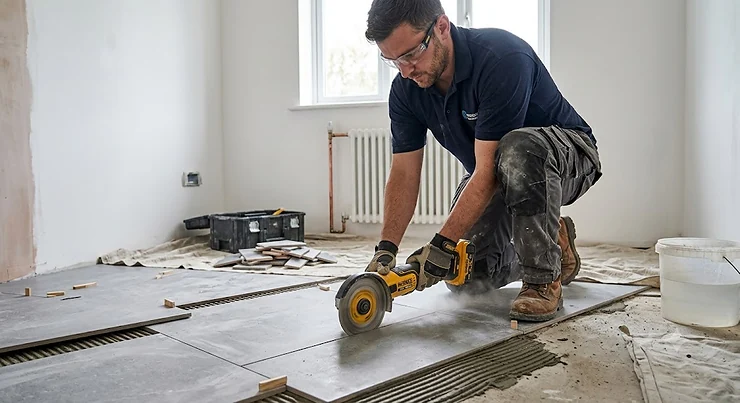
Somewhere between “just score it with a tile cutter” and “hire a wet saw for the weekend” sits the tool most tilers actually reach for first: a cordless angle grinder for cutting tiles. It’s the tradesperson’s Swiss Army knife — small enough to fit in a bag, punchy enough to slice through porcelain, and free of the trailing lead that turns a bathroom job into a trip hazard. A cordless angle grinder for cutting tiles is a battery-powered 18V hand tool fitted with a diamond disc, used to make straight or notched cuts in ceramic, porcelain or natural stone tiles without a mains connection. That’s the short version — the long version is that not every cordless grinder handles tile with the same finesse, and not every diamond disc is built for the same job.
This guide cuts through the marketing fluff (pun very much intended). We’ve researched seven real, currently available cordless angle grinders sold in the UK, spanning budget bare units through to premium brushless models, and paired that with honest analysis of diamond disc selection, diamond blade types, dust control while cutting, and the perennial wet vs dry cutting debate. Cutting silica-bearing materials indoors isn’t risk-free, and the Health and Safety Executive rates silica dust among the most serious hazards a tradesperson faces, so we’ve built safety into the advice rather than bolting it on as an afterthought.
Whether you’re retiling a downstairs loo on a Saturday or fitting porcelain floor tiles for a living, the right cordless angle grinder for cutting tiles will save you hours, chipped edges and a fair amount of swearing. Let’s get into it.
Quick Comparison Table: Cordless Angle Grinders for Cutting Tiles at a Glance
Before the deep dive, here’s the shape of the market in one table. These are snapshot picks — full specs and reasoning follow in the Top 7 section below.
| Product | Category | Idle Speed | Best For |
|---|---|---|---|
| Milwaukee M18 FSAG115XB | Premium | Up to 9,000rpm | Tradespeople wanting corded-level power |
| Makita DGA463Z | Premium | 3,000–8,500rpm | Precision control on delicate tiles |
| Bosch GWS 18V-10 | Mid-range | Up to 10,000rpm | Fast cuts on a budget-conscious tool |
| Einhell TE-AG 18/115 Li | Budget | Up to 8,500rpm | Lightest option for occasional DIY |
A quick glance tells you most of the story: idle speed isn’t the whole picture, but it’s a decent proxy for how aggressively a grinder will bite into porcelain versus how much control you’ll have over a delicate edge cut. The Bosch GWS 18V-10 actually posts the highest raw rpm figure here, yet it isn’t automatically the best tile-cutting tool — variable speed control, as fitted to the Makita DGA463Z, often matters more for clean cuts than outright top speed. Budget buyers shouldn’t dismiss the Einhell TE-AG 18/115 Li either; at under half the weight of some premium rivals, fatigue over a long cutting session becomes a real factor in cut quality.
💬 Bookmark this table — you’ll want to compare it against the full breakdown below before you decide.
Top 7 Cordless Angle Grinders for Cutting Tiles: Expert Analysis
Coverage below spans budget, mid-range and premium tiers, plus two different battery ecosystems worth knowing about before you commit. Every product listed is a real, currently sold model — nothing invented, nothing exaggerated.
1. Milwaukee M18 FSAG115XB — closest cordless tool to a corded grinder’s punch
The headline here is that Milwaukee’s POWERSTATE brushless motor genuinely closes the gap with mains-powered grinders, which matters the moment you hit a dense porcelain floor tile that laughs off weaker cordless motors. Running on the M18 platform at up to roughly 9,000rpm, it pairs a metal gear housing with an electronic brake that stops the disc within roughly two seconds of release — a meaningful safety margin when you’re working close to grout lines and fingers. Based on the spec sheet, this is the pick for anyone doing tile cutting regularly rather than as a once-a-year job; the extra torque means you’re not forcing the disc through thicker porcelain, which is exactly the behaviour that causes chipping and premature disc wear. Reviewers on retailer and trade-forum pages consistently flag the build quality and battery-life ecosystem as the standout, with the M18 platform’s shared batteries across drills, saws and lights cited as a genuine cost-saver over time. On the flip side, a handful of buyers note the premium price tag stings if you’re not already invested in Milwaukee’s M18 tools.
Pros:
- ✅ Corded-level cutting power on dense porcelain and stone
- ✅ Electronic brake stops the disc within roughly two seconds
- ✅ Shares batteries across the wider M18 tool ecosystem
Cons:
- ❌ Premium price if you’re not already on the M18 platform
- ❌ Heavier in the hand than budget 115mm rivals
Bare-tool pricing typically sits in the £150-£220 range, check current price before buying. For anyone cutting tile weekly rather than occasionally, this is genuinely good value once you factor in the battery ecosystem.
2. Makita DGA463Z — best variable-speed control for delicate porcelain
What most buyers overlook about this model is the variable speed dial running from 3,000 to 8,500rpm, which on paper sounds like a minor spec but in practice is the difference between a clean edge cut and a cracked corner on brittle porcelain. Active Feedback Sensing Technology shuts the motor down if the disc suddenly binds, a genuinely useful safeguard on thin wall tiles that can crack unpredictably. The soft-start function and anti-restart protection round out a package clearly designed with control in mind rather than raw speed. Based on the spec comparison against faster-spinning rivals, this is the grinder to reach for when the tile itself — not the substrate underneath — is the fragile part of the job. Aggregated feedback from UK tool retailers points to strong long-term reliability being Makita’s calling card, a reputation built over decades of trade use rather than a single marketing cycle. The trade-off is that the slower low-end speed setting isn’t the fastest way to chew through thick porcelain paving if speed is your priority.
Pros:
- ✅ Variable speed dial suits delicate porcelain and glass tile
- ✅ Active feedback sensing cuts power if the disc binds
- ✅ Strong reputation for long-term trade-grade reliability
Cons:
- ❌ Slower low-end speed isn’t ideal for thick paving slabs
- ❌ Sold as a bare unit — battery and charger cost extra
Expect a bare-tool price in the £120-£180 range, with kits including a battery and charger pushing higher; always check current price at the time of buying.
3. DeWalt DCG405N — the trade-standard all-rounder
DeWalt’s DCG405N earns its reputation as a benchmark model by refusing to specialise — it’s built to cut tile today and grind welds tomorrow, and the brushless motor runs noticeably cooler under sustained cutting than older brushed designs. Here’s what to weigh: the XR battery platform is one of the most widely adopted in UK trade vans, so if you already own DeWalt drills or saws, this grinder slots straight into your existing battery pool at effectively zero extra cost. The kickback brake and no-volt release switch (which stops the tool restarting unexpectedly if power is interrupted) tick every safety box a professional would expect. What the spec sheet won’t tell you, but reviewers note, is that the ergonomic grip reduces hand fatigue noticeably across a full day of intermittent cutting and grinding — a detail that matters more than any single spec once you’re three hours into a retiling job. Feedback aggregated from trade users tends to praise its all-round versatility over specialist tile performance; it’s a jack-of-all-trades rather than a scalpel.
Pros:
- ✅ Runs cool under sustained cutting thanks to the brushless motor
- ✅ Slots into the widely-used DeWalt XR battery ecosystem
- ✅ Comfortable grip reduces fatigue across long sessions
Cons:
- ❌ Not as tile-specialised as purpose-tuned rivals
- ❌ Bare unit pricing means battery costs are separate
Bare-tool prices generally fall in the £110-£170 range at the time of research; buyers already on the XR platform get the best value here.
4. Bosch GWS 18V-10 — the fastest idle speed at the most competitive price
On paper, a 10,000rpm no-load speed is the highest figure in this entire round-up, and that translates into genuinely brisk cuts through both ceramic and harder porcelain. Based on the spec comparison, this is the model that best balances raw speed against price — Bosch has traditionally positioned its 18V range as the accessible entry point into serious cordless power tools, and the GWS 18V-10 continues that trend. Reviewers testing it directly against pricier rivals describe it as lively on lighter cutting tasks, though it doesn’t quite match the sustained torque of the premium Milwaukee and Makita options when working through thick, dense porcelain for extended periods. What most buyers overlook is that higher rpm alone doesn’t guarantee a cleaner cut — without a steady hand and the right disc, that extra speed can just as easily produce more chipping rather than less. Common feedback across UK retailer review pages highlights straightforward value for money as the standout quality, particularly for buyers who don’t already own a battery ecosystem and don’t want to overspend on their first cordless grinder.
Pros:
- ✅ Highest idle speed in this round-up at 10,000rpm
- ✅ Strong value relative to premium brushless rivals
- ✅ Compact and lightweight for extended handheld use
Cons:
- ❌ Less sustained torque than Milwaukee or Makita on thick porcelain
- ❌ Higher speed demands a steadier hand to avoid chipping
Expect bare-tool pricing in the £70-£100 range, making it one of the more accessible entry points into serious cordless cutting.
5. Ryobi ONE+ R18AG-0 — best for buyers already inside the ONE+ ecosystem
Ryobi’s ONE+ platform now spans, by the brand’s own count, over 300 compatible tools sharing a single battery type, and that ecosystem breadth is the real selling point of the R18AG-0 rather than any single headline spec. Running at a comparatively modest 6,500rpm, it’s tuned for control rather than outright speed — based on the spec comparison, that’s arguably the right trade-off for tile work specifically, since a slower, steadier disc speed generally means fewer chipped edges on brittle ceramic. All-metal gearing gives it a reassuringly solid feel for a tool at this price point, and the comfortable grip design keeps it usable for longer stints than its weight class might suggest. Aggregated customer feedback from UK retailer pages frequently praises it as a strong choice for home projects and first-time buyers building a DIY toolkit rather than a trade fleet, with the shared-battery convenience across mowers, drills and this grinder cited repeatedly as the deciding factor. The honest caveat is that the lower rpm ceiling will feel underpowered if you’re regularly cutting thick porcelain paving rather than standard wall and floor tile.
Pros:
- ✅ Compatible with Ryobi’s huge 300-plus tool ONE+ ecosystem
- ✅ Lower rpm gives steadier control on brittle ceramic tile
- ✅ All-metal gearing feels solid for the price bracket
Cons:
- ❌ Lower top speed than rivals when cutting thick porcelain
- ❌ Not the choice for daily trade-level cutting volumes
Bare-tool pricing typically sits in the £60-£90 range, and existing ONE+ battery owners will find this among the cheapest ways into cordless tile cutting.
6. Einhell TE-AG 18/115 Li — the lightest grinder in its class
Einhell markets this as the lightest angle grinder of its class, and at roughly 3.7kg including a 4.0Ah battery, that claim holds up well against premium rivals that can feel noticeably front-heavy after twenty minutes of overhead or awkward-angle cutting. The aluminium gearbox housing keeps weight down without sacrificing the robustness needed for repeated cutting sessions, and a soft-start function paired with overload cut-out protection brings genuine safety credentials to a genuinely budget-friendly price point. Based on the spec comparison, an 8,500rpm idle speed and 28mm maximum cutting depth put it comfortably in line with mid-range rivals despite the lower asking price — this is honest value engineering rather than a stripped-down compromise. Reviewers on Einhell’s own product pages and UK DIY retailer sites consistently highlight the lightweight handling as the standout quality, particularly among buyers upgrading from an older corded grinder for the first time. The trade-off, unsurprisingly, is that the plastic-heavy construction elsewhere on the tool doesn’t feel quite as bombproof as trade-grade brands under daily abuse.
Pros:
- ✅ Genuinely the lightest grinder in this comparison at 3.7kg
- ✅ Aluminium gearbox housing keeps weight down without flimsiness
- ✅ Soft-start and overload cut-out add real safety value
Cons:
- ❌ Feels less robust than trade-grade brands under daily use
- ❌ Battery and charger typically sold separately from the bare unit
Bare-tool pricing generally falls in the £45-£65 range, or in the mid-£70s as part of a battery-included starter kit — very much a budget-friendly entry point into cordless tile cutting.
7. Titan TTI894GRD — Screwfix’s own-brand budget pick, explicitly rated for tile
Titan’s own product listing is refreshingly direct about intended use, describing this grinder as ideal for cutting through metal pipes, stone slabs and ceramic floor tiles — a rare case of a manufacturer naming tile cutting outright rather than leaving buyers to infer it. The 2-in-1 quick-adjust guard switches between cutting and grinding configurations without needing separate accessories, a small but genuinely time-saving feature during a job that involves both trimming tiles and smoothing cut edges. Running on Titan’s TXP battery platform — a system also used across SDS drills and other Screwfix own-brand tools — it’s a sensible entry point if you’re building a budget toolkit from scratch rather than buying into an established premium ecosystem. Here’s what to weigh: as an own-brand line, it won’t match the fit and finish of Milwaukee or Makita, but for occasional DIY tile cutting the core functionality is honestly all most homeowners need. Aggregated feedback from Screwfix’s own review pages tends to describe reliable performance for the price, with value being the recurring theme rather than outright power.
Pros:
- ✅ Explicitly marketed by the manufacturer for cutting ceramic tiles
- ✅ 2-in-1 guard switches between cutting and grinding easily
- ✅ Genuinely budget-friendly entry into the TXP battery platform
Cons:
- ❌ Build quality doesn’t match premium trade brands
- ❌ TXP ecosystem is smaller than Milwaukee, DeWalt or Makita’s
Expect bare-tool pricing in the £35-£55 range, with battery kits available for a bit more — one of the cheapest genuinely tile-rated cordless grinders on the UK market.
Full Spec Comparison: All 7 Cordless Angle Grinders for Cutting Tiles
| Product | Tier | Idle Speed | Weight (approx.) | Price Range (bare tool) | Best For |
|---|---|---|---|---|---|
| Milwaukee M18 FSAG115XB | Premium | ~9,000rpm | ~2.3kg | £150-£220 | Regular, heavy-use tile cutting |
| Makita DGA463Z | Premium | 3,000-8,500rpm | ~2.1kg | £120-£180 | Delicate porcelain and glass tile |
| DeWalt DCG405N | Premium/Mid | ~9,000rpm | ~2.2kg | £110-£170 | All-round trade versatility |
| Bosch GWS 18V-10 | Mid | ~10,000rpm | ~1.9kg | £70-£100 | Fast cuts on a tighter budget |
| Ryobi ONE+ R18AG-0 | Mid | ~6,500rpm | ~2.0kg | £60-£90 | ONE+ ecosystem owners, DIY use |
| Einhell TE-AG 18/115 Li | Budget | ~8,500rpm | ~3.7kg (with battery) | £45-£65 | Lightweight occasional DIY use |
| Titan TTI894GRD | Budget | Not published | ~2.0kg | £35-£55 | First-time buyers on a strict budget |
Reading across this table, the pattern is fairly clear: premium tier buys you sustained torque and safety electronics, mid-tier buys you speed and ecosystem breadth, and budget tier buys you a genuinely capable — if less polished — tool at a fraction of the outlay. The Bosch GWS 18V-10 stands out as the value anomaly here, delivering the highest idle speed in the whole line-up at a distinctly mid-range price. Weight is worth double-checking against your own stamina too, since the featherweight Einhell TE-AG 18/115 Li will feel far kinder on the wrist during a long overhead cutting session than heavier premium rivals.
✨ Don’t Miss These Exclusive Deals!
🔍 Take your tile-cutting toolkit to the next level with these carefully selected cordless angle grinders. Click on any highlighted product name to check current pricing and availability. The right tool here will help you create authentic, professional-finish results your family and clients will genuinely notice!
Practical Usage Guide: Setting Up a Cordless Angle Grinder for Cutting Tiles
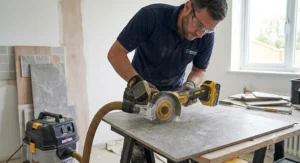
Getting a clean first cut starts well before the trigger is pulled. Fit the diamond disc with the rotation arrow matching the direction printed on the grinder’s guard — an easy mistake to make when you’re switching discs between jobs, and one that noticeably shortens disc life. Mark your cut line on the tile face with a fine permanent marker rather than pencil, since pencil marks disappear the moment water or dust hits the surface. For your first 30 days with a new cordless angle grinder for cutting tiles, resist the urge to lean into the cut; let the diamond disc’s own rotation do the grinding, since forcing the pace is the single most common cause of chipped edges and premature disc wear reported by tool retailers and trade forums alike.
Maintenance is genuinely low-effort but easy to neglect. Wipe down the guard and vents after every session, since tile dust is abrasive and will work its way into bearings if left to accumulate. Check the disc for glazing — a shiny, blunted rim that no longer bites — roughly every few dozen cuts, since a glazed disc produces more heat, more dust and worse cuts for the same effort. If you’re cutting dry, a genuinely common mistake in the first month is skipping eye protection because “it’s only a quick cut” — tile fragments travel fast and unpredictably, and a full face shield plus safety glasses underneath is the sensible baseline, not an optional extra.
Real-World Scenarios: Matching the Right Grinder to Your Project
Picture three fairly typical buyers. First, a homeowner retiling a small en-suite over one weekend, cutting maybe 20-30 tiles total around pipework and a shower tray — for this occasional, low-volume job, the budget-tier Titan TTI894GRD or Einhell TE-AG 18/115 Li genuinely does everything required without the outlay of a trade-grade tool that will spend most of its life in a drawer.
Second, a landlord or property developer retiling multiple rental flats across a year, cutting several hundred tiles in total sessions spread over months — here the mid-tier Bosch GWS 18V-10 or Ryobi ONE+ R18AG-0 earns its keep, offering enough speed and durability for repeat use without premium trade pricing.
Third, a working tiler cutting tile daily across multiple sites, often against tight deadlines and varied tile densities from softer ceramic to dense porcelain — for this frequency and load, the premium Milwaukee M18 FSAG115XB, Makita DGA463Z or DeWalt DCG405N justify their higher price through sustained torque, better safety electronics and genuine day-in, day-out reliability that cheaper tools simply aren’t built to sustain.
Problem → Solution: Fixing Common Tile-Cutting Mistakes
Chipped edges along a straight cut are almost always down to disc speed mismatched to material density — the fix is dropping to a lower speed setting where your grinder allows it, or switching to a continuous-rim diamond disc designed specifically for clean edges on brittle porcelain. Excessive dust clouding your cut line, making it impossible to follow your marked line accurately, is best solved by introducing a light, steady water trickle onto the cut point (wet cutting) or fitting an on-tool dust shroud connected to an M-class vacuum if working dry indoors.
A disc that stops cutting effectively despite looking physically intact is very likely glazed rather than worn out — running a few shallow test cuts into an abrasive scrap material, like a spare paving block, will often re-expose fresh diamond and restore cutting performance without buying a replacement disc. Finally, a grinder that seems to bog down mid-cut on thick porcelain is usually being forced faster than its torque allows; easing off the feed rate, rather than upgrading the whole tool, frequently solves the problem at zero extra cost.
How to Choose a Cordless Angle Grinder for Cutting Tiles
- Match disc diameter to your typical tile thickness. A 115mm disc suits most standard wall and floor tiles; thicker porcelain paving may call for 125mm to gain a little extra cutting depth.
- Prioritise variable speed control over raw top speed. Based on the spec comparison across all seven models here, a controllable low-end speed reduces chipping on brittle tile far more reliably than a higher headline rpm figure.
- Check the battery ecosystem you’re buying into. If you already own cordless drills or saws, staying within that brand’s platform saves real money on future batteries and chargers.
- Look for an electronic brake and anti-restart protection as standard. These aren’t luxury extras — they’re genuine safety features that matter the moment a disc catches an edge unexpectedly.
- Weigh the tool in your hand before assuming lighter is always better. A featherweight grinder reduces fatigue but can also feel less stable during a long, steady cut; there’s a genuine trade-off here worth testing if you can.
- Decide on wet or dry cutting before you buy discs. Wet-rated continuous rim discs and dry-rated turbo discs aren’t interchangeable, and this decision should shape your disc purchase, not the other way round.
- Budget for the disc, not just the grinder. A cheap grinder paired with a genuinely good diamond disc will often out-cut an expensive grinder saddled with a bargain-bin blade.
Diamond Disc Selection: Getting the Bond and Diameter Right
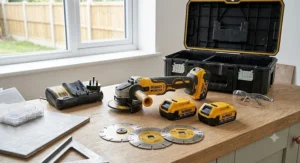
Diamond disc selection is where most of the actual cut quality lives, arguably more than the grinder itself. The core decision is bond hardness matched against material hardness: harder tiles like dense porcelain need a softer metal bond so the disc releases fresh diamond as it wears, while softer materials need a harder bond so the rim doesn’t wear away too quickly. Getting this backwards is a genuinely common and entirely avoidable mistake — a hard-bonded disc on hard porcelain will glaze over and stop cutting effectively within minutes.
Diameter matters just as much as bond. A 115mm disc is the standard fit for most compact cordless grinders and comfortably handles typical 8-12mm wall and floor tile, while anything thicker, like 20mm+ porcelain paving, benefits from the slightly deeper cut of a 125mm disc if your grinder accepts one. What most buyers overlook in diamond disc selection is that a slightly more expensive disc from a reputable manufacturer will frequently outlast two or three cheap alternatives, meaning the true cost per cut often favours spending a little more upfront rather than replacing bargain discs repeatedly.
Diamond Blade Types Explained: Continuous Rim vs Turbo vs Segmented
Among diamond blade types, three rim designs dominate the market, and each is genuinely suited to a different job rather than being interchangeable substitutes. A continuous rim blade has a smooth, uninterrupted diamond edge and, according to Norton Abrasives’ UK guidance on diamond blade design, is the standard choice for clean, chip-free cuts on ceramic and porcelain tile specifically because it contacts the material evenly rather than in interrupted bursts.
A segmented blade, by contrast, has visible gaps between diamond segments that aid cooling and debris ejection, making it the aggressive choice for masonry, concrete and pavers — but that same segmented contact pattern causes chipping on tile edges, so it’s genuinely the wrong choice for this job despite being a perfectly good blade for other materials. A turbo rim blade sits between the two, combining a mostly continuous edge with a serrated, wave-like pattern that sheds heat faster than a plain continuous rim while still producing a reasonably clean cut — a sensible middle-ground pick if you’re cutting a mix of tile and harder stone or masonry in the same session.
| Blade Type | Cut Quality on Tile | Best Suited To |
|---|---|---|
| Continuous rim | Cleanest, chip-free finish | Ceramic and porcelain tile, wet cutting |
| Turbo rim | Good finish, faster than continuous | Mixed tile, stone and general masonry |
| Segmented | Roughest finish, will chip tile edges | Concrete, pavers, masonry — not tile |
The table above makes the priority order fairly obvious: for genuine tile-cutting work, continuous rim is the default, turbo is the sensible compromise for mixed-material jobs, and segmented blades should be reserved for masonry rather than reached for out of habit.
Wet vs Dry Cutting Tiles: Which Method Wins?
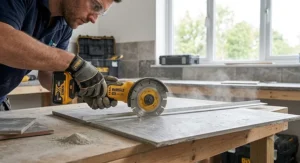
Wet vs dry cutting isn’t really a question of which method is universally better — it’s a question of which trade-offs suit your specific job. Wet cutting, where a continuous water feed suppresses dust at the point of contact, produces dramatically less airborne silica dust and generally a cooler, longer-lasting disc, which is why it’s the preferred method for any extended indoor cutting session. The obvious downside is the mess and the practical need for a water source and drainage, plus genuine caution around mixing water with electrical equipment.
Dry cutting, favoured for its convenience and lack of setup, is genuinely fine for short, occasional cuts in well-ventilated spaces when paired with proper dust extraction and respiratory protection — but the Health and Safety Executive’s guidance on construction dust control is unambiguous that grinding operations can produce very high levels of silica-containing dust, and that anyone close to the tool is particularly at risk without proper controls. Based on the spec comparison of both methods, our honest recommendation is wet cutting wherever practical for any sustained indoor job, with dry cutting reserved for quick, occasional cuts outdoors or in genuinely well-ventilated spaces with a dust shroud fitted.
| Method | Dust Level | Disc Life | Best For |
|---|---|---|---|
| Wet cutting | Very low | Longer | Extended indoor cutting sessions |
| Dry cutting | High without extraction | Shorter | Quick, occasional, well-ventilated cuts |
Dust Control While Cutting Tiles Indoors: Staying Safe and Compliant
Dust control while cutting isn’t a box-ticking exercise — respirable crystalline silica, released when grinding materials including tiles, concrete and stone, is linked to silicosis, an irreversible scarring of the lungs, alongside chronic lung disease and lung cancer, and the UK’s own workplace safety regulator has previously estimated silica dust contributed to several hundred construction worker deaths in a single year. That’s not scaremongering; it’s the stated position of the UK’s own workplace safety regulator, and it’s exactly why dust control while cutting deserves real attention rather than an afterthought.
Practically, this means three layers of control working together. First, prevent dust at source wherever possible by choosing wet cutting for anything beyond a handful of quick cuts. Second, where dry cutting is unavoidable, fit an on-tool dust shroud connected to an M-class rated vacuum extractor — a standard household vacuum genuinely isn’t rated to capture fine silica particles safely. Third, treat respiratory protective equipment such as an FFP3 mask as a backup layer under COSHH regulations, not a substitute for proper extraction or wet suppression. Ventilate the room, keep bystanders clear of the immediate cutting area, and clean up dust with a vacuum rather than a dry brush, which simply redistributes fine particles back into the air.
Common Mistakes When Buying a Cordless Angle Grinder for Cutting Tiles
The most frequent mistake is buying purely on price and ignoring the diamond disc entirely, then wondering why cut quality is disappointing — as covered above, the disc does at least as much work as the grinder itself. A close second is overlooking battery ecosystem entirely; buying into a brand you don’t already own tools from means paying full price for batteries and chargers on top of the bare unit, often doubling the real cost of ownership. Buyers also commonly assume a higher rpm figure automatically means a better tool for tile specifically, when in practice a controllable, moderate speed setting produces cleaner cuts on brittle material than raw top-end speed. Finally, many first-time buyers skip dust control planning entirely until after the first dusty, choking cut — deciding on wet or dry cutting, and buying the right accessories, before the grinder arrives saves both time and lungs.
Features That Actually Matter (And Those That Don’t)
Genuinely useful features worth paying for: variable speed control, an electronic brake, anti-restart protection, and a quick-adjust guard that switches easily between cutting and grinding configurations. These directly affect either cut quality or your physical safety, and the spec sheets of the premium models in this round-up all share them for good reason.
Features that generate marketing copy but matter less for tile cutting specifically: extremely high top-end rpm figures beyond what your disc and material actually need, and elaborate app connectivity or Bluetooth tracking features occasionally bundled into flagship trade tools. These aren’t worthless in every context, but for the specific job of cutting tiles cleanly, they add cost without adding cut quality.
Long-Term Cost & Maintenance
Total cost of ownership for a cordless angle grinder for cutting tiles extends well beyond the sticker price of the bare unit. Diamond discs wear out and need replacing periodically — budget for this as an ongoing running cost rather than a one-off purchase, since disc lifespan varies significantly based on bond-hardness matching, as covered in the diamond disc selection section above. Battery health also degrades gradually over hundreds of charge cycles, and buying into a wider tool ecosystem, where one battery powers several tools, generally delivers better long-term value than a standalone grinder-only battery purchase.
Maintenance costs stay low if you’re consistent: keeping vents clear of dust, checking discs for glazing regularly, and storing the tool away from damp all extend genuine working life. Reviewers across UK retailer platforms and trade forums repeatedly note that brushless motors — standard across all seven models featured here — meaningfully outlast older brushed designs, which is a genuine long-term saving even if the upfront price is slightly higher.
Frequently Asked Questions
❓ Can any angle grinder cut tiles?
❓ What size diamond disc do I need for tile cutting?
❓ Is wet cutting always better than dry cutting for tiles?
❓ How long does a diamond disc last cutting tiles?
❓ Do I need a mask when cutting tiles indoors?
Conclusion
There’s no single best cordless angle grinder for cutting tiles — there’s a best one for your specific job, budget and frequency of use. The Milwaukee M18 FSAG115XB and Makita DGA463Z earn their premium pricing through genuine control and safety electronics for regular, professional-grade use. The Bosch GWS 18V-10 and Ryobi ONE+ R18AG-0 strike a sensible mid-range balance for landlords, developers and keen DIYers cutting tile across multiple projects a year. And the Einhell TE-AG 18/115 Li and Titan TTI894GRD prove that a genuinely capable, tile-rated cordless grinder doesn’t have to cost a fortune for the occasional weekend retile.
Whichever grinder you land on, remember that the diamond disc you pair it with, and whether you cut wet or dry with proper dust control, will shape your results at least as much as the tool itself. Get those three decisions right together, and even a budget-tier grinder will produce genuinely professional-looking cuts.
✨ Ready to Start Your Tile Cutting Project?
🔍 Browse the seven cordless angle grinders featured above and find the one that matches your budget and battery ecosystem. Click through to check current pricing and availability, and pair your new tool with the right diamond disc for genuinely clean, professional results!
Recommended for You
- 125mm Angle Grinder: 7 Best Picks; Buying Guide (2026)
- Cordless Angle Grinder Under £100: 7 Best UK Picks for 2026
- Cordless Angle Grinder: 7 Best Picks Tested for UK Trades (2026)
Disclaimer: This article contains affiliate links. As an Amazon Associate, I earn from qualifying purchases. If you purchase products through these links, we may earn a small commission at no additional cost to you.
✨ Found this helpful? Share it with your friends! 💬🤗
