In This Article
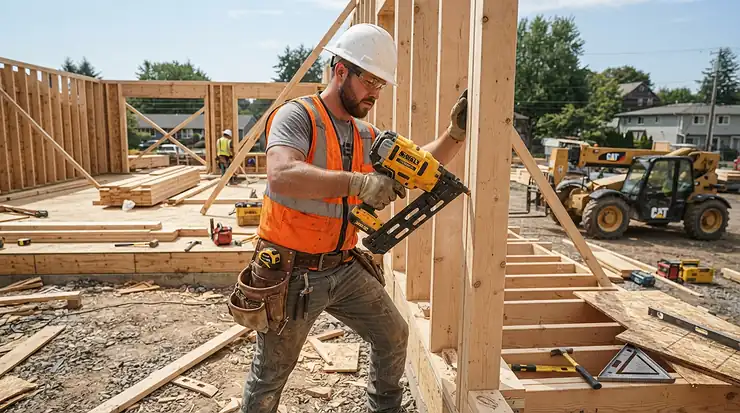
There’s a particular kind of misery reserved for anyone who has hand-nailed a stud wall. Your wrist aches by lunchtime, your thumbnail turns an interesting shade of purple, and the joiner two plots over is already three walls ahead because he’s carrying a first fix nail gun instead of a claw hammer. A first fix nail gun is a structural fastening tool that drives long nails — typically 50mm to 90mm — into timber framing, joists, roof battens and stud work, and it’s the difference between framing a room in twenty minutes or two hours.

This guide exists because “just buy a Paslode” is technically correct but unhelpfully thin advice. The first fix nail gun market has split into three genuinely different technologies — gas, cordless mechanical, and cordless air-spring — and each behaves differently on a cold February site versus a warm June one. According to HSE, nail gun use on UK sites has increased dramatically over recent years, and nail gun incidents now feature heavily in the organisation’s woodworking accident statistics, which is worth bearing in mind before you start comparing joules and battery runtimes and forget that this is still a tool that fires a piece of hardened steel at several hundred metres a second.
Below, we’ve pulled together seven real, current first fix nail guns spanning budget DIY kit through to daily-driver tradesman tools, alongside genuine spec comparisons, aggregated review sentiment, and the kind of practical detail that doesn’t show up on a product listing page. Whether you’re after a cordless first fix nailer to ditch the gas cartridges, or you’re simply trying to work out what “34-degree magazine angle” actually means for your job, this first fix nail gun buying guide UK edition should get you there.
Quick Comparison Table
| Nail Gun | Power Type | Nail Range | Magazine Capacity | Best For |
|---|---|---|---|---|
| Paslode IM350+ | Gas + Li-ion | 50-90mm | 55 nails | Best overall reliability |
| DeWalt DCN692 | 18V Cordless (mechanical) | 50-90mm | 55 nails | Gas-free everyday framing |
| Makita DBN900ZK | 18V Cordless (air-spring) | 50-90mm | 58 nails | LXT battery-system owners |
| Milwaukee M18 FFN | 18V Cordless (mechanical) | 50-90mm | 51 nails | Fastest cycle speed |
| Hikoki NR1890DC | 18V Cordless (air-spring) | 50-90mm | 47 nails | Best-value twin-battery kit |
| Senco F-35XP | 18V Cordless (compressed air) | 50-90mm | 60 nails | Most pneumatic-like feel |
| Ryobi RFN1834X | 18V Cordless (mechanical) | 50-90mm | Standard framing capacity | Budget DIY entry point |
Looking at the table, the split isn’t really about raw power — every tool here will comfortably sink a 90mm nail into softwood. It’s about how each one gets there. The Paslode IM350+ still leads on sheer track record and parts availability on UK sites, while the DeWalt DCN692 and Milwaukee M18 FFN trade the ongoing cost of gas cartridges for battery-only running, which pays for itself faster than most tradesmen expect. If your priority is stretching every last fixing out of a single charge, the air-spring designs from Makita and Hikoki are worth a longer look in the product breakdown below.
💬 Just one click — help others make better buying decisions too!😊
Top 7 First Fix Nail Guns: Expert Analysis
1. Paslode IM350+ — the gas-powered benchmark everyone else is measured against
The Paslode IM350+ has been the default first fix nail gun on British building sites for the best part of two decades, and its seventh-generation update hasn’t changed the fundamentals, just sharpened them. It runs on a combination of a butane fuel cell and a 7.4V lithium battery, delivering up to 82 joules of impact force with a magazine capacity of 55 fixings and a fuel cell rated for around 1,100 shots, and a single battery charge is good for roughly 9,000 fixings. In practice that means you’ll run through several fuel cells before the battery even needs topping up.
What most buyers overlook about the IM350+ is that its “cordless” tag is slightly misleading — it’s gas-driven with a battery only for ignition, which is precisely why it starts instantly in cold weather when purely electric alternatives can lag. Reviewers consistently note the tool’s balance and low felt recoil for its size, and its combination of gas-powered drive technology and lithium battery delivers consistent, powerful nailing performance suited to timber framing, truss fixing and roof battening. On the flip side, gas nailers need their combustion chamber cleaned periodically and the fuel cells are a recurring cost that cordless-mechanical rivals don’t carry.
Pros:
- ✅ Decades of proven reliability across UK timber-frame sites
- ✅ Fast cold-weather starts thanks to gas ignition
- ✅ Huge parts and service network across the trade
Cons:
- ❌ Ongoing fuel cell cost adds up over a project
- ❌ Combustion chamber needs periodic cleaning to avoid misfires
The Paslode IM350+ typically sits in the mid-to-premium price bracket depending on the kit configuration — check current price, as bundles with two fuel packs versus one vary. For a tool you’ll be relying on daily, it’s hard to argue with the resale value and trade-in confidence that decades of market dominance buys you.
2. DeWalt DCN692 — the tool that made gas-free framing normal
DeWalt describes the DCN692 as the world’s first cordless first fix framing nailer, and whatever you make of that claim, it’s the tool that convinced a lot of sceptical tradesmen that mechanical cordless nailers could genuinely replace gas. It uses a brushless motor to compress a mechanical spring rather than burning fuel, and accepts 30-34 degree angled nails between 2.8mm and 3.3mm diameter, a 50-90mm nail range, and a 55-nail magazine capacity, with sequential mode for precision placement and a bump mode for production speed.
Here’s what the spec sheet won’t tell you: because it’s mechanical rather than gas-fired, there’s no ramp-up, no combustion smell, and nothing to run out mid-fixing except battery charge. The DCN692 can run on DCB184 5.0Ah, DCB182 4.0Ah, or DCB183 2.0Ah battery packs, so if you’re already on DeWalt XR kit, this slots straight into your existing battery pool. Reviewers who’ve switched from gas repeatedly mention that they “don’t miss the fuel cells,” and one buyer summed up the sentiment plainly, saying they preferred it to a friend’s Paslode. The trade-off is weight — it’s noticeably heavier than the gas alternative once a battery is fitted, and it demands a genuinely charged, decent-capacity battery to keep firing consistently.
Pros:
- ✅ No gas cartridges to buy, store or run out of
- ✅ Shares batteries with the wider DeWalt 18V XR range
- ✅ Mechanical rather than gas operation for consistent cold-weather performance
Cons:
- ❌ Heavier in the hand than gas-powered equivalents
- ❌ Needs a high-capacity battery for a full day’s output
Prices for the DeWalt DCN692 range from bare-unit deals in the low-mid £300s to kitted versions with two 5.0Ah batteries pushing toward £450-£500, so check current price against what batteries you already own — buying body-only is the obvious move if you’re already deep into the DeWalt ecosystem.
3. Makita DBN900ZK — the premium pick for anyone already on LXT batteries
The Makita DBN900ZK uses an air-spring mechanism rather than a purely mechanical drive, and the brushless motor’s job is to rapidly compress that spring so the nail fires with something closer to a pneumatic tool’s snap than a typical cordless nailer’s push. It drives nails from 50mm to 90mm and supports clipped head nails with diameters from 2.9mm to 3.3mm, and the magazine accommodates up to 58 collated nails with a quick and easy reloading mechanism.
Based on the spec comparison, the DBN900ZK’s biggest practical advantage isn’t power — every tool in this list drives a 90mm nail fine — it’s the inspection window and depth dial combination. The magazine includes an inspection window that simplifies checking remaining nails, and drive depth is adjusted using an easy dial on the tool’s nose. It also includes an anti-dry-firing mechanism that activates before the last nails are driven, plus an anti-restart function to prevent accidental activation, which matters more than it sounds on a fast-paced framing crew where accidental double-fires damage timber. What most buyers overlook is that this is genuinely an LXT-ecosystem tool: if you’re not already running Makita batteries, the entry cost of body plus batteries plus charger stacks up quickly.
Pros:
- ✅ True air-spring drive for a pneumatic-like nail-seating feel
- ✅ Inspection window and dial-adjust depth control aid accuracy
- ✅ Anti-dry-fire and anti-restart functions reduce accidental misfires
Cons:
- ❌ Premium price if you’re not already on Makita LXT batteries
- ❌ Body-only listings mean batteries and charger are an extra cost
Expect the Makita DBN900ZK to sit in the £350-£450 range for the bare tool, climbing higher with batteries bundled in — always check current price as Makita’s LXT kit combinations shift regularly.
4. Milwaukee M18 FFN — built for tradesmen who don’t want to wait between shots
Milwaukee’s pitch for the M18 FFN centres on eliminating “ramp-up,” the brief lag some cordless nailers have before each shot reaches full power. The tool uses Milwaukee’s POWERSTATE brushless motor, REDLINK PLUS electronics and REDLITHIUM battery system to deliver Ready to Fire Nail technology, meaning no ramp-up between shots so each nail is driven with the same dependable impact and on-target depth, even in hardwoods. Specifications list a 50-90mm nail length, 51-nail magazine capacity, firing rate of up to three nails per second, and a body weight of 4.1kg without battery.
Reviewers consistently note best-in-class power for seating nails flush in dense hardwoods, and the tool fires up to 700 nails per charge using an M18 5.0Ah battery pack, which is respectable if not class-leading against the Paslode’s shot count. What the spec sheet won’t tell you, but reviewers note, is that the integrated LED work light genuinely earns its keep in loft spaces and under-floor work where natural light is poor. On the downside, at 4.1kg bare (heavier once battery-equipped), this isn’t the tool you want if you’re doing overhead toe-nailing for hours on end — your shoulder will know about it by 3pm.
Pros:
- ✅ No ramp-up delay between shots for consistent hardwood penetration
- ✅ Integrated LED work light aids visibility in dark spaces
- ✅ Two-speed sequential and bump-fire modes for flexibility
Cons:
- ❌ Among the heavier tools in this group at 4.1kg bare
- ❌ 700 shots per charge trails the Paslode’s fuel-assisted output
The Milwaukee M18 FFN commonly retails in the £400-£550 bracket depending on whether it’s bare or comes with a 5.0Ah battery and charger — as ever, prices may vary, so check current listings before buying.
5. Hikoki NR1890DC — the best-value twin-battery kit on this list
Formerly badged as a Hitachi, the Hikoki NR1890DC (sold as NR1890DBCL/JP in some UK listings) uses the same air-spring principle as the Makita, but comes to market at a noticeably friendlier price point. It accepts 50mm up to 90mm, 30-degree paper tape strip fasteners in either clipped head or offset round head, and weighs only 4.1kg without battery, giving it a well-balanced feel for less user fatigue. The on-tool control panel centralises the power button, battery charge indicator and selective actuation, and after 30 minutes of inactivity the nailer powers off automatically to conserve battery and improve safety.
The honest analytical take here is that the NR1890DC is the sleeper pick of this line-up — it isn’t the fastest or the lightest, with a driving speed of 1.5 to 2 nails per second, but it’s consistently the cheapest way to get a genuine 18V twin-battery kit with a carry case included. Hikoki backs it with a 3-year automatic warranty, extendable to 5 years when registered within four weeks of purchase, which is longer standard cover than several rivals offer out of the box. Reviewers who bought it as a second nailer for a van, rather than a primary tool, tend to be the most satisfied — it’s not trying to be flashy, it’s trying to be dependable and affordable.
Pros:
- ✅ Genuinely competitive price for a twin-battery, case-included kit
- ✅ Strong standard warranty extendable to five years on registration
- ✅ Auto power-off after inactivity protects battery and improves safety
Cons:
- ❌ Slower firing rate than mechanical rivals like the Milwaukee
- ❌ Smaller 47-nail magazine capacity means more frequent reloads
The Hikoki NR1890DC typically lands under £450 for the two-battery kit with carry case, making it one of the strongest value propositions here — check current price as Hikoki kit bundling changes seasonally.
6. Senco F-35XP — the closest cordless gets to a real pneumatic
Senco built its reputation on air-powered nailers, and the F-35XP is its attempt to bring that exact feel into a cordless body using what it calls Fusion technology. It uses an aluminium 34-degree magazine holding up to 60 paper-collated nails, accommodating nails from 2 to 3.5 inches long, and the self-contained compressed air cylinder gives an instant shot when the trigger is pulled with no ramp-up between shots, with a refillable air port for easy maintenance.
What the spec sheet doesn’t quite convey is how different this actually feels in the hand compared with the purely mechanical rivals — reviewers who’ve used both air-spring and mechanical cordless nailers describe the F-35XP’s recoil and cycle sound as closest to a genuine pneumatic gun on a compressor. The tool includes jam reduction intelligence, dry fire lockout, aggressive toenail safety, and an LED power gauge showing remaining battery charge. This is a tool for someone who’s used pneumatic guns for years and wants that exact behaviour without the hose — it’s a narrower use case than the more mainstream mechanical options, but it nails that use case precisely.
Pros:
- ✅ Closest cordless feel to a genuine pneumatic nail gun
- ✅ Largest magazine capacity on this list at up to 60 nails
- ✅ Jam reduction intelligence cuts down on stoppages
Cons:
- ❌ Less common in UK trade counters than the big four brands
- ❌ Requires periodic air port maintenance unlike purely mechanical rivals
The Senco F-35XP generally sits in the £400-£500 range with two 3.0Ah batteries included — always check current price, as Senco’s UK availability can be patchier than DeWalt or Makita’s.
7. Ryobi RFN1834X — best for renovators and DIYers who don’t nail daily
If you’re not a full-time tradesman and you just need a first fix nail gun for the odd extension, shed build or stud wall, the Ryobi RFN1834X is the sensible entry point. It uses AirStrike technology to eliminate the need for compressors, hoses or gas cartridges, firing 30-34 degree clipped or full round head nails between 50-90mm in length, and features a selectable drive switch between single sequential and bump fire modes, tool-free depth-of-drive adjustment, a shock-absorbing base, and an integrated belt clip and rafter hook.
Here’s what most first-time buyers overlook: because it’s part of the wider ONE+ ecosystem, it plugs into a system of over 200 cordless tools for home and garden use, so if you already own Ryobi drills or saws, this is effectively a free addition to a battery family you’ve already paid into. Using a 4.0Ah battery, the tool can drive up to 750 50mm nails into pine on a single charge, which is genuinely competitive against tools costing twice as much. It isn’t built for eight-hour daily framing shifts — the duty cycle and build quality reflect its DIY-and-light-trade positioning — but for the audience it’s aimed at, it punches well above its price bracket.
Pros:
- ✅ Fits directly into the huge Ryobi ONE+ battery ecosystem
- ✅ Genuinely competitive nail count per charge for the price
- ✅ Shock-absorbing base and rafter hook add real jobsite convenience
Cons:
- ❌ Not built for continuous, full-day professional framing use
- ❌ Firing speed and durability trail the trade-focused brands
The Ryobi RFN1834X is typically the most affordable route into a genuine cordless first fix nailer, often under £300 body-only — check current price, and remember batteries and a charger are usually sold separately if you’re starting from scratch.
Practical Usage Guide: Getting the Most From Your First Fix Nail Gun
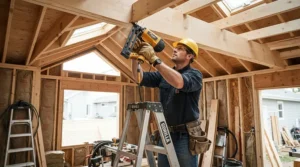
Getting a new first fix nail gun set up properly in the first week matters more than most buyers realise. Start by test-firing into scrap timber matching your actual job spec — CLS, C16 or C24 — rather than whatever offcut is nearest, because drive depth calibration on softwood versus denser structural timber isn’t the same. Set the depth-of-drive dial so nail heads sit flush rather than proud or sunk; over-driven nails weaken the joint’s holding power, while proud heads snag on boarding later.
Maintenance is where a lot of owners cut corners and pay for it in jams. Gas nailers like the Paslode need the combustion chamber wiped and the o-rings lightly lubricated roughly every few thousand shots, while mechanical cordless nailers benefit from a quick blast of dry lubricant in the magazine to stop nail-collation glue building up — a common cause of misfeeds on humid sites. Common first-30-days mistakes include storing the tool with a loaded magazine (which lets tension sit on the follower spring unnecessarily), charging batteries to 100% and leaving them on the charger overnight, and switching straight to bump-fire mode before you’ve built muscle memory with sequential mode. Bump fire is faster, but it’s also far less forgiving of a slipped nose probe, and most experienced framers only reach for it once they trust their own control of the tool.
Real-World Scenarios: Matching the Tool to the Job
Consider three fairly typical buyers. A self-employed carpenter running one to two extension jobs a month, working alone, values reliability and low running cost above outright speed — the Paslode IM350+ or DeWalt DCN692 both suit this profile well, since fuel or battery cost is the main ongoing consideration rather than raw cycle rate. A framing crew on a timber-frame new-build site, firing thousands of nails a week across multiple operators, needs shared battery compatibility and fast cycle times more than anything — this is where the Milwaukee M18 FFN or Makita DBN900ZK earn their premium price, particularly if the crew already standardises on one battery platform.
Then there’s the weekend renovator building a garden studio or knocking through for an extension twice a year. Buying a trade-grade nailer for this frequency of use rarely makes financial sense; the Ryobi RFN1834X or a bare Hikoki body paired with batteries already owned for other DIY tools gets the job done without tying up capital in a tool that’ll sit in a cupboard for eleven months of the year.
How to Choose a First Fix Nail Gun: UK Buying Guide
Working through a first fix nail gun buying guide UK checklist properly saves an expensive returns process later. Here’s the order to think it through in:
- Confirm the nail collation angle you need. Most UK trade nailers use 30-34 degree clipped head or paper-tape collation — check what your local merchant stocks before committing to a brand, since nails aren’t universally interchangeable between angles.
- Decide gas, mechanical or air-spring. Gas offers unmatched shot count per charge but ongoing fuel cost; mechanical cordless removes consumables entirely; air-spring tools like the Makita and Hikoki split the difference with a more pneumatic-like feel.
- Check battery-platform overlap with tools you already own. Buying into an existing 18V ecosystem — DeWalt, Makita, Milwaukee, Ryobi — often makes the bare-tool price the only real decision left.
- Weigh the tool empty and loaded. A 4kg+ nailer used overhead for hours is a genuinely different proposition to the same tool used waist-height on a bench.
- Look at magazine capacity against your typical run length. More nails per reload means fewer interruptions on long stud-wall runs.
- Read the warranty terms, not just the headline years. Registration deadlines and extended-cover conditions vary significantly between brands.
- Factor in total cost of ownership, not just sticker price. Add likely fuel cell spend (gas tools) or a second battery (cordless tools) to get a realistic comparison.
Cordless First Fix Nailer vs Gas vs Pneumatic: What the Difference Actually Means on Site
A cordless first fix nailer removes hoses and gas cartridges entirely, running purely on battery power through either a mechanical spring (DeWalt, Milwaukee, Ryobi) or a compressed air-spring cycle (Makita, Hikoki, Senco). Gas nailers like the Paslode still need a battery, but only to ignite the fuel-air mixture rather than to drive the nail directly, which is why they tend to have huge per-charge shot counts. Pneumatic nailers, less common now for first fix but still used on compressor-equipped sites, offer the lowest running cost per nail and near-zero ramp-up, at the expense of dragging a hose around every corner of the build.
The honest trade-off is this: cordless mechanical tools are the simplest to own and maintain, but they’re the heaviest for their power output. Gas splits the difference on weight but adds a recurring fuel cost that, over a busy year, can genuinely add up to more than the difference between a cheap and expensive tool in the first place. Air-spring cordless tools chase pneumatic feel without the hose, and generally succeed, but they cost more upfront than mechanical cordless equivalents doing a comparable job.
Framing Nail Capacity Explained
Magazine capacity — how many collated nails a first fix nail gun holds before reloading — ranges from around 47 to 60 nails across the tools in this guide, and it matters more on long, repetitive runs than on varied first-fix work. A crew running joist hangers and studwork all day benefits from the Senco F-35XP‘s 60-nail magazine or the Makita‘s 58-nail capacity, since fewer reloads directly translates to more nails driven per hour. Framing nail capacity also interacts with nail length: most magazines are rated for their full capacity only at the shorter end of the 50-90mm range, since longer nails physically take up more space in the strip. What most buyers overlook is that capacity figures are usually quoted for the shortest supported nail, so real-world capacity on 90mm fixings will typically run a little lower than the headline number suggests.
Battery Runtime on Site: What Actually Determines It
Battery runtime on site is less about the battery’s Ah rating alone and more about the combination of drive mechanism, ambient temperature and how much bump-fire versus sequential mode gets used. Mechanical cordless nailers like the DeWalt and Milwaukee draw a fixed amount of current per shot regardless of nail length, so shot counts scale fairly predictably with battery capacity — Milwaukee’s own figures put the M18 FFN at up to 700 nails per 5.0Ah charge. Air-spring tools behave slightly differently because the motor’s job is compressing a spring rather than directly striking the nail, which can make them marginally more efficient per shot in mild conditions but noticeably less so in cold weather when battery chemistry slows down regardless of brand.
Cold-weather runtime is where gas nailers genuinely pull ahead, since the fuel cell does most of the mechanical work and the battery’s role is limited to ignition — this is precisely why the Paslode remains popular for winter groundworks and roofing. For any cordless tool, carrying a spare battery on rotation isn’t optional if you’re relying on the nailer for a full working day; treat the quoted “up to” shot counts as best-case figures achieved on fresh, room-temperature batteries in softwood, not as a guaranteed daily output.

Common Mistakes When Buying a First Fix Nail Gun
The single most common mistake is buying based on brand loyalty from other tools without checking nail collation compatibility — a nailer that takes 34-degree clipped head nails won’t run 21-degree round head strips, and merchants don’t always stock every angle. A close second is underestimating total cost of ownership: a cheaper gas nailer can end up costing more over a year of fuel cells than a pricier cordless-mechanical alternative with no consumables at all. Buyers also frequently skip reading the fine print on work equipment obligations — under PUWER, work equipment provided for use at work must be suitable for its intended use, safe for use, maintained in a safe condition, and used only by people who have received adequate information, instruction and training, which applies whether you’re a sole trader or running a crew, and is worth a quick read before kitting anyone out.
Finally, plenty of first-time buyers choose the lightest tool on the shelf without test-firing it loaded, only to discover the balance point shifts uncomfortably once a battery and full magazine are fitted. Handling a nailer in its as-used state — battery in, magazine loaded — before buying avoids an expensive surprise.
Best First Fix Nailer for Tradesmen: Day-to-Day Reality
For full-time tradesmen, the calculation shifts away from headline specs toward things that only show up after months of daily use: how easily jams clear without tools, how the belt hook survives being dropped off scaffolding, and whether the local merchant actually stocks spares. The DeWalt DCN692 and Milwaukee M18 FFN tend to top informal site polls precisely because their parts networks are extensive and their battery platforms overlap with drills, saws and grinders most tradesmen already own. The Paslode IM350+ still wins loyalty from roofers and groundworkers who value its cold-start reliability above almost everything else.
What the spec sheet won’t tell you, but experienced site foremen will, is that reliability under abuse — being dropped, left in a damp toolbox overnight, run with a half-charged battery — matters more day to day than peak power figures. This is where the established trade brands earn their higher price tags: not through raw performance, which is broadly comparable across this list, but through consistent behaviour after the honeymoon period wears off.
Safety, Regulations and Compliance for UK Sites
First fix nail guns fall under general work equipment law in Great Britain, and anyone providing or using one at work should be familiar with the basics. Under PUWER, employers, the self-employed and anyone who provides, uses or controls equipment at work must ensure it’s suitable, safe, and accompanied by appropriate training. On the product-compliance side, UK-sold power tools should carry appropriate conformity marking — the UKCA marking applies to most goods previously requiring CE marking, including machinery, and came into effect on 1 January 2021, so it’s worth checking a tool’s documentation if you’re buying second-hand or from a non-mainstream importer.
On the day-to-day safety side, HSE’s investigations into nail gun incidents found that built-in safety features — designed so the trigger only fires once the nose guard is pressed against the timber — can be defeated, either accidentally or intentionally, and every documented incident fell into a small number of predictable categories. Practically, that means always using sequential-fire mode until you’re confident with a new tool, never disabling or modifying the nose safety, wearing eye protection as standard, and keeping fingers off the trigger while carrying or repositioning the tool between shots.
Long-Term Cost & Warranty and Support: What UK Buyers Should Check
Warranty and support terms vary more than most buyers expect, and the headline number on the box isn’t always the full picture. Paslode offers 2 years manufacturer’s warranty covering all components, conditions apply, which is standard for the category, while Hikoki backs the NR1890DC with a 3-year automatic warranty, extendable to 5 years if registered within four weeks of purchase — a meaningfully longer standard term that’s easy to miss if you don’t register promptly. Milwaukee separately offers an additional 2 years of warranty on top of standard cover if the tool is registered within 30 days of purchase, and claims are handled through the manufacturer’s own online portal rather than the retailer.
The practical lesson here is simple: registration deadlines are unforgiving, and missing a 30-day or 4-week window can cost you years of extended cover for the sake of five minutes with a form. Before buying, check not just the years quoted but whether they’re automatic or require registration, what’s excluded (wear parts like o-rings and seals are commonly outside cover), and whether spare parts are stocked locally or need ordering from abroad — a fast local parts network is often worth more on a live site than an extra warranty year that requires a two-week turnaround for a replacement.
Frequently Asked Questions
❓ What is a first fix nail gun used for?
❓ Is a cordless first fix nailer as powerful as a gas one?
❓ How much does a first fix nail gun cost in the UK?
❓ Which first fix nailer is best for tradesmen on a daily basis?
❓ Do first fix nail guns need a compressor?
Conclusion
There’s no single “best” first fix nail gun, because the job changes what best means. If you’re framing daily and already invested in an 18V battery platform, buying into that same ecosystem with the DeWalt DCN692 or Milwaukee M18 FFN is the low-friction choice. If cold-weather reliability and decades of proven site use matter more than avoiding consumables, the Paslode IM350+ still earns its reputation. For anyone stretching a tool budget across occasional projects, the Ryobi RFN1834X or a body-only Hikoki NR1890DC paired with existing batteries gets real work done without the trade-grade price tag.
Whichever way you lean, the underlying advice from this first fix nail gun buying guide UK breakdown holds: match the collation angle and nail range to your actual jobs first, check battery-platform overlap second, and only then start comparing joules and cycle speeds — the rest tends to sort itself out.
✨ Don’t Miss These Exclusive Deals!
🔍 Take your first fix framing to the next level with these carefully selected nail guns. Click on any highlighted item to check current pricing and availability. The right tool here will help you build genuinely solid, professional-grade framing your clients will trust!
Recommended for You
- Cordless Nail Gun vs Pneumatic Nail Gun: 7 Best Picks UK 2026
- Cordless Nail Gun For Skirting Boards: 7 Proven Picks (2026)
- Cordless Orbital Sander For Car Bodywork: 7 Best Picks (2026)
Disclaimer: This article contains affiliate links. As an Amazon Associate, I earn from qualifying purchases. If you purchase products through these links, we may earn a small commission at no additional cost to you.
✨ Found this helpful? Share it with your friends! 💬🤗
