
In This Article
There’s a particular sound every carpenter learns to love: that flat, satisfying thunk of a nail seating flush into timber in under a second. No swinging, no bent nails, no swearing at a joist that’s decided to split at the worst possible moment. That’s the whole pitch behind first fix nailers, and once you’ve framed a stud wall with one, going back to a hammer feels a bit like trading a cordless drill for a hand brace.
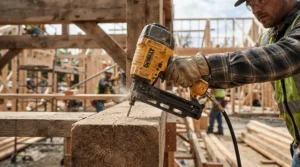
A first fix nailer is a structural nail gun built to drive long collated nails — typically 50mm to 90mm — into timber framing, joists, roof battens, studwork and decking, the “bones” of a building before plasterboard, skirting or anything decorative goes anywhere near it. Unlike a second fix nailer, which finishes off skirting boards and architrave with small discreet pins, a first fix tool is built for volume and muscle: hundreds of heavy fixings a day, in all weathers, often overhead.
This guide compares seven real, currently available first fix nailers sold in the UK, from proper site-grade gas and cordless tools through to a genuinely usable value first fix nail gun UK buyers on a tighter budget can justify. We’ll look at gas versus battery versus pneumatic power, dig into cost per nail once you factor in consumables, work out where magazine capacity actually earns its keep, and settle the long-running debate over whether value brands can hold their own against the big names. As the Wikipedia entry on nail guns notes, these tools have largely replaced the hammer as the builder’s tool of choice — and once you understand why, you’ll wonder how anyone ever framed a roof without one.
Quick Comparison Table
| Nailer | Power Type | Nail Length | Weight | Best For |
|---|---|---|---|---|
| Paslode IM350+ | Gas + Li-ion | 50–90mm | 3.3kg | Pro site standard, all-day reliability |
| DeWalt DCN692 | Cordless (gasless) | 50–90mm | ~3.3kg | DeWalt battery-system users |
| Milwaukee M18FFN | Cordless FUEL | 50–90mm | ~4.2kg | Hardwood, sub-flush precision |
| Makita GN900SE | Gas + Li-ion | 50–90mm | ~3.3kg | Paslode-compatible, portable |
| Ryobi RFN1834X | Cordless ONE+ | 50–90mm | 4.3kg | Budget entry, existing ONE+ owners |
| Tacwise KDH90V | Pneumatic | 50–90mm | ~3.5kg | Tightest budget, occasional use |
| HiKOKI NR1890DBCL | Cordless (gasless) | 50–90mm | 4.1kg | Pneumatic feel, no gas bill |
Look at that table for more than a few seconds and a pattern jumps out: every single one of these tools fires the same 50–90mm nail range, because that’s simply what UK stud walls, joists and roof timbers demand. The real differences — and the ones worth paying for — are in how each tool generates its driving force, how it copes with a full day’s abuse, and what it costs you every time you pull the trigger. Paslode IM350+ and Makita GN900SE both burn a fuel cell for power, which means buying gas as an ongoing cost; DeWalt DCN692, Milwaukee M18FFN, Ryobi RFN1834X and HiKOKI NR1890DBCL are all gasless cordless tools that only need batteries; and the Tacwise KDH90V trades cordless freedom for the lowest upfront price by running off a compressor.
💬 Just one click — help others make better buying decisions too!😊
Top 7 First Fix Nailers: Expert Analysis
We’ve picked these seven to cover every realistic buyer: the site professional who needs something bombproof, the DIYer building a garden room who can’t justify £600, and everyone in between. Each one is a genuine, currently sold product — no invented models, no rebadged mystery tools.
1. Paslode IM350+ — the site-standard benchmark for a reason
Forty years of refinement have gone into this one, and it shows the moment you pick it up. Paslode’s seventh-generation gas technology delivers up to 82 joules of driving force, enough to sink a 90mm ring-shank nail into softwood without the tool bouncing off in protest. The quick-charge lithium battery fires the ignition spark rather than the nail itself — the gas cell does the actual work — and Paslode claims up to 9,000 shots per battery charge, equating to over 4 nail fuel packs, with a fast-charge giving roughly 200 shots from just two minutes on the mains.
What most buyers overlook about the IM350+ is that its reputation isn’t really about raw power at all — plenty of cordless rivals now match or beat it on paper. It’s the consistency and parts availability that keep it on site: nail and gas packs are stocked in every builders’ merchant in the country, so a dead cell at 7am on a Monday isn’t a crisis. Reviewers consistently note the tool’s excellent balance and relatively low actuation force, which matters enormously if you’re firing a few hundred nails before lunch. A genuine common complaint is the ongoing cost of fuel cells and Paslode-branded consumables compared with a purely battery-driven tool.
Pros:
- ✅ Site-standard reliability with parts stocked everywhere
- ✅ Fast recharge and quick fuel-cell swaps minimise downtime
- ✅ Multi-angled nose teeth reduce slipping on tricky timber
Cons:
- ❌ Ongoing gas cell cost adds to long-term running expense
- ❌ Pricier than most gasless cordless alternatives up front
At the time of research, expect to pay somewhere in the £450–£600 range for a full kit with battery and charger, though body-only deals occasionally dip below that. Given how much site time it saves, most trade buyers consider it worth every penny — check current price before committing, as gas nailer stock and bundles shift often.
2. DeWalt DCN692 — gasless power for the DeWalt ecosystem
DeWalt describes this as the world’s first cordless first fix framing nailer, and whatever you think of that marketing claim, the engineering underneath is genuinely clever: a brushless motor mechanically compresses a spring rather than igniting gas, so there’s no fuel cell, no combustion smell, and no cold-weather misfires. It handles 50–90mm nails at 30–34 degrees, and DeWalt states it will drive a 90mm ring shank nail into softwood as well as 63mm into hardwoods.
On paper this means anyone already carrying DeWalt 18V XR batteries around effectively gets a free power source for this tool — a meaningful saving if you’re deep in that ecosystem already. The dual speed settings let you dial back power for shorter nails, extending runtime, and the sequential-versus-bump firing switch is genuinely useful for switching between careful joist work and rapid stud-wall production. User reports on well-used units mention thousands of nails fired without a single jam, though the tool does run notably heavier once a 5.0Ah battery is clipped in, and some buyers find the recoil more pronounced than a gas equivalent on longer nails.
Pros:
- ✅ No gas cells needed — runs entirely on XR batteries
- ✅ Works in temperatures from -20°C to 50°C reliably
- ✅ Tool-free jam clearance saves real time on site
Cons:
- ❌ Adds noticeable weight once the battery is fitted
- ❌ Locks you into buying DeWalt-specific batteries if starting fresh
Body-only, this typically sits around £300–£350; add a 5.0Ah battery and fast charger and the total kit price climbs meaningfully higher. If you’re already sat on a shelf of DeWalt batteries, this is close to a no-brainer.
3. Milwaukee M18 FUEL M18FFN — the hardwood specialist
Milwaukee doesn’t do things by halves, and the M18FFN is the proof: it’s built around what the brand calls “Ready to Fire” technology, which eliminates ramp-up time between each nail discharge, and its POWERSTATE brushless motor is tuned specifically for best-in-class power to consistently seat nails sub-flush to the surface in hardwoods.
That last point genuinely matters if your first fix work regularly involves hardwood joists, oak-framed extensions, or engineered lumber that laughs at lesser cordless nailers. Where a lighter-duty tool can leave a proud nail head that then needs a hammer to finish, the M18FFN is engineered specifically to avoid that callback. It runs on the same M18 batteries as Milwaukee’s drills, grinders and impact drivers, so tradespeople already in the ecosystem gain another tool without another charger cluttering the van. Reviewers highlight the near-zero lag between trigger pulls in bump mode, useful for production sheathing work, though the tool’s premium positioning means it’s consistently the priciest cordless option in any UK comparison, and its weight with a battery fitted is noticeably more than the Paslode.
Pros:
- ✅ Sub-flush seating even in dense hardwood timber
- ✅ Zero ramp-up between shots for production speed
- ✅ Shares batteries across the wider M18 tool range
Cons:
- ❌ The most expensive cordless option in this comparison
- ❌ Heavier in the hand than most rivals once loaded
As a twin-battery kit, this typically lands at the top of the market — think roughly £550–£700 depending on retailer and included accessories. For heavy hardwood framing, it’s the analytical choice even at that price; for softwood stud walls, you may be paying for capability you won’t use.
4. Makita GN900SE — Paslode-compatible and properly portable
Makita’s take on the gas nailer plays a clever compatibility card: it’s built to accept all major manufacturers’ nails including Paslode IM350 fixings, so switching brands doesn’t mean binning your existing nail stock. The 7.2V lithium battery charges in around 30 minutes, which Makita states is four times quicker than the leading competitor, and a single fuel cell delivers roughly 1,200 shots.
What the spec sheet won’t tell you, but the secondhand market strongly suggests, is just how well these units hold up over years of hard site use — a healthy trade in serviced, refurbished GN900SE units exists precisely because the mechanism is simple and robust enough to be worth repairing rather than replacing. That’s a genuinely useful signal about longevity that a brand-new spec sheet can’t give you. The LED fault-finding and battery warning system is a small but appreciated touch that saves guesswork when something misfires, and the nailer’s balance makes overhead roof battening noticeably less tiring than with bulkier rivals. On the downside, it’s a Makita-branded gas tool competing directly with Paslode’s near-monopoly on site familiarity, so some crews are simply reluctant to switch away from what they already know.
Pros:
- ✅ Genuine cross-compatibility with Paslode-style nails and gas
- ✅ Rapid 30-minute battery charge time
- ✅ Lightweight, well-balanced body reduces fatigue overhead
Cons:
- ❌ Less site-ubiquitous than Paslode, so borrowed consumables are rarer
- ❌ 7.2V battery system is exclusive to this tool, not shared across a range
Expect to pay somewhere around £400–£480 at the time of research for a kit with battery and charger — a genuinely competitive mid-range price for a gas nailer with this level of compatibility.
5. Ryobi ONE+ RFN1834X — the smartest value pick for weekend framers
Here’s where the value first fix nail gun UK conversation gets interesting. Ryobi’s ONE+ HP framing nailer uses what the brand calls AirStrike technology — essentially an onboard, user-refillable air spring — to eliminate the need for a compressor, hose or gas cartridge entirely, while plugging into the same 18V ONE+ battery platform as over 200 other Ryobi tools, from strimmers to impact drivers.
Based on the spec comparison, this is the tool that makes most sense for someone who already owns a Ryobi ONE+ drill or garden kit and doesn’t fix timber for a living. It handles the full 50–90mm nail range at 34 degrees, weighs 4.3kg, and Ryobi states it will drive up to 750 50mm nails into pine on a single charge from a 4Ah battery — genuinely respectable for a tool at this price point. Reviewers are split on whether it fully replaces a pneumatic framer for daily professional use, with one independent tester noting the recoil is a little more noticeable than on comparable pneumatic tools, even while praising the removable no-mar tip and the claw-tip toe-nailing feature for tight angles. It’s not pretending to be a Paslode rival — it’s aiming squarely at the serious DIYer and occasional tradesperson, and at that job it excels.
Pros:
- ✅ No gas or compressor costs — runs on ONE+ batteries alone
- ✅ Onboard air-fill valve keeps drive power topped up
- ✅ Shares batteries with 200+ other ONE+ tools already owned
Cons:
- ❌ Recoil management takes more practice than gas nailers
- ❌ Not marketed or built for continuous daily trade use
Body-only, this typically sits in the £180–£230 bracket, making it one of the most affordable genuine routes into cordless first fix nailing on the UK market — check current price, as ONE+ bare-tool deals move around frequently.

6. Tacwise KDH90V — proof that budget doesn’t mean flimsy
If pure upfront cost is your deciding factor, the Tacwise KDH90V pneumatic framing nailer is where most value-brand searches eventually land. It fires paper collated 34-degree clipped head nails from 50mm to 90mm, includes adjustable depth of drive and an adjustable single/multi-shot trigger, and one independent UK retailer notes that entry-level structural nailers such as the Tacwise KDH90V typically cost under £200.
Here’s what most buyers overlook when they dismiss value brands outright: pneumatic tools like this one have no battery to degrade, no gas ignition system to service, and a mechanically simple design that’s genuinely easy to repair. Tacwise has built its reputation over more than 50 years in the nailing, stapling and fastening industry, and while it’s never going to carry the site-cred of Paslode, the aggregated sentiment across UK tool retailers is consistently that Tacwise punches well above its price for occasional and semi-professional use. The obvious catch is that it needs a compressor and hose, which adds cost, weight and a genuine trip hazard that cordless and gas tools simply don’t have — and a compressor loud enough to run a framing nailer is not a quiet neighbour on a residential job.
Pros:
- ✅ Lowest upfront cost of any tool in this comparison
- ✅ Simple mechanism with fewer expensive parts to fail
- ✅ High-capacity magazine reduces reloading interruptions
Cons:
- ❌ Requires a separate compressor and hose to function
- ❌ Less portable and more restrictive on remote or upper-floor sites
At under £200 for the gun itself, this is the genuine value first fix nail gun UK buyers gravitate toward when a compressor is already sitting in the garage — just budget separately for that compressor if you don’t already own one.
7. HiKOKI NR1890DBCL — pneumatic feel without the gas bill
HiKOKI’s Air-Spring Drive System is the cleverest engineering story in this whole line-up: rather than gas combustion or a mechanical spring, it uses sealed compressed air within the tool itself to replicate genuine pneumatic-style recoil and driving force, cordlessly. HiKOKI states it delivers zero ramp up time, up to 2 nails driven per second, and recoil that feels like a pneumatic nailer, without ever needing to refill an air tank.
The spec sheet’s real-world translation is this: if you’ve used a proper compressor-fed framing nailer for years and hate the “dead” feel of some battery nailers, this is the cordless tool most likely to feel instantly familiar. At 4.1kg body weight it’s competitively light for a cordless framer, and the integrated operation panel with battery indicator and mode switching is genuinely well thought through rather than bolted on as an afterthought. Reviewers on trade forums consistently flag the driving speed — 1.5 to 2 nails per second — as noticeably snappier than some rival cordless tools, though it’s worth noting HiKOKI’s UK brand recognition still trails DeWalt and Makita, which occasionally affects resale value and how easily you can borrow consumables from another crew on site.
Pros:
- ✅ Pneumatic-feel recoil without any hose or compressor
- ✅ Fast 1.5–2 nails per second driving speed
- ✅ Compatible with all HiKOKI 18V slide-type batteries
Cons:
- ❌ Less brand recognition on UK sites than DeWalt or Milwaukee
- ❌ Twin-battery kits push the total price toward the premium end
Body-only pricing typically runs £300–£380, with twin-battery kits closer to £500–£550 depending on retailer bundles — a genuinely strong mid-range option if pneumatic feel matters more to you than brand badge.
Practical Usage Guide: Setting Up and Getting the Most From Your First Fix Nailer
Getting a new first fix nailer out of the box and straight onto a stud wall is how most avoidable problems start. Spend twenty minutes on setup and you’ll save hours of frustration later.
Start by matching your nail choice to the job before you even open the magazine: 50mm nails suit noggins and light stud fixing, while 75-90mm nails are for joists, trimmers and load-bearing framing where pull-out strength genuinely matters. Load the magazine fully rather than topping up little and often — partial loads on strip-fed magazines are a classic cause of feed jams, particularly once the collated strip gets down to its last few nails. Set your depth of drive on a scrap offcut of the same timber species you’re about to fix, not on a bench sample — pine and treated softwood behave differently, and what’s flush in one will be proud or sunk in the other.
For the first thirty days, the single most common mistake is neglecting basic maintenance because the tool “feels” fine. Gas nailers need their contact tip and driver blade kept free of resin build-up, which accumulates faster in softwood than most people expect; cordless gasless tools like the DeWalt and HiKOKI benefit from an occasional check of the nose for debris, since a jammed nail against a dirty contact point is the most common cause of misfires reported by users. Whatever tool you choose, always fire into scrap material to test depth after any change of nail batch — nail diameter tolerances shift slightly between manufacturers, even within the same nominal gauge, and that tiny variance is enough to change your drive depth noticeably.
Real-World Scenarios: Matching the Nailer to the Job
Scenario one — the self-builder framing a garden room on weekends. Budget is tight, usage is occasional, and a compressor already lives in the garage from painting jobs. The Tacwise KDH90V or Ryobi RFN1834X both make sense here: neither needs daily reliability at a professional level, and the lower upfront cost matches genuinely light annual usage.
Scenario two — a jobbing carpenter doing three or four stud wall jobs a week. Reliability and consumable availability now matter more than raw upfront price, because downtime costs real money. This is squarely Paslode IM350+ or Makita GN900SE territory — both gas systems with wide nail and fuel availability, so a dead cell doesn’t stall a job.
Scenario three — a timber frame erection crew working engineered lumber and hardwood beams daily. Here the extra investment in the Milwaukee M18FFN genuinely pays for itself through fewer proud nails, fewer callbacks, and battery compatibility across an already-owned M18 tool fleet. Meanwhile a crew standardised on DeWalt gear would reasonably choose the DeWalt DCN692 for the same ecosystem logic, even without Milwaukee’s hardwood-specific tuning.
Problem → Solution Guide
Problem: nails setting proud instead of flush. Almost always a depth-of-drive or air pressure issue rather than a faulty tool — recheck depth settings on the specific timber and nail batch in use, and on pneumatic tools like the Tacwise KDH90V, confirm the compressor is actually reaching its rated PSI under load.
Problem: frequent jams on a strip-fed magazine. Usually caused by a bent nail strip from rough handling, or firing the last few nails in a partially loaded magazine — always top up before the strip runs critically low, and store spare nail packs flat rather than upright.
Problem: gas nailer misfiring in cold weather. Gas combustion tools like the Paslode IM350+ and Makita GN900SE rely on stable fuel vaporisation, which struggles below freezing — keeping the fuel cell and battery in an inside pocket rather than a cold van overnight solves most winter misfire complaints.
Problem: excessive recoil causing fatigue on cordless tools. This is partly technique — let the tool’s weight do the work rather than pressing hard into the timber — and partly tool choice; if recoil fatigue is a persistent issue, tools with gas-spring or air-spring drive systems such as the HiKOKI NR1890DBCL are specifically engineered to soften this compared with simpler mechanical-spring cordless nailers.
Problem: uncertainty over which nail angle fits which tool. Not all 34-degree magazines accept 30-degree nails and vice versa — always check your specific nailer’s accepted angle range before bulk-buying nail packs, since a mismatch either won’t feed at all or will feed unreliably.
How to Choose a First Fix Nailer
- Confirm your nail range needs first. Most UK stud wall and joist work needs 50-90mm nails at 30-34 degrees — every tool in this guide covers that range, so this rules very little out on its own.
- Decide your power source honestly. Gas suits frequent professional use with easy consumable access; gasless cordless suits anyone avoiding ongoing fuel costs; pneumatic suits owners who already have a compressor and want the lowest tool price.
- Weigh your existing battery ecosystem. If you already own DeWalt, Milwaukee, Ryobi or HiKOKI batteries, that tool’s equivalent nailer effectively costs less than its sticker price once shared batteries are factored in.
- Check magazine capacity against your typical job size. Frequent reloading on a large framing job wastes real time — see the dedicated section below for exactly how much this matters.
- Be realistic about frequency of use. A tool used four times a year doesn’t need site-grade durability; one used four times a week absolutely does, and skimping there costs more in downtime than it saves upfront.
- Factor in running costs, not just the sticker price. Gas cells, batteries and even compressor electricity all add up — our cost-per-nail breakdown below puts real numbers against this.
- Read genuine buyer feedback before committing, since real-world reliability over hundreds or thousands of fixings tells you far more than a spec sheet ever will.
Employers and self-employed tradespeople should also note that any first fix nailer used at work in the UK falls under the Provision and Use of Work Equipment Regulations 1998, which require the tool to be suitable, well maintained, and used only by people who’ve had adequate instruction — worth bearing in mind before handing a nailer to an untrained apprentice.
Cordless First Fix Nailers vs Pneumatic and Gas Models
This is the debate that decides most purchases, so it deserves proper unpacking rather than a quick verdict.
| Factor | Cordless (Battery/Gasless) | Pneumatic (Compressor) | Gas (Fuel Cell) |
|---|---|---|---|
| Upfront tool cost | Mid to high | Lowest | Mid to high |
| Ongoing running cost | Battery replacement only | Compressor electricity, hose wear | Gas cell purchases |
| Portability | Excellent — no hose or compressor | Poor — tethered to compressor | Excellent |
| Cold weather reliability | Generally strong | Strong (mechanically simple) | Can misfire below freezing |
| Best for | Solo tradespeople, awkward access | Fixed workshop or ground-floor sites | High-volume daily site use |
Reading across that table, pneumatic tools like the Tacwise KDH90V win decisively on tool price alone, but that number is misleading in isolation — a decent compressor adds £150-£300 on top if you don’t already own one, plus the ongoing cost of running it and the practical hassle of dragging a hose up a ladder. Cordless gasless tools such as the DeWalt DCN692, Ryobi RFN1834X and HiKOKI NR1890DBCL trade a higher initial outlay for genuine freedom of movement, which matters enormously on upper floors, in lofts, or anywhere a hose becomes a trip hazard. Gas tools like the Paslode IM350+ and Makita GN900SE sit in an interesting middle ground: portable like cordless, but with an ongoing consumable cost that pneumatic and pure-cordless tools don’t carry in the same way.
Cost Per Nail: What a First Fix Nailer Really Costs to Run
Sticker price tells you almost nothing about what a first fix nailer actually costs over its working life, and cost per nail is the number serious buyers should actually be comparing.
Here’s what most buyers overlook: a gas nailer’s fuel cell typically delivers somewhere around 1,000–1,200 shots, meaning the gas cost alone adds a small but real amount to every single fixing, on top of the nail itself. Multiply that across several thousand nails a year on a busy site and it becomes a genuine line item, not a rounding error. Cordless gasless tools avoid that specific cost entirely — batteries degrade over hundreds of charge cycles rather than being consumed per shot — but the battery itself is an eventual replacement cost that a gas tool’s ignition battery, which lasts thousands of shots per charge, doesn’t carry in the same way. Pneumatic tools have arguably the lowest true cost per nail once a compressor is already owned, since compressed air itself costs only the electricity to generate it.
For a rough working example: a professional firing 3,000 nails a month on a Paslode IM350+ will get through roughly two to three gas cells monthly on top of nail packs, while the same volume on a Ryobi RFN1834X or HiKOKI NR1890DBCL costs only the nails plus a fraction of a battery’s total lifespan. Over a year, that gap is real money — but it has to be weighed against the reliability, parts availability and resale value that keep gas tools dominant on professional UK sites regardless.
Magazine Capacity and Why It Matters More Than You Think
It’s tempting to treat magazine capacity as a footnote spec, but on a genuinely busy first fix day it’s one of the differences you’ll notice within the first hour.
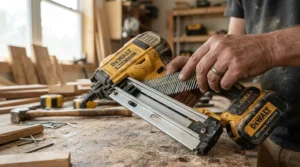
The Ryobi RFN1834X holds 60 nails per load, and the Tacwise KSN90V angled strip nailer holds 80 — both perfectly workable for stud wall and general framing work, but reload frequency scales directly with how big your job is. What most buyers overlook is that reloading isn’t just the ten seconds it takes to slot in a fresh strip; it’s the interruption to rhythm, the climb down from a ladder or scaffold, and the cumulative minutes that add up across a full day of joist fixing. On a large timber frame erection with hundreds of fixings needed before lunch, a higher-capacity magazine genuinely translates into fewer stoppages and a faster finish.
Where magazine capacity matters less is on smaller domestic jobs — a single stud wall partition or a run of noggins rarely exhausts even a modest magazine before the section is finished anyway. The practical takeaway: weekend and occasional users can reasonably deprioritise this spec, while anyone framing professionally at volume should treat magazine capacity as a genuine shortlisting criterion, not an afterthought buried in the small print.
Value Brands vs Big Names: Is the Premium Worth It?
This is where honesty matters most, because plenty of marketing exists specifically to make you feel guilty about buying anything other than the market leader.
Based on the spec comparison across all seven tools here, value brands like Tacwise genuinely do deliver on the fundamentals — they drive the correct nail range, to comparable depths, using broadly similar mechanisms to premium tools. What premium brands like Paslode and Milwaukee are actually charging for is refinement at the margins: slightly better balance, marginally faster cycle times, wider third-party parts and consumable availability, and — perhaps most significantly — the accumulated trust of decades on UK building sites, which genuinely does correlate with fewer unexpected failures across large fleets of tools. Reviewers consistently note that Tacwise’s own components feel a notch below Paslode’s in fit and finish, without necessarily being unreliable — it’s a difference of polish rather than fundamental competence.
The honest verdict: for occasional and semi-professional use, a value brand first fix nail gun UK buyers pick up for under £200 will do the job asked of it perfectly well, and the money saved is genuinely money saved, not a false economy. For daily professional use across multiple sites and crews, the premium brands’ reliability track record and parts availability tend to justify their higher price over the tool’s working life — not because the budget tool is bad, but because downtime costs a tradesperson far more than the price difference between brands ever will.
Cordless First Fix Nailers for Stud Walls: What Changes Indoors
Stud wall work has its own quirks that differ meaningfully from roof battening or joist fixing outdoors, and it’s worth addressing specifically.
Indoor stud partitions are typically built from lighter timber sections — often 89mm x 38mm studs at 400mm centres — and a cordless first fix nailer for stud walls generally has an easier time of it than the same tool would tackling dense structural joists or hardwood beams. This is exactly the environment where a lighter, well-balanced tool like the Ryobi RFN1834X or HiKOKI NR1890DBCL genuinely shines: there’s no need for the Milwaukee’s hardwood-specific power, and the lack of a hose or gas smell matters more indoors, where ventilation is often limited and a tethered compressor is genuinely impractical in a finished or semi-finished room.
Noise is a real, underrated factor here too — a compressor running a pneumatic nailer like the Tacwise KDH90V is considerably louder than any cordless alternative, which matters enormously if you’re working in an occupied house rather than an empty shell. Battery runtime is rarely a limiting factor on stud wall jobs specifically, since a single partition wall typically uses far fewer nails than a full roof or floor structure — meaning even a modest-capacity battery comfortably outlasts most single-room jobs without a swap.
Safety, Regulations and PPE for First Fix Nailing
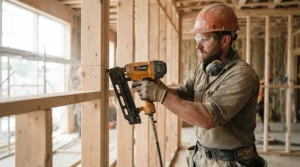
First fix nailers are genuinely powerful tools, and treating them casually is how avoidable injuries happen. The Health and Safety Executive’s own guidance on nail gun safety is unambiguous on the fundamentals: repeat firing features are not suitable on nail guns that fire large nails for construction use, meaning a second nail should never fire without the trigger being fully released and pulled again on structural work. The guidance also warns that safety features must not be defeated or disconnected under any circumstances, and that accident analysis found that the vast majority of eye injuries caused by nail guns would have been prevented if eye protection had been worn — a genuinely sobering statistic worth taking seriously every time you pick one up.
Beyond eye protection, sensible practice includes keeping hands and fingers well clear of the nose while loading, never carrying a loaded nailer with a finger resting on the trigger, and disconnecting the battery or fuel cell before clearing any jam rather than assuming the tool is inert. If you’re an employer or self-employed contractor providing any of these tools for use at work, remember the PUWER obligations already covered above apply in full — suitable tool, properly maintained, and used only by someone adequately instructed in it.
FAQ
❓ What is a first fix nailer used for?
❓ How much does a first fix nailer cost in the UK?
❓ Can I use a cordless first fix nailer for stud walls?
❓ What's the difference between a first fix and second fix nail gun?
❓ Do I need a compressor for a first fix nailer?
Conclusion
Choosing between these seven first fix nailers really comes down to being honest about how often you’ll actually use one and what environment it’ll be working in. If you’re framing daily and need bulletproof reliability with parts on every merchant’s shelf, the Paslode IM350+ remains the sensible default, with the Makita GN900SE a genuinely capable and often cheaper alternative that shares its consumables. Anyone deep in a particular cordless ecosystem should lean toward the matching tool — the DeWalt DCN692 or Milwaukee M18FFN for existing battery owners, the latter specifically if hardwood framing is a regular part of the job. For everyone working to a tighter budget, whether that’s a weekend self-builder or an occasional tradesperson, the Ryobi RFN1834X and Tacwise KDH90V both prove that a genuine value first fix nail gun UK price tag doesn’t have to mean a compromised tool, while the HiKOKI NR1890DBCL sits neatly in between, offering pneumatic-style performance without ever needing a compressor.
Whichever you choose, the fundamentals stay the same: match the tool to your nail range and power preference, respect the safety guidance covered above, and factor in running costs rather than just the price on the box. Get that right, and any of these seven will earn its keep many times over.
✨ Ready to speed up your next framing job? Compare current prices on today’s picks and get building! 🔨
Recommended for You
- First Fix Nail Gun: 7 Best Picks UK Tradesmen Rely On (2026)
- Cordless Nail Gun vs Pneumatic Nail Gun: 7 Best Picks UK 2026
- Cordless Nail Gun For Skirting Boards: 7 Proven Picks (2026)
Disclaimer: This article contains affiliate links. As an Amazon Associate, I earn from qualifying purchases. If you purchase products through these links, we may earn a small commission at no additional cost to you.
✨ Found this helpful? Share it with your friends! 💬🤗
