
In This Article
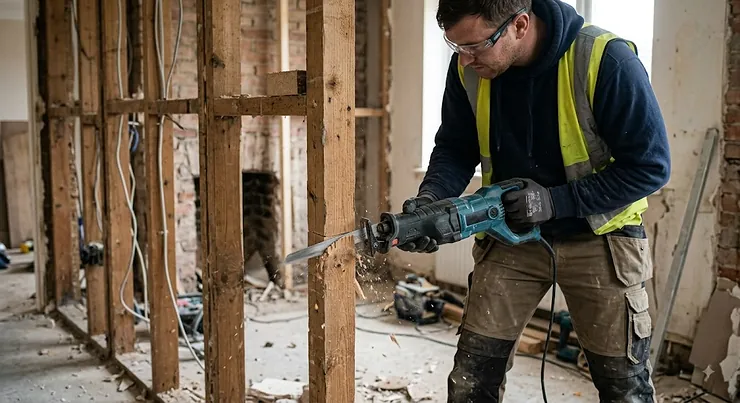
Knocking through a stud wall, hacking out an old kitchen carcass, or freeing a rusted radiator bracket that’s been welded to life by forty years of paint — a sabre saw for demolition work turns jobs that would take an afternoon with a hand saw into a fifteen-minute task. If you’ve ever tried to dismantle anything with nails still buried in it using a jigsaw or a circular saw, you’ll already understand why tradespeople reach for this tool the moment “tidy cutting” stops being the goal and “just get it apart” becomes the priority.
A sabre saw for demolition work is essentially a reciprocating saw: a long blade driven back and forth in a straight line by an electric motor, built specifically to plough through mixed, messy materials — timber with nails still in it, old pipework, plasterboard, even the odd bit of masonry render — without much regard for finish. Where a circular saw wants clean, predictable stock and a jigsaw wants thin sheet material, this tool is happiest chewing through whatever a demolition job throws at it.
Below, we’ve pulled together seven genuine models currently sold in the UK, spanning true budget DIY kit through to site-grade cordless machines, alongside the practical detail Amazon’s own listings won’t give you — how these saws actually behave on rusted nails, damp timber, and long sessions of overhead cutting. Before you spend anything, it’s worth checking whether your building predates 2000, since the Health and Safety Executive notes that asbestos can be present in buildings constructed before that date — worth ten minutes of your time before the saw ever touches a wall.
Quick Comparison Table
| Saw | Type | Cutting Depth (Wood) | Price Range | Best For |
|---|---|---|---|---|
| Bosch GSA 1100 E | Corded | 230mm | around £120-150 | Long demolition sessions without battery worries |
| Black+Decker BDCR18N | Cordless (18V) | ~150mm | under £90 | Occasional DIY, light budget jobs |
| Makita DJR186Z | Cordless (18V) | 255mm | £100-270 range | All-round mixed-material demolition |
| DeWalt DCS382N-XJ | Cordless (18V) | around 230mm | £130-160 range | Balanced power and control on a budget |
| Bosch GSA 18V-28 | Cordless (18V BITURBO) | 230mm | £220-260 range | Serious cordless site work |
| Milwaukee M18 FUEL 2720-20 | Cordless (18V) | 300mm+ | £150-190 range | Fastest cordless cutting on test |
| DeWalt DCS389N-XJ | Cordless (54V FlexVolt) | up to 300mm | £220-280 range | Corded-level power, cordless freedom |
Looking at the spread above, the gap between the cheapest and most expensive DeWalt or Bosch models isn’t really about whether the saw will cut — nearly all of them will get through a stud wall — it’s about how long they’ll do it for, how much muscle they’ve got in thicker material, and whether you’re tied to a socket. If you’re doing one project this year, the Bosch GSA 1100 E or Black+Decker BDCR18N will do the job; if you’re on-site weekly, the extra outlay on the Milwaukee or DeWalt DCS389N-XJ pays for itself in reduced downtime.
💬 Found this comparison useful? A quick share helps other DIYers and tradespeople find the right saw first time!😊
What Is a Sabre Saw for Demolition Work?
A sabre saw for demolition work is a hand-held power saw that drives a long, replaceable blade in a rapid push-pull motion, designed to cut through mixed and often contaminated materials — timber with embedded nails, old pipe, plasterboard, and light metal — without needing a clean, pre-marked line. Unlike a circular saw or jigsaw, it’s built for controlled destruction rather than joinery-grade accuracy.
Reciprocating saws — the family this tool belongs to — are one of the few power tools genuinely designed to be abused a little. The blade is sacrificial by design; you’re expected to burn through several during a big strip-out, and the saw itself is built to shrug off the odd nail strike that would wreck a circular saw blade in seconds.
Top 7 Sabre Saws for Demolition Work: Expert Analysis
We’ve spread these seven picks across budget, mid-range and premium tiers, covering both corded and cordless options, so there’s a genuine match here whether you’re gutting one bathroom or running a saw five days a week on site.
1. Bosch GSA 1100 E — best corded reliability for long sessions
The standout here is straightforward: no battery to manage, no charge anxiety mid-strip-out, just plug in and go for as long as the job takes. The 1,100W motor drives the blade at up to 2,700 strokes per minute with a 28mm stroke length, giving a 230mm cutting depth in wood and 20mm in metal — plenty for stud walls, old skirting, and light steel conduit.
Based on the spec comparison, this is squarely a “get the job done, not the fastest tool in the van” machine. What most buyers overlook about corded reciprocating saws is that the extra weight of a permanently attached cable is more than offset by never needing to down tools to swap a battery — for a full day of demolition, that adds up. The tool-free SDS blade change and built-in LED work light are the kind of small conveniences that matter more than they sound on paper once you’re three hours into stripping a kitchen.
Reviewers consistently note that this model punches above its price bracket for raw cutting power, with several long-time users citing it as a reliable “get the ugly jobs done” saw rather than a precision instrument — which is exactly what it’s built to be.
Pros:
- ✅ No battery downtime during long demolition sessions
- ✅ Strong 230mm wood cutting depth for the price
- ✅ Tool-free SDS blade changes save time on site
Cons:
- ❌ Cable limits reach in awkward, hard-to-access spaces
- ❌ Heavier in the hand than comparable cordless models
At around £120-150, the Bosch GSA 1100 E represents strong value for anyone doing regular demolition work from a fixed power source — check current price before buying, as stock and bundled accessories vary.
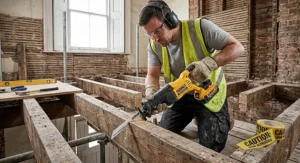
2. Black+Decker BDCR18N — lightest budget pick for occasional DIY
The standout feature here is sheer accessibility: this is the saw for someone who needs to cut through a few studs, some old decking, or a redundant shed frame once or twice a year and doesn’t want to spend serious money doing it. Running at up to 3,000 strokes per minute with a 22mm stroke length, it’s genuinely compact and light in the hand.
Key specs translate into real limitations worth knowing about — the shorter stroke length and lighter overall build mean it won’t cut as deep or as fast as the trade-focused options on this list, and it’s part of Black+Decker’s 18V POWERCONNECT system, so battery compatibility only extends within that ecosystem. What most buyers overlook about entry-level reciprocating saws is that the tool-free blade change and anti-slip grip — both present here — matter more for occasional users than raw power, since comfort and ease of use are what actually gets a beginner through an unfamiliar job safely.
Aggregated review sentiment for this model and its siblings in the range consistently highlights good value and ease of use for light DIY tasks, with the honest caveat that it isn’t intended to compete with trade-grade tools on sustained cutting power.
Pros:
- ✅ Genuinely affordable entry point into reciprocating saws
- ✅ Compact and lightweight for overhead or awkward cuts
- ✅ Tool-free blade changes suit total beginners
Cons:
- ❌ Shorter stroke length limits cutting depth versus rivals
- ❌ Not built for daily, heavy-duty demolition use
Priced under £90 for a battery-included kit (body-only versions run cheaper still), the Black+Decker BDCR18N is the sensible choice if this is a once-a-year tool rather than a trade essential.
3. Makita DJR186Z — best all-rounder for mixed demolition materials
What stands out immediately is the 32mm stroke length — longer than most rivals in this price bracket — paired with up to 2,800 strokes per minute, which together give it a genuinely useful 255mm cutting depth in wood and the ability to slice through 130mm steel pipe or box section without labouring.
The newly designed crank mechanism reduces blade deflection, which in practice means straighter, more controlled cuts even when you’re working one-handed above your head — something the spec sheet won’t tell you, but user reports consistently mention as a real point of difference versus older reciprocating saw designs. Based on the spec comparison, this sits comfortably as a genuine trade tool that’s also approachable enough for a confident DIYer tackling a full renovation.
Reviewers consistently report that the elastomer-wrapped handle keeps vibration manageable during extended cutting, and several highlight the tool-less blade change as noticeably quicker than rival systems — a small thing that saves real minutes across a demolition day involving dozens of blade swaps.
Pros:
- ✅ 255mm wood cutting depth outperforms similarly priced rivals
- ✅ Reduced blade deflection for straighter, controlled cuts
- ✅ Comfortable for extended one-handed or overhead work
Cons:
- ❌ Battery and charger typically sold separately on body-only units
- ❌ Noticeably heavier once a battery is fitted
Body-only versions sit in the £100-150 range, while kits bundled with batteries and a charger stretch toward £270 — the Makita DJR186Z earns its keep either way if mixed-material demolition is a regular part of your work.
4. DeWalt DCS382N-XJ — best balance of power and control
The standout advantage is DeWalt’s brushless motor technology delivering strong cutting performance without the bulk of the firm’s heavier 54V FlexVolt range, making this the pick for anyone who wants trade-grade reliability without carrying the heaviest tool in the bag.
The brushless motor means less heat generated during long cuts and a genuinely longer service life than brushed alternatives, while the two-position blade clamp allows for flush cutting against walls and floors — a detail that matters enormously in demolition work, where you’re often cutting pipework or studwork as close to a surface as physically possible. Here’s what to weigh: this model favours control and finish over outright brute force, so it suits detailed strip-out work better than pure heavy-impact demolition.
Aggregated feedback on the DCS382N and its close siblings in the DeWalt 18V XR range consistently points to strong build quality and dependable performance, with the ergonomic rubber-overmoulded handle repeatedly flagged as reducing fatigue during longer sessions.
Pros:
- ✅ Brushless motor for longer service life and less heat
- ✅ Two-position blade clamp enables true flush cutting
- ✅ Rubber overmould handle reduces hand fatigue over time
Cons:
- ❌ Sold body-only, so battery costs add to the total spend
- ❌ Not the outright fastest cutter in this line-up
At £130-160 range for the body, the DeWalt DCS382N-XJ is a smart mid-tier pick for anyone already invested in DeWalt’s 18V battery platform.
5. Bosch GSA 18V-28 — best cordless power for site use
BITURBO brushless technology is the headline feature, delivering cutting performance the manufacturer positions as equivalent to a 1,100W corded machine — genuinely impressive for a cordless tool and a strong argument for anyone tired of trailing extension leads around a demolition site.
With a 2,900 stroke-per-minute rate, a 28mm stroke length, and cutting depths of 230mm in wood and 150mm in steel, this sits at the top end of what an 18V cordless reciprocating saw can currently do. What most buyers overlook about this model is the toolless snap-in blade system via the Fixtec holder, which allows genuinely one-handed blade changes — a real advantage when you’re up a ladder or holding material steady with your other hand. On paper this means less time fumbling for a hex key mid-job, and reviewers consistently back that up as one of the tool’s most-praised features.
The motor brake with rapid blade stop also adds a genuine safety margin over cheaper models that let the blade coast to a stop, which matters when you’re working in tight, cluttered demolition spaces.
Pros:
- ✅ Corded-level cutting power from a cordless platform
- ✅ One-handed, tool-free blade changes via Fixtec system
- ✅ Motor brake with rapid stop improves on-site safety
Cons:
- ❌ Premium pricing compared with standard 18V rivals
- ❌ Battery and charger not included in body-only listings
Expect to pay in the £220-260 range for the body-only unit — the Bosch GSA 18V-28 is built for tradespeople who need cordless freedom without sacrificing cutting authority.

6. Milwaukee M18 FUEL Sawzall 2720-20 — fastest cordless cutting on test
The POWERSTATE brushless motor is the defining feature, engineered specifically to close the performance gap between cordless and corded reciprocating saws — Milwaukee’s own testing claims cutting speeds up to 30% faster than competitive 18V cordless saws, a bold claim but one that lines up with how this model is generally discussed among tradespeople.
The REDLINK PLUS intelligence system communicates between tool, battery and charger to optimise performance while protecting against overload, overheating and over-discharge — in practical terms, that means the saw self-manages its output rather than relying on you to babysit it during a long, hot demolition session. The gear-protecting clutch is a detail worth flagging too: it’s designed to absorb the shock of a blade binding on a stubborn nail or hidden fixing, protecting the internal gearing from damage that cheaper saws simply can’t shrug off.
Reviewers consistently highlight the combination of speed and extended run-time as the standout reasons to choose this model over rivals, with several longer-term users noting the saw still felt strong well after a year of regular trade use — genuine longevity feedback rather than a first-week impression.
Pros:
- ✅ Among the fastest-cutting cordless reciprocating saws available
- ✅ REDLINK PLUS protects tool and battery from overload damage
- ✅ Gear-protecting clutch reduces wear from blade binding
Cons:
- ❌ Sold as bare tool — batteries add significantly to total cost
- ❌ Premium brand pricing versus budget-tier alternatives
Body-only pricing sits in the £150-190 range, climbing well past £250 for a full kit with batteries and charger — the Milwaukee M18 FUEL Sawzall 2720-20 is the pick for anyone who treats cutting speed as a genuine priority.
7. DeWalt DCS389N-XJ — corded-level power without the cord
The 54V FlexVolt platform is the headline story: this is DeWalt’s answer to the “cordless tools can’t match corded power” complaint, delivering up to 19% more power than its DCS388 predecessor and a genuinely aggressive stroke length of around 29mm.
With a no-load stroke rate of up to 3,000 spm and cutting depths stretching to 300mm in wood and 130mm in metal, this is the most capable cutter on this list by a clear margin — the kind of spec sheet that starts to make sense once you understand FlexVolt batteries automatically switch voltage depending on the tool they’re plugged into. The crank-type drivetrain is worth calling out specifically: it delivers noticeably lower vibration than simpler mechanisms, measured by DeWalt at roughly 13 m/s² on board material, which in real terms means less hand fatigue across a demanding demolition day — directly relevant given the Health and Safety Executive’s well-documented guidance that hand-arm vibration from hand-held power tools is a genuine and significant cause of ill health among regular users.
Aggregated feedback on the DCS389N consistently praises its raw cutting authority in thick timber and metal, with reviewers repeatedly framing it as genuinely comparable to a corded machine — which, for a cordless tool, is the highest compliment this category can receive.
Pros:
- ✅ Cuts up to 300mm wood — deepest capacity in this round-up
- ✅ Crank drivetrain reduces vibration on long cutting sessions
- ✅ FlexVolt battery compatibility across DeWalt’s wider range
Cons:
- ❌ Highest price point of any model in this guide
- ❌ Heavier build makes overhead work more tiring
At £220-280 range body-only, the DeWalt DCS389N-XJ is the premium choice for professionals who need corded-grade performance on a cordless site.
Top 7 Saws: Full Comparison
| Saw | Stroke Rate | Stroke Length | Metal Cutting Depth | Best For |
|---|---|---|---|---|
| Bosch GSA 1100 E | 2,700 spm | 28mm | 20mm | Sustained corded sessions |
| Black+Decker BDCR18N | 3,000 spm | 22mm | Light gauge only | Once-a-year DIY jobs |
| Makita DJR186Z | 2,800 spm | 32mm | 130mm | Mixed-material demolition |
| DeWalt DCS382N-XJ | Variable | Standard | Moderate | Controlled flush cutting |
| Bosch GSA 18V-28 | 2,900 spm | 28mm | 150mm | Cordless site power |
| Milwaukee M18 FUEL 2720-20 | up to 3,000 spm | Standard | Strong | Fastest overall cutting |
| DeWalt DCS389N-XJ | up to 3,000 spm | ~29mm | 130mm | Deepest wood cutting capacity |
Reading across this table, stroke length and stroke rate together tell you more about real-world performance than either figure alone — the Makita DJR186Z‘s longer 32mm stroke lets it clear material faster per pass even at a lower spm than the Milwaukee. If your work leans heavily toward metal pipework and box section rather than timber, the Bosch GSA 18V-28‘s 150mm metal capacity is the standout figure worth prioritising over raw speed.
📌 Compare specs side-by-side before you buy — bookmark this table for later!
Reciprocating Saw vs Sabre Saw
These two names cause more confusion than almost any other power tool terminology in the UK market, so it’s worth settling clearly: a reciprocating saw and a sabre saw are the same tool. “Sabre saw” is simply the more traditional British and European term, drawing on the tool’s resemblance to a cavalry sabre in profile, while “reciprocating saw” describes the mechanical action — the blade moving back and forth (reciprocating) rather than rotating or oscillating.
Where genuine confusion does creep in is with jigsaws, which are sometimes also loosely called “sabre saws” in older UK trade parlance, despite being a much lighter tool designed for curved, precision cuts in thin sheet material rather than demolition-grade destruction. If a listing or a tradesperson’s advice mentions a “sabre saw” for pruning branches or gutting a kitchen, they mean what this guide covers; if the context is precision cutting of worktops or intricate shapes, they may be describing a jigsaw instead.
| Tool | Cutting Style | Best Use Case |
|---|---|---|
| Sabre Saw / Reciprocating Saw | Straight, aggressive push-pull cuts | Demolition, mixed materials, embedded nails |
| Jigsaw | Curved, precision cuts | Worktops, thin sheet, decorative shapes |
| Circular Saw | Fast, straight rip cuts | Clean timber, sheet material, decking boards |
The practical takeaway from this comparison is that buyer confusion over naming rarely leads to buying the wrong tool by accident — retailers overwhelmingly use “reciprocating saw” as the primary listing term now, with “sabre saw” appearing as an alternative search term or secondary descriptor. What genuinely matters is matching the tool’s cutting style to your job: if you’re demolishing rather than crafting, you want the tool this guide is built around.

How to Choose a Sabre Saw for Demolition Work
- Match power source to your job length. Corded models like the Bosch GSA 1100 E suit long, stationary demolition sessions near a power supply; cordless models suit mobility and awkward access but need battery management.
- Prioritise stroke length for cutting speed. A longer stroke, like the Makita DJR186Z‘s 32mm, clears material faster per pass — genuinely useful when time on site is money.
- Check metal cutting depth if pipework is involved. Models like the Bosch GSA 18V-28 with 150mm metal capacity handle old plumbing and steel conduit far more comfortably than budget alternatives.
- Consider blade clamp type. Tool-free systems like Bosch’s Fixtec or DeWalt’s lever-action clamp save real time across a demolition day involving frequent blade changes.
- Weigh vibration output for extended use. Crank-type drivetrains, as used in the DeWalt DCS389N-XJ, reduce hand-arm vibration exposure — directly relevant to long-term hand health under UK workplace guidance.
- Factor in battery ecosystem if going cordless. Buying into an existing 18V platform (Makita, DeWalt, Bosch, Milwaukee) saves money long-term if you already own compatible batteries.
- Set a realistic budget band. Occasional DIY rarely justifies premium pricing; regular trade use rarely benefits from false economy on a budget saw.
Demolition Blade Types
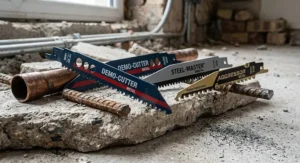
The saw is only half the equation — blade choice arguably matters more for demolition work, since the wrong blade turns even a premium saw into a slow, frustrating tool. Demolition-specific blades are typically bi-metal, combining a flexible spring-steel body with hardened high-speed steel teeth, giving them the durability to survive nail strikes that would snap a standard wood blade outright.
Tooth count, measured in teeth per inch (TPI), is the key variable: low TPI blades (around 6-10 TPI) cut aggressively through thick timber and nail-embedded wood but leave a rougher finish, while higher TPI blades (14-24 TPI) suit thinner metal and pipework but cut more slowly through wood. Many demolition-specific blades use a variable tooth design — a mix of tooth sizes along the same blade — specifically engineered to handle mixed materials like nail-embedded studwork without snapping mid-cut.
| Blade Type | TPI Range | Best For |
|---|---|---|
| Wood/Demolition (variable tooth) | 6-10 TPI | Nail-embedded timber, stud walls |
| Bi-Metal Multi-Purpose | 10-14 TPI | Mixed wood and light metal |
| Metal-Cutting | 14-24 TPI | Pipework, box section, conduit |
| Carbide-Tipped | Varies | Masonry, cement board, tile backer |
The clear pattern across blade types is that demolition work almost always benefits from carrying two or three blade types in the van rather than relying on one — a single wood-rated blade will dull rapidly the moment it hits an unexpected nail or screw, whereas a demolition-rated variable-tooth blade is specifically engineered to shrug that off and keep cutting.
Nail-Embedded Wood Cutting
Cutting through timber that still has nails in it is arguably the single task a sabre saw for demolition work exists to do — it’s the job that separates this tool category from every other saw in a typical toolkit, and it’s worth understanding properly rather than just pointing the blade and pulling the trigger.
The technique that actually matters here is letting the blade do the work rather than forcing it: pushing too hard against embedded nails increases the risk of blade deflection or snapping, whereas a steady, moderate feed rate combined with the saw’s own reciprocating action lets the hardened teeth work through the metal without excessive strain. Demolition-rated bi-metal blades with variable tooth geometry, discussed above, are specifically engineered for this scenario — their mixed tooth sizes handle the sudden transition from soft wood fibre to hard nail shank without the tooth breakage that a standard wood blade would suffer.
What most buyers overlook about nail-embedded cutting is blade orientation: angling the saw slightly, rather than cutting perfectly perpendicular to the material, often reduces the shock loading on the blade when it strikes a nail head-on, extending blade life significantly across a full demolition job. It’s also worth noting that repeated nail strikes generate real heat in the blade — pausing periodically to let it cool, rather than pushing through continuously, measurably extends usable blade life during long strip-out sessions.
Practical Usage Guide: Setup and Your First 30 Days
Getting a new sabre saw set up correctly from day one avoids most of the common frustrations first-time users report. Before first use, fit the appropriate demolition-rated blade — don’t default to whatever ships in the box if you already know nail strikes are likely — and check the blade clamp is fully engaged, since a loose blade is the single most common cause of poor, wandering cuts in the first few sessions.
For cordless models, fully charge the battery before first use and allow it to run down naturally on the first couple of jobs rather than topping it up constantly, which helps the battery management system calibrate accurately. During the first 30 days, resist the temptation to force the saw through thick material at full pressure — let the stroke rate and blade geometry do the cutting, and reposition rather than push if the blade starts to bind. Common early mistakes include cutting at the wrong angle to grain direction in thick timber, over-tightening the blade clamp (which can strip tool-free mechanisms on cheaper models), and neglecting to check for embedded nails or screws before starting a cut on unfamiliar material.
A simple maintenance habit worth adopting from week one: wipe down the shoe and blade clamp area after dusty demolition work, since plaster and masonry dust is notably abrasive and accelerates wear on moving parts if left to accumulate. For cordless models, store batteries at partial charge rather than fully depleted if the saw won’t be used for several weeks, which meaningfully extends long-term battery lifespan.
Real-World Scenarios: Which Saw Suits Which Job
The weekend renovator — tackling a single bathroom strip-out or removing an old shed, working perhaps two or three weekends a year, on a tight budget and without an existing battery ecosystem. For this profile, the Black+Decker BDCR18N or the corded Bosch GSA 1100 E make the most sense: low upfront cost, no wasted spend on capability that won’t get used, and straightforward enough for someone without extensive power tool experience.
The active DIYer mid-renovation — running a multi-room project over several months, cutting a genuine mix of timber, pipework and stud walls, likely already owning some 18V cordless kit. The Makita DJR186Z or DeWalt DCS382N-XJ fit this profile well, offering enough cutting depth and speed to handle varied demolition without the premium pricing of full trade-grade tools.
The working tradesperson — using the saw multiple times weekly across different sites, where downtime from a struggling tool directly costs money, and where battery runtime and cutting speed genuinely affect how many jobs get completed in a day. Here, the Bosch GSA 18V-28, Milwaukee M18 FUEL 2720-20, or DeWalt DCS389N-XJ justify their higher price through reduced blade changes, faster cuts, and the kind of durability that survives daily site abuse.
Common Mistakes When Buying a Sabre Saw for Demolition Work
Buyers new to this category consistently make a handful of avoidable mistakes. The most common is prioritising stroke rate (spm) above all else, when stroke length and motor torque under load matter just as much for actually clearing material — a saw with a high spm figure but a short stroke can still feel underpowered against thick timber.
Another frequent misstep is buying a cordless body-only unit without checking existing battery compatibility, only to discover the battery and charger add £60-100 on top of the advertised price. Buyers also commonly underestimate blade cost as an ongoing expense — a single demolition-rated blade rarely lasts an entire strip-out job once nails are involved, so budgeting for a pack of spares from the outset avoids mid-job frustration. Finally, choosing based on brand loyalty alone, without checking actual cutting depth and metal capacity specs against the job at hand, leads some buyers to overspend on capability they’ll never use, while others underspend and find themselves underpowered on their very first proper demolition task.
Safety, Regulations and Site Compliance
Demolition work carries genuine risks beyond the saw itself, and UK guidance is worth taking seriously before starting. If your property or worksite was built or refurbished before 2000, the Health and Safety Executive is explicit that you should assume asbestos is present until proven otherwise — a single ill-timed cut through a hidden asbestos cement panel or old insulating board is not a risk worth taking, and professional testing or removal should be arranged before demolition begins in any suspect area.
Vibration exposure is another genuine long-term risk with reciprocating saws, particularly during extended sessions. The HSE’s guidance on hand-arm vibration notes that regular exposure can cause Hand-Arm Vibration Syndrome, affecting nerves, blood vessels and joints in the hands and arms — models with genuine anti-vibration engineering, like the crank-drivetrain design on the DeWalt DCS389N-XJ, aren’t just a comfort feature, they’re a real health consideration for anyone using a saw regularly.
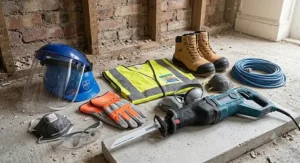
Personal protective equipment matters more for demolition than for most other cutting tasks, given the volume of dust, debris and flying fragments involved. HSE guidance on choosing the right PPE recommends safety spectacles or goggles rated for impact and dust, alongside appropriate gloves and, where dust levels are high, respiratory protection — none of which a saw listing will remind you to budget for, but all of which matter in practice.
Long-Term Cost and Maintenance
The purchase price of a sabre saw is only part of the real cost of ownership. Blades are the ongoing expense that catches most buyers off guard — a pack of five to ten demolition-rated bi-metal blades typically needs replacing every few significant jobs once nail strikes are involved, so factoring blade cost into the total spend gives a far more honest picture than the headline saw price alone.
Battery-powered models add a second long-term cost: lithium-ion batteries have a finite cycle life, and heavy daily use on a trade site will see performance noticeably decline within a few years, eventually requiring replacement. This is worth weighing against corded alternatives like the Bosch GSA 1100 E, which sidestep battery degradation entirely at the cost of mobility. When batteries or the saw itself eventually reach end of life, UK guidance requires responsible disposal — gov.uk’s guidance on recycling batteries and electrical waste confirms that lithium-ion batteries should never go into general household rubbish, both due to environmental impact and genuine fire risk if damaged in a waste stream.
Weighed over several years of regular use, the higher upfront cost of premium models like the Milwaukee M18 FUEL 2720-20 or DeWalt DCS389N-XJ is often offset by longer tool lifespan and better resistance to the wear that demolition work inevitably causes — a genuine total-cost-of-ownership argument, not just marketing language.
Features That Actually Matter (And Those That Don’t)
Cutting through the marketing language on most reciprocating saw listings, a handful of features genuinely affect real-world performance, while others are largely cosmetic. Tool-free blade changes matter enormously in practice — anyone who has fumbled with a hex key mid-demolition, hands covered in dust, will confirm this isn’t a minor convenience. Stroke length and metal cutting depth are equally worth prioritising over headline stroke-rate figures alone, since they more accurately predict how the saw handles genuinely thick or mixed material.
Features that matter far less than their marketing suggests include cosmetic LED brightness claims (any integrated light is broadly useful in dim spaces; the specific lumen count rarely changes the practical experience) and headline maximum stroke-rate numbers in isolation, which mean little without stroke length and motor torque data alongside them. Carrying cases and included blade sets are a nice bonus but shouldn’t heavily influence a buying decision, since aftermarket blades are cheap and widely available regardless of what ships in the box.
FAQ
❓ Is a sabre saw the same as a reciprocating saw?
❓ Can a sabre saw cut through nails?
❓ What's the best sabre saw for demolition work as a beginner?
❓ Do I need a corded or cordless sabre saw for demolition?
❓ How often should I replace demolition saw blades?
Conclusion
Choosing a sabre saw for demolition work ultimately comes down to matching the tool to how often, and how hard, you’ll actually use it. Occasional DIYers get excellent value from the Black+Decker BDCR18N or corded Bosch GSA 1100 E, while anyone tackling a genuine multi-room renovation will likely find the Makita DJR186Z or DeWalt DCS382N-XJ hits the sweet spot of capability and price. Working tradespeople putting a saw through daily site abuse are the group most likely to see real return from the premium tier — the Bosch GSA 18V-28, Milwaukee M18 FUEL 2720-20, and DeWalt DCS389N-XJ all justify their higher cost through speed, durability and reduced downtime.
Whichever tier you land in, the details covered here — blade selection for nail-embedded timber, genuine safety precautions around asbestos and vibration exposure, and realistic total cost of ownership including blades and batteries — matter more to a good outcome than the headline spec sheet alone. Buy for the job you’ll actually be doing, not the job you might one day do, and check current prices before committing, since UK power tool pricing shifts regularly across retailers.
✨ Don’t Miss These Exclusive Deals!
🔍 Take your next demolition project further with the models covered above. Click through on any highlighted saw to check current pricing and availability, and get the right tool in your hands before the next job starts!
Recommended for You
- Cordless Jigsaw for Laminate Flooring: 7 Brilliant 2026 Picks
- Compact Cordless Jigsaw: 7 Best Picks for UK DIYers in 2026
- Cordless Jigsaw For Metal Cutting: 7 Top Picks Tested for 2026
Disclaimer: This article contains affiliate links. As an Amazon Associate, I earn from qualifying purchases. If you purchase products through these links, we may earn a small commission at no additional cost to you.
✨ Found this helpful? Share it with your friends! 💬🤗
